Article generation failed: Error code: 402 – {‘error’: {‘message’: ‘Insufficient credits. Add more using https://openrouter.ai/settings/credits’, ‘code’: 402}}
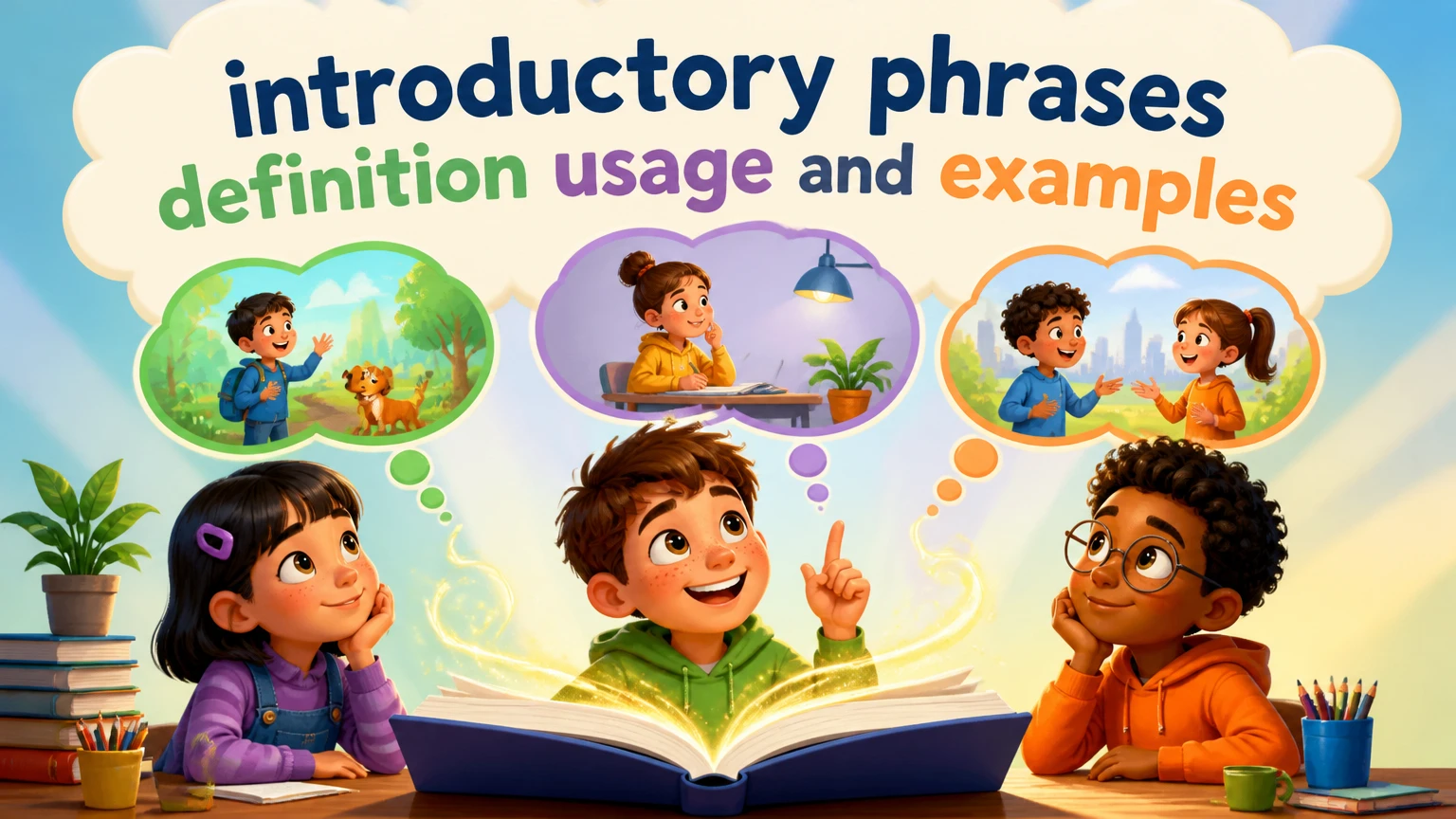
In the world of grammar and composition, introductory phrases act as the “bridge” that connects the reader to the main idea of a sentence. They provide essential context, such as time, place, manner, or condition, before the subject and verb of the main clause appear. Mastering these phrases is key to improving sentence variety and flow in your writing.
Table of Contents
What is an Introductory Phrase?
An introductory phrase is a group of words that comes at the beginning of a sentence, preceding the main independent clause. Unlike a clause, a phrase does not contain both a subject and a verb performing an action. Its primary purpose is to set the stage for the rest of the sentence, providing a “hook” or background information that makes the transition into the main point smoother.
Common Types of Introductory Phrases
Introductory phrases come in several grammatical forms. Understanding these types helps writers choose the right structure for their intended meaning.
1. Prepositional Phrases
These are the most common introductory phrases. they begin with a preposition (like in, at, on, after, during) and end with a noun or pronoun.
2. Participial Phrases
These phrases function as adjectives and start with a participle (a verb ending in -ing or -ed).
3. Infinitive Phrases
These begin with the infinitive form of a verb (to + verb) and often express purpose or intent.
4. Appositive Phrases
An appositive renames or identifies the noun that follows it. When placed at the start of a sentence, it provides immediate descriptive detail.
The Punctuation Rule: When to Use a Comma
While some short phrases (fewer than four words) may technically omit the comma if the meaning remains clear, it is almost always safer and clearer to include it. Consider the difference:
- Confusing: After eating the cat napped. (Wait, did someone eat the cat?)
- Clear: After eating, the cat napped.
Examples in Context
| Type of Phrase | Introductory Phrase | Main Clause |
|---|---|---|
| Prepositional | In the middle of the night, | the alarm went off. |
| Infinitive | To win the championship, | the team must practice daily. |
| Participial | Hoping for a miracle, | he checked his lottery ticket. |
| Appositive | A brilliant scientist, | Dr. Aris discovered the cure. |
Common Mistakes to Avoid
One of the most frequent errors involving introductory phrases is the dangling modifier. This happens when the phrase describes a subject that isn’t actually in the main clause.
Correct: Walking to the store, I felt the rain start to fall.
Frequently Asked Questions
Do I always need a comma?
If the phrase is very short (two or three words) and the sentence is clear without it, you can omit the comma. However, if the phrase is longer than four words, or if there is any chance of a “garden path” sentence (where the reader misinterprets the start), use the comma.
Can a sentence have two introductory phrases?
Yes. For example: “In the morning, before the sun rose, we started our journey.” Just be careful not to clutter the sentence too much, as it can overwhelm the reader.
Practice Exercise
Identify the introductory phrase in the following sentence and add the necessary punctuation:
“Disappointed by the results the scientist decided to restart the experiment.”
Answer: “Disappointed by the results, the scientist…” (Participial phrase)