
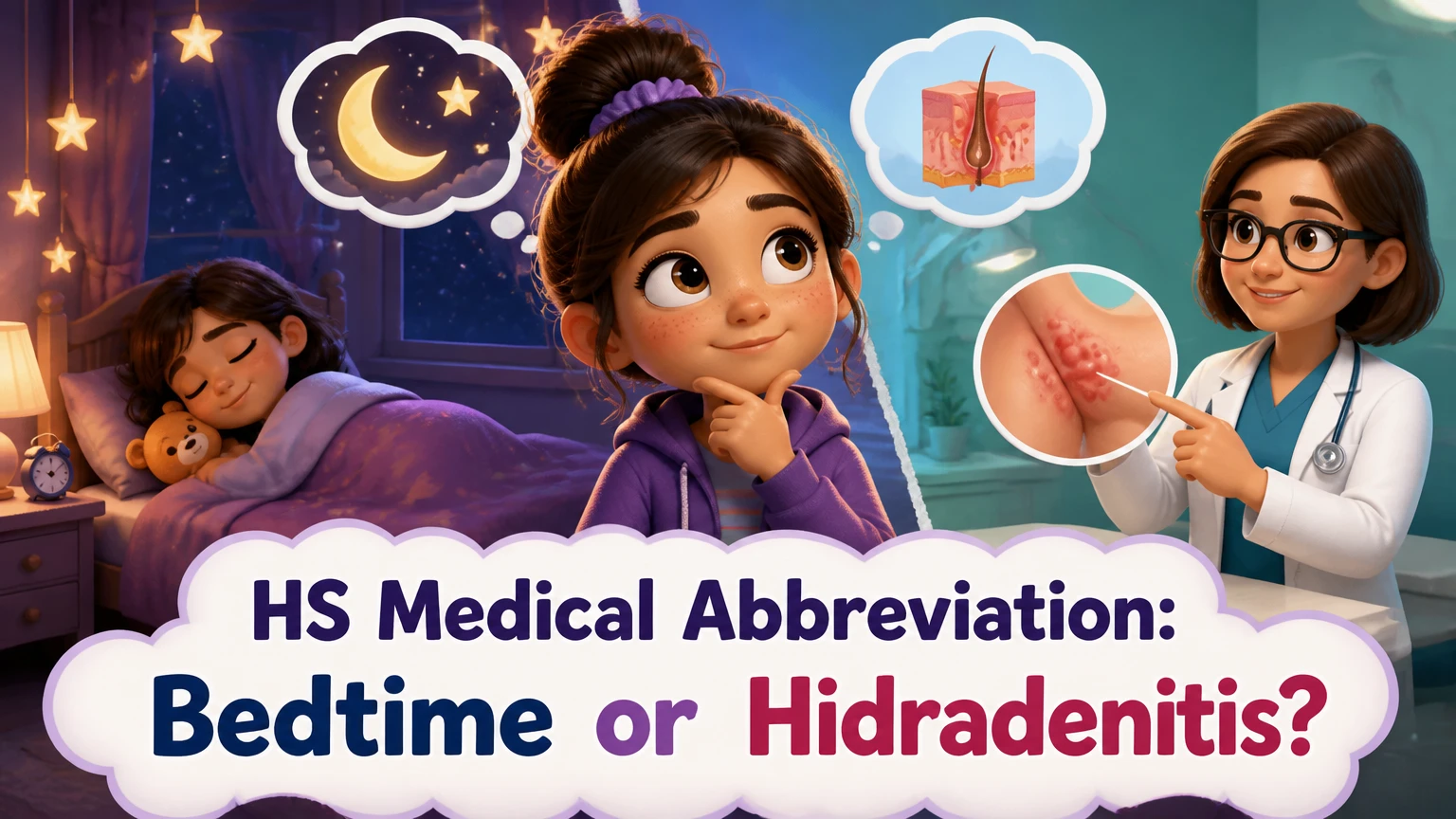
The hs medical abbreviation most commonly means hora somni, Latin for “at bedtime,” when it appears in a prescription. In dermatology, HS commonly means hidradenitis suppurativa, a chronic inflammatory skin disease that causes recurring painful nodules, abscesses, drainage, and tunnels; the surrounding clinical context determines the meaning.
Key Facts at a Glance
- HS on a medication order usually means “at bedtime,” but writing the phrase in full is safer.
- Hidradenitis suppurativa is unrelated to the prescription abbreviation despite sharing the same initials.
- QHS traditionally means “every night at bedtime,” while PRN HS means “as needed at bedtime.”
- Hidradenitis suppurativa usually affects the armpits, groin, buttocks, inner thighs, and inframammary folds.
- Hidradenitis suppurativa is inflammatory and follicular, not a condition caused by poor hygiene or simple contagious infection.
- A handwritten or electronically ambiguous HS order should be verified before anyone administers the medication.
What Does HS Mean in Medicine?
The meaning of HS depends on where the abbreviation appears. On a prescription, medication administration record, or discharge list, HS generally refers to hora somni, meaning “at bedtime.” In a dermatology note, HS generally refers to hidradenitis suppurativa.
The same abbreviation therefore represents two distinct entities:
| Context | HS expansion | Meaning | Example |
|---|---|---|---|
| Prescription | Hora somni | At bedtime | “Take 1 tablet PO HS” |
| Dermatology | Hidradenitis suppurativa | Chronic inflammatory skin disease | “Hurley stage II HS” |
| Cardiology or physical examination | Heart sounds | Findings heard through a stethoscope | “HS normal, no murmur” |
| Hematology | Hereditary spherocytosis | Inherited red-cell membrane disorder | “Family history of HS” |
A medication list containing “HS” should be interpreted alongside the drug, dose, route, and patient instructions. A dermatology note containing “HS,” “sinus tracts,” or “Hurley stage” almost certainly refers to hidradenitis suppurativa.
Why can one abbreviation have several meanings?
Medical abbreviations are compressed language, and specialties develop separate shorthand conventions. “HS” is especially context-sensitive because Latin prescription terminology, dermatology terminology, cardiology examination notes, and hematology diagnoses all use the same letters.
The drug and surrounding words usually resolve the ambiguity. “Doxycycline for HS” may refer to hidradenitis suppurativa, whereas “zolpidem 5 mg HS” refers to bedtime dosing. The abbreviation alone is not enough evidence.
What Does HS Mean on a Prescription?
On a prescription, HS means take or administer the medication at bedtime. The instruction does not automatically mean a fixed number of minutes before sleep, and it does not specify whether the medicine should be taken with food, without food, or after another medication.
For example, “amlodipine 5 mg PO HS” traditionally means “take 5 milligrams by mouth at bedtime.” The pharmacy label should translate the shorthand into plain language, such as “Take 1 tablet at bedtime.”
Bedtime dosing may be selected for several different reasons:
- A medication may cause drowsiness, as with some sedating medicines.
- Symptoms may worsen overnight, as with selected reflux or allergy regimens.
- Drug effects may align with a biological rhythm, although the optimal timing depends on the individual medicine.
- A clinician may be targeting a patient’s routine rather than prescribing a pharmacological clock-based strategy.
Bedtime is not synonymous with “immediately before sleep.” A prescriber may intend dosing with the evening meal, at a consistent evening hour, or shortly before lying down. The pharmacy label and medication-specific instructions take priority over assumptions.
Is HS the same as once daily?
HS is not automatically equivalent to once daily. “Once daily” describes frequency, while HS describes timing. A medication prescribed once daily may be taken in the morning, at noon, or in the evening depending on its pharmacology and the treatment plan.
| Instruction | Traditional meaning | Frequency information | What it does not specify |
|---|---|---|---|
| HS | At bedtime | Not necessarily stated | Exact clock time |
| QHS | Every night at bedtime | Every night | Food or duration |
| Daily | Once each day | Once daily | Morning or evening |
| qPM | Every afternoon or evening | Usually daily | Exact bedtime |
| PRN HS | As needed at bedtime | Variable | Maximum safe dose |
How Do HS, QHS, and PRN HS Differ?
HS means at bedtime, QHS means every night at bedtime, and PRN HS means as needed at bedtime. These abbreviations can appear similar but produce different instructions about frequency and circumstances.
“QHS” comes from quaque hora somni, traditionally interpreted as “every night at bedtime.” A prescription for a maintenance medicine may use QHS to indicate a nightly schedule. “PRN HS” adds an important condition: the medication is used only when needed at bedtime, subject to the prescribed maximum dose.
Modern medication-safety practice favors plain language. The Institute for Safe Medication Practices has identified ambiguous abbreviations as contributors to medication errors, and many organizations restrict shorthand that can be confused during transcription.
| Written order | Intended plain-language translation | Main risk |
|---|---|---|
| “1 tab HS” | Take 1 tablet at bedtime | HS may be misread |
| “1 tab QHS” | Take 1 tablet every night at bedtime | Nightly frequency may be overlooked |
| “1 tab PRN HS” | Take 1 tablet as needed at bedtime | Patient may use it every night unnecessarily |
| “1 tab daily” | Take 1 tablet once daily | Timing remains unclear |
| “1 tab at bedtime” | Take 1 tablet at bedtime | Lowest interpretation risk |
Why Is HS Unsafe on Medication Orders?
HS is unsafe when handwriting, software, or transcription allows it to be mistaken for another instruction, including “half-strength.” The risk is not that hora somni has two legitimate meanings on the same prescription; the risk is that a reader may interpret unclear characters or shorthand incorrectly.
A pharmacist or nurse should pause and verify an ambiguous order rather than infer the intended dose or timing. Patients should also ask the pharmacy to explain any abbreviation that remains on the label.
What should you do if a prescription says HS?
Use this verification sequence:
- Read the pharmacy label, not only the prescriber’s handwritten order.
- Confirm the medication name, strength, route, dose, and frequency.
- Ask whether HS means “at bedtime” for this specific prescription.
- Confirm whether bedtime means a clock time, the evening meal, or immediately before sleep.
- Ask what to do after a missed dose and whether food changes absorption.
- Contact the pharmacist or prescriber before taking the first dose if the directions conflict.
Do not change the dose, split tablets, or move a medication from morning to night solely because HS appears on an old medication list. Some medicines can cause harm when their timing changes.
What Does HS Mean in Dermatology?
In dermatology, HS means hidradenitis suppurativa, a chronic inflammatory skin disease that usually develops in hair-bearing areas where skin touches or rubs together. Hidradenitis suppurativa produces recurrent tender nodules, abscess-like lesions, drainage, open wounds, and scar tissue.
Hidradenitis suppurativa often begins after puberty and may follow a relapsing course. It is associated with follicular occlusion and immune-mediated inflammation. The disease is not simply a series of ordinary boils, so repeated short courses of antibiotics or repeated incision and drainage may not control the underlying process.
Typical locations include the axillae, groin, perineum, buttocks, inner thighs, and skin beneath the breasts or abdomen. Lesions can occur elsewhere, including the nape of the neck, but the distribution and recurrence pattern are important diagnostic clues.
How does hidradenitis suppurativa develop?
Hidradenitis suppurativa begins with blockage and rupture involving a hair follicle, followed by inflammation in deeper skin. Immune signaling, including pathways involving tumor necrosis factor and interleukin-17, contributes to persistent inflammation, tunnel formation, and scarring.
The condition is not caused by inadequate bathing. Heat, friction, smoking, hormonal influences, genetics, and body weight may affect severity or flares, but no single factor explains every case. A person with hidradenitis suppurativa has not caused the disease through poor cleanliness.
Which Symptoms Suggest Hidradenitis Suppurativa?
Recurrent painful lumps in the same skin-fold areas suggest hidradenitis suppurativa, particularly when lesions drain, heal slowly, or leave scars and rope-like bands. The diagnosis is clinical, meaning a clinician evaluates lesion type, location, and recurrence rather than relying on one definitive blood test.
| Finding | Hidradenitis suppurativa pattern | Ordinary folliculitis or boil pattern |
|---|---|---|
| Recurrence | Repeated lesions over months or years | Often isolated or occasional |
| Location | Armpits, groin, buttocks, folds | Any hair-bearing skin |
| Drainage | Recurrent drainage from openings | Usually resolves after one episode |
| Tunnels | Possible sinus tracts beneath skin | Uncommon |
| Scarring | Thick, bridged, or rope-like scars | Usually limited scar |
| Contagiousness | Not contagious | Some bacterial infections can spread |
Hidradenitis suppurativa may also cause pain, odor from drainage, restricted movement, embarrassment, sleep disruption, and depression or anxiety. These effects are clinically relevant and should be included in treatment decisions.
Can hidradenitis suppurativa spread to another person?
Hidradenitis suppurativa cannot spread from person to person because it is not contagious. Drainage may contain bacteria, but the disease itself arises from follicular and inflammatory mechanisms rather than transmission between people.
Open lesions still require sensible wound hygiene. Avoid sharing dressings, wash hands after changing bandages, and seek assessment if rapidly worsening redness, fever, or systemic illness suggests a separate infection.
How Is Hidradenitis Suppurativa Staged?
Clinicians commonly use the Hurley staging system to describe the extent of structural disease. Hurley stage is useful for communicating severity, but it does not capture every factor, such as pain, lesion count, drainage, or quality-of-life impact.
| Hurley stage | Defining pattern | Typical structural findings | Treatment implication |
|---|---|---|---|
| Stage I | Isolated or multiple abscesses | No tunnels or extensive scarring | Medical and local care |
| Stage II | Recurrent separated lesions | Tunnels and scarring in distinct areas | Combination medical and procedural care |
| Stage III | Extensive regional disease | Interconnected tunnels and diffuse involvement | Specialist medical and surgical planning |
Modern clinicians may add lesion counts, flare frequency, pain scores, drainage measures, and patient-reported outcomes. A person with Hurley stage I disease can still experience severe pain, while stage III describes anatomy rather than a person’s worth or overall health.
How Is Hidradenitis Suppurativa Treated?
Hidradenitis suppurativa treatment reduces inflammation, pain, drainage, new lesions, and progression; treatment is individualized because disease location, stage, pregnancy status, other illnesses, and prior treatment response affect the safest plan.
Topical and oral options
Topical clindamycin may be prescribed for limited inflammatory lesions, although prolonged antibiotic exposure requires medical supervision. Antiseptic washes such as benzoyl peroxide or chlorhexidine may reduce surface bacteria for some patients, but they do not remove established tunnels.
Oral tetracyclines, including doxycycline, may be used for their anti-inflammatory effects. Rifampin and clindamycin combinations require careful interaction and adverse-effect review. Antibiotics are not proof that hidradenitis suppurativa is merely an infection.
Hormonal treatment may help selected patients whose flares follow menstrual cycles or other androgen-related patterns. Weight management and smoking cessation can improve disease control for some people, but clinicians should present these as supportive measures rather than blame.
Biologic medicines
Biologic therapy may be considered for moderate-to-severe hidradenitis suppurativa or disease that remains active despite other treatment. Adalimumab targets tumor necrosis factor, while secukinumab and bimekizumab target the interleukin-17 pathway; eligibility and approvals vary by country and date.
Biologics require screening, monitoring, and discussion of infection risks, vaccinations, pregnancy, and insurance authorization. Response is not immediate. A dermatologist may assess improvement over several weeks or months using lesion counts, flare frequency, drainage, and pain.
Procedures and surgery
An intralesional corticosteroid injection may reduce inflammation in a selected painful nodule. Deroofing removes the covering of a persistent tunnel, while wide excision removes more extensive affected tissue. Incision and drainage can relieve pressure from an acute collection, but it often does not prevent recurrence when used alone.
Laser hair reduction may reduce follicular targets in selected patients, but it requires repeated sessions and is not a universal substitute for anti-inflammatory treatment. Surgical planning becomes more complex when disease involves the groin, perineum, breast, or large interconnected areas.
What Does HS Treatment Cost?
Hidradenitis suppurativa costs vary substantially by country, insurance, deductibles, drug assistance, facility type, and disease severity. Published cost figures should not be treated as personal quotes; the ranges below are typical United States planning estimates, not guaranteed prices.
| Treatment or service | Typical U.S. out-of-pocket range | Usual timeframe | Main cost variable |
|---|---|---|---|
| Generic topical medicine | $10-$100 monthly | Weeks to months | Insurance and pharmacy |
| Oral antibiotic course | $10-$150 per course | 8-12 weeks | Drug combination and monitoring |
| Dermatology visit | $100-$400 before insurance | Single visit | Region and specialist |
| Biologic therapy | Several thousand dollars monthly before coverage | Ongoing | Formulary and assistance |
| Laser hair reduction | $200-$600 per session and area | Every 4-6 weeks initially | Treatment area and clinic |
| Deroofing or excision | Hundreds to several thousand dollars | One procedure plus healing | Extent and facility |
A patient considering biologic treatment should request an insurance authorization estimate, specialty-pharmacy copay information, laboratory requirements, and manufacturer assistance rules before starting. Emergency visits and repeated drainage procedures can add costs without addressing chronic tunnel formation.
What Are Common HS Misdiagnoses and Treatment Errors?
The most consequential error is treating hidradenitis suppurativa as poor hygiene or as repeated isolated infection. That framing can delay dermatology care and worsen stigma.
Common problems include:
- Calling every lesion a boil despite recurring locations and tunnels.
- Repeating incision and drainage without a long-term inflammatory plan.
- Stopping treatment after one improved week.
- Using irritating deodorants, shaving methods, or tight clothing over active lesions.
- Applying strong antiseptics to open skin without clinician guidance.
- Assuming a low Hurley stage means symptoms are mild.
- Ignoring anemia, depression, metabolic disease, inflammatory bowel disease, or joint symptoms that may coexist.
A practical rule is to photograph lesions privately during flares, record dates and locations, and bring the pattern to the appointment. Recurrence is diagnostically valuable.
When Does HS Require Prompt Medical Care?
Hidradenitis suppurativa requires prompt medical assessment when pain escalates rapidly, redness spreads, fever develops, movement becomes difficult, or drainage is accompanied by weakness or confusion. These signs can indicate a superimposed infection or another urgent condition.
Seek urgent care for heavy bleeding, rapidly expanding swelling, severe dehydration, fainting, or uncontrolled pain. People with diabetes, immune suppression, pregnancy, or recent surgery should use a lower threshold for contacting a clinician.
A chronic HS flare does not always require an emergency department. When there is no systemic illness, a dermatologist or primary-care clinician can often create a more appropriate anti-inflammatory and wound-care plan.
What Are the Less Common Meanings of HS?
Less common medical meanings of HS include heart sounds and hereditary spherocytosis. These interpretations depend on specialty, sentence structure, and accompanying findings.
| Meaning | Specialty | Clues nearby | Example |
|---|---|---|---|
| Heart sounds | Cardiology, physical examination | Murmur, S1, S2, auscultation | “HS normal” |
| Hereditary spherocytosis | Hematology | Hemolysis, jaundice, splenomegaly, reticulocytes | “Workup for HS” |
| Hidradenitis suppurativa | Dermatology | Nodules, tunnels, Hurley stage, drainage | “HS flare” |
| Hora somni | Pharmacy, prescribing | Dose, route, tablet, bedtime | “5 mg PO HS” |
“Heart sounds” is usually clearer when written as “heart sounds,” and hereditary spherocytosis is usually accompanied by laboratory or family-history clues. If a chart abbreviation could change treatment, the responsible clinician should clarify it.
Frequently Asked Questions
Does HS mean half-strength?
No. In prescription context, HS traditionally means hora somni, or “at bedtime,” but ambiguous shorthand can be misread as “half-strength.” Because the error could alter treatment, patients and healthcare professionals should confirm the intended instruction with the pharmacist or prescriber before using an unclear order.
Should HS medication be taken exactly at 10 p.m.?
Not necessarily. HS identifies bedtime rather than a universal clock time, and the appropriate schedule depends on the medicine, meals, sleep pattern, and treatment goal. Ask the pharmacist whether the dose should be taken with food, at a consistent evening time, or immediately before sleep.
Is hidradenitis suppurativa an autoimmune disease?
Hidradenitis suppurativa is generally described as a chronic inflammatory or autoinflammatory follicular disease. Immune pathways contribute to the inflammation, but the terminology and mechanisms differ from classic autoimmune diseases in which the immune system specifically attacks a defined self-antigen.
Can diet cure hidradenitis suppurativa?
No diet has been proven to cure hidradenitis suppurativa. Some patients identify food-related flare patterns, and clinicians may address weight, metabolic health, or individual intolerances, but restrictive diets can create nutritional problems and should not replace dermatologic treatment.
Does hidradenitis suppurativa always need surgery?
No. Surgery is one option for persistent tunnels, localized disease, or extensive structural damage, while medical treatment may control inflammatory activity and prevent new lesions. Surgery works best when planned with ongoing disease control because untreated inflammation can produce lesions outside the treated area.
Which specialist diagnoses HS?
A dermatologist usually diagnoses and manages hidradenitis suppurativa. Primary-care clinicians can begin evaluation and treatment, while advanced disease may require coordinated care involving wound specialists, surgeons, pain clinicians, gynecologists, gastroenterologists, or mental-health professionals.
The Bottom Line
The hs medical abbreviation has two dominant meanings: hora somni, “at bedtime,” on a medication order, and hidradenitis suppurativa, a chronic inflammatory skin disease in dermatology. Context, surrounding terms, and the medication label determine the interpretation. Verify ambiguous prescription shorthand, and seek dermatologic assessment for recurrent painful lesions, drainage, tunnels, or scarring.


