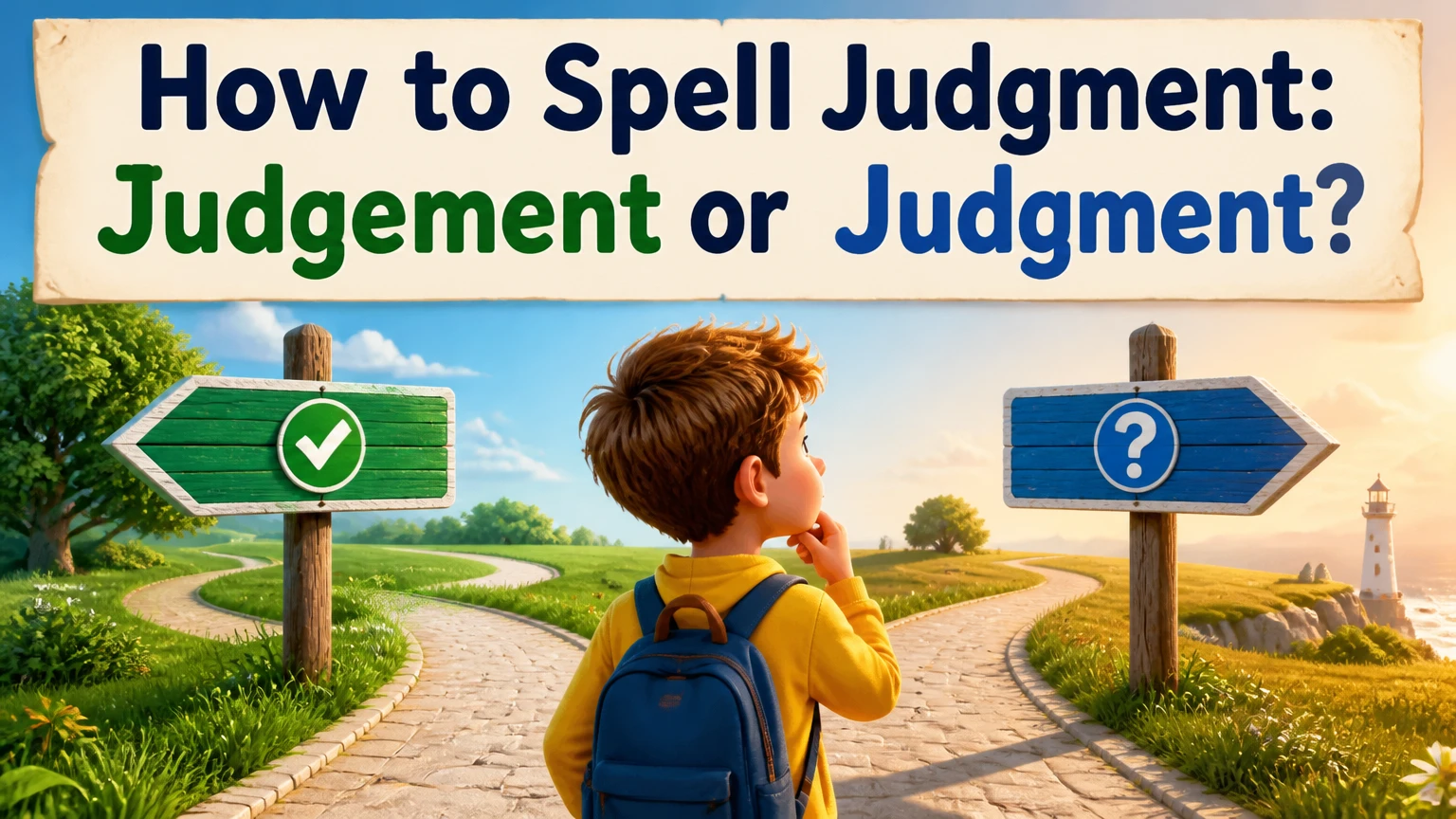
Judgment and judgement are both established English spellings of the same noun. Use judgment in American English and in many legal, academic, and international contexts; use judgement in ordinary British English when that is the preferred house style. Neither spelling changes the word’s meaning, but audience, jurisdiction, publisher, and consistency determine the better choice.
Key Facts at a Glance
- Judgment is the standard spelling in American English for every meaning, including a court ruling.
- Judgement is common in general British English, Australian English, and New Zealand English.
- Judgment is widely preferred in legal writing in the United Kingdom, but judgement is not automatically invalid in every Commonwealth legal document.
- The noun means reasoned decision-making, an opinion, or a formal court decision.
- Judgmental and judgemental are both recorded variants, although judgmental is more common internationally.
- A document should follow its required dictionary, jurisdictional convention, or editorial style guide rather than an assumed universal rule.
Is Judgment or Judgement Correct?
Judgment and judgement are correct spellings, not different words. The choice is mainly regional: US publishers normally require judgment, while UK publishers commonly use judgement in general prose and often reserve judgment for legal writing. A named style guide overrides a general regional preference.
The two forms have identical pronunciation and meanings. For example, “She showed good judgment” and “She showed good judgement” describe the same quality of decision-making. The difference is orthographic, meaning it concerns written form rather than grammar, pronunciation, or definition.
The most reliable rule is audience first, then domain. A US business report should use judgment throughout. A general-interest article for a British newspaper may use judgement. A court filing, case citation, or legal document should follow the court’s rules, which frequently specify judgment.
What Does the Word Mean?
The noun judgment or judgement has three closely related meanings:
- The ability to make sensible decisions, as in “Her judgment improved with experience.”
- An opinion or assessment, as in “The committee reached a judgment about the proposal.”
- A formal decision issued by a court, as in “The court entered judgment for the claimant.”
Capitalization does not create a spelling distinction. “Judgment” may be capitalized in a document title or at the beginning of a sentence, but the noun remains the same word.
Why Are There Two Spellings?
The two spellings developed from the same historical word, but English spelling did not become standardized in a single event. Judgement reflects the French-derived form, while judgment became established through English spelling preferences that removed the medial e in some words.
The word entered English through Anglo-French and Old French forms related to jugement. English inherited several competing spellings, and dictionaries, printers, schools, and national conventions gradually favored different versions.
Samuel Johnson’s 1755 dictionary helped strengthen judgment in British written English, although it did not eliminate judgement. Noah Webster later promoted simplified American spellings, helping make judgment the dominant US form. The history explains the variation, but it does not create a legal rule that applies identically in every country.
David Crystal’s description of English spelling as “notoriously irregular” captures the practical issue: historical pronunciation and spelling changes do not always produce one logical modern form. Judgment and judgement are a normal example of regional standardization rather than a case of one form being universally misspelled.
Which Region Uses Each Spelling?
Regional preference determines the default spelling, but national borders do not provide a perfect prediction. Official style guides, publishers, courts, and individual institutions can select a different form.
| Audience or locale | General prose | Legal writing | Recommended default |
|---|---|---|---|
| United States | judgment | judgment | judgment |
| United Kingdom | judgement commonly | judgment often preferred | Follow publisher or court |
| Australia | judgement commonly | judgment or local house style | Check institution |
| New Zealand | judgement commonly | judgment or local house style | Check institution |
| Canada | judgment commonly | judgment commonly | judgment |
| South Africa | judgement and judgment both encountered | Institution-specific | Check style guide |
What Is the American English Rule?
American English uses judgment without the middle e in general writing, journalism, education, business, psychology, and law. “Against my better judgment” is the expected US spelling, as is “the judge issued a judgment.”
American dictionaries, including Merriam-Webster, list judgment as the main US form. A US spellchecker may flag judgement, although the latter can appear in quotations, names, imported texts, or historical material.
The safest approach for a US document is complete consistency. Do not use judgement in one section and judgment in another unless the second occurrence belongs to a quotation or official title.
What Is the British English Rule?
British English commonly uses judgement for everyday writing, including personal decisions, managerial assessments, and critical opinions. “The editor used her judgement” fits ordinary UK prose.
British legal writing frequently uses judgment, particularly for a judge’s written reasons or a court’s formal decision. The distinction is a convention, not a universal prohibition. The Oxford English Dictionary, British publishers, and individual courts may record or prescribe different practices, so a legal writer must check the applicable rule.
The UK rule can therefore be summarized as follows: judgement is a common general British spelling, while judgment is a strong legal and institutional preference.
Does Canada Follow American English?
Canadian usage often prefers judgment, especially in formal, legal, and professional writing, but Canadian English contains both British and American influences. A Canadian publisher may specify judgement, particularly in a house style influenced by British usage.
Canadian court documents require the applicable court’s rules, not a generic internet recommendation. A writer preparing a filing should search the court’s current formatting guide or copy the spelling used in its official forms and precedents.
How Do You Choose the Right Spelling?
Choose the spelling through a four-step decision process. Identify the audience, identify the document’s authority, check the required style guide, and apply the selected form consistently.
- Identify the primary readers. Select US English for a US audience and British English for a UK audience unless another standard is specified.
- Identify the document type. Treat court filings, contracts, judgments, case summaries, and legal citations as controlled documents.
- Check the governing authority. Use the court rule, publisher guide, university style sheet, or client terminology list.
- Search for consistency. Use Find and Replace to check both
judgmentandjudgement, then review quotations and proper names before changing anything. - Preserve official wording. Do not alter a company name, case title, book title, quotation, or historic document merely to impose your preferred regional spelling.
| Writing situation | Preferred form | Reason |
|---|---|---|
| US college essay | judgment | Standard American spelling |
| UK newspaper article | judgement | Common British general usage |
| US court filing | judgment | US legal and dictionary convention |
| UK court document | judgment often | Common legal convention |
| Australian blog post | judgement commonly | General local usage |
| International software interface | judgment | Least regionally marked option |
| Quoted historical letter | Original spelling | Accuracy takes priority |
The “safest globally” answer is usually judgment, because readers in both major English standards recognize it and legal institutions commonly use it. That does not make judgement wrong in British or Commonwealth general writing.
Is Judgment or Judgement Used in Legal Writing?
Judgment is the safer legal spelling in the United States and a frequent legal spelling in the United Kingdom and other jurisdictions. Judgement should not be called universally invalid, because legal usage differs by court, country, document type, and institutional style.
In US law, a court enters a judgment, a creditor may enforce a judgment, and a party may seek judgment notwithstanding the verdict. US legal dictionaries and court rules overwhelmingly use the spelling without e.
In the UK, legal sources commonly distinguish a judge’s judgment from general judgement, but actual usage can vary. A solicitor preparing a filing should copy the spelling in the relevant procedural rules and court templates. A legal publisher may also require judgment in case reports even when its general editorial style uses judgement.
The practical risk is inconsistency, not usually legal invalidity. A spelling variation rarely determines whether a pleading is legally effective, but a court-specific style requirement can trigger an amendment request, editorial correction, or avoidable credibility problem.
Does Judgement Invalidate a Legal Document?
Judgement does not automatically invalidate every legal document. Legal validity depends on jurisdiction, filing rules, substance, deadlines, signatures, service, and procedural compliance. Spelling can still matter when a court, agency, or publisher has explicitly prescribed a form.
For a US filing, use judgment without exception unless reproducing a quotation or official name. For a UK or Commonwealth filing, verify the current local rule instead of relying on the claim that one spelling is globally mandatory.
What Is the Difference Between Judgment and Judgement?
The difference is regional spelling and institutional preference, not meaning, pronunciation, grammatical category, or intensity. Both forms function as nouns and can refer to decisions, opinions, reasoning ability, or court rulings.
| Feature | Judgment | Judgement |
|---|---|---|
| Letters | 8 letters | 9 letters |
| Pronunciation | Same as judgement | Same as judgment |
| US general usage | Standard | Usually nonstandard |
| UK general usage | Accepted and common in legal contexts | Common in general contexts |
| Court meaning | Standard in many jurisdictions | Accepted in some jurisdictions |
| Meaning | Opinion, discernment, court ruling | Opinion, discernment, court ruling |
Examples demonstrate the equivalence:
- Decision-making: “Good judgment prevented a costly mistake.”
- British general prose: “Good judgement prevented a costly mistake.”
- Court ruling: “The court delivered its judgment on Friday.”
- Personal opinion: “That judgment seems unfair.”
Do not confuse the spelling difference with sentence, verdict, or order. A judgment is a court’s formal decision, while a verdict is commonly the decision of a jury, and an order is a direction issued by a court or authorized body.
How Do You Spell Judgmental and Related Words?
Judgmental is the dominant international form, but judgemental is also recorded and used, especially in British English. The claim that the letter e must always disappear in every variety of English is too strong.
| Word or phrase | US preference | UK or Commonwealth usage | Meaning |
|---|---|---|---|
| judgment | judgment | judgement or judgment | Decision or assessment |
| judgement | Usually avoid | Common in general prose | Same noun |
| judgmental | judgmental | judgmental commonly | Overly critical |
| judgemental | Usually avoid | Recorded variant | Same adjective |
| misjudgment | misjudgment | misjudgement also used | Incorrect assessment |
| judgment-proof | judgment-proof | Jurisdiction-specific | Unable to satisfy a judgment |
Use the dominant form required by the document. A British writer using judgemental is not necessarily making the same kind of error as an American writer using it, although many international style systems prefer judgmental for consistency.
The related verb is judge, and the noun judiciary has no competing e form. The word judicious is also spelled independently and does not follow either variant.
How Can You Fix the Spelling in Word or Google Docs?
Set the document language before proofreading, then search for both spellings manually. A typical locale change takes about 1-2 minutes and costs nothing when using the built-in settings in Microsoft Word or Google Docs.
| Application | US setting | UK setting | Typical path |
|---|---|---|---|
| Microsoft Word | English (United States) | English (United Kingdom) | Review, Language, Set Proofing Language |
| Google Docs | English (USA) | English (UK) | File, Language |
| Apple Pages | English (U.S.) | English (U.K.) | File, Language and Region |
| LaTeX | en-US dictionary |
en-GB dictionary |
Editor or spellchecker configuration |
Follow this workflow:
- Select the entire document.
- Apply the intended English locale.
- Run the spelling checker.
- Search manually for
judgement,judgment,judgemental, andjudgmental. - Exclude quotations, case names, book titles, and company names from bulk replacement.
- Run a final consistency check after accepting tracked changes.
Spellcheckers identify dictionary forms, not always the correct audience or legal convention. A British English setting may accept both spellings, and a US setting may not understand a quoted UK passage. Human review remains necessary for controlled documents.
What Common Mistakes Should You Avoid?
The most common error is treating a regional preference as a universal correctness rule. Writers also change official names, mix locales, and assume spellcheck software understands legal context.
- Mixing forms in one document: Choose one house style and search the complete file.
- Calling judgement illegal: Spelling alone rarely determines legal validity; consult the governing court rule.
- Changing quotations: Preserve the original spelling inside direct quotations.
- Changing proper names: Keep names such as Judgement Day or an organization’s registered title unchanged.
- Assuming Australia equals the UK: Australian usage often resembles British usage, but legal and institutional styles vary.
- Replacing every derivative automatically: Check both judgmental and judgemental against the required dictionary.
- Relying only on autocorrect: Software can enforce a locale, but it cannot select the correct jurisdiction or publication standard.
A useful practitioner rule is to decide language settings before drafting, not after editing. Late conversion can alter legitimate quotations and introduce inconsistent forms into headings, captions, footnotes, and metadata.
Which Spelling Should Different Writers Use?
Different writers should select the form tied to their readers and governing authority rather than choosing by visual preference.
| Writer or organization | Recommended choice | Verification point |
|---|---|---|
| US lawyer | judgment | Court rules and local forms |
| UK journalist | judgement generally | Publication style guide |
| International company | judgment | Corporate language policy |
| UK academic author | judgement generally | Journal submission guide |
| Canadian legal writer | judgment commonly | Court or publisher rules |
| Fiction author | Setting-specific | Narrator and audience locale |
A novelist writing a London-set narrator may choose judgement for authenticity, while a global technology company may choose judgment to avoid switching terminology across markets. A university thesis should follow its department or journal requirements even when the author’s personal preference differs.
Is Judgment Better for International Content?
Judgment is usually the lower-risk choice for international professional content. It is standard in US English, common in legal terminology across jurisdictions, and readily understood by British, Australian, and New Zealand readers.
International content still needs an explicit style decision. A UK government audience may expect judgement, and changing established local terminology can make a document appear imported. Global consistency matters more than the theoretical reach of one spelling.
FAQ
Is Judgement Wrong in American English?
Judgement is generally treated as a nonstandard or foreign variant in edited American English. US dictionaries, publishers, schools, businesses, and courts normally use judgment. The form may still appear correctly inside a quotation, historical title, proper name, or text intentionally preserving British English.
Is Judgment Wrong in British English?
Judgment is not wrong in British English. British legal writing commonly uses it, and many British dictionaries recognize it. General British prose often prefers judgement, so the choice depends on context, publisher, and house style rather than a universal prohibition.
Does the Court Use Judgment or Judgement?
Courts frequently use judgment, especially in the United States and in UK legal terminology. The exact rule depends on the jurisdiction and document. Check the court’s procedural rules, templates, and published judgments before filing, because legal conventions differ between countries and institutions.
Which Form Appears in Judgment Day?
Judgment Day is the most widely recognized spelling of the religious and cultural expression, including in American and many international publications. Judgement Day also appears, particularly in British and Commonwealth usage. Preserve the spelling used by the source, title, translation, or publication you are citing.
Is It Judgement-Free or Judgment-Free?
Judgment-free is the common international and US spelling, while judgement-free follows the British general-writing variant. Use the form required by the surrounding document. The hyphen is normally retained when the compound adjective appears before a noun, as in “a judgment-free discussion.”
The Bottom Line
Judgment and judgement name the same concept and are both legitimate English spellings. Use judgment for American English, most international professional content, and legal writing unless a local authority says otherwise. Use judgement for general British, Australian, or New Zealand prose when that regional style is intended. For how to spell judgement judgement or judgment, the decisive factors are audience, legal jurisdiction, publisher, and consistency.