
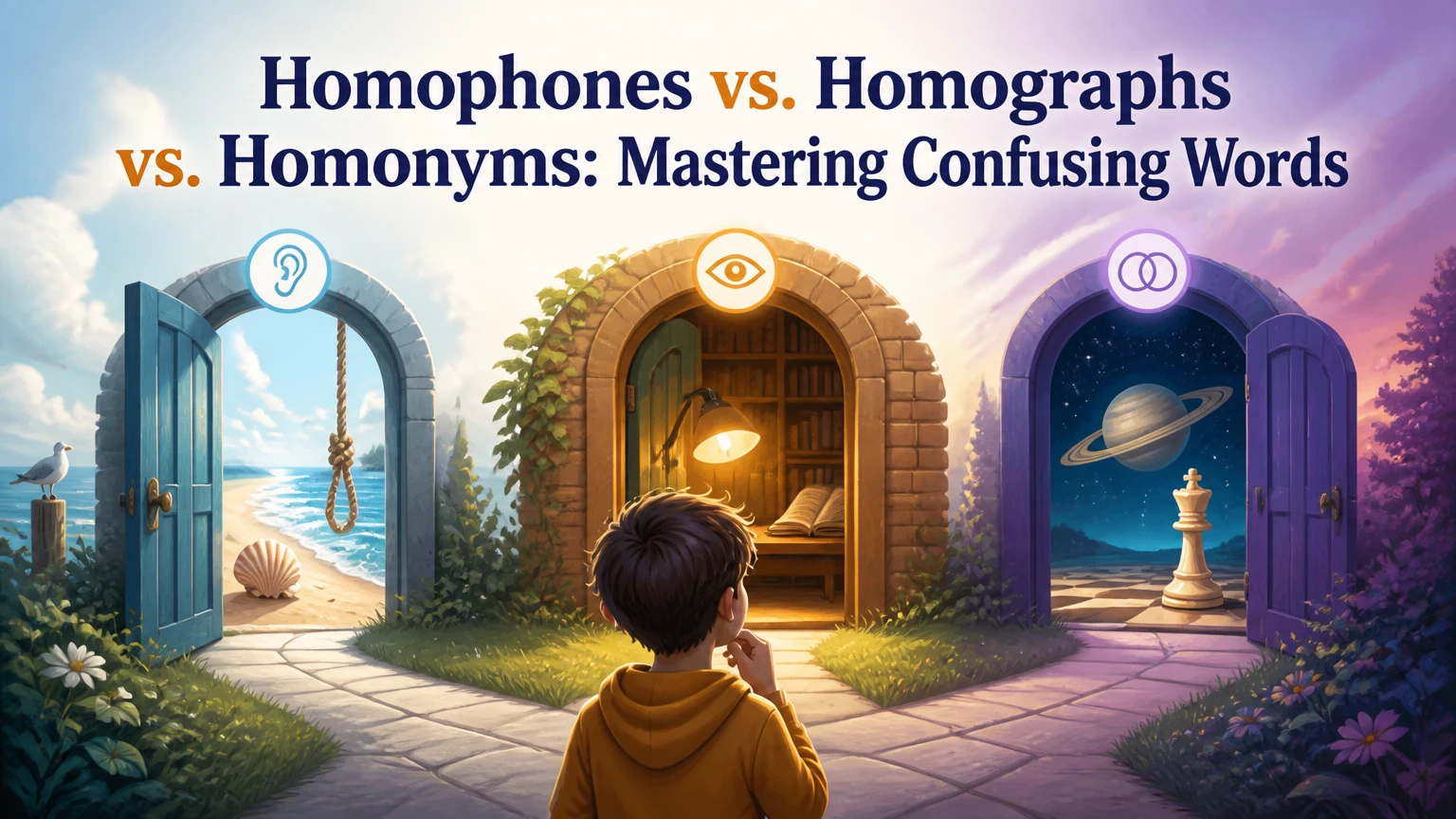
English is full of words that sound alike or look alike but have different meanings, which can be confusing for both native speakers and language learners. Three common types of these tricky words are homophones, homographs, and homonyms. Homophones are words that sound the same but have different meanings and spellings, such as “there,” “their,” and “they’re.” Homographs are words that are spelled the same but have different meanings and sometimes different pronunciations, for example, “tear” (a drop of water from the eye) and “tear” (to rip). Homonyms, including words like “bat,” “bank,” and “fine,” are words that share the same spelling and pronunciation but have different meanings. Understanding the differences between these types of words is crucial for clear communication and avoiding embarrassing errors. This article breaks down each concept, provides numerous examples, and offers practice exercises to help you master these tricky aspects of the English language.
Table of Contents
- Definitions: Homophones, Homographs, and Homonyms
- Structural Breakdown
- Types and Categories
- Examples
- Usage Rules and Guidelines
- Common Mistakes
- Practice Exercises
- Advanced Topics
- Frequently Asked Questions (FAQ)
- Conclusion
Definitions: Homophones, Homographs, and Homonyms
To effectively use the English language, it’s essential to grasp the nuances between words that sound alike, look alike, or both. Let’s clearly define homophones, homographs, and homonyms to provide a solid foundation for understanding their differences and proper usage.
A homophone is a word that shares the same pronunciation as another word but has a different meaning, origin, and spelling. Think of the phrase “sounds the same.” Common examples include “to,” “too,” and “two,” all pronounced the same but having distinct meanings. Homophones can often lead to confusion in writing if not carefully considered, making it essential to understand their individual meanings and contexts. The existence of homophones highlights the importance of proofreading and contextual understanding in written communication.
A homograph is a word that shares the same spelling as another word but has a different meaning and sometimes a different pronunciation. Consider the word “tear,” which can refer to a drop of liquid from the eye (pronounced /tɪər/) or the act of ripping something (pronounced /tɛər/). The pronunciation difference can be subtle, but the meaning is significantly different. Homographs demonstrate how the same written form can represent multiple distinct concepts, requiring readers to pay close attention to context to determine the intended meaning. Recognizing homographs enhances reading comprehension and vocabulary skills.
A homonym is a word that shares the same spelling and pronunciation as another word but has a different meaning. The word “bank,” for example, can refer to a financial institution or the side of a river. Homonyms are a subset that includes both homophones and homographs that happen to overlap. They represent the ultimate challenge in distinguishing word meanings because both the sound and the spelling are identical. Context is absolutely critical when interpreting homonyms to avoid miscommunication and understand the writer’s or speaker’s intended meaning. Recognizing homonyms is an advanced skill in language proficiency.
Structural Breakdown
Understanding the structural differences between homophones, homographs, and homonyms is key to mastering their usage. Each category has unique characteristics that define its relationship to other words in the English language.
Homophones are structurally distinct because they focus solely on pronunciation. The structure of the words themselves has no bearing on their classification as homophones; it is purely based on shared sounds. This means that homophones can have completely different origins, spellings, and grammatical functions. For instance, “see” (to perceive with the eyes) and “sea” (a large body of saltwater) are homophones because they sound identical, despite their different spellings and meanings. The structural focus is on the aural similarity, making them tricky in written context where sound cues are absent.
Homographs, on the other hand, are structurally focused on spelling. The words must share the same written form, regardless of their pronunciation or meaning. The structural similarity in spelling can sometimes mask significant differences in origin and usage. For example, “present” (a gift) and “present” (to introduce or show) are spelled identically but may be pronounced differently depending on their usage. The structural focus here is on the visual similarity, emphasizing the importance of context to discern the correct meaning and pronunciation.
Homonyms represent a combination of both aural and visual similarity. Structurally, they must share both the same spelling and the same pronunciation. This dual similarity makes them the most challenging to distinguish without careful attention to context. For example, “address” can refer to a location or the act of speaking to someone. The structural focus is on both the sound and the appearance, demanding a deep understanding of contextual clues to differentiate between the possible meanings. Homonyms underscore the complexity and richness of the English language.
Types and Categories
Each category—homophones, homographs, and homonyms—can be further categorized based on specific characteristics. Understanding these subcategories can help refine your ability to identify and use these words correctly.
Homophones
Homophones are primarily categorized by their shared pronunciation and differing spellings and meanings. However, they can also be informally grouped based on the degree of confusion they cause. Some common types and examples include:
- Commonly Confused Homophones: These are pairs or groups of words that are frequently misused due to their phonetic similarity. Examples include “there/their/they’re,” “to/too/two,” and “your/you’re.”
- Less Common Homophones: These homophones are less frequently confused but still share the same pronunciation. Examples include “cite/sight/site,” “fair/fare,” and “cell/sell.”
- Homophones with Multiple Variants: Some words have more than two homophones, increasing the potential for error. Examples include “hear/here,” “see/sea/C,” and “for/four/fore.”
Homographs
Homographs are categorized based on whether they share the same pronunciation (homonyms) or have different pronunciations. This distinction leads to two main subcategories:
- Homonyms (Perfect Homographs): These words share the same spelling and pronunciation but have different meanings. Examples include “bat” (animal and equipment) and “bank” (financial institution and riverbank).
- Heteronyms (Imperfect Homographs): These words share the same spelling but have different pronunciations and meanings. Examples include “tear” (drop of liquid and to rip) and “read” (present tense and past tense).
Homonyms
Homonyms, as the intersection of homophones and homographs, can be categorized by the degree of semantic relatedness between their meanings. This categorization helps to understand how the different meanings evolved and how they are used in context.
- Related Homonyms: These are homonyms where the meanings are historically related or share a common origin. For example, “star” (celestial body) and “star” (celebrity) are related through the concept of brightness and prominence.
- Unrelated Homonyms: These are homonyms where the meanings have no discernible historical or conceptual connection. For example, “bat” (animal) and “bat” (equipment) have completely unrelated origins and usages.
Examples
To solidify your understanding of homophones, homographs, and homonyms, let’s explore a wide range of examples organized by category. These examples will illustrate how each type of word functions in different contexts.
Homophone Examples
Below is a table with 30 examples of homophones, showing the different spellings and meanings for each set of words. Understanding these distinctions is crucial for accurate writing.
| Homophone Set | Meaning 1 | Meaning 2 | Example Sentence 1 | Example Sentence 2 |
|---|---|---|---|---|
| to, too, two | toward; also; the number 2 | also; number | I am going to the store. | I want to go too. I have two apples. |
| there, their, they’re | a place; belonging to them; they are | possession; contraction | Over there is my house. | That is their car. They’re going to be late. |
| your, you’re | belonging to you; you are | possession; contraction | Is that your book? | You’re very kind. |
| see, sea | to perceive with eyes; ocean | ocean | I can see the mountains. | The sea is very rough today. |
| hear, here | to perceive with ears; in this place | location | Did you hear that noise? | Come over here. |
| their, there | belonging to them; a place | possession; location | That is their house. | Put it over there. |
| it’s, its | it is; belonging to it | contraction; possession | It’s a beautiful day. | The dog wagged its tail. |
| which, witch | what one; a sorceress | question; sorceress | Which book do you want? | The witch cast a spell. |
| know, no | to understand; negative | understanding; negation | I know the answer. | No, I don’t want to go. |
| son, sun | male child; star | male offspring; celestial body | He is my son. | The sun is shining brightly. |
| one, won | the number 1; past tense of win | numeral; succeed | I have one apple. | He won the race. |
| pair, pear | a set of two; a fruit | duo; fruit | I need a pair of socks. | I ate a pear for breakfast. |
| ate, eight | past tense of eat; the number 8 | ingested; numeral | I ate dinner already. | I have eight cousins. |
| buy, by, bye | to purchase; near; goodbye | acquire; proximity; farewell | I want to buy a new car. | The store is by the river. Bye for now! |
| cent, scent, sent | a penny; a smell; past tense of send | monetary unit; aroma; dispatched | I have one cent. | The flower has a lovely scent. I sent a letter. |
| cell, sell | a small room; to exchange for money | compartment; trade | He is in a prison cell. | They sell books at that store. |
| flour, flower | powder used for baking; blossom | baking ingredient; bloom | I need flour to bake a cake. | The flower is very pretty. |
| for, four | preposition indicating purpose; the number 4 | purpose; numeral | This gift is for you. | I have four brothers. |
| hare, hair | a rabbit; strands on your head | mammal; filaments | The hare ran quickly. | She has long brown hair. |
| hole, whole | an opening; complete | aperture; entire | There is a hole in the wall. | I ate the whole pizza. |
| knight, night | a warrior; time of darkness | soldier; evening | The knight was brave. | It is a dark night. |
| mail, male | letters; masculine | correspondence; gender | I received some mail today. | He is a male teacher. |
| meat, meet | animal flesh; to encounter | protein; assemble | I like to eat meat. | Let’s meet for coffee. |
| pain, pane | physical suffering; a sheet of glass | discomfort; glass | I feel a sharp pain. | The window pane is broken. |
| right, write, wright, rite | correct; to inscribe; maker; ceremony | correct; compose; craftsperson; ritual | That is the right answer. Please write your name. He is a wheelwright. It is a religious rite. | Do what is right. Write a letter. |
| road, rode, rowed | a path; past tense of ride; past tense of row | route; journeyed; propelled | The road is long. | I rode my bike. He rowed the boat. |
| scene, seen | a setting; past participle of see | location; observed | The scene was beautiful. | I have seen that movie before. |
| steal, steel | to take without permission; a metal | theft; alloy | Don’t steal anything. | The bridge is made of steel. |
| waste, waist | unwanted material; part of the body | debris; midsection | Don’t waste your time. | The belt goes around my waist. |
This table provides a comprehensive list of homophones to help you distinguish between their meanings and spellings. Pay close attention to the example sentences to understand how each word is used in context.
Homograph Examples
Here is a table containing 30 examples of homographs. Note that some of these words have different pronunciations depending on their meaning (heteronyms), while others are pronounced the same (homonyms).
| Homograph | Meaning 1 | Pronunciation 1 | Meaning 2 | Pronunciation 2 | Example Sentence 1 | Example Sentence 2 |
|---|---|---|---|---|---|---|
| tear | a drop of liquid from the eye | /tɪər/ | to rip | /tɛər/ | A tear rolled down her cheek. | Be careful not to tear the paper. |
| read | to look at and understand written words (present) | /riːd/ | past tense of read | /rɛd/ | I like to read books. | I read that book yesterday. |
| close | near | /kloʊs/ | to shut | /kloʊz/ | The store is very close to my house. | Please close the door. |
| present | a gift | /ˈprɛzənt/ | to introduce or show | /prɪˈzɛnt/ | I received a lovely present. | I will present my findings tomorrow. |
| minute | a unit of time | /ˈmɪnɪt/ | extremely small | /maɪˈnjuːt/ | Wait a minute. | The details were minute. |
| bow | to bend at the waist | /baʊ/ | a weapon for shooting arrows | /boʊ/ | They bow before the king. | He used a bow and arrow. |
| wind | air in natural motion | /wɪnd/ | to turn or wrap | /waɪnd/ | The wind is blowing strongly. | You need to wind the clock. |
| object | a thing | /ˈɒbdʒɪkt/ | to express disapproval | /əbˈdʒɛkt/ | What is that strange object? | I object to that statement. |
| subject | a topic | /ˈsʌbdʒɪkt/ | to force to undergo | /səbˈdʒɛkt/ | The subject of the meeting is finance. | They were subject to harsh conditions. |
| desert | a dry, barren area | /ˈdɛzərt/ | to abandon | /dɪˈzɜːrt/ | The desert is very hot. | Do not desert your friends. |
| entrance | a way in | /ˈɛntrəns/ | to delight | /ɪnˈtræns/ | The entrance is around the corner. | The music entranced her. |
| produce | fresh fruits and vegetables | /ˈproʊduːs/ | to create | /prəˈduːs/ | I bought fresh produce at the market. | The factory can produce 100 cars a day. |
| combine | a harvesting machine | /ˈkɒmbaɪn/ | to merge | /kəmˈbaɪn/ | The farmer used a combine to harvest the wheat. | We need to combine our efforts. |
| attribute | a quality | /ˈætrɪbjuːt/ | to ascribe | /əˈtrɪbjuːt/ | Honesty is an important attribute. | They attribute the success to hard work. |
| perfect | flawless | /ˈpɜːrfɪkt/ | to complete | /pərˈfɛkt/ | The performance was perfect. | You need to perfect your skills. |
| upset | unhappy | /ʌpˈsɛt/ | to disturb | /ʌpˈsɛt/ | She was very upset by the news. | Don’t upset the balance. |
| separate | distinct | /ˈsɛpərət/ | to divide | /ˈsɛpəreɪt/ | Keep the items separate. | Please separate the trash. |
| live | to be alive | /lɪv/ | broadcast | /laɪv/ | I live in New York. | The concert was broadcast live. |
| record | a disc with music | /ˈrɛkərd/ | to document | /rɪˈkɔːrd/ | I bought a new record. | Please record the meeting. |
| entrance | a way in | /ˈɛntrəns/ | to delight | /ɪnˈtræns/ | The entrance is around the corner. | The music entranced her. |
| progress | advancement | /ˈprɒɡrɛs/ | to advance | /prəˈɡrɛs/ | There has been significant progress on the project. | We need to progress faster. |
| house | a building | /haʊs/ | to provide shelter | /haʊz/ | That is a beautiful house. | We can house you for the night. |
| resume | a summary | /ˈrɛzjuːmeɪ/ | to begin again | /rɪˈzuːm/ | I sent my resume to the company. | Let’s resume the meeting after the break. |
| number | a digit | /ˈnʌmbər/ | to count | /ˈnʌmbər/ | What is your phone number? | We need to number the pages. |
| estimate | an approximation | /ˈɛstɪmət/ | to approximate | /ˈɛstɪmeɪt/ | What is your estimate for the cost? | Can you estimate the time? |
| refuse | garbage | /ˈrɛfjuːs/ | to decline | /rɪˈfjuːz/ | Please take out the refuse. | I refuse to accept that offer. |
| does | plural of doe (female deer) | /doʊz/ | third-person singular of do | /dʌz/ | The does were grazing in the field. | He does his homework every night. |
| sow | female pig | /saʊ/ | to plant seeds | /soʊ/ | The farmer has a sow. | It’s time to sow the seeds. |
| lower | to reduce | /ˈloʊər/ | comparative of low | /ˈloʊər/ | Please lower the volume. | The temperature is lower today. |
| polish | shiny | /ˈpɑːlɪʃ/ | to shine | /ˈpɑːlɪʃ/ | The furniture has a nice polish. | I need to polish the furniture. |
This table illustrates the diversity of homographs in the English language, highlighting the importance of context and pronunciation in determining their correct usage. Remember to pay attention to the subtle differences in pronunciation for heteronyms to avoid confusion.
Homonym Examples
The following table presents 20 examples of homonyms, words that share the same spelling and pronunciation but have different meanings. Context is crucial for understanding which meaning is intended.
| Homonym | Meaning 1 | Meaning 2 | Example Sentence 1 | Example Sentence 2 |
|---|---|---|---|---|
| bank | financial institution | side of a river | I deposited money in the bank. | We sat on the bank of the river. |
| bat | flying mammal | equipment used in baseball | A bat flew out of the cave. | He swung the bat and hit the ball. |
| fine | a penalty | of high quality | I had to pay a fine for speeding. | That is a fine piece of art. |
| address | location | to speak to | What is your address? | I need to address the audience. |
| mean | average | unkind | What is the mean of these numbers? | Don’t be so mean to your brother. |
| fair | equitable | a gathering for entertainment | That’s not fair! | We went to the county fair. |
| watch | to observe | a timepiece | I like to watch movies. | I wear a watch on my wrist. |
| well | in a good manner | a hole in the ground to access water | I am feeling well today. | They dug a well for water. |
| bright | shining | intelligent | The sun is very bright. | She is a bright student. |
| clip | fastener | to trim | Use a clip to hold the papers together. | I need to clip my nails. |
| date | calendar day | a social appointment | What is the date today? | We went on a date last night. |
| drop | a small amount of liquid | to fall | There was a drop of rain. | Don’t drop the glass. |
| left | opposite of right | past tense of leave | Turn to the left at the corner. | He left the building. |
| lie | to recline | to tell an untruth | I need to lie down. | Don’t lie to me. |
| park | a public garden | to leave a vehicle | Let’s go to the park. | I need to park the car. |
| plant | vegetation | to put in the ground to grow | I have a plant in my room. | I will plant some flowers. |
| rose | a flower | past tense of rise | The rose is red. | The sun rose early. |
| seal | sea animal | to close tightly | I saw a seal at the zoo. | Seal the envelope. |
| spring | a season | a coil | Spring is my favorite season. | The spring is very bouncy. |
| type | category | to write on a keyboard | What type of music do you like? | I need to type a letter. |
These examples demonstrate the importance of understanding context when encountering homonyms. Without careful attention to the surrounding words and the overall meaning of the sentence, it can be easy to misinterpret the intended meaning.
Usage Rules and Guidelines
To ensure correct usage of homophones, homographs, and homonyms, it’s essential to follow specific rules and guidelines. These rules will help you avoid common errors and write with clarity and precision.
Homophones: The primary rule for using homophones correctly is to understand the specific meaning of each word in the set. Since they sound alike, you must rely on context to determine which word is appropriate. For example, when writing about going in a certain direction, use “to.” When indicating excess or also, use “too.” When referring to the number, use “two.” Pay close attention to the surrounding words in your sentence to make the right choice. Remember, there is no shortcut here; careful consideration is always required.
Homographs: For homographs, the key is to recognize that the same spelling can represent different words with different meanings and sometimes different pronunciations. If the pronunciation changes, as with heteronyms like “tear” (/tɪər/ vs. /tɛər/), be sure to use the correct pronunciation for the intended meaning. Again, context is crucial. Read the sentence carefully to determine which meaning fits the overall message. If you are unsure, consult a dictionary to confirm the different meanings and pronunciations.
Homonyms: Since homonyms share both spelling and pronunciation, context is even more critical. The surrounding words must provide enough information to clarify which meaning is intended. For instance, if you are talking about money, “bank” likely refers to a financial institution. If you are discussing a geographical feature, “bank” likely refers to the side of a river. There are no universal rules beyond careful reading and contextual analysis. Practice recognizing homonyms in various contexts to improve your understanding and usage.
Common Mistakes
Many common mistakes arise from confusion between homophones, homographs, and homonyms. Recognizing these errors is the first step toward avoiding them. Let’s examine some frequent mistakes and how to correct them.
Homophone Errors: One of the most common mistakes is mixing up “there,” “their,” and “they’re.” A correct sentence would be: “They’re going to put their books over there.” Another frequent error involves “your” and “you’re.” A correct example: “You’re going to need your coat.” Incorrectly using these homophones can significantly alter the meaning of your sentences and confuse your readers.
Homograph Errors: A common mistake with homographs involves mispronouncing heteronyms. For example, saying “I want to pre-SENT this gift” instead of “I want to pre-ZENT this gift.” Paying attention to the context will usually help you choose the correct pronunciation. Another common error is not recognizing that a word can have multiple meanings. For instance, using ”