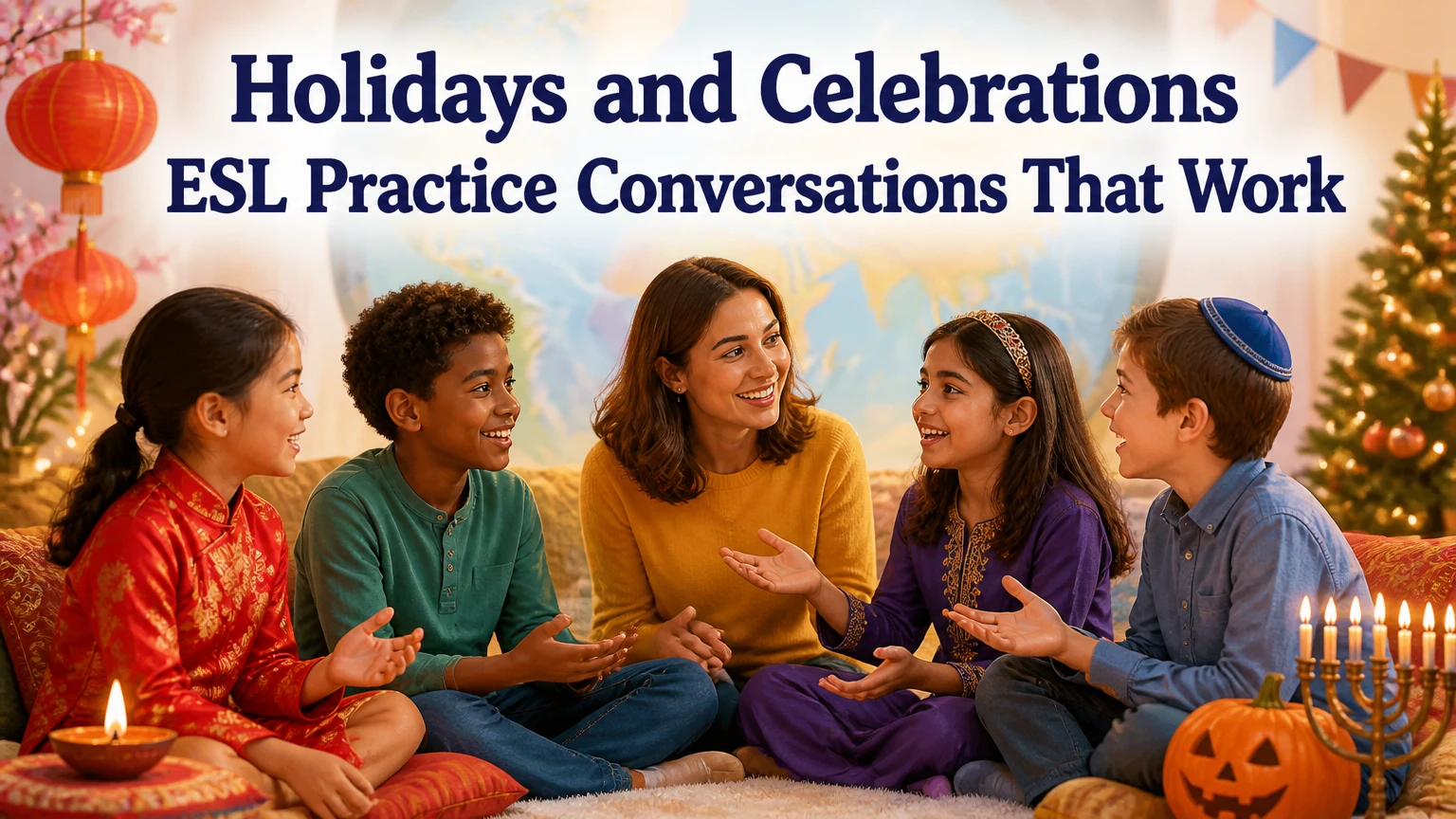
Holidays and celebrations ESL practice conversations are structured speaking activities that use invitations, traditions, food, greetings, and personal experiences to develop practical English. Effective lessons combine modeled dialogue, controlled rehearsal, role-play, and delayed feedback, while allowing learners to discuss familiar, unfamiliar, religious, secular, or national celebrations without assuming one cultural norm.
Key Facts at a Glance
A complete holiday conversation lesson typically takes 45-60 minutes.
Pairs or groups of 2-4 learners provide the most useful speaking time.
Beginners need roughly 6-8 new terms; advanced learners can handle cultural comparison and debate.
The core language functions are inviting, accepting, declining, describing, asking follow-up questions, and expressing appreciation.
Scripted dialogues reduce anxiety; guided role-play develops spontaneous speech; open debate suits advanced learners.
A holiday lesson should teach English about culture without requiring students to disclose private beliefs or family practices.
What Are Holidays and Celebrations ESL Practice Conversations?
Holidays and celebrations ESL practice conversations are contextual dialogues and speaking tasks built around social events. The holiday supplies a meaningful setting, while the language objective might be making an invitation, explaining a custom, discussing a past event, or declining politely.
A useful activity is more than a vocabulary list. Students hear a model, notice functional expressions, rehearse a manageable exchange, and then adapt the exchange to a new situation. That progression moves learners from recognition to retrieval and finally to independent production.
The celebration can be Thanksgiving, Lunar New Year, Diwali, Eid al-Fitr, Hanukkah, Christmas, Halloween, Día de los Muertos, Holi, a national day, a birthday, or a locally important event. Teachers should present these examples as context, not as universal experiences. A learner may celebrate differently, observe privately, follow no religion, or prefer to describe a community event rather than a family practice.
Which language functions should learners practice?
Learners should practice one primary function and one supporting function in each conversation. A beginner lesson might combine identifying a celebration with asking about food; an intermediate lesson might combine inviting someone with arranging transport.
| Primary function | Useful expressions | Typical learner output |
|---|---|---|
| Invite someone | Would you like to come? Are you free on Saturday? | An invitation with date and place |
| Accept | I’d love to. That sounds great. | Confirmation and follow-up question |
| Decline politely | I’m sorry, I can’t. I have another commitment. | Refusal plus optional alternative |
| Describe a tradition | We usually…, People often…, It is common to… | A short cultural explanation |
| Ask respectfully | What does it mean? How do you celebrate it? | Clarification without judgment |
| Express gratitude | Thank you for inviting me. I appreciate it. | Thanks before or after an event |
| Compare practices | In my family…, Unlike…, Both celebrations… | Similarity or difference with evidence |
The strongest materials distinguish a genuine invitation from a polite social gesture. English speakers may say, “We should get together sometime,” without proposing a specific plan. Learners need practice asking, “Do you mean this weekend?” rather than treating every friendly phrase as a firm arrangement.
How Does a Holiday Conversation Lesson Work?
A holiday conversation lesson works through five stages: activate background knowledge, model the language, rehearse the exchange, change the conditions, and give focused feedback. A 45-60 minute lesson usually works best when the teacher limits the language target and protects time for student production.
Step 1: Activate prior knowledge
Spend 5-10 minutes using photos, objects, a calendar, or a short silent video. Ask questions that do not require religious knowledge: “What kinds of events bring people together?” and “What food do people prepare for important occasions?”
Check assumptions before teaching details. Ask learners whether the event is familiar, unfamiliar, celebrated, observed, or not part of their lives. This creates an inclusive schema and prevents a student from being positioned as a spokesperson for an entire country or faith.
Success checkpoint: learners can name the event, setting, and one possible activity.
Common mistake: beginning with a long historical lecture. Keep background information to 3-5 relevant facts.
Step 2: Model a short dialogue
Use a dialogue of 8-14 lines for A1-A2 learners and 12-20 lines for B1-C1 learners. Read it once naturally, once with pauses, and once with students marking stressed words, reductions, and question intonation.
For example, mark the sentence “Would you like to join us for dinner?” with stress on “like,” “join,” and “dinner.” Do not demand a perfect accent. Prioritize intelligible word stress, final consonants, and enough volume for a partner to understand the invitation.
Success checkpoint: students identify the invitation, response, and follow-up question.
Common mistake: asking students to memorize every line before they understand the purpose.
Step 3: Rehearse with controlled practice
Give pairs the printed dialogue and let them read it twice, switching roles after the first reading. Follow with a substitution drill in which students replace the event, date, food, location, or reason for declining.
| Practice round | Teacher changes | Student task | Time |
|---|---|---|---|
| Round 1 | No changes | Read exactly as written | 3 minutes |
| Round 2 | Celebration and food | Substitute two details | 4 minutes |
| Round 3 | Date and location | Ask and answer from prompts | 5 minutes |
| Round 4 | Response type | Accept, decline, or postpone | 5 minutes |
Controlled practice is valuable because it lowers cognitive load. It is not the final goal. A student who reads a flawless script may still struggle when a partner changes the date or asks an unexpected question.
Success checkpoint: each learner produces the target structure without looking at every word.
Common mistake: correcting pronunciation after every line. Record recurring errors and address them after the exchange.
Step 4: Move to role-play
Give each learner private information so that the conversation has a reason to exist. One person may be hosting a Lunar New Year meal on Sunday, while the other works that day and wants to suggest Monday. Information gaps produce more authentic interaction than identical cue cards.
Use role cards with four fields: relationship, event, constraint, and goal. A role-play should last 3-5 minutes, then repeat with a new partner or changed constraint.
Success checkpoint: students negotiate at least one detail and ask two follow-up questions.
Common mistake: providing so many instructions that learners spend more time reading than speaking.
Step 5: Give delayed feedback
During production, note successful phrases, recurring grammar errors, pronunciation problems, and cultural misunderstandings. After the activity, write anonymous examples on the board and ask students to improve them.
Delayed correction protects fluency. Immediate correction remains appropriate when a misunderstanding blocks communication, a phrase could cause offense, or the teacher has asked for a focused pronunciation drill.
Which Conversation Types Suit Different Learners?
The best holiday conversation type depends on proficiency, confidence, group size, and the language function being taught. A1-A2 students usually need visual support and sentence frames; B1-B2 students benefit from changing conditions; C1-C2 students can evaluate social meaning and competing viewpoints.
| CEFR level | Language focus | Support materials | Suitable output |
|---|---|---|---|
| A1 | Simple present, dates, food, likes | Pictures, word bank, sentence frames | 6-8 line exchange |
| A2 | Wh- questions, can, would like | Cue cards and substitution grid | Invitation and short description |
| B1 | Past events, future plans, reasons | Role cards and follow-up prompts | 3-minute arranged conversation |
| B2 | Modals, politeness, comparison | Conflicting schedules and opinions | Negotiation or cultural interview |
| C1 | Register, implication, stance | Authentic posts, menus, workplace cases | Debate, presentation, or analysis |
| C2 | Nuance, irony, historical context | Independent research and source checking | Sustained discussion with rebuttal |
Casual conversations
Casual conversations cover birthdays, family meals, barbecues, fireworks, gifts, and weekend plans. Contractions and everyday expressions are appropriate, but slang should be labeled as informal and optional.
Useful examples include “Are you doing anything for the holiday?” “Do you want to come over?” and “I might be able to make it.” Teach “come over” as an informal phrasal verb rather than presenting it as universally suitable.
Formal and workplace conversations
Formal conversations cover office receptions, client greetings, seasonal messages, and professional invitations. Learners need indirect questions, restrained personal disclosure, and polite exits such as “I should let you get back to your guests.”
A workplace lesson should not assume that every employee celebrates Christmas. Neutral phrases include “Do you have any plans for the break?” “How does your organization mark the end of the year?” and “I hope you enjoy the holiday period.”
Tradition-explanation conversations
A tradition interview gives one learner a role as explainer and another as a respectful questioner. The explainer should use qualifiers such as “In my family” or “Some people in my community,” because no individual can represent every participant in a large cultural group.
Useful follow-up questions include “When does it take place?” “What do people usually eat?” “Has the tradition changed?” and “Is there anything visitors should avoid doing?”
Which Practice Format Is Most Effective?
Guided role-play is the strongest general choice for intermediate learners because it combines a safe structure with unpredictable responses. Scripted dialogues remain better for beginners and anxious speakers, while open cultural debate is more productive for advanced learners who can sustain an argument and distinguish personal experience from general claims.
| Format | Typical duration | Best level | Main strength | Main limitation |
|---|---|---|---|---|
| Scripted dialogue | 10-15 minutes | A1-A2 | Accurate model and low anxiety | Can sound memorized |
| Substitution drill | 5-10 minutes | A1-B1 | Fast retrieval of sentence patterns | Limited spontaneous meaning |
| Guided role-play | 15-20 minutes | B1-B2 | Negotiation and flexible speaking | Can stall without vocabulary |
| Information gap | 10-15 minutes | A2-B2 | Genuine need to ask questions | Requires careful card design |
| Small-talk mixer | 10-15 minutes | B1-C1 | Short social exchanges | Some students may avoid partners |
| Cultural debate | 15-25 minutes | C1-C2 | Nuanced argument and comparison | Can expose unequal participation |
A practical rule is to move from script to prompt, not from script directly to free conversation. Remove approximately 25% of the written support at each repetition. Students then retain the communicative purpose while gradually generating more language themselves.
How should a teacher choose between formats?
Choose a scripted dialogue when accuracy and confidence are the immediate goals. Choose guided role-play when learners already control the core phrases but need retrieval practice. Choose debate only when students have enough language to disagree respectfully and the topic does not pressure them to reveal private beliefs.
What Materials, Time, and Cost Are Typical?
A complete holiday speaking module usually requires 15-30 minutes of teacher preparation and 45-60 minutes of class time. Typical costs range from zero for teacher-created cards and public-domain images to approximately $5-$20 for a commercial unit; physical textbooks commonly cost $30-$60.
| Resource type | Typical cost | Preparation time | Recommended use | Limitation |
|---|---|---|---|---|
| Teacher-created dialogue | $0 | 20-30 minutes | Exact level and local context | Requires editing |
| Public image set | $0 | 10-15 minutes | Warm-up and vocabulary | Image rights need checking |
| Commercial digital unit | $5-$20 | 5-10 minutes | Fast classroom deployment | Cultural fit may vary |
| Coursebook chapter | $30-$60 per book | 10-20 minutes | Integrated skills sequence | Often less flexible |
| Voice-recording app | $0-$15 per month | 5 minutes | Self-study pronunciation | Automated feedback may misjudge accents |
A two- to four-person group usually provides a workable balance between interaction and individual speaking time. Larger groups need timed rotations, observer roles, or multiple simultaneous stations, otherwise confident speakers can absorb the available practice.
How Can Learners Practice Alone?
Self-learners can practice alone by recording both sides of a short dialogue, leaving a pause for the unseen partner, and replaying the recording to evaluate clarity. A 10-minute routine works well: two minutes of vocabulary review, four minutes of role-play recording, two minutes of transcript correction, and two minutes of rerecording.
Use a voice recorder, language-learning platform, or conversational AI as a rehearsal partner. AI can generate variations such as “decline because you are working” or “ask whether guests should bring food,” but it may produce culturally narrow examples or unnatural expressions. Verify important phrases with a reliable dictionary, teacher, or established language-learning source.
Self-learners should evaluate four features:
- Did the invitation or explanation have a clear purpose?
- Did the response include a reason or follow-up?
- Did pauses occur at sensible phrase boundaries?
- Could an unfamiliar listener understand the key details?
Recording both parts can become mechanical. The limitation is important: solo practice cannot fully reproduce overlapping speech, negotiation, eye contact, or a partner’s unexpected question.
What Cultural Safeguards Make These Activities Better?
Culturally responsible holiday ESL practice treats celebrations as varied practices rather than fixed national characteristics. Teachers should offer a secular route, permit students to pass, and distinguish “some families” from “everyone in this culture.”
Avoid questions that assume religion, wealth, family structure, or participation. Replace “What does your family do for this religious holiday?” with “Is there a celebration or public event you would like to describe, or would you prefer to discuss a fictional example?”
Use these safeguards:
- Explain that food, clothing, dates, and rituals differ by region and household.
- Avoid asking one learner to represent an entire country or faith.
- Teach respectful questions before assigning cross-cultural interviews.
- Include public holidays, harvest events, sports celebrations, birthdays, and community festivals.
- Do not grade students on the authenticity of their personal tradition.
- Check whether images and examples reduce a group to costumes, food, or stereotypes.
- Let students invent a celebration when personal disclosure is uncomfortable.
A counterintuitive teaching point is that unfamiliar holidays can generate better language practice than familiar ones, provided the teacher supplies concise background information. Students must ask clarification questions, paraphrase, and check understanding instead of relying on shared assumptions.
How Do You Keep Conversations From Stalling?
Conversation stalls usually result from insufficient task information, excessive difficulty, or an absent reason to continue. Add a conversation-extender card with specific questions, not a vague instruction to “keep talking.”
| Stall pattern | Likely cause | Immediate fix | Follow-up prompt |
|---|---|---|---|
| Students finish in one minute | Too few constraints | Add a schedule conflict | What alternative date works? |
| One student dominates | Unequal turn access | Use three speaking tokens each | Can you ask your partner now? |
| Students read continuously | Support is too complete | Cover selected lines | What key word comes next? |
| Learners switch languages | Missing vocabulary | Provide five essential terms | Can you explain it another way? |
| Students avoid the topic | Personal sensitivity | Offer a fictional event | What might a guest experience? |
| Debate becomes factual conflict | No source boundary | Separate experience from claim | Is that true everywhere or locally? |
Token speaking can regulate turn-taking. Give each student three tokens, such as paperclips, and require one token for each substantial turn. The technique is less suitable for very young learners or students with motor difficulties, so verbal turn cards or a digital timer provide accessible alternatives.
For shy learners, use read-and-look-up practice. Students read one line silently, look at their partner, and say the line from short-term memory. This intermediate step builds eye contact and retrieval without demanding immediate improvisation.
How Should Holiday Conversations Be Assessed?
Assess the communication outcome rather than cultural performance. A short four-category rubric can score task completion, intelligibility, interaction, and language control from 1 to 4, producing a maximum of 16 points.
| Criterion | 1 point | 2 points | 3 points | 4 points |
|---|---|---|---|---|
| Task completion | Key purpose missing | Partly completed | Completed with support | Completed independently |
| Intelligibility | Often unclear | Meaning usually recoverable | Clear with minor issues | Clear and well paced |
| Interaction | Rarely responds | Responds to direct prompts | Asks follow-ups | Negotiates and repairs meaning |
| Language control | Frequent blocking errors | Basic meaning maintained | Mostly accurate target forms | Flexible, accurate, appropriate |
Do not award extra points because a student celebrates a particular holiday or knows more cultural facts. A learner who explains a fictional festival with clear English has met the speaking objective.
Teacher feedback should identify one successful phrase, one high-value correction, and one next-step target. Correcting every error produces a longer correction session but does not necessarily produce better future performance.
How Can You Adapt the Lesson for Online Classes?
Online holiday conversation practice works best with pairs in breakout rooms, a shared prompt document, and timed rotations. Give students the task, success criteria, and emergency phrases before opening the rooms because repeated teacher explanations interrupt speaking time.
Use a shared table with columns for event, date, location, invitation, response, and follow-up. Each pair completes one row after speaking, creating a visible record of language rather than requiring the teacher to visit every room continuously.
Online-specific problems include microphone delay, camera fatigue, and students reading from another screen. Reduce the dialogue length, require one unscripted detail, and allow text chat for vocabulary support. Do not equate camera use with participation; audio-only learners can still meet the speaking objective.
What Are the Best Ready-to-Use Conversation Templates?
The following templates work because each has a clear communicative problem and adjustable details. Replace the celebration, date, food, and relationship to suit the class.
Intermediate invitation and polite refusal
A: Are you doing anything for the spring festival on Saturday?
B: I’m not sure yet. Why do you ask?
A: My family is having dinner at seven. Would you like to join us?
B: I’d love to, but I have to work until nine.
A: No problem. We could meet for lunch on Sunday instead.
B: That sounds great. Should I bring anything?
A: A dessert would be helpful, if you have time.
B: I can bring fruit and pastries.
Practice variations: change the event to a birthday or national day; accept without bringing anything; postpone because of transport; ask whether the gathering is formal.
Tradition explanation and respectful questions
A: I saw lanterns outside your home. Are they connected to a celebration?
B: Yes. My family uses them during Lunar New Year.
A: What do they represent?
B: They represent hope and a positive beginning, although customs differ between families.
A: Do people usually exchange gifts?
B: Some people do. My relatives usually share food and visit older family members.
A: Is there anything a guest should know?
B: Arriving on time is polite, and asking before taking photos is appreciated.
Practice variations: explain a local festival; compare childhood and current practice; correct an assumption politely.
Advanced workplace small talk
A: How does your team usually mark the end of the year?
B: We have a voluntary lunch, although not everyone observes the same holidays.
A: That sounds inclusive. Are you attending this year?
B: I may stop by briefly, but I have a client call afterward.
A: Of course. I hope the event goes well.
B: Thank you. I hope you enjoy the break too.
Practice variations: enter a conversation, leave gracefully, respond when someone asks a personal question, or write a neutral seasonal email.
How Can Teachers Personalize the Activity?
Personalization means changing the communicative conditions, not demanding private information. Let learners choose among a real celebration, a public event, a childhood memory, a fictional household, or a workplace gathering.
For mixed-level classes, keep the situation constant but vary the output. A1 learners can select phrases from a card, B1 learners can add reasons and alternatives, and C1 learners can discuss register or social expectations. Mixed-level pairs work when roles rotate and the stronger learner is not permanently assigned as the “teacher.”
For children, use birthdays, school festivals, costumes, food, and fireworks with visual prompts. For adult migrants, practice invitations, neighborhood events, school-calendar conversations, and workplace boundaries. For business learners, prioritize neutral greetings, optional attendance, scheduling, dietary questions, and professional email language.
Frequently Asked Questions
What holiday vocabulary should beginners learn first?
Beginners should learn six to eight functional terms before adding cultural detail: celebrate, invite, party, family, food, gift, date, and holiday. Add sentence frames such as “We celebrate on…” and “Would you like to come?” Vocabulary becomes useful when learners immediately use it to ask, answer, accept, or decline.
How do you politely decline a holiday invitation in English?
A polite refusal usually contains appreciation, a clear but brief reason, and an optional alternative: “Thank you for inviting me, but I can’t come on Saturday because I’m working. Could we meet next week?” Learners do not need to invent an elaborate excuse, and professional situations often require less personal detail.
Are holiday dialogues appropriate for students who do not celebrate holidays?
Yes, if participation is not tied to personal belief or disclosure. Use public events, fictional celebrations, birthdays, seasonal breaks, or community activities, and allow students to compare how people gather rather than describe their own religious practice. The language objective remains valid without personal participation.
How many new words should one lesson introduce?
A typical beginner lesson should introduce about 6-8 new words, while an intermediate lesson can manage approximately 8-10 if students actively recycle them. More vocabulary is appropriate only when learners already have strong retrieval skills; otherwise, additional terms reduce speaking time and increase dependence on written prompts.
Can AI practice both sides of a holiday conversation?
AI can generate role-play variations, ask follow-up questions, and provide a patient rehearsal partner. AI should not be treated as the final authority on cultural customs, dialect suitability, or pronunciation quality, because generated examples can generalize a tradition or favor one variety of English. Human interaction remains necessary for turn-taking and repair.
What is the ideal group size for holiday speaking practice?
Pairs provide the highest individual speaking time, while groups of three or four add audience variety and role rotation. In groups larger than four, use timed stations or rotating pairs. Without a structure, larger groups commonly produce unequal participation, especially when one fluent learner answers every question.
The Bottom Line
Holidays and celebrations ESL practice conversations work best when a specific language function drives the cultural topic. Use a short model, controlled rehearsal, guided role-play, and delayed feedback within 45-60 minutes; adapt support to CEFR level; and provide fictional or secular alternatives when personal disclosure is inappropriate. The most effective lesson is inclusive, measurable, and designed around what learners must say, not merely what they must know.