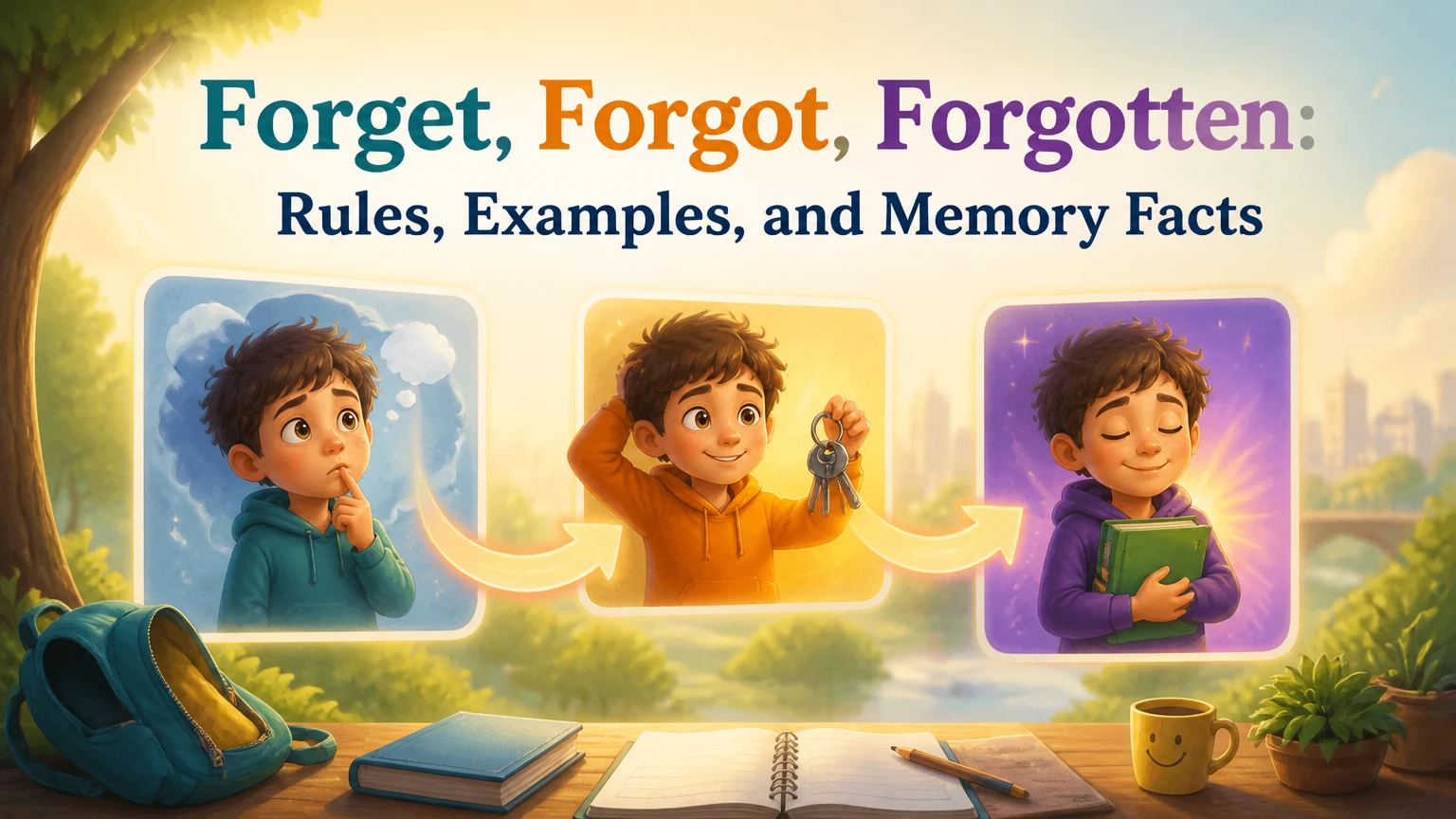
Forget, forgot, and forgotten are three forms of the irregular English verb forget, meaning to fail to remember or to fail to do something because it was not remembered. Forget is the base and present form, forgot is the past simple form, and forgotten is the past participle used mainly with have, has, or had.
Key Facts / At a Glance
Forget is the base form: “Please forget the mistake.”
Forgot is the past simple: “I forgot my password yesterday.”
Forgotten is the past participle: “She has forgotten the address.”
Standard modern English uses have forgotten, not have forgot, in perfect tenses.
The pronunciation changes across the forms: /fəˈɡet/, /fəˈɡɒt/ or /fəˈɡɑːt/, and /fəˈɡɒtən/ or /fəˈɡɑːtən/.
Human forgetting can result from weak encoding, retrieval difficulty, interference, or gradual loss of accessibility.
What Do Forget, Forgot, and Forgotten Mean?
Forget means to fail to retain, recall, or act on information. The verb can describe a missing memory, an omitted action, or a deliberate decision to stop thinking about something, depending on its complement and context.
“I forgot the appointment” describes a past failure to remember. “Don’t forget your appointment” describes a present instruction about a future action. “I have forgotten the appointment” connects the earlier failure with the speaker’s current state.
The forms are irregular because the past does not take the regular -ed ending. The related forms developed from older Germanic verb patterns, and modern English preserves the vowel change between the base and past forms.
The Three Principal Forms
| Form | Grammatical role | Example | Meaning |
|---|---|---|---|
| forget | Base or present form | I forget names easily. | Habit or general fact |
| forgot | Past simple | I forgot her name. | Completed past event |
| forgotten | Past participle | I have forgotten her name. | Past event linked to another time |
| forgetting | Present participle or gerund | Forgetting names is common. | Ongoing action or activity |
How Are the Forms Pronounced?
The pronunciation of forget has stress on the second syllable, while the two past forms normally use a different vowel sound.
| Word | IPA, common British form | IPA, common American form | Syllables |
|---|---|---|---|
| forget | /fəˈɡet/ | /fɚˈɡet/ | fer-GET |
| forgot | /fəˈɡɒt/ | /fɚˈɡɑːt/ | fer-GOT |
| forgotten | /fəˈɡɒtən/ | /fɚˈɡɑːtən/ | fer-GOT-en |
| forgetting | /fəˈɡetɪŋ/ | /fɚˈɡetɪŋ/ | fer-GET-ing |
British and American pronunciation differ most noticeably in the vowel of forgot and forgotten. The final syllable in forgotten is usually pronounced as a weak /ən/, not as a fully stressed “ten.”
When Should You Use Forget?
Use forget for the base form, present-tense subjects other than third-person singular he, she, or it, infinitives, imperatives, and constructions with modal verbs. The form remains unchanged after to, do, does, did, will, can, should, and similar auxiliaries.
Examples include:
- “I often forget where I put my glasses.”
- “Please forget what I said.”
- “You must not forget the deadline.”
- “Did they forget the tickets?”
- “She does not forget important dates.”
- “Try to forget the argument.”
The third-person singular present form is forgets: “He forgets passwords frequently.” The form forget also appears in the imperative, where the subject is understood: “Forget the old instructions.”
Forget in Common Tenses
| Tense or construction | Correct pattern | Example |
|---|---|---|
| Present simple | forget / forgets | We forget; she forgets |
| Present continuous | am/is/are forgetting | He is forgetting details |
| Past simple | forgot | They forgot the key |
| Present perfect | have/has forgotten | I have forgotten the code |
| Past perfect | had forgotten | She had forgotten the warning |
| Future | will forget | You will forget the phrase |
| Modal | modal + forget | You should forget the rumor |
| Infinitive | to forget | It is hard to forget |
English speakers rarely use the present continuous for a single ordinary memory lapse. “I am forgetting names” usually describes a developing or repeated problem, not one completed event.
When Should You Use Forgot?
Use forgot for a completed event in the past when the verb does not have an auxiliary such as have, has, or had. A finished time expression often accompanies the past simple, including yesterday, last week, in 2022, or when I was a child.
Examples:
- “I forgot my wallet at home.”
- “She forgot to send the invoice yesterday.”
- “We forgot about the change in schedule.”
- “Did you forget my birthday?”
- “I did not forget the instructions.”
The negative form is did not forget, not “did not forgot,” because did already carries the past tense. The same rule applies to questions: “Did he forget?” is correct, while “Did he forgot?” is not standard English.
When Should You Use Forgotten?
Use forgotten as the past participle, normally after have, has, or had, and sometimes as an adjective. The auxiliary carries the tense, while forgotten identifies the participle form.
Examples:
- “I have forgotten the password.”
- “She has forgotten his name.”
- “They had forgotten the original plan.”
- “By noon, we had forgotten the disagreement.”
- “The village became a forgotten place.”
The perfect construction often emphasizes a present consequence or a relationship between two past events. “I forgot the key” reports a past incident. “I have forgotten the key” emphasizes the current problem of not remembering it.
Is “I Have Forgot” Correct?
“I have forgotten” is the standard form in contemporary formal and neutral English; “I have forgot” is nonstandard for most international learners, although it appears in some dialects, informal speech, and older literary English. After have, has, or had, use the past participle forgotten in careful writing.
| Sentence | Standard status | Reason |
|---|---|---|
| I forgot the address. | Correct | Past simple |
| I have forgotten the address. | Correct | Present perfect |
| I had forgotten the address. | Correct | Past perfect |
| I have forgot the address. | Nonstandard in most formal English | Past simple used after have |
| I did forgot the address. | Incorrect | Did requires the base form |
| I should forget the address. | Correct | Modal requires the base form |
A speaker may use “have forgot” as a regional form, so correction should consider audience and dialect. Learners writing academic, professional, or international English should choose have forgotten.
What Is the Difference Between Forgetting to Do Something and Forgetting Doing Something?
“Forget to do” means failing to complete an intended action, while “forget doing” means failing to remember a previous action or experience. The infinitive points toward an omitted task; the gerund points backward toward an event.
Compare these pairs:
- “I forgot to lock the door.”
I did not lock it because I failed to remember. - “I forgot locking the door.”
I locked it, but I do not remember doing so. - “She forgot to call her mother.”
The call probably did not happen. - “She forgot calling her mother.”
The call happened, but the memory is absent.
In ordinary conversation, forget doing can sound less natural than not remember doing. “I don’t remember locking the door” is often clearer when the speaker wants to avoid ambiguity.
Related Patterns With Forget
| Pattern | Typical meaning | Example |
|---|---|---|
| forget + noun | Fail to remember information | I forgot his name |
| forget to + verb | Fail to perform an intended action | Do not forget to check |
| forget + gerund | Fail to recall a past activity | I forgot meeting her |
| forget that + clause | Fail to retain a fact | He forgot that today was Monday |
| forget about + noun | Stop considering something | Forget about the old plan |
| forget how/where/when | Lose recall of a detail | I forgot where we parked |
| never forget + noun | Retain a strong memory | I will never forget that day |
| forget it | Reject, dismiss, or end a topic | Forget it, we can leave |
Why Do People Forget Information?
Forgetting usually reflects a problem with encoding or retrieval rather than proof that information was permanently erased. Attention, sleep, stress, competing memories, age, medication, and the quality of retrieval cues all influence whether a person can recall a stored detail.
Cognitive psychology commonly distinguishes four mechanisms:
- Encoding failure: The information receives too little attention to become a stable memory. Someone may “forget” a name immediately because the name was never fully registered.
- Retrieval failure: The memory is available but cannot be accessed at that moment. A familiar word may return after a conversation ends.
- Interference: Similar information competes with the target memory. An old password can disrupt recall of a newly changed password.
- Decay or reduced accessibility: A memory may become harder to retrieve when it is not revisited, although the exact biological process is more complex than a simple timer.
The Canadian psychologist Endel Tulving described episodic remembering as dependent on “the interaction between information stored in the brain and information available in the environment.” That principle explains why a place, smell, phrase, or photograph can suddenly restore a detail.
What Are Proactive and Retroactive Interference?
Proactive interference occurs when older information disrupts newer learning, while retroactive interference occurs when newer information disrupts older learning. Both effects become more likely when the competing items are similar, such as names, dates, passwords, or vocabulary words.
| Interference type | Direction of disruption | Concrete example | Useful countermeasure |
|---|---|---|---|
| Proactive | Old affects new | Old address replaces new address | Say the new address aloud |
| Retroactive | New affects old | New phone number blocks old number | Practise both with labels |
| Output interference | Earlier recall affects later recall | First list items crowd out later items | Recall in varied order |
| Context interference | Setting mismatch blocks recall | Classroom cue absent during exam | Study in multiple contexts |
Interference is one reason repeated information can be easier to remember than isolated facts. Distinctive examples reduce overlap between competing memory traces.
What Does the Ebbinghaus Forgetting Curve Actually Show?
The Ebbinghaus forgetting curve shows that recall for meaningless material can fall rapidly after learning and then decline more slowly, but its percentages are not universal human deadlines. Hermann Ebbinghaus’s 1885 experiments used himself as the principal participant and relied on lists of nonsense syllables, so results vary with meaning, prior knowledge, sleep, attention, and testing.
Frequently repeated online figures claim that people retain 58% after 20 minutes, 44% after one hour, 33% after one day, and 21% after one month. Those numbers should not be presented as fixed biological measurements for every learner. Ebbinghaus’s work established the general shape of rapid initial loss followed by slower decline, not a universal schedule that predicts every memory.
Later research shows that retrieval practice and spaced review can substantially change retention. The practical lesson is specific: test recall soon after learning, then increase the interval when recall becomes reliable.
| Learning condition | Typical review window | Main risk | Better action |
|---|---|---|---|
| One exposure, meaningless list | 10-30 minutes | Rapid early loss | Retrieve without notes |
| New vocabulary | 1 day | Form or meaning confusion | Recall both directions |
| Exam concept | 2-7 days | Familiarity mistaken for mastery | Use closed-book questions |
| Procedure or skill | 1-4 weeks | Context-specific recall | Practise in varied settings |
| Well-learned knowledge | 1-6 months | Slow accessibility loss | Schedule cumulative review |
How Can You Retrieve a Word That You Have Forgotten?
A forgotten word is often recovered by changing the retrieval cue rather than forcing direct recall. Reconstruct the situation, search the first sound, describe the meaning, and return to the problem after a short break.
Use this sequence:
- Name the category. Ask whether the word is a person, place, object, action, or abstract idea.
- Generate meaning clues. Describe what the word does, where you encountered it, and which words appeared nearby.
- Scan the first sound. Move through likely initial letters or syllables without guessing indefinitely.
- Recreate context. Return mentally or physically to the room, document, conversation, or task associated with the memory.
- Relax the search. A brief change of activity can reduce competing thoughts and allow an alternative cue to work.
- Verify the answer. Check a reliable dictionary, source document, or person rather than accepting the first plausible word.
The “tip-of-the-tongue” state often contains partial information, such as word length, initial sound, grammatical category, or rhythm. Partial access is evidence that retrieval is incomplete, not necessarily that the memory has disappeared.
How Can Spaced Practice Reduce Forgetting?
Spaced practice reduces forgetting by requiring repeated retrieval after increasing delays, rather than concentrating all review into one session. A learner might review new vocabulary after 10 minutes, one day, three days, one week, and three weeks, adjusting the next interval according to recall accuracy.
Active recall is stronger than passive rereading because the learner must produce the answer. Flashcard systems such as Anki schedule reviews algorithmically, but a paper calendar works when each item is tested before the answer is viewed.
| Review stage | Example interval | Test format | Promotion rule |
|---|---|---|---|
| Initial check | 10-20 minutes | Recall without notes | Repeat if incomplete |
| Short delay | 24 hours | Definition to word | Move on after correct recall |
| Medium delay | 3-4 days | Word to definition | Add an example sentence |
| Long delay | 10-14 days | Mixed retrieval | Extend interval if fluent |
| Maintenance | 1-3 months | Cumulative test | Reinsert after an error |
Sleep supports memory consolidation, but sleep cannot rescue material that received almost no attention during learning. The National Institute of Neurological Disorders and Stroke identifies sleep as important for learning and memory, while individual sleep needs vary; adults commonly require at least seven hours, but a fixed seven-to-eight-hour rule does not fit everyone.
Forgetting Versus Misplacing: What Is the Difference?
Forgetting is a memory problem, while misplacing is a location problem, although the two frequently overlap. A person forgets that a bill is due when the deadline is inaccessible from memory; a person misplaces a phone when the location was not encoded or cannot be reconstructed.
| Situation | Primary failure | Example | Best recovery cue |
|---|---|---|---|
| Forgotten appointment | Prospective memory | Meeting time disappears | Calendar notification |
| Misplaced keys | Spatial encoding | Keys left in an unusual room | Retrace movement |
| Forgotten name | Retrieval access | Face is familiar, name absent | Context and first-letter cues |
| Lost password | Cue or storage failure | Correct sequence unavailable | Password manager |
| Forgotten instruction | Encoding or interference | Several tasks compete | Written checklist |
The distinction matters because the remedy differs. A calendar improves future-intention memory, while a consistent storage location improves spatial retrieval.
When Is Forgetfulness Normal, and When Is It Concerning?
Occasional forgetfulness is common when attention, sleep, stress, or competing information is poor; persistent decline that disrupts work, safety, communication, or independent living deserves medical assessment. A single forgotten name is usually less informative than a repeated pattern of missed bills, unsafe driving, lost routines, or inability to learn familiar procedures.
Seek prompt professional advice when memory problems appear with sudden confusion, weakness, speech difficulty, severe headache, fainting, or a recent head injury. Those symptoms can indicate an urgent medical problem.
Possible contributors include depression, anxiety, sleep disorders, alcohol, medication effects, thyroid disease, vitamin deficiencies, hearing loss, and neurological conditions. A clinician can review timing, medications, mood, sleep, and functional changes instead of treating every lapse as dementia.
What Is Motivated Forgetting?
Motivated forgetting describes attempts to avoid, suppress, or disengage from unwanted memories. People can sometimes reduce access to a memory through intentional suppression, but deliberate forgetting is neither complete nor reliably controllable.
Trauma-related memory is especially complex. A gap in recall does not prove that an event happened, and vivid recall does not guarantee perfect accuracy. Legal, clinical, and personal decisions should rely on corroborating evidence rather than confidence alone.
Which Synonyms Can Replace Forget?
The best synonym depends on whether the person lost information, failed to act, or intentionally stopped caring about a topic. No single replacement matches every use of forget.
| Intended meaning | Suitable alternative | Example |
|---|---|---|
| Fail to remember | Not recall | I cannot recall her name |
| Fail to act | Overlook | We overlooked the deadline |
| Put somewhere and lose track | Misplace | I misplaced my glasses |
| Stop considering | Disregard | Disregard the earlier version |
| Stop thinking about | Put out of mind | She put the incident out of mind |
| Fail to include | Omit | The editor omitted one detail |
| Lose memory gradually | Become unable to remember | He became unable to remember dates |
Overlook can mean fail to notice, but it does not always mean forget. Ignore usually describes a choice not to attend to something, whereas forget may be accidental. Misplace concerns a physical item and should not replace forget for an appointment or fact.
Common Errors With Forget, Forgot, and Forgotten
The most frequent errors involve auxiliary verbs, time reference, and the complement after the verb.
- Wrong: “I have forgot his name.”
Correct: “I have forgotten his name.” - Wrong: “Did you forgot the tickets?”
Correct: “Did you forget the tickets?” - Wrong: “She did not forgot.”
Correct: “She did not forget.” - Ambiguous: “I forgot locking the door.”
Clearer: “I do not remember locking the door.” - Wrong meaning: “I forgot calling him,” when the intended meaning is that no call occurred.
Correct: “I forgot to call him.” - Incorrect agreement: “He forget the password.”
Correct: “He forgets the password.”
A useful editing rule is to identify the auxiliary first. If did or a modal appears, use forget. If have, has, or had appears, use forgotten. If neither appears and the event is completed, use forgot.
Practice: Choose the Correct Form
Choose forget, forgot, or forgotten in each sentence.
- I always ___ where I put my keys.
- Marta ___ the appointment last Tuesday.
- We have ___ the original instructions.
- Did you ___ to attach the file?
- He had ___ the address before the journey began.
- Please do not ___ your passport.
- They have never ___ that experience.
Answer Key
- forget, because the sentence describes a present habit.
- forgot, because “last Tuesday” identifies a completed past time.
- forgotten, because it follows have.
- forget, because did takes the base form.
- forgotten, because it follows had.
- forget, because the sentence is an imperative.
- forgotten, because it follows have.
FAQ About Forgetting and Verb Forms
Is “forgotten” always used with “have”?
No. Forgotten is commonly used with have, has, or had, but it can also function as an adjective: “a forgotten tradition.” It may also appear in passive or participial structures, although the perfect construction is the main pattern learners need to master.
What is the past tense of forget?
The past simple tense of forget is forgot. Use it for a completed event without a perfect auxiliary: “I forgot my umbrella.” In a question or negative sentence with did, return to the base form: “Did you forget?” and “I did not forget.”
Is “forgetted” a word?
Forgetted is not the standard past form of the English verb forget. The correct forms are forget, forgot, and forgotten. Learners may produce “forgetted” by applying the regular -ed rule, but forget is irregular and changes internally.
Can forget mean “forgive”?
Sometimes forget can suggest moving past an offense, as in “Forget the insult” or “I will never forget what happened.” It does not directly mean forgive. Forgiveness concerns releasing resentment or excusing harm, while forgetting concerns memory or attention.
Why do I remember something after I stop trying?
Relaxing can reduce interference from competing thoughts and allow a different retrieval cue to activate the memory. A change of location, a related word, or a later conversation may provide the missing cue. The delay does not prove that the memory was permanently stored with perfect accuracy.
Does forgetting mean the memory was erased?
Not necessarily. A failure to recall can result from weak encoding, interference, or unavailable cues, and later recognition may occur even when free recall fails. However, repeated non-retrieval can reduce accessibility, and some memories can become substantially inaccurate or unavailable over time.
The Bottom Line
Forget, forgot, and forgotten share one irregular verb but perform different grammatical jobs: forget is the base form, forgot is the past simple, and forgotten is the past participle. Use did forget after did, have forgotten after a perfect auxiliary, and choose forget to do or forget doing according to whether an intended action was omitted or a completed action is no longer remembered. In cognitive terms, forgetting can reflect weak attention, interference, or retrieval difficulty, so spaced recall, strong cues, sleep, and reliable external reminders offer more practical value than cramming.