
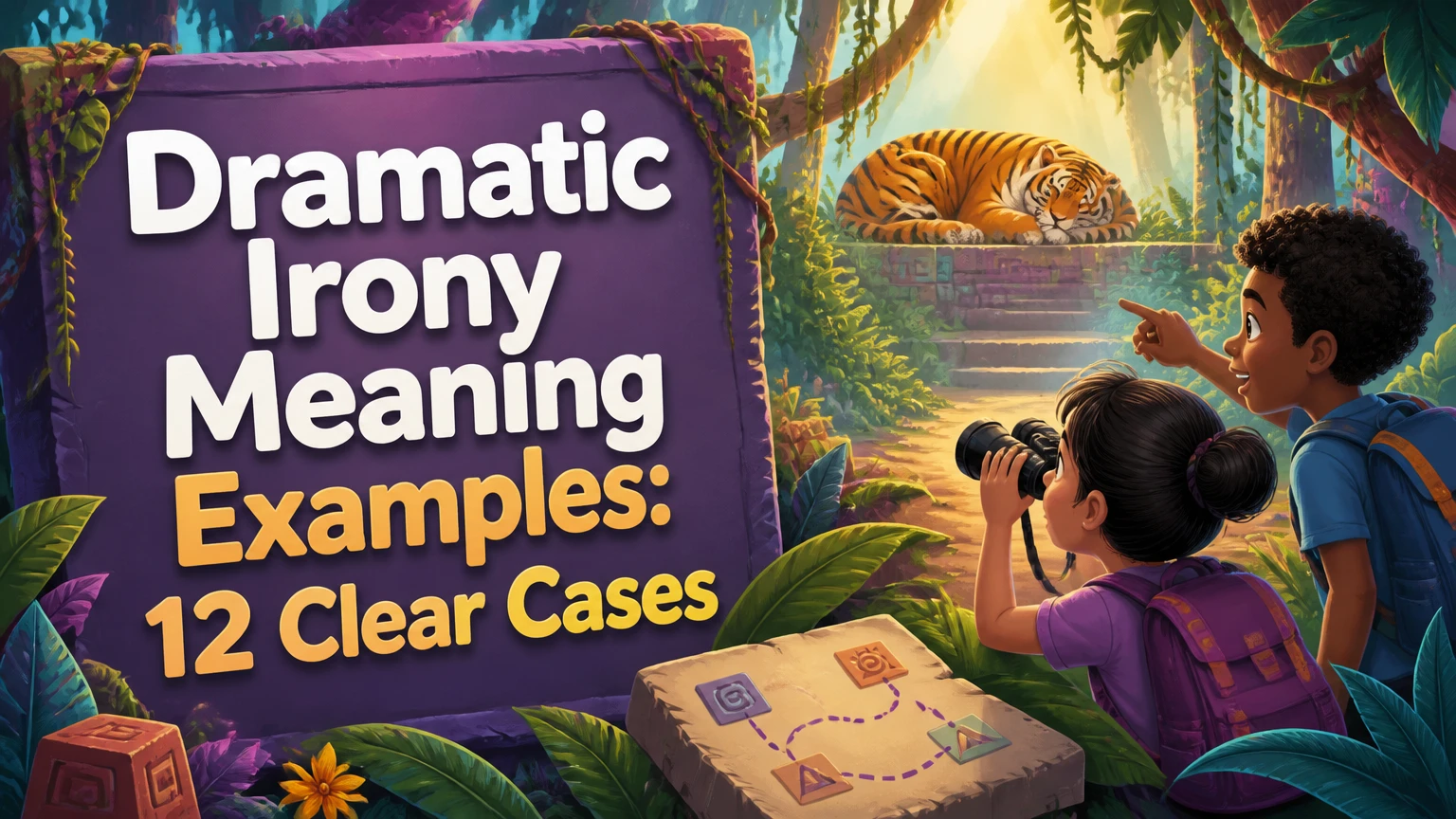
Dramatic irony is a literary and theatrical device in which the audience or reader knows important information that a character does not know. The resulting knowledge gap creates suspense, dread, surprise, or humor because viewers understand the meaning and consequences of actions before the character does.
Key Facts About Dramatic Irony
- Dramatic irony requires unequal knowledge between the audience and at least one character.
- The audience must know information that materially changes the meaning of a scene.
- The device commonly produces suspense, tragic anticipation, discomfort, or comedy.
- Dramatic irony is different from situational irony, which depends on an unexpected outcome.
- Dramatic irony is different from verbal irony, which depends on a contrast between words and intended meaning.
- The device usually has an installation, exploitation, and revelation phase.
What Is Dramatic Irony?
Dramatic irony occurs when a story gives the audience significant information that a character lacks, causing the audience to interpret the character’s words or actions differently. The character may believe a decision is safe, loving, sensible, or successful, while the audience already understands the hidden danger or false assumption.
The information gap must matter. If the audience knows that a character prefers tea while another character does not, the difference is usually not dramatic irony because it has no meaningful effect on the plot. If the audience knows that a sealed letter contains evidence of betrayal while the protagonist publicly praises the supposed friend, the gap creates dramatic tension.
The device appears in drama, novels, short stories, cinema, television, comedy, tragedy, and interactive fiction. “Dramatic” refers to its historical association with performance, not to an exaggerated emotional tone. A quiet conversation can contain dramatic irony if the audience knows what one speaker cannot.
Dramatic irony also depends on timing. The audience must receive the information early enough to process it, and the character must remain unaware long enough for the gap to generate consequences.
How Does Dramatic Irony Work?
Dramatic irony works through three connected stages: the story reveals hidden information, the uninformed character acts on a false understanding, and the truth eventually produces a consequence or recognition. The emotional result depends on what the audience knows, how long the gap lasts, and whether the character’s mistake appears reasonable.
1. Installation: Give the Audience the Secret
Installation establishes the knowledge difference. A scene may show the villain hiding in a room, reveal a mistaken identity, disclose a character’s illness, or present evidence that another character has not seen.
The information must be clear enough for the audience to understand its relevance. Subtlety can enrich dramatic irony, but confusion weakens it. A viewer who does not recognize the secret cannot experience the intended tension.
2. Exploitation: Let the Character Act in Ignorance
Exploitation occurs when the uninformed character makes decisions based on incomplete or false information. The character’s behavior should follow logically from the character’s beliefs, goals, and available evidence.
This stage creates the main emotional pressure. The audience may want to warn the character, laugh at a misunderstanding, or dread an approaching disaster. Dialogue can carry two meanings: an innocent meaning for the character and a threatening meaning for the audience.
3. Revelation: Expose the Truth
Revelation is the point at which the character discovers the information previously held by the audience. The reveal may cause grief, reconciliation, punishment, laughter, or a reversal of power.
A revelation does not always end the story. In a tragedy, recognition may arrive seconds too late. In a comedy, recognition may repair a misunderstanding and prepare the characters for marriage or reconciliation. In a thriller, the audience may learn the truth before the protagonist, while a second reveal changes the situation again.
How Does Dramatic Irony Create Suspense?
Dramatic irony creates suspense by changing the audience’s central question from “What will happen?” to “When will the character understand, and what will the knowledge cost?” Alfred Hitchcock described suspense through the famous hypothetical contrast between a bomb exploding without warning and an audience watching a bomb beneath a table, although the wording appears in several retellings of his explanation rather than one universally fixed quotation.
The mechanism is practical. When viewers know that a danger exists, ordinary actions acquire threatening meaning. A character opening a door, trusting a friend, or drinking from a glass can become tense because the audience knows what the character cannot see.
Dramatic irony does not automatically create suspense. If the audience has no reason to care about the character, or if the outcome remains static, knowledge becomes passive information. Strong suspense combines knowledge with stakes, movement, and a credible possibility that the character could escape.
What Are the Main Types of Dramatic Irony?
The three common functional types are tragic, comic, and suspenseful dramatic irony. The categories describe the dominant emotional effect, although a single scene can move between them as the audience’s feelings change.
| Type | Audience knows | Character believes | Typical effect |
|---|---|---|---|
| Tragic | Death, betrayal, or unavoidable loss is approaching | The character’s plan can succeed | Dread, pity, grief |
| Comic | A disguise, secret, or misunderstanding is visible | The character’s interpretation is correct | Laughter, embarrassment |
| Suspenseful | A concealed threat is nearby | The character is safe or alone | Anxiety, anticipation |
| Romantic | Mutual attraction or a hidden identity is known | One or both characters misunderstand the relationship | Frustration, delight |
| Political or social | A public claim is false or manipulated | A character trusts the official story | Suspicion, criticism |
Tragic Dramatic Irony
Tragic dramatic irony occurs when the audience recognizes that a character’s choices are moving toward ruin while the character remains confident, hopeful, or morally certain. The effect often combines anticipation with pity because the audience sees both the danger and the character’s inability to perceive it.
In Sophocles’ Oedipus Rex, the audience knows that Oedipus is connected to the murder and pollution he is trying to investigate, while Oedipus believes he is pursuing justice as a capable ruler. His investigation is rational, but every discovery brings him closer to a truth that destroys his identity and family.
Shakespeare uses a related pattern in Romeo and Juliet. Romeo believes Juliet is dead after seeing her apparently lifeless body, but the audience knows that the potion has created a temporary deathlike state. Romeo’s decision is emotionally understandable, yet the audience recognizes that a short delay would change the outcome.
The tragedy does not depend only on the audience knowing the ending. It depends on watching a character make meaningful choices under a mistaken interpretation.
Comic Dramatic Irony
Comic dramatic irony occurs when audiences understand a secret, disguise, or misunderstanding that characters treat as genuine. Comedy often uses near misses, double meanings, mistaken identities, and characters who confidently draw the wrong conclusion.
In Shakespeare’s Twelfth Night, the audience knows that Viola is disguised as Cesario, while Olivia falls in love with Cesario and Orsino uses Cesario to communicate his own romantic message. The audience can interpret each exchange on two levels: the characters’ immediate conversation and the larger identity confusion.
Oscar Wilde’s The Importance of Being Earnest also uses concealed identities and false social performances. The humor comes from watching characters construct respectable explanations while the audience understands that their identities and motives are unstable.
Comic dramatic irony becomes less effective when the audience cannot follow the secret. Writers must repeat essential information through actions, visual cues, or carefully chosen dialogue without making every character unnaturally slow.
Suspenseful Dramatic Irony
Suspenseful dramatic irony places a concealed threat in the audience’s view while the character behaves as if danger is absent. Horror films often use the pattern of a character entering a room while the audience sees the attacker hiding nearby.
In Alfred Hitchcock’s Psycho, the shower sequence creates terror through editing, vulnerability, and the audience’s awareness that the location has become dangerous. In Steven Spielberg’s Jaws, the audience frequently sees the shark or understands its proximity while swimmers and beachgoers remain unaware. A calm surface therefore carries a threat that the characters cannot evaluate.
Suspenseful irony is strongest when the character has a plausible reason to continue. A person may enter a dark room because a child is calling, investigate a noise because of professional duty, or ignore a warning because previous alarms were false.
What Are Some Dramatic Irony Meaning Examples?
The clearest dramatic irony examples come from scenes where the audience can state the hidden fact in one sentence and explain how that fact changes the character’s behavior. The following examples cover literature, film, television, and ordinary communication.
| Work or scenario | Audience knows | Character does not know | Resulting effect |
|---|---|---|---|
| Romeo and Juliet | Juliet’s apparent death is temporary | Romeo believes she has died | Tragic misjudgment |
| Oedipus Rex | Oedipus is tied to the crime he investigates | Oedipus believes the culprit is someone else | Tragic recognition |
| Twelfth Night | Viola is disguised as Cesario | Olivia treats Cesario as a male messenger | Romantic comedy |
| Jaws | The shark is near swimmers | Swimmers do not see the threat | Suspense and fear |
| Psycho | The motel contains a deadly danger | Marion Crane believes she has found temporary safety | Horror suspense |
| The Truman Show | Truman’s world is an artificial television set | Truman believes his environment is real | Unease and social satire |
| Rome | Characters hide political motives from one another | The audience sees the competing plans | Political tension |
| The Office | Jim and Pam’s feelings are often visible to viewers | Other characters, or the couple themselves, misunderstand them | Romantic comedy |
| A wedding speech | The audience knows a surprise proposal is planned | The recipient thinks the event is a normal toast | Anticipation |
| A thriller phone call | The caller is in the same building as the victim | The victim believes the caller is remote | Anxiety |
Shakespearean Dramatic Irony
Shakespeare frequently builds scenes around unequal knowledge, especially when disguise, prophecy, mistaken identity, or private ambition controls the plot. The device appears in both tragedies and comedies because the same knowledge structure can produce fear or laughter.
In Macbeth, the audience understands Macbeth’s murderous ambition before many characters around him do. His public courtesy therefore acquires a second meaning. In Othello, the audience recognizes Iago’s manipulation while Othello interprets staged evidence as proof of Desdemona’s betrayal.
Shakespeare’s comic plays often give the audience a stable viewpoint that the characters lack. Disguises remain visible to spectators even when other characters accept them as genuine. That visual knowledge makes every conversation more complicated.
Dramatic Irony in Film and Television
Film can create dramatic irony through editing, camera position, sound, props, and cross-cutting. A screenplay may conceal information in dialogue, but cinema can show the audience a threat without giving the character access to the same image.
A cross-cut sequence is especially effective. One scene shows a character setting a trap, while another shows the target approaching the location. The audience mentally connects the scenes before either character understands the connection.
Television can sustain the device across episodes, but long-running stories face a continuity problem. Writers must track who knows each fact, when they learned it, and whether they have correctly interpreted it. A knowledge chart prevents accidental revelations that make characters appear inconsistent.
How Can You Identify Dramatic Irony?
You can identify dramatic irony by testing four questions: What important fact does the audience know, which character lacks it, how does the character act because of that ignorance, and what emotional or plot consequence follows? If the audience does not possess privileged information, the scene may use another form of irony or ordinary suspense.
Use this diagnostic process:
- State the hidden fact. Write it as a complete sentence, such as “The medicine is actually poison.”
- Name the uninformed character. The gap must belong to a specific person or group.
- Connect knowledge to behavior. Explain why the character’s next action changes meaning.
- Identify the effect. Choose suspense, dread, humor, pity, embarrassment, or another clear response.
- Check the timing. Confirm that the audience learned the fact before the character did.
- Separate knowledge from prediction. Guessing that a character may die is not the same as knowing a concealed fact.
A scene is not automatically dramatic irony because viewers know more about the entire story. The knowledge must be relevant to the character’s immediate choices.
How Does Dramatic Irony Compare With Other Irony?
Dramatic irony depends on unequal knowledge between audience and character. Situational irony depends on a meaningful reversal between expectation and outcome, while verbal irony depends on a contrast between a speaker’s words and intended meaning.
| Irony type | Knowledge structure | Defining test | Example |
|---|---|---|---|
| Dramatic | Audience knows more than a character | Does the audience know a relevant secret first? | Viewers see the hidden attacker |
| Situational | Outcome differs sharply from expectation | Does the result contradict the expected situation? | A fire station burns down |
| Verbal | Speaker’s words differ from intended meaning | Does the speaker mean something other than the literal words? | “Perfect timing” after a long delay |
| Structural | A narrator’s belief differs from reality | Does the story expose a narrator’s mistaken interpretation? | An unreliable narrator misreads evidence |
| Socratic | A person pretends not to know | Does someone use apparent ignorance to expose another person? | Socrates questions a confident speaker |
Dramatic Irony Versus Suspense
Dramatic irony and suspense are related but not identical. Suspense is an emotional condition of uncertainty or anticipation, whereas dramatic irony is a storytelling arrangement based on unequal knowledge.
A mystery often withholds the culprit, making the audience ask who committed the crime. A dramatic-irony thriller may reveal the culprit early and make the audience ask when the detective will recognize the evidence. Both stories create tension, but they distribute information differently.
Dramatic Irony Versus Foreshadowing
Foreshadowing plants clues about a future event, while dramatic irony gives the audience information that a character lacks in the present. Foreshadowing may be subtle and may not create a knowledge gap.
For example, an ominous storm can foreshadow a shipwreck without the characters knowing what it predicts. If the audience watches someone sabotage the ship while the crew celebrates the voyage, the scene uses dramatic irony.
How Do Writers Use Dramatic Irony?
Writers create dramatic irony by controlling information, establishing credible character ignorance, and escalating the consequences of each uninformed decision. The strongest scenes reveal enough for the audience to understand the danger but withhold enough from the character to keep the action active.
Build a Knowledge Matrix
A knowledge matrix records what each character knows after every important scene. Track facts, interpretations, and false beliefs separately because a character may possess evidence without understanding its meaning.
| Character | Knows | Believes incorrectly | Does not know |
|---|---|---|---|
| Mara | The key was stolen | Her brother borrowed it | The thief left a second key |
| Leon | The alarm is disabled | Mara caused the problem | The security guard saw him |
| Audience | Both keys exist | No character has the full picture | The final motive |
This tool is especially useful for mystery novels, ensemble television, and stories with multiple narrators.
Give Ignorance a Rational Cause
A character should lack information for a specific reason: physical absence, deception, social pressure, incomplete evidence, memory loss, or a credible misunderstanding. “The character did not notice” is weak when the information was obvious and the character had no reason to miss it.
Escalate Through Near Misses
A near miss brings the character close to the truth without resolving the gap. The character may open the wrong drawer, receive an interrupted phone call, or interpret a warning according to an existing belief.
Near misses should change the situation. Repeating the same almost-discovery without new consequences creates frustration rather than tension.
Use Double-Meaning Dialogue Carefully
A line can sound ordinary to the uninformed character and ominous to the audience. The technique works when both meanings arise naturally from the same words.
For example, a character who has hidden evidence might tell a police officer, “You will not find anything in this house.” The sentence sounds confident, but the audience hears a dangerous promise because it knows where the evidence is located.
When Does Dramatic Irony Become Ineffective?
Dramatic irony becomes ineffective when the audience’s knowledge produces no changing consequence, when the character’s ignorance appears impossible, or when the story delays the reveal without escalating the stakes. The device should pressure decisions, not merely decorate scenes with secrets.
Common failure modes include:
- Obvious ignorance: The character ignores evidence that any reasonable person would investigate. Give the character a competing explanation or urgent goal.
- Static repetition: The same secret is shown repeatedly without new risk. Add a deadline, a witness, or a narrowing escape route.
- Knowledge inconsistency: A character acts on information they should not possess. Track every revelation and conversation.
- Premature disclosure: The character learns the truth before the audience has emotionally invested in the gap. Install the secret earlier.
- Overlong suspense: The audience understands the danger but sees no progress. Use a near miss or force a costly decision.
- False importance: The secret changes nothing. Connect it to reputation, safety, identity, relationship, or survival.
Dramatic irony is not ideal for every story. It is a poor choice when the intended experience depends on surprise, such as a tightly concealed twist, because revealing the key information early may eliminate the desired shock. It also weakens first-person narration when the narrator could not plausibly reveal facts outside their knowledge.
How Should You Analyze Dramatic Irony in an Essay?
Analyze dramatic irony by explaining the knowledge gap, the character’s resulting action, and the audience’s emotional response rather than merely labeling a scene ironic. A strong paragraph identifies when the audience learns the secret and shows how that earlier knowledge changes the interpretation of later dialogue.
A useful analytical structure is:
- Claim: State that the scene uses dramatic irony.
- Audience knowledge: Identify the information the audience possesses.
- Character belief: Describe the character’s mistaken or incomplete understanding.
- Technique: Explain how dialogue, staging, narration, editing, or symbolism maintains the gap.
- Effect: Connect the device to suspense, comedy, pity, or criticism.
- Consequence: Show what the character’s ignorance causes.
A weak sentence says, “The author uses dramatic irony to create tension.” A stronger sentence says, “Because the audience has seen the forged letter, the protagonist’s public defense of the accused becomes tense: each expression of trust increases the cost of the eventual discovery.”
What Is a Simple Original Example?
A simple original example of dramatic irony is a character hiding in a closet while the audience watches the homeowner invite the disguised intruder inside. The homeowner believes the guest is a repair technician, but the audience knows the guest caused the earlier break-in.
The scene becomes dramatic irony when the homeowner’s actions depend on the false belief. Offering the visitor a key, leaving the room, or explaining the security system all increase the danger. If the audience learns only that the guest looks suspicious, the scene creates suspicion rather than definite dramatic irony.
The example can become comic if the intruder repeatedly tries to leave while the homeowner continues offering hospitality. It can become tragic if the homeowner reveals the location of a vulnerable family member. The structure remains the same, but the emotional result changes with genre, stakes, and outcome.
FAQ
Is dramatic irony always tragic?
No. Dramatic irony can be tragic, comic, romantic, suspenseful, or satirical. The device describes the distribution of information, not the emotional tone. A disguised character in a comedy can create laughter, while a concealed murderer in a thriller creates fear.
Can the narrator create dramatic irony?
Yes. An omniscient narrator can reveal facts that a character lacks, and an unreliable narrator can create irony when readers recognize that the narrator’s interpretation is false. First-person narration usually limits dramatic irony unless the narrator unknowingly reveals more than they understand.
What is the opposite of dramatic irony?
There is no single standard opposite. A story that withholds information from the audience while a character knows it is sometimes called suspense through restricted information, but literary terminology varies. The essential contrast is that dramatic irony gives the audience privileged knowledge over a character.
Is sarcasm dramatic irony?
Sarcasm is usually verbal irony, not dramatic irony. Sarcasm depends on a speaker meaning something different from the literal words. It becomes dramatic irony only when the audience understands an additional truth that another character in the scene does not.
How long should dramatic irony last?
There is no universal duration. A short story may establish and resolve the knowledge gap within two or three scenes, while a novel or television season may sustain it for chapters or episodes. The gap should remain active through changing decisions, escalating consequences, or meaningful near discoveries.
Why do audiences enjoy knowing more than characters?
Privileged knowledge creates participation because audiences interpret clues, anticipate consequences, and evaluate decisions before characters can do so. The experience can produce empathy, superiority, dread, or amusement, depending on whether the character’s ignorance seems innocent, foolish, manipulated, or morally significant.
The Bottom Line
Dramatic irony means that the audience or reader knows important information that a character does not know. The device creates tension by making ordinary actions carry hidden consequences, and its effects range from the tragedy of Romeo and Juliet to the comedy of Twelfth Night and the suspense of Jaws. To identify dramatic irony, locate the secret, name the uninformed character, connect ignorance to action, and explain the resulting emotional effect. Dramatic irony meaning examples become clearest when the knowledge gap changes what the audience understands before the character does.


