
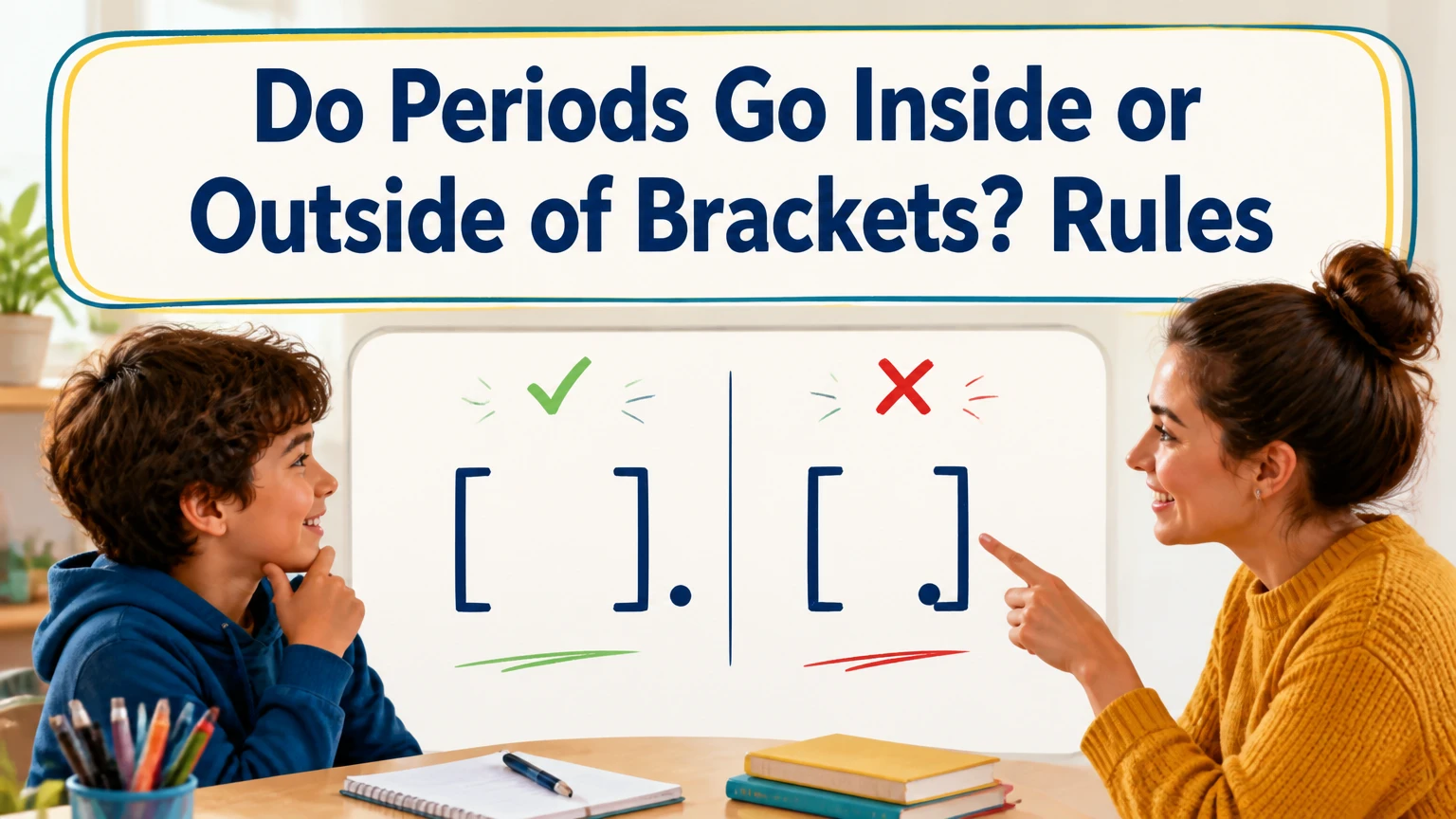
Periods go inside parentheses or other brackets when the bracketed words form a separate, complete sentence. Periods go outside when the bracketed material is a fragment or an embedded part of the surrounding sentence. With citations, quotation marks, square brackets, and technical notation, the punctuation system may add a second rule.
Key Facts at a Glance
- A complete sentence standing alone in parentheses ends with its period before the closing parenthesis.
- An embedded phrase or clause has no internal period, so the main sentence ends after the closing parenthesis.
- Parenthetical citations normally come before the final period in APA, MLA, and Chicago author-date prose.
- Square brackets do not automatically move a period inside; their function and the surrounding quotation determine placement.
- A sentence should not end with two periods merely because a parenthetical phrase comes before the final punctuation.
- Angle brackets and braces usually belong to markup, mathematics, programming, or formal notation rather than ordinary prose.
What Is the Basic Rule for Periods and Brackets?
The basic rule is grammatical independence: punctuation belongs inside a bracket when the bracketed words are a complete sentence, and punctuation belongs outside when the bracketed words are integrated into a larger sentence. The bracket type alone does not decide period placement.
Compare these two structures:
- Separate sentence:
The meeting ended early. (The roads were flooding.) - Embedded material:
The meeting ended early because the roads were flooding (see the weather alert).
In the first example, the parenthetical sentence has its own subject, verb, capital letter, and terminal period. In the second, the parenthetical words function as an insertion within the main sentence, so the sentence-ending period follows the closing parenthesis.
The rule applies most reliably to parentheses. Square brackets often appear inside quotations, where quotation punctuation and editorial conventions also matter. Mathematical, programming, and markup notation may use brackets according to a syntax that has nothing to do with prose punctuation.
The four-question test
Use this editing test when the placement is unclear:
- Can the bracketed words stand as a grammatical sentence by themselves?
- Do they begin with a capital letter because they are independent?
- Would removing the bracketed words leave a complete sentence?
- Is the bracketed sentence genuinely separate, rather than an interruption inside the main sentence?
If the answer to the first two questions is yes and the parenthetical sentence is separate, place the period inside. If the bracketed words are a phrase, dependent clause, citation, or short insertion, place the period outside.
Do Periods Go Inside or Outside Parentheses?
Periods go inside parentheses when the parenthetical content is a complete sentence that is separate from the sentence before it. Periods go outside when the parenthetical content is embedded in the larger sentence, even if the inserted words could be expanded into a sentence in another context.
| Structure | Correct form | Reason |
|---|---|---|
| Separate sentence | The archive closed. (The alarm system failed.) |
The parenthetical sentence is independent |
| Embedded phrase | The archive closed (after the alarm failed). |
The insertion is a dependent phrase |
| Embedded clause | The archive closed (although staff remained inside). |
The clause depends on the main sentence |
| Parenthetical citation | The archive closed early (Nguyen, 2024). |
The citation supports the main sentence |
A standalone parenthetical sentence usually begins with a capital letter and ends with its own period before the closing parenthesis. An embedded parenthesis usually begins with a lowercase word unless the first word is a proper noun, acronym, or other word that is conventionally capitalized.
When does the period go outside parentheses?
The period goes outside parentheses when the parentheses contain information that belongs grammatically to the sentence around them. The surrounding sentence remains the primary structure, while the parenthetical material supplies an example, date, qualification, citation, or aside.
Correct examples include:
The bridge opened in 1987 (three years ahead of schedule).The report identifies lead contamination (see pages 14-16).The replacement filter lasts six months (or 4,000 operating hours).The committee approved the proposal (with two abstentions).
Removing each parenthesis leaves a sentence that still works:
The bridge opened in 1987.The report identifies lead contamination.The replacement filter lasts six months.The committee approved the proposal.
That removal test is useful, but it is not sufficient by itself. A complete sentence can also appear in parentheses as a separate interruption, and the writer must decide whether the thought deserves its own sentence.
When does the period go inside parentheses?
The period goes inside parentheses when the parenthetical statement is a complete sentence placed after, before, or between independent sentences. A separate parenthetical sentence should not be attached to the preceding sentence merely because it provides additional information.
Examples:
The shipment arrived on Tuesday. (The labels were damaged.)(The labels were damaged.) The shipment arrived on Tuesday.The shipment arrived on Tuesday. (The carrier documented the damage.) The warehouse accepted it.
A parenthetical sentence between two sentences keeps its own capital letter and terminal punctuation. In formal writing, this construction should be used sparingly because a long parenthetical sentence can interrupt the reader’s path through the argument.
How Do Square Brackets Affect Period Placement?
Square brackets do not have one universal period rule. Square brackets usually identify an editorial insertion inside quoted material, but they can also function like parentheses in legal writing, scholarship, linguistics, and technical notation. The bracket’s role determines how the period interacts with it.
| Square-bracket use | Example | Period treatment |
|---|---|---|
| Editorial clarification in a quote | "The [second] report was incomplete." |
Quotation punctuation follows the quote style |
| Changed grammatical form | "The committee [was] prepared." |
Brackets surround the insertion, not the period |
| Citation in legal prose | The ruling requires notice [42 F.4th 118]. |
Main sentence period follows the citation |
| Omitted quoted words | "The results [...] remain inconclusive." |
Ellipsis conventions govern the omission |
| Technical placeholder | Use [value] in the template. |
Code or markup syntax governs the notation |
In ordinary prose, a square-bracketed citation at the end of a sentence normally comes before the period:
The regulation applies to all imported batteries [European Commission, 2023].
However, a quotation may place the period inside the quotation marks according to the selected style:
The witness wrote, "The shipment left at dawn [on 14 May]."
The period belongs to the quoted sentence, while the square brackets identify an editorial change or clarification. The precise arrangement should follow the publication’s style guide.
Why are square brackets different from parentheses?
Parentheses usually add information supplied by the current writer. Square brackets usually signal that an editor, translator, or quoting writer has inserted or altered material within an existing quotation.
Compare:
- Parenthetical addition:
The original contract was signed in 1998 (before the merger). - Editorial insertion:
The contract states, "The buyer [not the seller] must pay."
The second example tells readers that the words inside square brackets were not part of the original quoted wording. That editorial function is more important than treating square brackets as a simple visual alternative to parentheses.
Where Does the Period Go With Parenthetical Citations?
A parenthetical citation at the end of a sentence normally appears before the sentence-ending period. The citation is part of the documentation attached to the claim, while the period closes the complete sentence after the citation.
Common forms include:
- APA:
The effect was statistically significant (Patel, 2022). - MLA:
The effect was statistically significant (Patel 48). - Chicago author-date:
The effect was statistically significant (Patel 2022, 48). - Legal citation:
The court rejected the argument. (Smith v. Jones, 2021).
APA Style, in its guidance on parenthetical citations, places the citation immediately before the punctuation that ends the sentence. MLA follows the same basic placement for a parenthetical page reference. Chicago author-date also places the parenthetical reference before the final period.
Legal citation is more varied. A citation may appear within a sentence before the period, or a citation sentence may use a separate citation format governed by a court manual or the Bluebook. Legal writers should not transfer a general APA rule into a jurisdiction with a mandatory local citation system.
| Citation context | Typical form | Governing factor |
|---|---|---|
| APA in-text source | Claim (Lopez, 2021). |
APA sentence punctuation |
| MLA page reference | Claim (Lopez 17). |
MLA documentation |
| Chicago author-date | Claim (Lopez 2021, 17). |
Chicago citation system |
| Legal authority in prose | Claim [12 F.4th 88]. |
Court or legal style manual |
How Do Quotation Marks Change the Rule?
Quotation marks create a separate punctuation decision. In American English, a period normally appears inside closing quotation marks, whether or not the period was present in the original source. In British English, punctuation is more often placed according to whether it belongs to the quoted material.
Examples in common American style:
The notice said, "Return the form by Friday."The word "bracket" ends the sentence.The policy calls the process "optional."
The third example uses a period inside the quotation marks under common American publishing conventions, even though the quoted word is not an independent sentence. British and technical styles may use logical punctuation instead:
The policy calls the process "optional".
When square brackets occur inside a quotation, determine which punctuation belongs to the quoted sentence and which punctuation closes the writer’s surrounding sentence. Do not assume that moving the square bracket also moves every other mark.
What if the quotation and main sentence both need periods?
Avoid two terminal periods. If a complete quoted sentence is followed by a parenthetical citation, place the citation according to the style guide and retain only the punctuation required by the sentence structure.
For example, APA prose commonly uses:
"The results were conclusive" (Morgan, 2020, p. 18).
The quotation is integrated into the writer’s sentence, so the period follows the citation. A block quotation follows different indentation and punctuation rules, particularly in APA and MLA.
How Do Major Style Guides Handle Periods?
APA, MLA, and Chicago generally agree on the structural distinction between independent parenthetical sentences and embedded parenthetical material. Their biggest differences appear in citation punctuation, quotation treatment, block quotations, and discipline-specific exceptions.
| Style system | End citation form | Parenthetical sentence | Main emphasis |
|---|---|---|---|
| APA 7 | (Author, 2023). |
(A separate sentence.) |
Author-date citations and research reporting |
| MLA 9 | (Author 23). |
(A separate sentence.) |
Author-page documentation |
| Chicago notes-bibliography | Superscript note after claim | (A separate sentence.) |
Notes, bibliography, and book publishing |
| Chicago author-date | (Author 2023, 23). |
(A separate sentence.) |
Author-date research citation |
| Legal style | Varies by authority | Varies by court manual | Bluebook or local court rules |
The Chicago Manual of Style distinguishes a parenthetical statement that forms a complete sentence from a parenthetical element inside a sentence. The practical rule remains structural, but Chicago offers detailed guidance for notes, quotations, capitalization, and punctuation in complex prose.
A house style can override a general convention. Academic journals, courts, publishers, and software documentation teams often specify a local rule, so the governing manual takes precedence when an example appears ambiguous.
Does British English Place Periods Differently?
British English generally places periods according to whether they belong to the parenthetical sentence or the surrounding sentence, but quotation punctuation is often more logical than in American English. Regional practice therefore changes quotation marks more consistently than it changes ordinary parenthesis rules.
Compare:
- British-style embedded sentence:
The result was unexpected (although the model predicted it). - British-style separate sentence:
The result was unexpected. (The model predicted it.) - Logical quotation punctuation:
The label says "fragile".
Oxford and Cambridge publishing practices are not identical in every detail, and individual publishers may use house rules. British writers should check the intended publication’s instructions rather than treating “British English” as a single punctuation standard.
The structural test still works across both varieties: decide whether the bracketed material is a sentence or an insertion, then apply the relevant quotation and citation convention.
What About Angle Brackets and Braces?
Angle brackets and braces usually do not function as ordinary prose parentheses. Period placement with < > and { } is therefore controlled by markup, programming, mathematics, linguistics, or another notation system rather than by the standard parenthetical sentence rule.
Examples include:
- HTML:
<p>Text ends here.</p> - A template variable:
Enter {account_number}. - A set in mathematics:
{1, 2, 3}. - A linguistic placeholder:
<subject> <verb>.
In HTML, the period is text content and the closing tag follows the text. In a programming language, a period may be an operator or part of an object name. In mathematics, a period may close an explanatory sentence outside the expression. Treating every angle bracket or brace as a parenthesis can produce invalid code, malformed markup, or misleading notation.
| Bracket type | Common domain | Period rule |
|---|---|---|
Parentheses ( ) |
General prose | Independence determines placement |
Square brackets [ ] |
Editorial work, citations, law | Function and quotation style determine placement |
Braces { } |
Sets, code, templates | Syntax or mathematical convention governs |
Angle brackets < > |
HTML, XML, linguistics | Markup or notation governs |
How Should Nested Brackets Be Punctuated?
Nested brackets should preserve the function of each layer, with the outer sentence receiving its final period after the complete construction. Writers should avoid unnecessary nesting because readers can lose track of which punctuation belongs to which structure.
Examples:
The report was revised ([see the appendix] for the data).The report was revised (see the appendix [especially pages 8-10]).The editor added "[sic]" to preserve the original error.
A common hierarchy uses parentheses outside and square brackets inside:
The survey results (including the regional sample [n = 420]) were published.
The final period belongs to the entire main sentence, so it appears after the closing parenthesis. No period belongs after n = 420 because that notation is not a sentence.
When nesting becomes deeper than two levels, rewrite the sentence, use a footnote, or separate the information. Punctuation can technically remain correct while the sentence becomes difficult to parse.
What Are the Most Common Period Mistakes?
The most common errors involve treating every parenthetical insertion as a sentence, adding two periods, or applying quotation punctuation to citations without checking the style guide.
| Mistake | Incorrect | Correct | Repair principle |
|---|---|---|---|
| Double period | The box is sealed (with tape.). |
The box is sealed (with tape). |
Delete the internal period |
| Detached sentence | The box is sealed (The lid is locked.) |
The box is sealed. (The lid is locked.) |
Separate independent thoughts |
| Wrong capitalization | The box is sealed (The lid is locked). |
The box is sealed (the lid is locked). |
Lowercase an embedded clause |
| Citation after period | The box is sealed. (Chen, 2023) |
The box is sealed (Chen, 2023). |
Put the citation before the final period |
| Misread abbreviation | The size is 5 in.). |
The size is 5 in.). only if the sentence requires it |
Do not remove a period from in. automatically |
The abbreviation example requires care. In The size is 5 in.)., the period after in belongs to the abbreviation, while the period after the closing parenthesis ends the sentence. That sequence is not a duplicate sentence-ending period, although rewriting to 5 inches may improve readability.
Expert editing insight: punctuation ownership matters
Editors should assign each period to a specific owner: an abbreviation, a quoted sentence, a parenthetical sentence, or the surrounding sentence. Two adjacent periods are not automatically wrong when they perform different grammatical jobs, although a rewrite is often clearer.
Expert editing insight: sentence completeness is structural
A phrase can contain a subject and verb without being an independent sentence. Although the roads were flooded has a subject and verb, but the subordinating conjunction makes it dependent. The period belongs outside the parenthesis when that clause appears inside a larger sentence.
Expert editing insight: citations are not ordinary asides
A citation may look like optional parenthetical information, but it has a documentation function. Moving the citation after the period can change how readers interpret the source, especially in APA and MLA prose, where the reference is conventionally attached to the preceding claim.
How Can You Decide the Correct Placement Quickly?
Use the following workflow during drafting or proofreading:
- Remove the bracketed material. Confirm that the remaining words form a complete sentence.
- Read the bracketed material alone. Check for a subject, predicate, complete meaning, and appropriate capitalization.
- Identify the bracket’s function. Classify it as an aside, citation, editorial insertion, quotation element, abbreviation, code expression, or mathematical notation.
- Assign punctuation ownership. Decide whether the period closes the bracketed sentence, the quoted material, or the writer’s main sentence.
- Check the style guide. Apply APA, MLA, Chicago, legal, technical, or house-style rules where a specialized convention applies.
- Read the final sentence aloud. A doubled ending or awkward interruption often reveals that a sentence should be divided.
A practical rewrite often solves difficult cases. Instead of writing The policy changed (because the old rule was unclear.)., write The policy changed because the old rule was unclear. The clearest sentence usually needs fewer parentheses.
FAQ
Do periods go inside parentheses in academic writing?
Periods go inside parentheses only when the parenthetical words form a separate sentence. Academic citations at the end of a sentence usually appear inside the sentence’s closing structure and before the final period, as in (Garcia, 2023). Follow the required manual because block quotations, notes, and disciplinary conventions can differ.
Should a period go inside brackets in a quotation?
A period may go inside the quotation marks when American quotation style requires it, but square brackets themselves do not create a universal placement rule. Editorial brackets identify inserted or altered wording. Check whether the period belongs to the quoted sentence, the writer’s sentence, or a citation attached to the quotation.
Is a period outside parentheses always correct?
A period outside parentheses is correct when the parenthetical material is embedded in the main sentence, but it is not always correct. A complete, independent parenthetical sentence needs its own period inside the closing parenthesis, as in The test ended. (The equipment overheated.)
Can a parenthesis contain a complete sentence?
A parenthesis can contain a complete sentence when the writer presents it as a separate statement. Begin that sentence with a capital letter and place its period before the closing parenthesis. Do not use the same treatment when the words function as a dependent clause or phrase inside another sentence.
Do brackets change punctuation in British English?
Brackets do not normally change the structural rule in British English. Independent parenthetical sentences still take internal periods, while embedded phrases take the surrounding sentence’s period outside. British practice differs more noticeably in quotation punctuation, where logical placement is more common than in American publishing.
How do I avoid a double period?
First determine whether the internal period belongs to an abbreviation or a complete parenthetical sentence. Delete the internal period when the parenthetical material is only a phrase, as in The sample was stored in a freezer (at 4°C). Keep both marks only when they have separate functions, and rewrite if the result looks confusing.
The Bottom Line
For do periods go inside or outside of brackets, use sentence structure first: an independent parenthetical sentence takes its period inside, while an embedded phrase, clause, or citation takes the period outside the closing bracket. Square brackets, quotations, abbreviations, legal citations, and technical notation add specialized rules, so identify each mark’s function before editing.


