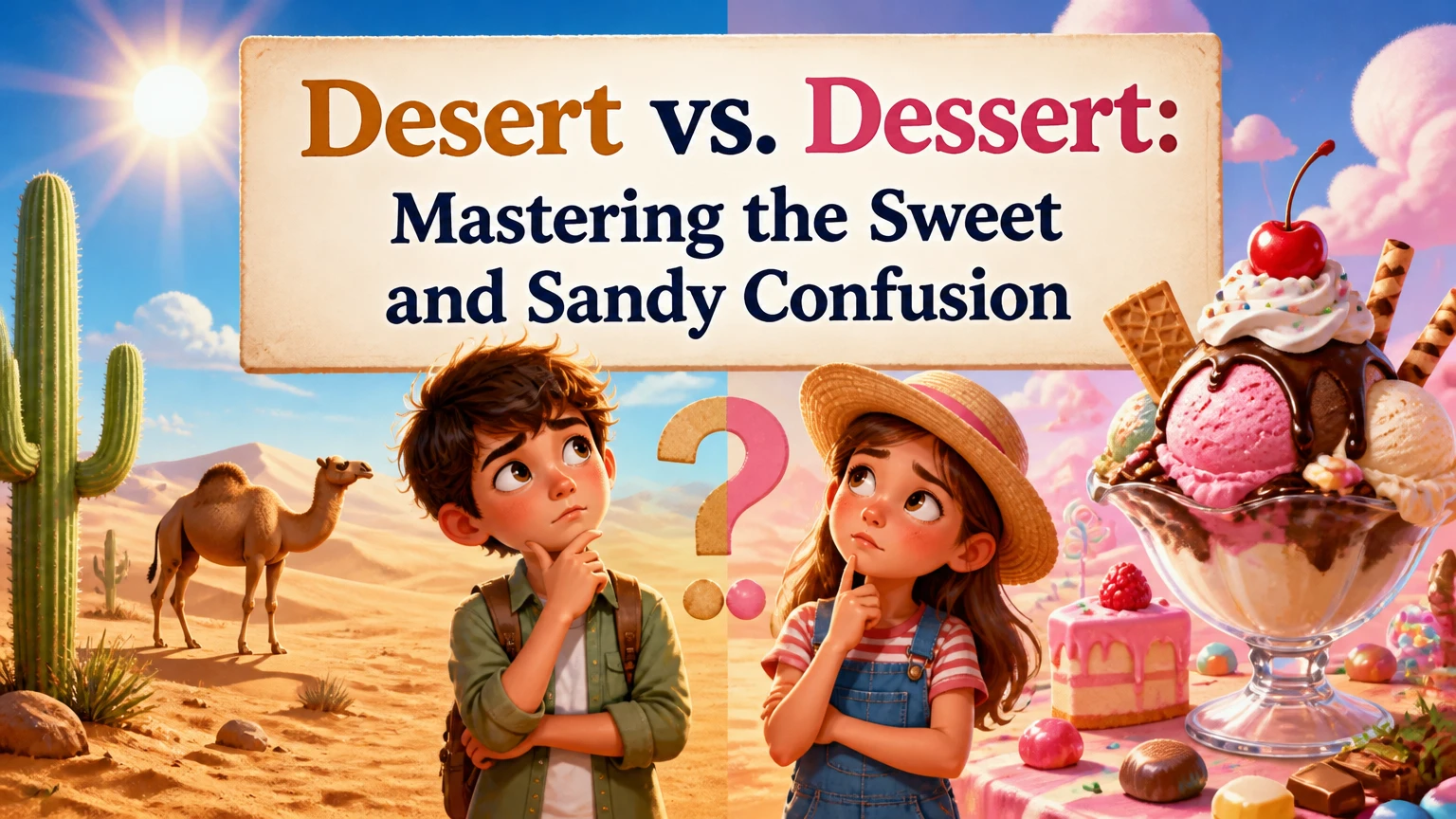
English, with its rich history and diverse influences, often presents us with words that sound similar but have vastly different meanings. A classic example of this linguistic quirk is the pair “desert” and “dessert.” One evokes images of arid landscapes, like the Sahara or the Mojave, while the other conjures thoughts of sweet treats, including cakes, pies, and ice cream. Understanding the distinction between these two words is crucial not only for correct spelling and pronunciation but also for clear communication. Misusing them can lead to humorous, albeit confusing, situations. This article will delve into the definitions, usages, and common pitfalls associated with “desert” and “dessert,” equipping you with the knowledge to confidently navigate this common linguistic challenge. Knowing the difference between arid landscapes and sweet treats is crucial for avoiding dietary and geographical misunderstandings, such as confusing sand dunes with chocolate dunes.
This article will be beneficial for English language learners, writers aiming for precision, and anyone who wants to avoid embarrassing mix-ups. By the end of this guide, you’ll be able to confidently use “desert” and “dessert” in your writing and conversations, ensuring your message is always clear and accurate.
Table of Contents
- Introduction
- Definitions: Desert and Dessert
- Pronunciation
- Etymology
- Structural Breakdown
- Types of Deserts
- Types of Desserts
- Examples
- Usage Rules
- Common Mistakes
- Practice Exercises
- Advanced Topics
- Frequently Asked Questions (FAQ)
- Conclusion
Definitions: Desert and Dessert
To understand the difference between “desert” and “dessert,” it’s essential to define each word clearly.
Desert Definition
A desert (pronounced /ˈdezərt/) is a barren or desolate area, typically characterized by extreme temperatures and little or no rainfall. Deserts are often covered in sand or rock and support only sparse vegetation. As a noun, “desert” refers to this type of landscape. For example, the Sahara Desert is the largest hot desert in the world. The word “desert” can also be used as a verb (pronounced /dɪˈzɜːrt/), meaning to abandon or leave someone or something, especially in a time of need. For instance, “He deserted his post during the battle.”
Dessert Definition
A dessert (pronounced /dɪˈzɜːrt/) is a sweet course eaten at the end of a meal. Desserts typically include items such as cakes, pies, ice cream, and fruit. The key characteristic of a dessert is its sweetness and its role as a concluding dish. For example, “After dinner, we had chocolate cake for dessert.” Unlike “desert,” “dessert” functions exclusively as a noun.
Pronunciation
While the spelling difference is subtle, the pronunciation of “desert” varies depending on whether it’s used as a noun or a verb. As a noun (referring to the arid land), it’s pronounced with the emphasis on the first syllable: /ˈdezərt/. As a verb (meaning to abandon), the emphasis shifts to the second syllable: /dɪˈzɜːrt/. “Dessert,” on the other hand, consistently places the emphasis on the second syllable: /dɪˈzɜːrt/.
Etymology
The words “desert” and “dessert” have distinct origins, contributing to their different meanings. “Desert” (as a noun) comes from the Latin word *desertum*, meaning “an abandoned place.” This reflects the desolate and uninhabited nature of desert landscapes. When used as a verb, “desert” also comes from Latin, *deserere*, meaning to abandon or forsake. “Dessert,” however, originates from the French word *desservir*, meaning “to clear the table.” This refers to clearing the table after the main course to make way for the sweet dish.
Structural Breakdown
The structural difference between “desert” and “dessert” is simple: one ‘s’. “Desert” has one ‘s,’ while “dessert” has two. Remembering that “dessert” has two ‘s’ can be a helpful mnemonic, as it often feels like you want seconds of dessert, hence the extra ‘s’. Structurally, both words function as nouns, but “desert” also has a verb form, adding another layer to its usage.
Types of Deserts
Deserts are not all the same; they can be classified based on various factors such as temperature and location.
Hot Deserts
Hot deserts are characterized by high temperatures and low rainfall. The Sahara Desert in Africa and the Arabian Desert in the Middle East are prime examples. These deserts often have extreme temperature variations between day and night.
Cold Deserts
Cold deserts, such as the Gobi Desert in Asia and the Antarctic polar desert, experience cold winters and relatively warm summers. While they receive little precipitation like hot deserts, their temperatures are significantly lower.
Types of Desserts
Desserts come in a wide variety of forms, catering to different tastes and preferences.
Cakes
Cakes are a classic dessert, often made with flour, sugar, eggs, and butter or oil. They can be flavored with chocolate, vanilla, fruit, or nuts. Examples include chocolate cake, vanilla cake, and cheesecake.
Pies
Pies consist of a filling enclosed in a pastry crust. Fillings can be sweet, such as apple pie, cherry pie, or pumpkin pie.
Ice Cream
Ice cream is a frozen dessert made from milk, cream, sugar, and flavorings. Popular flavors include vanilla, chocolate, strawberry, and cookies and cream.
Pastries
Pastries are baked goods made from dough, often layered with butter or other fats. Examples include croissants, danishes, and éclairs.
Candies
Candies are sweet confections made from sugar or other sweeteners, often flavored with fruit, chocolate, or nuts. Examples include chocolates, lollipops, and gummy bears.
Puddings and Custards
Puddings and custards are creamy desserts made from milk or cream, sugar, and eggs or starch. Examples include chocolate pudding, vanilla custard, and crème brûlée.
Fruit-Based Desserts
Fruit-based desserts can include fresh fruit salads, baked fruit, or fruit crisps and cobblers. These desserts offer a lighter, healthier alternative to richer options.
Examples
To further illustrate the difference between “desert” and “dessert,” here are some example sentences.
Desert Examples
The following table provides examples of “desert” used as both a noun and a verb.
| Sentence | Part of Speech |
|---|---|
| The Sahara desert is the largest hot desert in the world. | Noun |
| Camels are well-suited to survive in the desert. | Noun |
| The explorers had to cross the vast desert to reach their destination. | Noun |
| The arid climate makes it difficult to grow crops in the desert. | Noun |
| Many animals have adapted to the harsh conditions of the desert. | Noun |
| He felt like he was wandering in a desert of loneliness after she left. | Noun (figurative) |
| The abandoned building stood like a lonely monument in the urban desert. | Noun (figurative) |
| The company decided to desert the project due to financial difficulties. | Verb |
| He vowed never to desert his friends, no matter the circumstances. | Verb |
| The sailors deserted the ship during the storm. | Verb |
| She felt deserted by her family when she needed them most. | Verb |
| The soldiers were punished for attempting to desert their posts. | Verb |
| Don’t desert me now; I need your help! | Verb |
| It felt like everyone had deserted her after the scandal. | Verb |
| The team was criticized for deserting their strategy mid-game. | Verb |
| The oasis provided a welcome respite in the middle of the desert. | Noun |
| The drought turned the once-fertile land into a barren desert. | Noun |
| The lizards are well-camouflaged to blend in with the desert surroundings. | Noun |
| The prospectors searched for gold in the remote desert regions. | Noun |
| The Bedouins have a rich cultural heritage shaped by life in the desert. | Noun |
| He wouldn’t desert a friend in need. | Verb |
| The cat would never desert its favorite napping spot. | Verb |
| She felt she had been deserted by fate. | Verb |
| The town was gradually deserted as jobs dried up. | Verb |
Dessert Examples
The following table provides examples of “dessert” used in various contexts.
| Sentence |
|---|
| For dessert, we had a delicious chocolate cake. |
| Ice cream is a popular dessert, especially in the summer. |
| She always looks forward to having dessert after dinner. |
| The restaurant is known for its exquisite desserts. |
| We decided to skip the main course and go straight for dessert. |
| He ordered a slice of apple pie for dessert. |
| The buffet included a wide selection of desserts. |
| She made a homemade tiramisu for dessert. |
| Let’s have some fruit for dessert to keep it healthy. |
| The children were excited about the ice cream dessert. |
| After the heavy meal, a light dessert was the perfect ending. |
| He has a sweet tooth and always craves dessert. |
| The chef prepared a special dessert for the anniversary celebration. |
| She enjoys experimenting with new dessert recipes. |
| The dessert menu featured both classic and innovative options. |
| We shared a decadent chocolate brownie for dessert. |
| A scoop of vanilla ice cream makes a simple but satisfying dessert. |
| The party wouldn’t be complete without a delicious dessert. |
| She brought a platter of assorted cookies for dessert. |
| The creamy texture of the cheesecake made it an irresistible dessert. |
| After a long day, a sweet dessert can be a comforting treat. |
| The elaborate dessert presentation was a work of art. |
| They offered a complimentary dessert to apologize for the long wait. |
| The family tradition is to have a special dessert on Sundays. |
| The dessert was so rich and flavorful that a small portion was enough. |
Usage Rules
Understanding the grammatical rules governing “desert” and “dessert” is crucial for accurate usage.
Desert as a Noun and Verb
As mentioned earlier, “desert” can function as both a noun and a verb. As a noun, it refers to a dry, barren area. As a verb, it means to abandon. Pay attention to the context to determine the intended meaning and pronunciation.
Dessert as a Noun Only
“Dessert” functions exclusively as a noun, referring to a sweet dish eaten at the end of a meal. It does not have a verb form.
Mnemonic Devices
Several mnemonic devices can help you remember the difference between “desert” and “dessert.” One popular method is to remember that “dessert” has two ‘s’ because you always want “seconds” of dessert. Another trick is to think of “stressed” spelled backwards, which is “desserts;” feeling stressed often leads to craving sweets.
Common Mistakes
One of the most common mistakes is confusing the spelling of “desert” and “dessert.” This often leads to humorous errors, such as saying “I can’t wait to eat my desert” when you mean “dessert.” Another common mistake is mispronouncing “desert” when used as a verb. Keep in mind the different pronunciations for the noun and verb forms.
Here are some examples of common mistakes and their corrections:
| Incorrect | Correct |
|---|---|
| I’m so hungry; I could eat a whole desert right now! | I’m so hungry; I could eat a whole dessert right now! |
| He desserted his family during the war. | He deserted his family during the war. |
| The camel is well-suited for life in the desserts. | The camel is well-suited for life in the desert. |
| After dinner, we had ice cream for desert. | After dinner, we had ice cream for dessert. |
| She felt desert when her friends moved away. | She felt deserted when her friends moved away. |
Practice Exercises
Test your understanding of “desert” and “dessert” with the following exercises.
Exercise 1: Fill in the Blanks
Fill in the blanks with either “desert” or “dessert.”
| Question | Answer |
|---|---|
| 1. The Sahara is a vast ______. | desert |
| 2. I love having ice cream for ______. | dessert |
| 3. He would never ______ his friends in need. | desert |
| 4. What’s your favorite ______ to eat after dinner? | dessert |
| 5. Camels are well-adapted to life in the ______. | desert |
| 6. This cake is a delicious ______. | dessert |
| 7. The army warned soldiers not to ______ their posts. | desert |
| 8. A cold ______ can be as harsh as a hot one. | desert |
| 9. After a spicy meal, a sweet ______ is very satisfying. | dessert |
| 10. The lost travelers were dying of thirst in the ______. | desert |
Exercise 2: Multiple Choice
Choose the correct word (“desert” or “dessert”) to complete each sentence.
| Question | Options | Answer |
|---|---|---|
| 1. They crossed the hot ______ on camels. | (a) desert (b) dessert | (a) desert |
| 2. She ordered a chocolate sundae for ______. | (a) desert (b) dessert | (b) dessert |
| 3. He promised not to ______ her, no matter what. | (a) desert (b) dessert | (a) desert |
| 4. This bakery is famous for its amazing ______. | (a) desert (b) dessert | (b) dessert |
| 5. The Gobi ______ is known for its extreme temperatures. | (a) desert (b) dessert | (a) desert |
| 6. What kind of ______ do you want after the main course? | (a) desert (b) dessert | (b) dessert |
| 7. The captain warned the sailors not to ______ the ship. | (a) desert (b) dessert | (a) desert |
| 8. Many plants and animals have adapted to the harsh conditions of the ______. | (a) desert (b) dessert | (a) desert |
| 9. A slice of apple pie is the perfect ______. | (a) desert (b) dessert | (b) dessert |
| 10. The prospectors searched for gold in the remote ______ regions. | (a) desert (b) dessert | (a) desert |
Exercise 3: Sentence Correction
Correct the sentences below that use “desert” or “dessert” incorrectly.
| Question | Answer |
|---|---|
| 1. After dinner, we enjoyed a delicious desert. | After dinner, we enjoyed a delicious dessert. |
| 2. The lost travelers were dying of thirst in the dessert. | The lost travelers were dying of thirst in the desert. |
| 3. He would never dessert his post as a soldier. | He would never desert his post as a soldier. |
| 4. She baked a wonderful cake for desert. | She baked a wonderful cake for dessert. |
| 5. The camel is well-suited to survive in the desserts. | The camel is well-suited to survive in the desert. |
| 6. For desert, I’ll have the chocolate mousse. | For dessert, I’ll have the chocolate mousse. |
| 7. The company decided to dessert the project due to lack of funds. | The company decided to desert the project due to lack of funds. |
| 8. That area used to be a forest, but it has become a desert. | That area used to be a forest, but it has become a desert. (Correct) |
| 9. Ice cream is my favorite desert. | Ice cream is my favorite dessert. |
| 10. He felt deserted when his best friend moved away. | He felt deserted when his best friend moved away. (Correct) |
Advanced Topics
For advanced learners, let’s explore some more complex aspects of “desert” and “dessert.”
Idiomatic Expressions
The word “desert” appears in several idiomatic expressions, such as “desert island,” referring to a remote, uninhabited island, and “a desert of despair,” describing a state of utter hopelessness. Understanding these expressions requires grasping the figurative meaning of “desert” as a place of isolation and desolation.
Example:
- After losing his job and his home, he found himself in a desert of despair.
- They dreamed of being stranded on a desert island, far away from the stresses of modern life.
Regional Variations
While the core meanings of “desert” and “dessert” remain consistent across different English-speaking regions, there might be slight variations in the types of desserts that are popular or the specific idiomatic expressions used. For instance, certain desserts might be more common in American cuisine than in British cuisine, and vice versa.
Frequently Asked Questions (FAQ)
Here are some frequently asked questions about “desert” and “dessert.”
- What is the main difference between “desert” and “dessert”?
The main difference lies in their meanings: “desert” refers to a dry, barren area or the act of abandoning, while “dessert” refers to a sweet dish eaten at the end of a meal. The spelling difference – one ‘s’ in “desert” and two ‘s’ in “dessert” – is a helpful visual cue.
- How do I pronounce “desert” and “dessert” correctly?
“Desert” (the noun) is pronounced /ˈdezərt/, with the emphasis on the first syllable. “Desert” (the verb) is pronounced /dɪˈzɜːrt/, with the emphasis on the second syllable. “Dessert” is always pronounced /dɪˈzɜːrt/, with the emphasis on the second syllable.
- Is “desert” ever used as an adjective?
Yes, “desert” can be used as an adjective to describe something related to a desert environment, such as “desert climate” or “desert plants.”
- Can “dessert” be used as a verb?
No, “dessert” functions exclusively as a noun. There is no verb form of “dessert.”
- What is a good mnemonic device to remember the difference?
Remember that “dessert” has two ‘s’ because you always want “seconds” of dessert. Or, “stressed” spelled backwards is “desserts,” and people often crave sweets when stressed.
- Are there any regional variations in the types of desserts served?
Yes, different regions have their own unique dessert traditions. For example, sticky toffee pudding is a popular British dessert, while apple pie is a classic American dessert.
- What are some common mistakes people make with these words?
The most common mistake is confusing the spelling, writing “desert” when they mean “dessert,” or vice versa. Another mistake is mispronouncing “desert” as a verb.
- How can I practice using “desert” and “dessert” correctly?
Practice by writing your own sentences using both words, completing fill-in-the-blank exercises, and paying attention to how the words are used in books, articles, and conversations. The exercises in this article are a great start!
Conclusion
Mastering the difference between “desert” and “dessert” is a small but significant step toward improving your English proficiency. By understanding their definitions, pronunciations, and usage rules, you can avoid common mistakes and communicate more effectively. Remember that “desert” can be a barren landscape or an act of abandonment, while “dessert” is always a sweet treat. With the help of mnemonic devices and practice exercises, you can confidently navigate this linguistic challenge and ensure your message is always clear and delicious – or perhaps, appropriately arid.
Continue to practice and pay attention to the context in which these words are used. With consistent effort, you’ll be able to distinguish between “desert” and “dessert” with ease, adding clarity and precision to your communication. Happy learning, and may your language journey be filled with sweet successes, not dry spells!