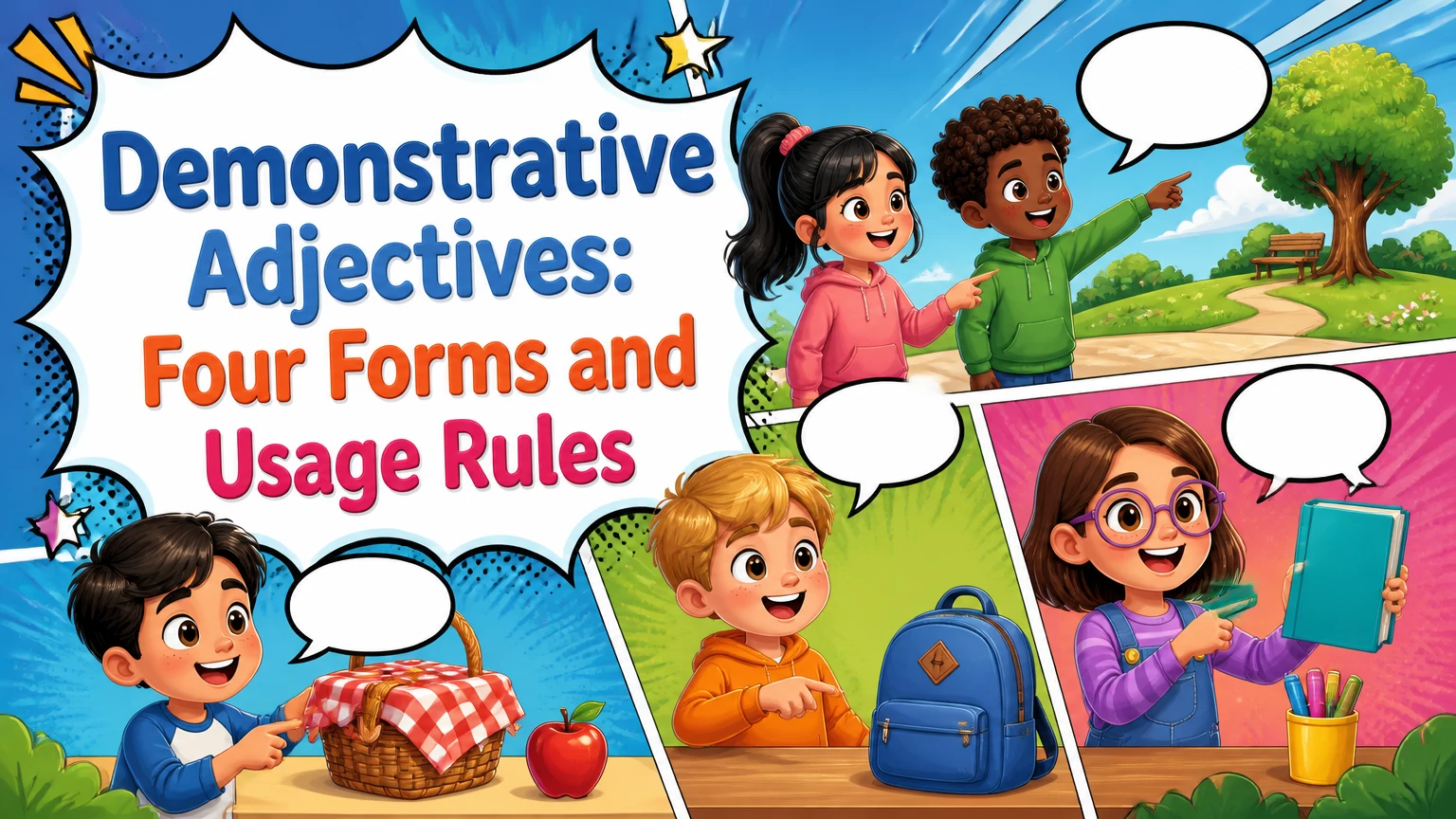
Demonstrative adjectives are the words this, that, these, and those when they modify a noun to identify a particular person, object, place, time, or idea. The choice depends mainly on grammatical number and perceived distance: this and these indicate near or current nouns, while that and those indicate distant or less immediate nouns.
Key Facts at a Glance
- This modifies one singular noun that feels near or current: “this book.”
- That modifies one singular noun that feels distant or less immediate: “that building.”
- These modifies more than one noun that feels near or current: “these books.”
- Those modifies more than one noun that feels distant or less immediate: “those buildings.”
- Demonstrative adjectives appear directly before a noun or noun phrase.
- The same four words become demonstrative pronouns when they stand without a following noun.
What Are Demonstrative Adjectives?
A demonstrative adjective identifies a specific noun by signaling the noun’s relationship to the speaker, listener, time, or surrounding conversation. In the sentence “Please pass me this folder,” the word this modifies folder and distinguishes one folder from other possible folders.
Traditional school grammar calls these forms demonstrative adjectives. Many modern grammar references classify them as demonstrative determiners, because they determine which noun the speaker means rather than describing the noun’s quality. Both labels refer to the same practical construction when this, that, these, or those comes before a noun.
The core pattern is:
Demonstrative + noun = specific identification
Examples include:
- this question
- that problem
- these results
- those documents
A demonstrative does not describe size, color, ownership, or material. Compare “the red car”, which describes a car, with “that car”, which points to a particular car.
Which Four Forms Does English Use?
English has four primary demonstrative forms. Each combines a number value, singular or plural, with a proximity value, near or far.
| Form | Number | Typical distance | Example noun phrase |
|---|---|---|---|
| this | Singular | Near or current | this pencil |
| that | Singular | Far or less immediate | that pencil |
| these | Plural | Near or current | these pencils |
| those | Plural | Far or less immediate | those pencils |
The forms also work with people, places, periods, events, and abstract nouns. For example, this student, that restaurant, these weeks, and those decisions all follow the same basic system.
How Do Number and Distance Control the Choice?
Choose a demonstrative adjective by asking two questions: Is the noun singular or plural? and Does the noun feel near or distant? Singular nouns take this or that, while plural nouns take these or those.
| Noun condition | Near or current | Far or less immediate |
|---|---|---|
| One countable noun | this chair | that chair |
| More than one countable noun | these chairs | those chairs |
| One event or idea | this decision | that decision |
| Several events or ideas | these decisions | those decisions |
A simple selection procedure prevents most errors:
- Find the modified noun. Identify the noun after the demonstrative.
- Check number. Determine whether the noun is singular or plural.
- Assess proximity. Consider physical, temporal, emotional, or conversational distance.
- Select the matching form. Pair singular-near, singular-far, plural-near, or plural-far.
The noun determines grammatical number; the speaker’s perspective determines distance. Therefore, “this information” is correct because information is normally uncountable and grammatically singular, whereas “these facts” is correct because facts is plural.
A Four-Question Decision Test
| Question | If the answer is yes | Example |
|---|---|---|
| Is the noun one item? | Use a singular form | this phone |
| Is the noun several items? | Use a plural form | these phones |
| Is the noun near or current? | Choose this or these | this week |
| Is the noun far or past? | Choose that or those | those years |
Physical distance is not measured by a universal number. A speaker may say “this house” while standing inside it, but “that house” while looking at it from the street. The listener’s perspective and the conversational purpose can alter the choice.
When Should You Use This, That, These, and Those?
When Is This Correct?
Use this before a singular noun that is physically near, currently relevant, newly introduced, or treated as psychologically close.
Examples:
- This cup is still warm.
- I need this document before the meeting.
- This idea could reduce processing time.
- We are reviewing this month’s sales figures.
The noun after this must be singular in standard English. This reports and this shoes are incorrect because the plural nouns require these.
When Is That Correct?
Use that before a singular noun that is physically distant, associated with a past time, already separated from the immediate discussion, or viewed negatively.
Examples:
- Please move that chair beside the window.
- That meeting lasted four hours.
- I disagree with that assumption.
- That storm damaged the eastern road.
The word that does not always express literal physical distance. In “I remember that summer,” the summer is temporally distant. In “I reject that explanation,” the distance is argumentative rather than spatial.
When Are These and Those Correct?
Use these before plural nouns that are near, current, or connected to the speaker’s present focus. Use those before plural nouns that are farther away, earlier in time, or separated from the speaker’s position.
Examples:
- These keys belong to the office manager.
- These changes apply to all customers.
- Look at those clouds above the hills.
- Those proposals were rejected last year.
The contrast often appears in one sentence:
These samples are from today, but those samples are from last month.
The sentence uses these for current samples and those for temporally distant samples. The forms do not merely point in physical space.
How Does Demonstrative Distance Work in Time?
Demonstrative adjectives can locate nouns in time. This and these usually frame a period as current, ongoing, or connected to the speaker’s present situation, while that and those frame a period as completed, remembered, or separated from the present.
| Temporal expression | Usual meaning | Example |
|---|---|---|
| this morning | The current morning | I answered emails this morning. |
| that morning | A particular earlier morning | That morning, the train stopped. |
| these days | The current period | These days, many forms are digital. |
| those days | An earlier period | In those days, offices used paper files. |
| this year | The current calendar or business year | This year has been unusually dry. |
| that year | A specific past year | That year changed the company. |
Usage depends on the speaker’s reference point. At 11 p.m., “this morning” can refer to the same day. During a historical discussion, “this year” may refer to the year under discussion rather than the current year.
How Can Demonstratives Express Attitude?
Demonstrative adjectives can create psychological distance. Speakers often use this or these to present an idea as immediate, familiar, or approved, and that or those to make an idea sound remote, rejected, surprising, or disapproved.
Compare:
- This clever solution saved the project.
- That careless solution created new errors.
- We should support these communities.
- We should not repeat those policies.
The grammatical rule remains the same, but adjective choice adds pragmatic meaning. A presenter saying “this strategy” may invite the audience to identify with the strategy, whereas “that strategy” can place it outside the speaker’s preferred position.
Demonstratives are therefore useful in speeches, editorials, negotiations, and reviews. Writers should use the rhetorical effect intentionally, because changing this to that can alter perceived approval even when the noun remains identical.
Are Demonstrative Adjectives and Pronouns Different?
Demonstrative adjectives and demonstrative pronouns use the same four forms, but their syntactic roles differ. A demonstrative adjective modifies an expressed noun, whereas a demonstrative pronoun replaces the noun and can stand alone.
| Feature | Demonstrative adjective | Demonstrative pronoun |
|---|---|---|
| Following noun | Required in the basic noun phrase | Omitted |
| Example | I want this laptop. | I want this. |
| Main function | Identifies a named noun | Refers to an understood noun |
| Main benefit | Makes the reference explicit | Avoids repetition |
| Main risk | Can repeat a noun unnecessarily | Can create an unclear reference |
A reliable test is to inspect what follows the demonstrative. In “those files,” those modifies files, so it functions adjectivally under traditional terminology. In “Those are confidential,” those stands as the subject, so it functions as a pronoun.
Pronouns require a recoverable meaning:
- The blue folders are ready. Those can go first.
- I compared two plans. This is cheaper.
If the antecedent is unclear, repeat the noun:
- Ambiguous: We changed the database settings. This caused an outage.
- Clearer: We changed the database settings. This change caused an outage.
How Should Writers Resolve Demonstrative Ambiguity?
Professional writers should name the noun after a demonstrative when more than one antecedent is possible. “This caused a delay” may refer to a decision, a shipment, a software update, or an entire preceding situation; “this software update caused a delay” removes that uncertainty.
Use one of four clarification methods:
- Repeat the noun: “This revision changed the calculation.”
- Add a prepositional phrase: “That mountain on the left has snow.”
- Use a more precise determiner: “The second proposal failed.”
- Replace the demonstrative with a named reference: “The server migration caused the delay.”
Demonstratives are especially risky after long paragraphs, where several possible antecedents compete. A practical editorial rule is to avoid standalone this, that, these, or those when the preceding sentence contains multiple events or entities.
Why Does Discourse Context Matter?
Demonstratives can point to words, ideas, or events rather than physical objects. In “The supplier missed the deadline. This created a shortage,” this refers to the preceding event, not a visible object.
The reference may also point forward:
This is the problem: the data was entered twice.
Here this is a pronoun with cataphoric reference because its meaning becomes clear from the following clause. In formal reports, forward-pointing this works well when the explanation follows immediately.
What Happens With Uncountable Nouns and Ideas?
Singular demonstratives can modify uncountable nouns, while plural demonstratives require plural countable nouns or pluralized abstract nouns. Correct usage depends on the noun’s grammatical number, not on whether the noun represents a physical thing.
| Noun category | Correct singular form | Correct plural form |
|---|---|---|
| Uncountable substance | this water | these bottles of water |
| Abstract noun | that research | those studies |
| Collective topic | this information | these details |
| Material noun | that equipment | those machines |
| Mass food noun | this rice | those bowls of rice |
Common errors include “these information” and “those equipment.” In standard English, information and equipment are uncountable, so they take this or that when used directly.
To express several units, add a countable noun:
- this information
- these pieces of information
- that equipment
- those items of equipment
What Are the Most Common Errors?
Number Mismatch
Incorrect: These shirt is clean.
Correct: This shirt is clean.
Incorrect: This shoes are expensive.
Correct: These shoes are expensive.
The demonstrative and noun must match singular or plural number, and the verb must agree with the resulting noun phrase.
Using “Them” Before a Noun
In formal standard English, “them cars” should be “those cars.” Some regional dialects use them as a demonstrative in speech, but academic, professional, and examination writing normally requires those.
- Informal dialectal form: Look at them cars.
- Standard written form: Look at those cars.
Adding “Here” or “There” Unnecessarily
Standard English usually does not need here after this or there after that:
- Preferred: This pen works.
- Preferred: That dog is barking.
- Marked regional or emphatic form: this here pen, that there dog.
The combinations can be grammatical in particular dialects or for emphasis, so they are not universally impossible. They are inappropriate as a default in formal writing.
Confusing “These” With “Those” in Speech
Learners sometimes select a form from pronunciation rather than meaning. The solution is to identify number first, then decide whether the noun is near or distant.
- Singular near: this
- Singular far: that
- Plural near: these
- Plural far: those
Treating Distance as a Fixed Measurement
There is no universal rule such as “use this within one meter.” A speaker can use that for an object nearby if the object is conceptually rejected, belongs to another person, or has already been discussed as separate from the current focus.
How Does English Compare With Other Languages?
English has a two-way proximity contrast, near and far, combined with singular and plural number. Spanish commonly distinguishes three spatial zones: este for near the speaker, ese for near the listener or at an intermediate distance, and aquel for far from both.
| Language | Near speaker | Intermediate or listener | Far from participants |
|---|---|---|---|
| English singular | this | that | that |
| Spanish singular | este | ese | aquel |
| French singular | ce/cette | ce/cette | ce/cette |
| Japanese | kore | sore | are |
Japanese makes a particularly clear three-way distinction between the speaker’s location, the listener’s location, and distance from both. English often expresses the same detail with additional words such as here, there, near you, or over by the door.
Learners transferring from Spanish or Japanese should avoid translating proximity systems mechanically. English usually requires a contextual judgment rather than a dedicated intermediate-distance form.
How Do You Pronounce the Four Forms?
The demonstratives have distinct vowel patterns that matter in listening and speaking:
| Word | Common pronunciation | Example contrast |
|---|---|---|
| this | /ðɪs/ | this book |
| that | /ðæt/ | that book |
| these | /ðiːz/ | these books |
| those | /ðoʊz/ in many varieties | those books |
The initial sound in all four words is the voiced dental fricative /ð/, produced with the tongue near or lightly between the teeth. This and these differ in vowel and final consonant, while that and those differ in vowel and number.
In connected speech, demonstratives may receive less stress when the noun is already clear. Speakers emphasize them when contrast matters:
THIS report is current, but THAT report is outdated.
How Can You Practice Them Efficiently?
A short physical drill links grammar to meaning. Typical beginner practice takes 5-10 minutes per session, and consistent daily practice usually produces more reliable selection than memorizing a list without context.
Use this sequence:
- Place one object beside you and say, “This pen.”
- Place several objects beside you and say, “These pens.”
- Point to one distant object and say, “That chair.”
- Point to several distant objects and say, “Those chairs.”
- Add time expressions such as this week and those years.
- Record five sentences and check number agreement.
A useful writing exercise contrasts pairs:
- This method is efficient; that method is expensive.
- These files are current; those files are archived.
- This decision affects us; that decision affected the previous team.
Practice Exercise
Choose this, that, these, or those.
- Please review ___ contract on my desk.
- ___ mountains across the valley are covered with snow.
- I remember ___ summer when we moved.
- ___ results from today support the hypothesis.
- Could you pass me ___ scissors beside your hand?
Answers:
- this
- those
- that
- these
- those
The fifth answer depends on the intended viewpoint. If the scissors are beside the listener, those is natural. If the speaker is holding or touching them, these would be appropriate.
FAQ About Demonstrative Adjectives
Are “this” and “that” articles?
No. This and that are demonstrative determiners, traditionally called demonstrative adjectives, because they identify a specific noun. Articles such as a, an, and the also determine nouns, but they do not encode the same near-versus-far contrast. A noun phrase normally uses one primary determiner: this book, not the this book.
Can demonstrative adjectives modify people?
Yes. Demonstratives can identify people when the context is clear, as in “this teacher”, “that man”, “these students”, and “those children.” Tone matters because that person can sound neutral, distant, or dismissive depending on stress, facial expression, and the surrounding words.
Is “these kinds of things” grammatical?
Yes. These kinds of things is grammatical because these modifies the plural noun kinds, while of things specifies the category. This kind of thing uses singular agreement. The common error is “this kinds of things,” which incorrectly combines a singular demonstrative with plural kinds.
Can “that” refer to an entire sentence?
Yes. In “The payment failed, and that delayed delivery,” that refers to the preceding event. In formal writing, repeat the event noun if several interpretations are possible: “The failed payment delayed delivery.” Explicit nouns generally provide stronger reference control than an isolated pronoun.
Why do some speakers say “them books”?
Them books occurs in some regional and nonstandard varieties as a demonstrative construction, but formal standard English uses those books. Speakers should preserve the regional form when representing authentic dialogue, while academic, workplace, and examination writing should use those.
Do demonstratives always indicate physical distance?
No. Demonstratives can indicate time, emotional attitude, discourse focus, or social distance. This proposal may signal current involvement, while that proposal may signal rejection or separation. The correct interpretation comes from context, not from physical location alone.
Conclusion
Demonstrative adjectives are this, that, these, and those when they modify nouns to identify specific people, objects, times, or ideas. Choose this or that with singular nouns, choose these or those with plural nouns, and use perceived proximity, time, or conversational distance to select between the two forms. With that rule, the distinction between demonstrative adjectives and demonstrative pronouns, and the common errors become easier to control.