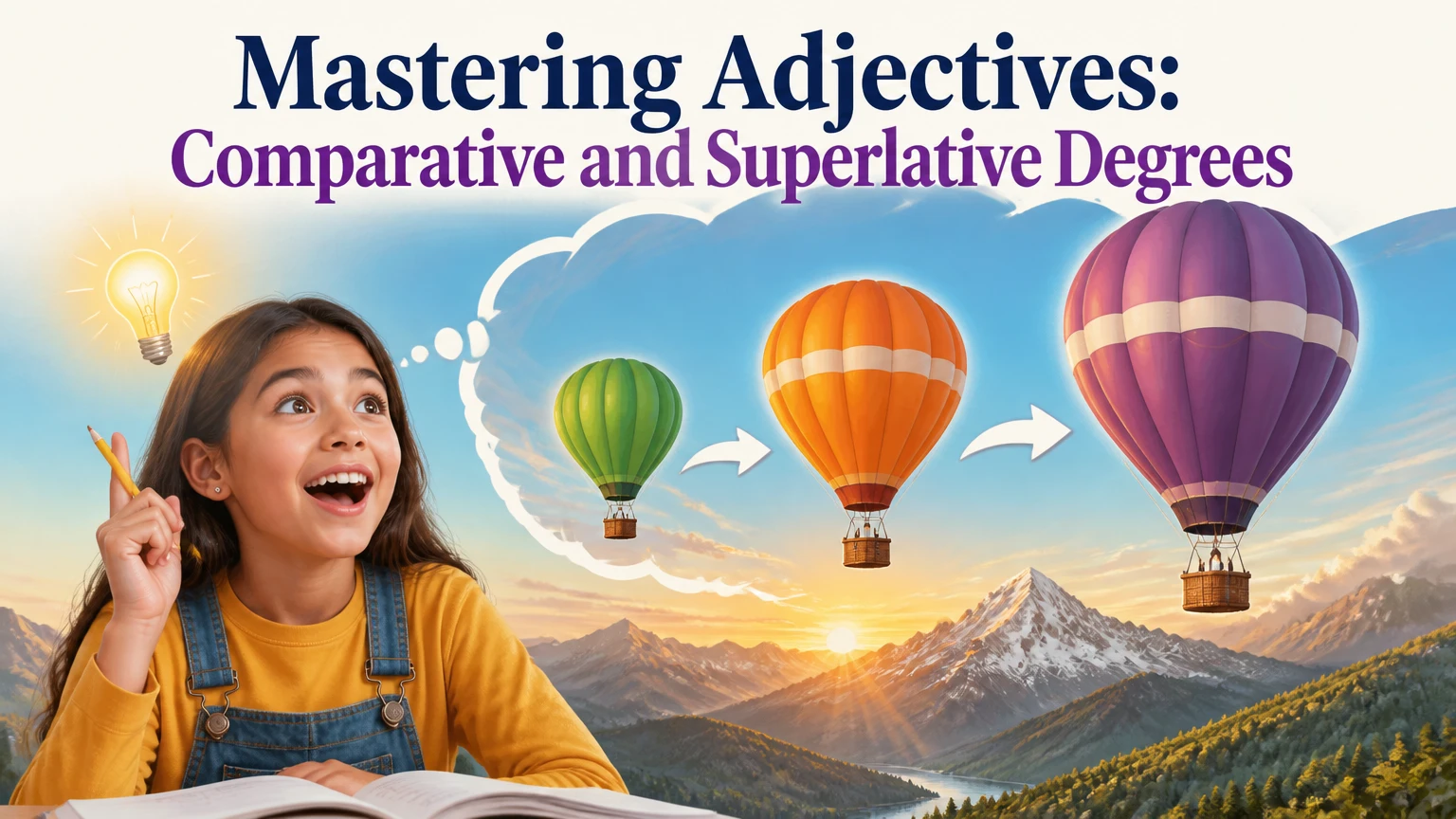
Adjectives are words that describe nouns, adding detail and specificity to our language. They can indicate qualities such as size, color, or shape. But adjectives can also show degrees of comparison, indicating whether something has *more* or *the most* of a particular quality. These degrees are known as the comparative and superlative forms, and understanding how to use them correctly—with words like “smaller,” “bigger,” “faster,” “more interesting,” and “most beautiful”—is essential for clear and precise communication. This guide will help students, writers, and anyone looking to improve their English grammar skills by providing a comprehensive overview of comparative and superlative adjectives, complete with examples, rules, and practice exercises.
Table of Contents
- Definition of Comparative and Superlative Adjectives
- Structural Breakdown
- Types of Comparative and Superlative Formation
- Examples of Comparative and Superlative Adjectives
- Usage Rules
- Common Mistakes
- Practice Exercises
- Advanced Topics
- FAQ
- Conclusion
Definition of Comparative and Superlative Adjectives
Adjectives describe nouns, but they can also express different degrees of a quality. The positive degree is the base form of the adjective (e.g., tall, interesting). The comparative degree is used to compare two things (e.g., taller, more interesting). The superlative degree is used to compare three or more things, indicating the highest degree of the quality (e.g., tallest, most interesting). Understanding these degrees allows for more precise and nuanced descriptions.
Structural Breakdown
The formation of comparative and superlative adjectives depends on the number of syllables in the adjective. Generally, one-syllable adjectives form the comparative by adding “-er” and the superlative by adding “-est.” For example, small becomes smaller and smallest. However, adjectives with two or more syllables typically use “more” and “most” to form the comparative and superlative, respectively. For instance, beautiful becomes more beautiful and most beautiful. There are also irregular adjectives like good, which becomes better and best, that do not follow these rules.
Types of Comparative and Superlative Formation
Regular Forms
Regular adjectives follow predictable patterns for forming comparatives and superlatives. One-syllable adjectives usually add “-er” for the comparative and “-est” for the superlative. Two-syllable adjectives often use “more” and “most,” although some can also take “-er” and “-est,” especially those ending in “-y,” “-er,” “-ow,” or “-le.” Adjectives with three or more syllables always use “more” and “most.”
Irregular Forms
Irregular adjectives do not follow the standard rules. They have unique forms for the comparative and superlative degrees. It’s essential to memorize these irregular forms, as they are commonly used and do not conform to the typical patterns. Examples include good, bad, and far.
Examples of Comparative and Superlative Adjectives
Here are several examples illustrating the different types of comparative and superlative adjectives. These examples are categorized by syllable count and regularity to provide a clear understanding of each form.
One-Syllable Adjectives
One-syllable adjectives typically form their comparative and superlative degrees by adding “-er” and “-est,” respectively. The following table provides examples of this pattern. Note that some adjectives require doubling the final consonant before adding the suffix if the adjective ends in a single vowel followed by a single consonant (e.g., big becomes bigger).
| Positive | Comparative | Superlative |
|---|---|---|
| Tall | Taller | Tallest |
| Short | Shorter | Shortest |
| Big | Bigger | Biggest |
| Small | Smaller | Smallest |
| Fast | Faster | Fastest |
| Slow | Slower | Slowest |
| Old | Older/Elder | Oldest/Eldest |
| Young | Younger | Youngest |
| High | Higher | Highest |
| Low | Lower | Lowest |
| Hard | Harder | Hardest |
| Soft | Softer | Softest |
| Long | Longer | Longest |
| Strong | Stronger | Strongest |
| Weak | Weaker | Weakest |
| Hot | Hotter | Hottest |
| Cold | Colder | Coldest |
| Dark | Darker | Darkest |
| Light | Lighter | Lightest |
| Rich | Richer | Richest |
| Poor | Poorer | Poorest |
| Wide | Wider | Widest |
| Thin | Thinner | Thinnest |
| Thick | Thicker | Thickest |
| Deep | Deeper | Deepest |
Two-Syllable Adjectives
Two-syllable adjectives can form comparatives and superlatives in two ways: by adding “-er” and “-est,” or by using “more” and “most.” Adjectives ending in “-y,” “-er,” “-ow,” or “-le” typically use “-er” and “-est.” Other two-syllable adjectives often use “more” and “most,” although usage can vary. The following table illustrates examples of both types.
| Positive | Comparative | Superlative |
|---|---|---|
| Happy | Happier | Happiest |
| Easy | Easier | Easiest |
| Pretty | Prettier | Prettiest |
| Simple | Simpler | Simplest |
| Narrow | Narrower | Narrowest |
| Clever | Cleverer | Cleverest |
| Gentle | Gentler | Gentlest |
| Shallow | Shallower | Shallowest |
| Quiet | More quiet / Quieter | Most quiet / Quietest |
| Modern | More modern | Most modern |
| Useful | More useful | Most useful |
| Careful | More careful | Most careful |
| Helpful | More helpful | Most helpful |
| Pleasant | More pleasant | Most pleasant |
| Anxious | More anxious | Most anxious |
| Worried | More worried | Most worried |
| Famous | More famous | Most famous |
| Tired | More tired | Most tired |
| Boring | More boring | Most boring |
| Excited | More excited | Most excited |
| Handsome | More handsome | Most handsome |
| Awful | More awful | Most awful |
| Painful | More painful | Most painful |
| Thankful | More thankful | Most thankful |
Three or More Syllable Adjectives
Adjectives with three or more syllables always form the comparative and superlative degrees using “more” and “most,” respectively. This rule is consistent and simplifies the formation process for longer adjectives.
| Positive | Comparative | Superlative |
|---|---|---|
| Beautiful | More beautiful | Most beautiful |
| Interesting | More interesting | Most interesting |
| Expensive | More expensive | Most expensive |
| Important | More important | Most important |
| Difficult | More difficult | Most difficult |
| Dangerous | More dangerous | Most dangerous |
| Comfortable | More comfortable | Most comfortable |
| Popular | More popular | Most popular |
| Significant | More significant | Most significant |
| Responsible | More responsible | Most responsible |
| Considerate | More considerate | Most considerate |
| Optimistic | More optimistic | Most optimistic |
| Pessimistic | More pessimistic | Most pessimistic |
| Extravagant | More extravagant | Most extravagant |
| Magnificent | More magnificent | Most magnificent |
| Incredible | More incredible | Most incredible |
| Remarkable | More remarkable | Most remarkable |
| Extraordinary | More extraordinary | Most extraordinary |
| Unbelievable | More unbelievable | Most unbelievable |
| Sophisticated | More sophisticated | Most sophisticated |
| Complicated | More complicated | Most complicated |
| Delightful | More delightful | Most delightful |
| Enthusiastic | More enthusiastic | Most enthusiastic |
| Generous | More generous | Most generous |
Irregular Adjectives Examples
Irregular adjectives have unique comparative and superlative forms that do not follow the standard rules of adding “-er”/”-est” or using “more”/”most.” These forms must be memorized.
| Positive | Comparative | Superlative |
|---|---|---|
| Good | Better | Best |
| Bad | Worse | Worst |
| Far | Farther/Further | Farthest/Furthest |
| Little | Less | Least |
| Many/Much | More | Most |
Usage Rules
Using comparative and superlative adjectives correctly involves understanding a few key rules. These rules ensure clarity and grammatical accuracy in your writing and speech.
Using “than” in Comparative Sentences
When using a comparative adjective, it is essential to use the word “than” to indicate what is being compared. “Than” introduces the second element in the comparison. For example, “John is taller than Mary.” The word “than” is crucial for making the comparison clear and grammatically correct.
Correct: This book is more interesting than that one.
Incorrect: This book is more interesting that that one.
Using “the” with Superlative Adjectives
Superlative adjectives are typically preceded by the definite article “the.” This indicates that the noun being described has the highest degree of the quality being discussed. For example, “She is the tallest girl in the class.” The use of “the” specifies that she is the tallest among all the girls in the class.
Correct: This is the most beautiful painting in the museum.
Incorrect: This is most beautiful painting in the museum.
Expressing Equality and Inequality
To express that two things are equal in a certain quality, use “as…as.” For example, “John is as tall as Mary.” To express that two things are not equal, use “not as…as” or “less…than.” For example, “John is not as tall as Mary” or “John is less tall than Mary.” These constructions are useful for making comparisons without using comparative or superlative forms directly.
Equality: This car is as fast as that one.
Inequality: This car is not as fast as that one.
Inequality: This car is less fast than that one.
Common Mistakes
Several common mistakes can occur when using comparative and superlative adjectives. Being aware of these errors can help you avoid them and improve your grammar.
Double Comparatives/Superlatives: Avoid using “more” or “most” with adjectives that already have “-er” or “-est” endings. This is a common error known as a double comparative or superlative.
Incorrect: This is the most tallest building in the city.
Correct: This is the tallest building in the city.
Incorrect: He is more taller than his brother.
Correct: He is taller than his brother.
Incorrect use of “than” and “then”: Confusing “than” (used for comparisons) with “then” (used to indicate time) is a common error.
Incorrect: He is taller then I am.
Correct: He is taller than I am.
Incorrect: I went to the store, then I went home.
Correct: I went to the store, then I went home.
Incorrect formation of irregular adjectives: Not knowing the correct forms of irregular adjectives can lead to errors.
Incorrect: This is the goodest cake I have ever tasted.
Correct: This is the best cake I have ever tasted.
Incorrect: My health is more good now.
Correct: My health is better now.
Practice Exercises
Test your understanding of comparative and superlative adjectives with these practice exercises. Fill in the blanks with the correct form of the adjective in parentheses.
| Question | Answer |
|---|---|
| 1. This summer is ______ (hot) than last summer. | hotter |
| 2. She is the ______ (tall) girl in her class. | tallest |
| 3. My car is ______ (old) than yours. | older |
| 4. This book is ______ (interesting) than the one I read last week. | more interesting |
| 5. He is the ______ (good) student in the school. | best |
| 6. This is the ______ (difficult) question on the test. | most difficult |
| 7. The weather today is ______ (bad) than yesterday. | worse |
| 8. She is ______ (happy) now that she has a new job. | happier |
| 9. This is the ______ (expensive) restaurant in town. | most expensive |
| 10. My house is ______ (far) from the city center than yours. | farther/further |
| 11. Elephants are ______ (big) than cats. | bigger |
| 12. This movie is the ______ (boring) I have ever seen. | most boring |
| 13. She is ______ (young) than her brother. | younger |
| 14. This problem is ______ (easy) than the last one. | easier |
| 15. He is the ______ (clever) student in the class. | cleverest |
| 16. This garden is ______ (beautiful) than the park. | more beautiful |
| 17. The blue car is ______ (fast) than the red car. | faster |
| 18. This is the ______ (delicious) cake I have ever eaten. | most delicious |
| 19. Winter is ______ (cold) than autumn. | colder |
| 20. She is the ______ (famous) actress in Hollywood. | most famous |
Advanced Topics
For advanced learners, there are more complex aspects of comparative and superlative adjectives to explore. These include double comparatives and superlatives (which are generally incorrect but can be used in specific contexts), and the use of “less” and “least” to express lower degrees of comparison.
Double Comparatives and Superlatives
As mentioned earlier, double comparatives and superlatives (e.g., “more better,” “most tallest”) are generally incorrect in standard English. However, they can be used for emphasis in informal speech or writing, although this is typically discouraged in formal contexts. It’s important to be aware of this usage but to avoid it in formal writing.
Generally Incorrect: This is more better than that one.
Generally Incorrect: She is the most tallest in the class.
Using “Less” and “Least”
“Less” and “least” are used to express a lower degree of a quality. “Less” is the comparative form, and “least” is the superlative form. They are used with both countable and uncountable nouns to indicate a smaller quantity or degree.
Comparative: This car is less expensive than that one.
Superlative: This is the least expensive option available.
Countable Noun: I have less books than you.
Uncountable Noun: I drink less coffee than you.
FAQ
Here are some frequently asked questions about comparative and superlative adjectives.
Q1: What is the difference between comparative and superlative adjectives?
A1: Comparative adjectives compare two things, while superlative adjectives compare three or more things, indicating the highest degree of a quality. For example, “taller” is comparative, while “tallest” is superlative.
Q2: How do I form the comparative and superlative of long adjectives?
A2: For adjectives with three or more syllables, use “more” for the comparative and “most” for the superlative. For example, “more beautiful” and “most beautiful.”
Q3: What are irregular adjectives?
A3: Irregular adjectives have unique comparative and superlative forms that do not follow the standard rules. Examples include “good” (better, best) and “bad” (worse, worst).
Q4: When should I use “than” in a sentence?
A4: Use “than” when making a comparison between two things using a comparative adjective. For example, “John is taller than Mary.”
Q5: When should I use “the” with a superlative adjective?
A5: Use “the” before a superlative adjective to indicate that the noun being described has the highest degree of the quality being discussed. For example, “She is the tallest girl in the class.”
Q6: Can I use “more” and “-er” together?
A6: No, using “more” and “-er” together is a double comparative and is generally incorrect. For example, avoid saying “more taller.”
Q7: Is it correct to say “gooder” or “goodest”?
A7: No, “gooder” and “goodest” are incorrect. The correct forms are “better” (comparative) and “best” (superlative).
Q8: What is the difference between “farther” and “further”?
A8: “Farther” typically refers to physical distance, while “further” can refer to metaphorical or non-physical distance. However, “further” is often used in place of “farther” in modern English.
Conclusion
Mastering the use of comparative and superlative adjectives is crucial for expressing degrees of comparison accurately and effectively. Whether you are describing something as *smaller* or *more interesting*, understanding these grammatical forms allows for clearer and more nuanced communication. Remember to pay attention to the number of syllables in the adjective, and be aware of irregular forms that do not follow the standard rules. By practicing these concepts and avoiding common mistakes, you can significantly enhance your English language skills. Keep practicing and refining your knowledge, and you’ll find your writing and speaking become more precise and compelling.