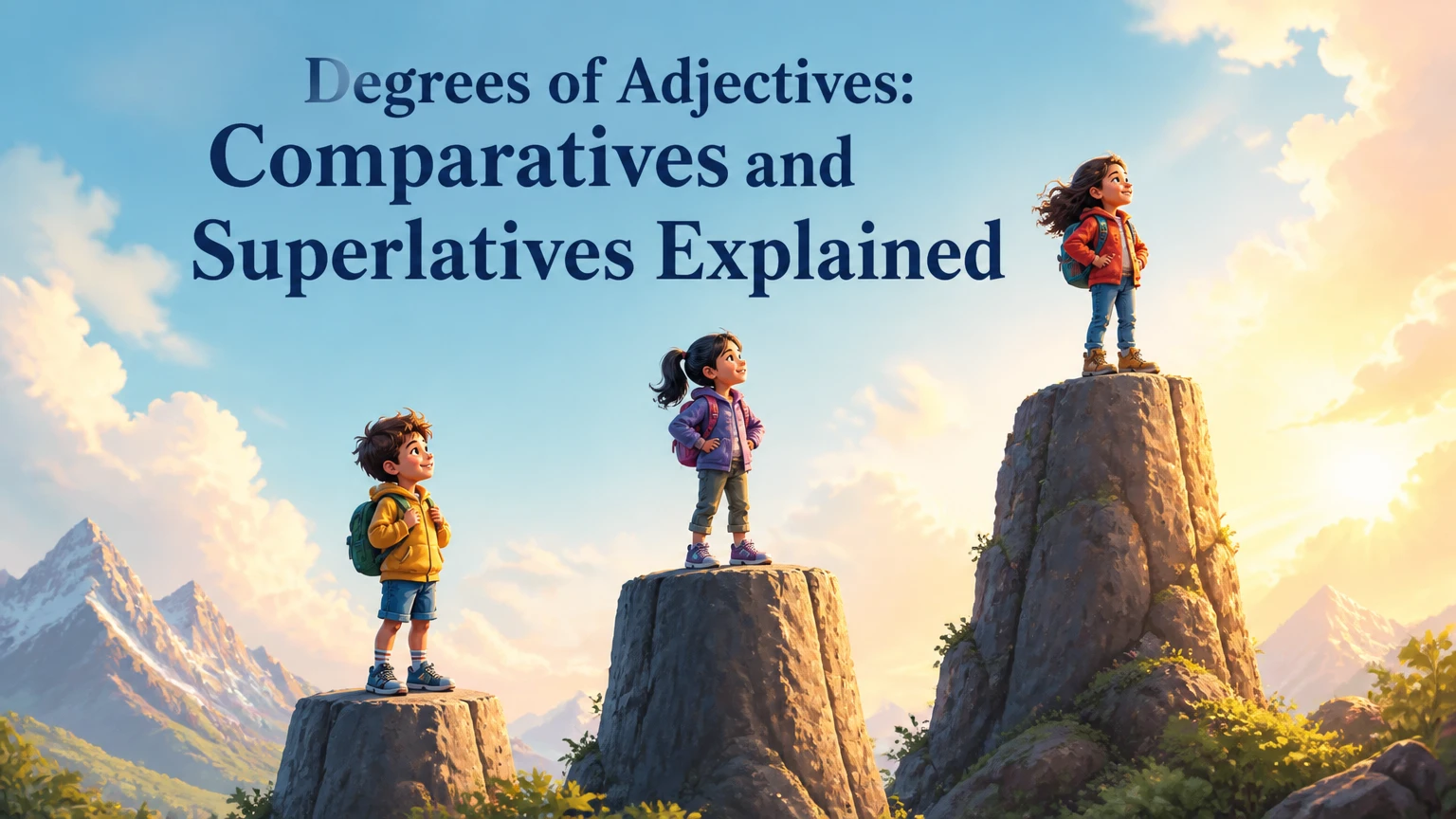
Degrees of adjectives, also called degrees of comparison, show whether an adjective simply describes a noun, compares two nouns, or ranks one noun within a group. English uses the positive degree as the base form, the comparative degree for two entities, and the superlative degree for three or more entities or a whole category.
Key Facts at a Glance
- The positive degree describes a quality without making a comparison: “The lake is deep.”
- The comparative degree normally compares two entities: “Lake A is deeper than Lake B.”
- The superlative degree normally ranks one entity against three or more: “Lake A is the deepest lake in the region.”
- Short adjectives usually take -er and -est, while longer adjectives usually take more and most.
- English forms some common adjectives irregularly, including good, better, best and bad, worse, worst.
- A comparison must match equivalent things, such as one city’s pollution with another city’s pollution.
What Are the Three Degrees?
The three degrees of comparison are grammatical forms that express increasing or decreasing comparison: positive, comparative, and superlative. The positive form gives the reference quality, the comparative form contrasts two entities, and the superlative form identifies the highest or lowest degree within a stated or understood group.
| Degree | Main function | Typical structure | Example |
|---|---|---|---|
| Positive | Describes without comparison | noun + adjective | “The engine is quiet.” |
| Comparative | Contrasts two entities | adjective + than | “This engine is quieter than that one.” |
| Superlative | Ranks a group | the + adjective | “This is the quietest engine.” |
| Negative comparative | Shows a lower degree | less + adjective | “This engine is less powerful.” |
| Negative superlative | Shows the lowest degree | least + adjective | “It is the least expensive model.” |
The word degree does not mean that every adjective has a measurable numerical scale. A quality such as quiet can vary naturally, but an adjective such as wooden generally identifies a material rather than a scale. Native usage also permits context-dependent variation: a “more wooden” performance can mean less natural, even though wooden is not normally graded as a material adjective.
How Does the Positive Degree Work?
The positive degree is the base adjective, such as small, careful, bright, or reliable. It describes one noun without explicitly measuring that noun against another noun.
Examples include:
- “The apartment is small.”
- “Maya is careful.”
- “The screen is bright.”
- “The connection is reliable.”
The positive form can still occur in a comparison of equality. The pattern as + adjective + as compares two entities without changing the adjective: “This battery is as reliable as the previous model.” The negative pattern not as + adjective + as means that the first entity has a lower degree: “The replacement is not as reliable as the original.”
How Does the Comparative Degree Work?
The comparative degree contrasts exactly two entities, two groups, or two alternatives. Short adjectives usually add -er, longer adjectives usually use more, and the comparison commonly ends with than.
Examples:
- “A train is faster than a bus.”
- “This explanation is more precise than the first one.”
- “Winter nights are colder than autumn nights.”
- “The revised contract is less restrictive than the earlier version.”
A comparative can omit than when the second item is obvious: “Of the two routes, the northern route is shorter.” The sentence still compares two routes because of the two supplies the comparison set.
Comparative adjectives can take degree modifiers. Slightly, somewhat, and a little reduce the difference; much, far, and considerably increase it.
- “The new lens is slightly sharper.”
- “The north route is much longer.”
- “The updated model is considerably more efficient.”
What Is the Correct Comparative Sentence Pattern?
The clearest pattern is subject + comparative adjective + than + parallel comparison. Parallel comparison means that both sides represent equivalent categories.
- Correct: “The air quality in Madrid is worse than the air quality in Lisbon.”
- Correct: “Madrid’s air quality is worse than Lisbon’s.”
- Faulty: “The air quality in Madrid is worse than Lisbon.”
The faulty version compares air quality with Lisbon, a city. Readers may understand the intended meaning, but formal writing should make the comparison target explicit.
How Does the Superlative Degree Work?
The superlative degree ranks one entity against at least two others or against an entire defined category. English commonly places the before a superlative adjective, followed by a phrase identifying the group.
Examples:
- “Nora is the tallest student in her class.”
- “This is the most reliable server in the cluster.”
- “January was the coldest month of the year.”
- “That was the least convincing explanation.”
The group must be logically appropriate. “The fastest of the two runners” is possible, but faster is usually more natural because the comparison contains only two runners. Use a superlative when the context ranks one item within three or more or within a category: “She is the fastest of the five runners.”
The phrase one of the + superlative + plural noun means that the item belongs to a group of highly ranked examples, not that it holds the single highest position.
- “Kyoto is one of the oldest cities in Japan.”
- “This is one of the most useful reference books available.”
How Do You Form Comparatives and Superlatives?
Adjective length provides a useful starting rule, but spelling, pronunciation, and established usage also matter. One-syllable adjectives generally take -er and -est; adjectives of three or more syllables normally take more and most.
| Adjective pattern | Comparative rule | Superlative rule | Example |
|---|---|---|---|
| One syllable | Add -er | Add -est | tall, taller, tallest |
| Ends in silent e | Add -r | Add -st | safe, safer, safest |
| Consonant-vowel-consonant | Double final consonant, add -er | Double final consonant, add -est | hot, hotter, hottest |
| Ends in consonant + y | Change y to i, add -er | Change y to i, add -est | dry, drier, driest |
| Two syllables ending in -y | Change y to i, add -er | Change y to i, add -est | happy, happier, happiest |
| Three or more syllables | Use more | Use most | accurate, more accurate, most accurate |
Which Spelling Changes Matter?
A final silent e is not repeated: large, larger, largest and wise, wiser, wisest. A one-syllable adjective ending in one consonant after one vowel usually doubles that consonant: thin, thinner, thinnest and sad, sadder, saddest.
The doubling rule does not apply after two consonants or when the final syllable lacks the required stressed pattern. Thus, fast becomes faster, not fastter, and helpful normally becomes more helpful, not helpfuller.
For consonant plus y, replace y with i: easy, easier, easiest and messy, messier, messiest. Do not change a vowel plus y: gray, grayer, grayest and playful follows a different pattern.
How Do Two-Syllable Adjectives Behave?
Two-syllable adjectives are the least predictable group. Adjectives ending in -y, -ow, -er, and some ending in -le often accept -er and -est, while many others prefer more and most.
| Positive form | Common comparative | Common superlative | Usage note |
|---|---|---|---|
| happy | happier | happiest | Standard inflection |
| narrow | narrower | narrowest | Standard inflection |
| clever | cleverer or more clever | cleverest or most clever | Both occur |
| simple | simpler or more simple | simplest or most simple | simpler is common |
| polite | politer or more polite | politest or most polite | Both occur by dialect |
| useful | more useful | most useful | usefuler is nonstandard |
When both forms are grammatical, choose the form that sounds natural in the sentence and remains consistent with the surrounding prose. More simple is not automatically wrong, but simpler is usually the conventional choice when the meaning is “less complicated.”
Should You Use -er or More?
Use -er and -est for most short, familiar adjectives; use more and most for long adjectives, participial adjectives, and forms that sound awkward with an ending. English does not use more merely because an adjective feels important, nor does it use -er for every two-syllable word.
| Positive adjective | Preferred comparative | Preferred superlative | Reason |
|---|---|---|---|
| quick | quicker | quickest | One syllable |
| narrow | narrower | narrowest | Common two-syllable pattern |
| modern | more modern | most modern | moderner sounds less natural |
| interesting | more interesting | most interesting | Three syllables |
| bored | more bored | most bored | Participial adjective |
| careful | more careful | most careful | Four syllables |
| fun | more fun or funner | most fun or funnest | Usage varies by context |
The forms more better, most fastest, and more happier combine two comparative mechanisms. Standard English selects one: better, fastest, and happier.
Which Adjectives Are Irregular?
Irregular adjectives change their forms rather than following predictable spelling rules. The most important irregular forms are frequent words such as good, bad, far, little, many, and much, so memorizing them prevents recurring errors.
| Positive | Comparative | Superlative | Meaning distinction |
|---|---|---|---|
| good | better | best | Quality or performance |
| bad | worse | worst | Low quality or harmful result |
| far | farther/further | farthest/furthest | Distance or extended meaning |
| little | less | least | Amount, not countable number |
| many | more | most | Countable quantity |
| much | more | most | Uncountable quantity |
| well | better | best | Health or manner as an adverb |
| old | older/elder | oldest/eldest | Elder mainly family relationships |
Farther traditionally refers to measurable physical distance: “The station is farther from here.” Further commonly refers to additional degree, time, or discussion: “No further evidence was submitted.” Modern usage often allows further for physical distance as well, but the distinction remains useful in careful writing.
Less modifies uncountable nouns, while fewer modifies countable nouns: “less water,” “fewer errors,” “less traffic,” and “fewer vehicles.” The contrast concerns quantity, not adjective comparison alone.
Can Adverbs Have Comparative and Superlative Forms?
Adverbs can take the same degrees, but their formation depends on the adverb rather than the adjective it modifies. Short adverbs often take -er and -est, while adverbs ending in -ly usually take more and most.
| Positive adverb | Comparative | Superlative | Example |
|---|---|---|---|
| fast | faster | fastest | “The server responds fastest.” |
| hard | harder | hardest | “She worked harder today.” |
| early | earlier | earliest | “Arrive earliest for registration.” |
| carefully | more carefully | most carefully | “Review the form more carefully.” |
| efficiently | more efficiently | most efficiently | “The program runs most efficiently overnight.” |
| well | better | best | “The revised method works best.” |
The adjective fast and the adverb fast have the same form: “a fast train” and “the train travels fast.” The adjective quick normally requires the adverb quickly: “a quick response” but “respond quickly.”
What Are the Main Comparison Mistakes?
The most common errors involve using two comparison markers, comparing unlike things, choosing the wrong quantity word, or treating an absolute description as naturally gradable.
- Double comparative: “more taller” should be “taller.”
- Double superlative: “most easiest” should be “easiest.”
- Wrong comparison target: “The rainfall in Dublin is higher than London” should be “higher than London’s rainfall.”
- Missing group: “She is the fastest” should identify the relevant group when context does not supply it.
- Wrong quantity form: “Less books” should be “fewer books.”
- Incorrect adjective choice: “He is more better prepared” should be “He is better prepared.”
- Faulty parallelism: “The new policy is more practical than reducing staff” compares an adjective phrase with a gerund phrase in an unclear way.
A practical editing test is to underline the two comparison targets. If the underlined phrases are not equivalent nouns, noun phrases, clauses, or actions, revise the sentence.
Are Absolute Adjectives Comparable?
Absolute adjectives describe conditions that are usually treated as all-or-nothing, so ordinary comparison can sound illogical. Examples include dead, unique, perfect, empty, and impossible, although real usage sometimes grades them for approximation, emphasis, or rhetorical effect.
Prefer precise qualifiers when the literal meaning is absolute:
- “nearly empty” instead of “emptier” when the container is already almost empty
- “highly unusual” instead of “more unique”
- “almost perfect” instead of “more perfect”
- “closer to complete” instead of “completer”
Context can license modified forms. A design may be “more unique” in the loose sense of being more distinctive, and a container can be “more empty” in ordinary conversation. Formal technical writing should choose more distinctive, less typical, or a measurable attribute instead.
How Do You Compare Equality, Inequality, and Quantity?
English has several comparison structures beyond -er, -est, more, and most. Each structure expresses a different relationship, so substituting one for another can change the meaning.
| Meaning | Structure | Example |
|---|---|---|
| Equality | as + adjective + as | “The two cables are as durable as each other.” |
| Lower degree | less + adjective + than | “The second cable is less flexible than the first.” |
| Highest degree | the + superlative | “The third cable is the most durable.” |
| Repeated change | comparative + and + comparative | “The connection became weaker and weaker.” |
| Linked change | the + comparative, the + comparative | “The longer the cable, the greater the signal loss.” |
| Quantity, countable | fewer + plural noun | “The update produced fewer errors.” |
| Quantity, uncountable | less + mass noun | “The update used less memory.” |
The construction the more…, the more… expresses a linked relationship, not a superlative ranking: “The more data the system receives, the more accurate the forecast becomes.” The second clause states a changing result.
What Does Comparison Look Like in Real Sentences?
Degree selection depends on the adjective, the number of entities, and the intended relationship. The following examples show how the same topic can use all three degrees accurately.
- Positive: “The coastal road is narrow.”
- Comparative: “The coastal road is narrower than the inland route.”
- Superlative: “The coastal road is the narrowest route in the county.”
- Equality: “The coastal road is as scenic as the mountain route.”
- Lower degree: “The coastal road is less direct than the highway.”
In academic writing, make the comparison criterion explicit: “The second sample produced a lower error rate than the first sample.” In product descriptions, avoid unsupported superlatives such as “the best battery”; specify the category and evidence: “the longest-lasting battery among the four tested models.”
After than, both object and subject pronouns occur in standard usage. “She is taller than me” is ordinary conversational English; “She is taller than I am” is more explicit and often preferred in formal prose. The expanded clause removes ambiguity.
What Is the Best Way to Learn These Forms?
Memorize the high-frequency irregular forms, then apply a decision sequence to unfamiliar adjectives. Syllable counting helps, but pronunciation and established dictionary usage matter more than mechanically counting written letters.
- Identify whether the adjective is regular or irregular.
- Check whether it has one syllable.
- Apply spelling changes for silent e, final y, or consonant doubling.
- Use more and most for long adjectives and awkward short forms.
- Confirm that the sentence compares two entities for a comparative.
- Confirm that the superlative has a defined group.
- Check whether the comparison targets are parallel.
- Replace absolute or vague comparisons with measurable wording.
A useful learner exercise is to create three sentences from one adjective, such as “The room is quiet,” “Room A is quieter than Room B,” and “Room C is the quietest room in the building.” The exercise teaches form, meaning, and sentence structure simultaneously.
FAQ
Is “more simple” grammatically correct?
Yes, more simple can be grammatical, but simpler is usually the more conventional comparative in general English. Writers may choose more simple when contrasting simple with a longer phrase or when maintaining a deliberate parallel structure, but the choice should remain consistent throughout a document.
Is “funner” or “more fun” correct?
Both funner and more fun occur in modern English. More fun is widely accepted across formal and informal contexts, while funner is common in conversational language, especially in North American English. Use more fun when writing for an international or formal audience.
Can I use a superlative for only two things?
A superlative is possible with two things when the group is treated as a category, but a comparative is normally clearer. Write “the better of the two options” rather than “the best of the two options” when directly contrasting two alternatives.
What is the difference between “older” and “elder”?
Older applies broadly to people and things. Elder is mainly used before a family relationship noun, as in “my elder sister,” and is not normally used for objects. The superlative eldest also belongs mainly to family relationships, while oldest has general use.
Why is “best” preceded by “the”?
Superlatives commonly take the because they identify one position within a defined group: “the best solution in the report.” The article can disappear when the superlative functions as a complement after a possessive or similar determiner, as in “my best solution” or “her fastest time.”
Do adjectives always have all three degrees?
No. Many relational or absolute adjectives do not normally form natural comparatives and superlatives. Words such as wooden, medical, and triangular usually classify a noun rather than place it on a scale, while unique and perfect are traditionally treated as absolute, although informal usage may grade them.
The Bottom Line
Degrees of adjectives, comparatives and superlatives explained simply, follow one central pattern: the positive degree describes, the comparative degree contrasts two entities, and the superlative degree ranks one entity within a group. Use -er/-est for most short adjectives, more/most for longer or awkward forms, memorize irregular forms, and verify that every comparison matches equivalent targets.