
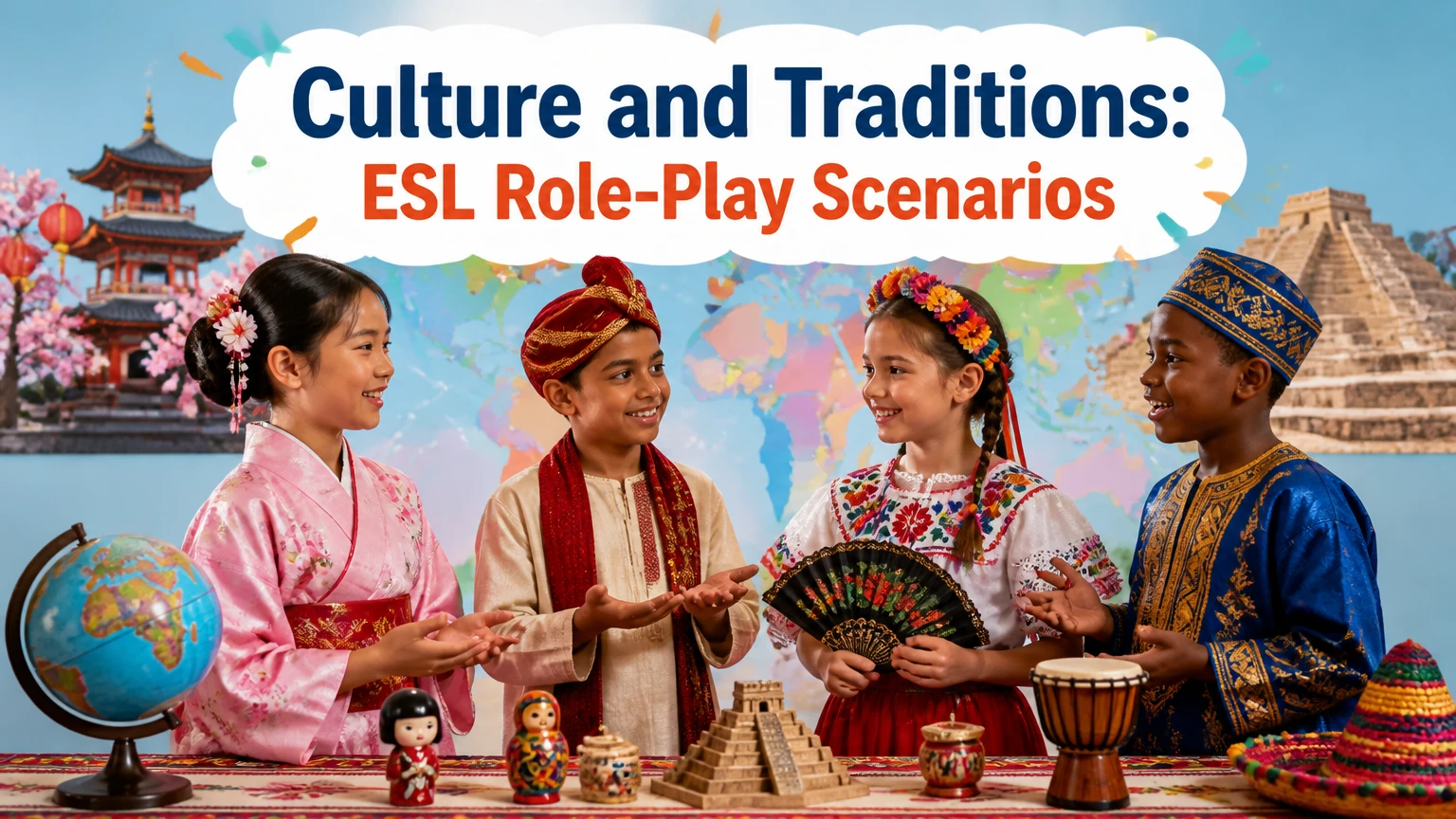
Role-playing is a dynamic and engaging method for ESL (English as a Second Language) learners to practice their language skills in realistic contexts. When these scenarios are centered around culture and traditions, such as celebrating holidays, navigating social customs, or understanding different perspectives, the learning experience becomes even more enriching. Concepts like respecting elders, observing festivals, and understanding family dynamics are brought to life through interactive practice. This approach not only improves language proficiency but also fosters cultural awareness and sensitivity, benefiting students in their personal and professional lives.
Table of Contents
- Definition of Culture and Traditions in ESL Role-Play
- Benefits of Using Role-Play in ESL Learning
- Key Elements of Effective Culture and Traditions Role-Play Scenarios
- Types of Culture and Traditions Role-Play Scenarios
- Role-Play Scenario Examples
- Language Focus in Culture and Traditions Role-Play
- Rules for Creating and Facilitating Effective Role-Plays
- Common Mistakes in Culture and Traditions Role-Play
- Practice Exercises
- Advanced Topics in Culture and Traditions Role-Play
- Frequently Asked Questions
- Conclusion
Definition of Culture and Traditions in ESL Role-Play
Culture, in the context of ESL, refers to the shared beliefs, values, customs, behaviors, and artifacts that characterize a group or society. Traditions are the practices and beliefs that are passed down from generation to generation within a culture. In ESL role-play, these elements are used as the foundation for creating realistic and engaging scenarios. These scenarios allow learners to explore different cultural perspectives, practice using culturally appropriate language, and develop intercultural communication skills. For instance, understanding the significance of gift-giving in some cultures or the importance of punctuality in others are crucial aspects that can be incorporated into role-play activities.
Benefits of Using Role-Play in ESL Learning
Role-play offers numerous benefits for ESL learners. Firstly, it provides a safe and supportive environment for practicing speaking skills. Learners can experiment with new vocabulary and grammar structures without the fear of making mistakes in a real-world situation. Secondly, role-play enhances listening comprehension as learners must actively listen to their partners and respond appropriately. Thirdly, it improves fluency by encouraging learners to communicate spontaneously and naturally. Finally, role-play fosters critical thinking and problem-solving skills as learners must adapt to unexpected situations and find solutions to conflicts that arise within the scenario. Furthermore, role-playing cultural interactions helps to develop empathy and understanding, improving overall intercultural competence.
Key Elements of Effective Culture and Traditions Role-Play Scenarios
Several key elements contribute to the effectiveness of culture and traditions role-play scenarios. Clear objectives are essential; learners should understand what they are expected to achieve through the activity. Realistic contexts are crucial for engaging learners and making the experience relevant. Well-defined roles provide learners with clear guidelines on how to behave and interact. Authentic language, including appropriate vocabulary and expressions, is necessary for creating a believable scenario. Finally, constructive feedback from the teacher and peers helps learners identify areas for improvement. The use of props and visual aids can also enhance the realism and engagement of the role-play.
Clear Learning Objectives
Before initiating any role-play, it’s critical to establish clear learning objectives. What specific language skills are you targeting? Is it the use of polite requests, expressing opinions, or describing past experiences? Defining these objectives helps both the teacher and the students focus their efforts and measure their progress. For example, a role-play scenario about ordering food in a restaurant might aim to improve learners’ ability to use phrases like “Could I have…” or “I would like…” along with relevant vocabulary related to food and beverages.
Realistic and Relevant Contexts
The more realistic and relevant the context, the more engaged learners will be. Choose scenarios that reflect real-life situations they might encounter, such as visiting a doctor, attending a job interview, or interacting with customer service. The context should also be culturally appropriate and sensitive, avoiding stereotypes or potentially offensive situations. Consider the learners’ backgrounds and interests when selecting contexts to maximize their motivation and participation.
Well-Defined and Engaging Roles
Each role in the scenario should be clearly defined with specific characteristics, motivations, and goals. This helps learners understand how to behave and interact within the given context. Giving learners some creative freedom to interpret their roles can also enhance their engagement and spontaneity. For instance, in a scenario about negotiating a price at a market, one role might be a seasoned vendor who is skilled at bargaining, while the other role might be a tourist who is unfamiliar with the local customs.
Authentic and Appropriate Language
Use language that is authentic and appropriate for the context and roles. This includes vocabulary, grammar, and expressions that are commonly used in real-life situations. Expose learners to a variety of language styles, such as formal and informal, to prepare them for different communication scenarios. Providing learners with a list of useful phrases and vocabulary before the role-play can also boost their confidence and fluency. Remember that the goal is to equip them with practical language skills that they can use in the real world.
Constructive Feedback and Reflection
After the role-play, provide learners with constructive feedback on their performance. Focus on both their strengths and areas for improvement. Encourage them to reflect on their experience and identify what they learned. Peer feedback can also be valuable, as learners can learn from each other’s successes and mistakes. The feedback should be specific, actionable, and focused on the learning objectives. For example, instead of saying “You did a good job,” you might say “Your pronunciation of ‘excuse me’ was very clear, but you could work on using more polite intonation when making requests.”
Types of Culture and Traditions Role-Play Scenarios
There are various types of culture and traditions role-play scenarios that can be used in ESL classrooms. Cultural misunderstandings scenarios explore situations where cultural differences lead to miscommunication or conflict. Holiday celebrations scenarios focus on practicing vocabulary and expressions related to specific holidays and traditions. Social customs scenarios involve interactions that highlight different social norms and etiquette. Family dynamics scenarios explore relationships and interactions within families from different cultural backgrounds. Each type offers unique opportunities for learners to develop their language and cultural awareness.
Cultural Misunderstandings Scenarios
These scenarios are designed to highlight potential areas of cultural conflict and misunderstanding. They often involve characters from different cultural backgrounds who have different expectations or interpretations of social cues. The goal is for learners to identify the source of the misunderstanding and practice using language to resolve the conflict in a respectful and culturally sensitive manner. For instance, a scenario could involve an American businessperson who is unaware of the importance of building rapport before discussing business in Japan.
Holiday Celebrations Scenarios
These scenarios revolve around specific holidays and traditions, such as Christmas, Diwali, or Lunar New Year. Learners can practice using vocabulary related to the holiday, describing customs and rituals, and expressing their feelings and opinions about the celebration. These scenarios can also be used to compare and contrast different holiday traditions from around the world. A role-play might involve a family preparing for a traditional Thanksgiving dinner, with each member having specific tasks and responsibilities.
Social Customs Scenarios
These scenarios focus on different social norms and etiquette, such as greetings, gift-giving, dining customs, and communication styles. Learners can practice using appropriate language and behavior in various social situations. These scenarios can also help learners avoid making cultural faux pas. For example, a scenario could involve a visitor to a foreign country who is unsure of how to greet their host or what to bring as a gift.
Family Dynamics Scenarios
These scenarios explore relationships and interactions within families from different cultural backgrounds. Learners can practice using language to express affection, resolve conflicts, and discuss family matters. These scenarios can also provide insights into different family structures and values. A role-play might involve a family discussing whether to send their child to study abroad, with different members having different opinions and concerns.
Role-Play Scenario Examples
Here are several detailed examples of role-play scenarios that can be used in ESL classrooms. These examples cover a range of cultural and traditional themes, providing learners with opportunities to practice different language skills and develop their cultural awareness. Each scenario includes a brief description, the roles involved, and some suggested language prompts.
Scenario 1: Visiting a Foreign Exchange Student
Description: A student from the US is visiting a foreign exchange student’s home in Japan. They are invited for dinner with the family.
Roles:
- American Student (polite, curious)
- Japanese Host Family (welcoming, traditional)
Language Prompts:
- Expressing gratitude for the invitation
- Asking about Japanese customs and traditions
- Using appropriate table manners
- Discussing differences between American and Japanese culture
Scenario 2: Celebrating Diwali with Friends
Description: A group of friends from different cultural backgrounds are celebrating Diwali together.
Roles:
- Indian Host (enthusiastic, knowledgeable)
- Guests from different countries (curious, respectful)
Language Prompts:
- Explaining the significance of Diwali
- Describing traditional Diwali customs
- Sharing personal experiences of celebrating Diwali
- Expressing appreciation for the cultural experience
Scenario 3: Negotiating a Price at a Moroccan Souk
Description: A tourist is trying to negotiate a price for a souvenir at a Moroccan souk (market).
Roles:
- Tourist (bargaining, polite)
- Moroccan Vendor (persuasive, friendly)
Language Prompts:
- Using bargaining phrases
- Expressing interest in the product
- Making counter-offers
- Understanding the cultural context of bargaining
Scenario 4: Attending a Traditional Tea Ceremony in China
Description: A visitor is attending a traditional tea ceremony in China.
Roles:
- Visitor (respectful, observant)
- Tea Master (knowledgeable, gracious)
Language Prompts:
- Asking questions about the tea ceremony
- Using appropriate etiquette
- Expressing appreciation for the experience
- Learning about the history and significance of tea in Chinese culture
Scenario 5: Discussing Family Traditions During Thanksgiving
Description: A family is discussing their Thanksgiving traditions.
Roles:
- Grandmother (traditional, nostalgic)
- Grandson (modern, curious)
Language Prompts:
- Sharing childhood memories of Thanksgiving
- Explaining the origins of Thanksgiving traditions
- Discussing how Thanksgiving has changed over time
- Expressing gratitude for family and friends
Scenario 6: Navigating a Business Meeting in South Korea
Description: An American businessperson is attending a meeting in South Korea.
Roles:
- American Businessperson (polite, professional)
- South Korean Business Partner (formal, respectful)
Language Prompts:
- Exchanging business cards using appropriate etiquette
- Using formal language and titles
- Understanding the importance of hierarchy
- Avoiding direct confrontation
Scenario 7: Celebrating Lunar New Year with Vietnamese Family
Description: A friend is invited to celebrate Lunar New Year with a Vietnamese family.
Roles:
- Friend (curious, respectful)
- Vietnamese Family Member (welcoming, informative)
Language Prompts:
- Asking about the traditions of Tet (Lunar New Year)
- Learning about the significance of red envelopes (li xi)
- Participating in traditional customs
- Expressing good wishes for the New Year
Scenario 8: Understanding the Etiquette of Gift-Giving in Japan
Description: A visitor is giving a gift to a Japanese colleague.
Roles:
- Visitor (thoughtful, polite)
- Japanese Colleague (appreciative, formal)
Language Prompts:
- Presenting the gift with humility
- Using appropriate wrapping and presentation
- Understanding the significance of the gift
- Expressing gratitude for the gift
Language Focus in Culture and Traditions Role-Play
Culture and traditions role-play scenarios provide opportunities to focus on specific language skills and vocabulary. Polite requests, such as “Could you please tell me more about…”, are essential for respectful communication. Expressing opinions, such as “I think that…” or “In my opinion…”, allows learners to share their perspectives. Describing customs, such as “We usually…”, involves using descriptive language to explain traditions. Asking for clarification, such as “I’m not sure I understand…”, helps learners avoid misunderstandings. Expressing gratitude, such as “Thank you for…”, is crucial for showing appreciation. The scenarios also provide contexts for learning vocabulary related to specific holidays, customs, and cultural practices.
Rules for Creating and Facilitating Effective Role-Plays
To ensure that role-plays are effective learning experiences, it’s important to follow certain rules. Provide clear instructions so that learners understand the objectives and their roles. Set a time limit to keep the activity focused and prevent it from dragging on. Encourage active participation from all learners. Create a supportive and non-judgmental environment where learners feel comfortable taking risks. Offer constructive feedback after the role-play to help learners improve. Debrief the activity to discuss what was learned and address any questions or concerns. Additionally, ensure that the scenarios are culturally sensitive and avoid perpetuating stereotypes.
Common Mistakes in Culture and Traditions Role-Play
ESL learners often make common mistakes when participating in culture and traditions role-play. These mistakes can be related to language, cultural understanding, or role-playing technique. Addressing these mistakes is crucial for improving learners’ performance and maximizing the benefits of the activity.
Incorrect Language Use: Using grammatically incorrect sentences or inappropriate vocabulary can hinder communication and create misunderstandings. Incorrect: “I want eat now.” Correct: “I would like to eat now.”
Cultural Insensitivity: Making assumptions or stereotypes about other cultures can be offensive and undermine the purpose of the role-play. Incorrect: “All Japanese people are good at math.” Correct: “Japanese culture places a strong emphasis on education.”
Lack of Preparation: Not preparing for the role-play by reviewing vocabulary or researching cultural information can lead to a lack of confidence and fluency. Incorrect: Stumbling over words or being unable to answer basic questions. Correct: Having a list of useful phrases and cultural facts readily available.
Passive Participation: Not actively engaging in the role-play and allowing others to dominate the conversation can limit learning opportunities. Incorrect: Remaining silent or giving only brief answers. Correct: Asking questions, expressing opinions, and contributing to the dialogue.
Ignoring Non-Verbal Cues: Failing to pay attention to non-verbal cues, such as body language and facial expressions, can lead to misinterpretations. Incorrect: Ignoring a person’s discomfort or disinterest. Correct: Observing non-verbal cues and adjusting your behavior accordingly.
Not Asking for Clarification: Being afraid to ask for clarification when something is unclear can lead to misunderstandings and incorrect assumptions. Incorrect: Pretending to understand when you don’t. Correct: Saying “I’m sorry, I didn’t quite understand. Could you please repeat that?”
Practice Exercises
These practice exercises are designed to help ESL learners improve their language skills and cultural awareness in the context of role-play scenarios. Each exercise focuses on a specific aspect of culture and traditions and provides opportunities for learners to practice using relevant vocabulary and expressions.
Exercise 1: Ordering Food in a Restaurant (Cultural Differences)
Scenario: You are traveling in a foreign country and want to order food at a local restaurant. However, you are unfamiliar with the menu and the local customs.
Task: Role-play ordering food at the restaurant, asking questions about the menu, and being respectful of the local customs.
Instructions:
- Choose a partner to play the role of the waiter/waitress.
- Research the local customs and etiquette of dining in the country you have chosen.
- Prepare a list of questions to ask the waiter/waitress about the menu and the local customs.
- Role-play ordering food at the restaurant, using polite language and being respectful of the local customs.
- After the role-play, discuss what you learned about the local customs and what you could have done differently.
Exercise 2: Attending a Wedding (Social Etiquette)
Scenario: You have been invited to attend a wedding in a culture that is different from your own. You are unsure of the proper etiquette and customs.
Task: Role-play attending the wedding, interacting with the other guests, and being respectful of the local customs.
Instructions:
- Choose a partner to play the role of another guest at the wedding.
- Research the wedding customs and etiquette of the culture you have chosen.
- Prepare a list of questions to ask your partner about the wedding customs and etiquette.
- Role-play attending the wedding, using polite language and being respectful of the local customs.
- After the role-play, discuss what you learned about the wedding customs and what you could have done differently.
Exercise 3: Giving a Gift (Cultural Sensitivity)
Scenario: You want to give a gift to a colleague from a different culture. You are unsure of what type of gift would be appropriate and how to present it.
Task: Role-play giving the gift to your colleague, being mindful of the cultural sensitivities.
Instructions:
- Choose a partner to play the role of your colleague.
- Research the gift-giving customs and etiquette of your colleague’s culture.
- Choose a gift that would be appropriate and meaningful for your colleague.
- Role-play giving the gift to your colleague, using polite language and being respectful of the cultural sensitivities.
- After the role-play, discuss what you learned about the gift-giving customs and what you could have done differently.
Exercise 4: Resolving a Cultural Misunderstanding
Scenario: You have unintentionally offended someone from a different culture due to a cultural misunderstanding.
Task: Role-play resolving the misunderstanding, apologizing for your mistake, and learning from the experience.
Instructions:
- Choose a partner to play the role of the person you have offended.
- Identify the cultural misunderstanding and the reasons why it was offensive.
- Prepare an apology that is sincere and respectful.
- Role-play resolving the misunderstanding, apologizing for your mistake, and learning from the experience.
- After the role-play, discuss what you learned about the cultural difference and how you can avoid making the same mistake in the future.
Advanced Topics in Culture and Traditions Role-Play
For advanced ESL learners, culture and traditions role-play can be extended to explore more complex and nuanced topics. These might include: Analyzing cultural stereotypes and their impact on communication; Discussing ethical dilemmas related to cultural differences; Examining the role of language in shaping cultural identity; Exploring the challenges of intercultural adaptation; and Developing strategies for promoting cross-cultural understanding. Such activities require learners to engage in critical thinking, research, and sophisticated language use.
Frequently Asked Questions
Here are some frequently asked questions about using culture and traditions role-play in ESL learning:
Q: How can I choose appropriate role-play scenarios for my students?
A: Consider your students’ interests, language proficiency levels, and cultural backgrounds. Choose scenarios that are relevant, engaging, and culturally sensitive. Avoid scenarios that might be offensive or perpetuate stereotypes.
Q: How can I prepare my students for a role-play activity?
A: Provide them with clear instructions, background information, and relevant vocabulary. Allow them time to research the cultural context and practice their roles. Encourage them to ask questions and seek clarification.
Q: How can I create a supportive and non-judgmental environment for role-play?
A: Emphasize that the goal is to learn and practice, not to be perfect. Encourage students to take risks and make mistakes. Provide constructive feedback and celebrate their efforts.
Q: How can I assess my students’ performance in a role-play activity?
A: Focus on their language skills, cultural awareness, and role-playing technique. Use a rubric or checklist to evaluate their performance. Provide them with specific feedback on their strengths and areas for improvement.
Q: What should I do if a student is uncomfortable with a particular role-play scenario?
A: Respect their feelings and offer them an alternative role or activity. Do not force them to participate in something that makes them uncomfortable.
Q: How can I incorporate technology into culture and traditions role-play?
A: Use online resources to research cultural information, create virtual scenarios, or record and share role-play performances. You can also use video conferencing tools to connect with native speakers from different cultures.
Q: How do I address cultural misunderstandings that arise during role-play?
A: Use the opportunity to educate students about cultural differences and promote empathy and understanding. Facilitate a discussion about the misunderstanding and encourage students to share their perspectives.
Q: How can I make role-play scenarios more authentic?
A: Use real-life situations, authentic materials (such as menus, brochures, or articles), and invite native speakers to participate in the role-play.
Conclusion
Culture and traditions role-play scenarios are invaluable tools for ESL educators aiming to enhance language proficiency and cultural competence. By simulating real-world interactions, these activities provide learners with opportunities to practice using English in meaningful contexts, such as ordering food, attending social events, or navigating business meetings. Through careful planning, clear instructions, and constructive feedback, teachers can create engaging and effective role-play experiences that foster both language skills and cross-cultural understanding. Remember to choose scenarios that are relevant to your students’ lives, culturally sensitive, and aligned with your learning objectives. Encourage active participation, create a supportive environment, and celebrate your students’ progress. With these strategies, you can empower your students to become confident and culturally aware communicators in English.


