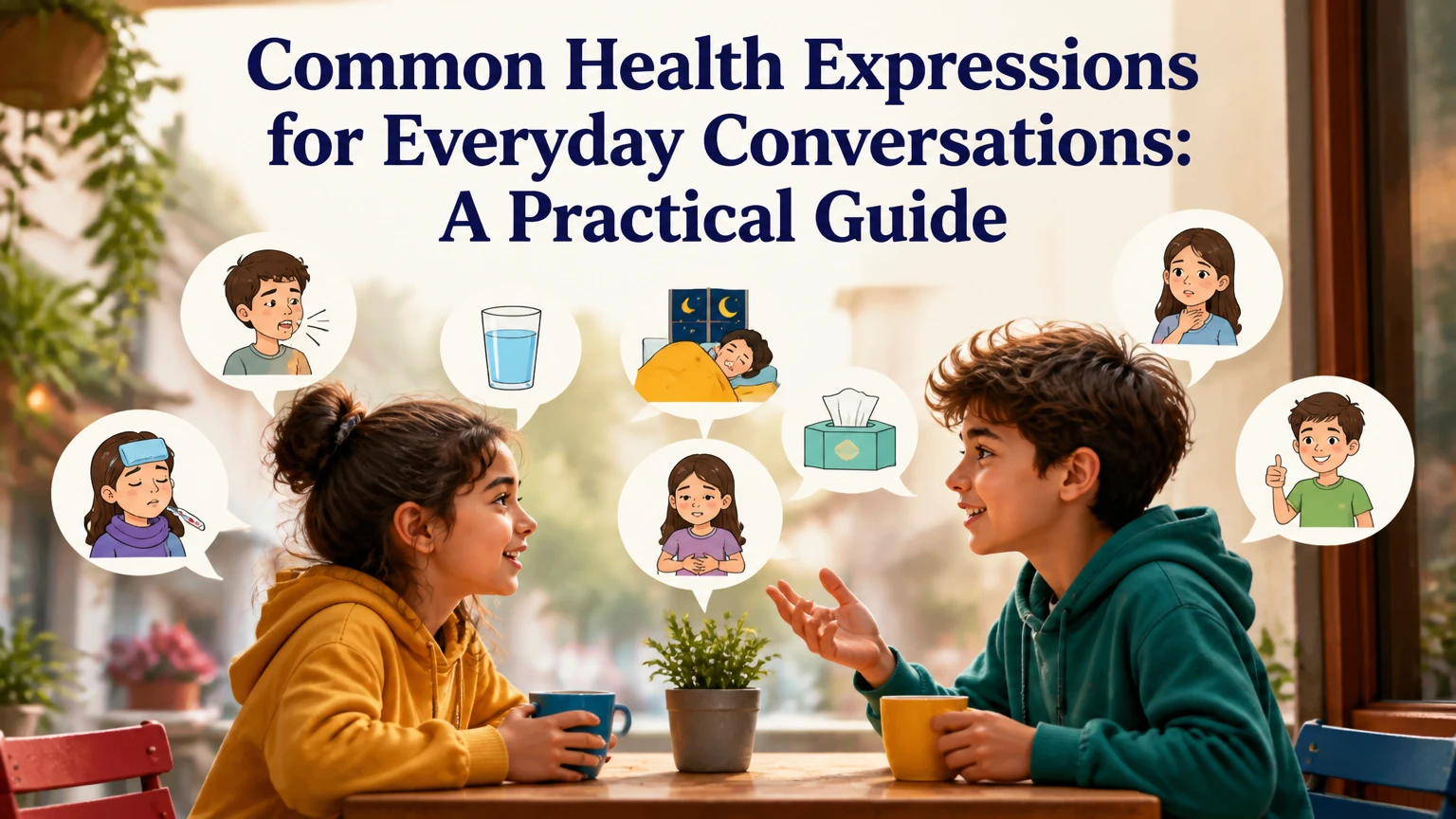
Common health expressions for everyday conversations are idioms and polite phrases that describe illness, fatigue, recovery, fitness, appearance, or energy without requiring detailed medical disclosure. The most useful examples include “under the weather,” “coming down with something,” “run-down,” “on the mend,” “back on my feet,” and “as fit as a fiddle.”
Key Facts at a Glance
“Under the weather” usually communicates a mild, temporary illness without naming symptoms.
“Coming down with something” suggests that an illness may be starting, while “on the mend” indicates ongoing recovery.
“Back on my feet” usually means a person can resume ordinary activities, not necessarily that they are completely recovered.
“A clean bill of health” traditionally refers to medical approval, while “picture of health” describes someone’s healthy appearance.
“Dog-tired” and “spent” describe exhaustion, but neither phrase identifies its medical cause.
Idioms are unsuitable for emergencies, urgent symptoms, formal medical information, or requests requiring precise accommodations.
What Are Common Health Expressions?
Common health expressions are fixed phrases that communicate a person’s physical condition, energy level, recovery, or general wellbeing. Many are idioms, meaning their intended meaning cannot be understood by interpreting every word literally.
“Under the weather,” for example, does not mean standing beneath rain clouds. In everyday English, the phrase generally means feeling somewhat ill or physically below one’s normal condition. Speakers use it because it communicates enough information to explain a canceled plan or a quieter mood while preserving personal privacy.
Health expressions also include semi-literal phrases such as “I’m feeling better,” euphemisms such as “I’m not at my best,” and medical-adjacent wording such as “the doctor cleared me.” The choice depends on accuracy, familiarity, relationship, and seriousness.
Why Do People Use Health Idioms?
Health idioms compress private experiences into socially recognizable signals. A speaker can say, “I’m feeling run-down this week,” and communicate reduced energy without describing sleep problems, pain, medication, or stress.
These expressions also guide the listener’s response. “I’m on the mend” normally invites reassurance, while “I’m feeling awful and need medical help” signals a practical or urgent need. The phrase therefore carries two kinds of information: the speaker’s condition and the amount of conversational attention the condition requires.
Idioms are useful, but they are not diagnostic language. “Feeling under the weather” does not identify an infection, and “green around the gills” does not prove nausea. The expressions describe perception or experience rather than a verified medical cause.
Which Health Expressions Describe Illness or Low Energy?
The most useful illness and fatigue expressions differ in severity, duration, and formality. “Under the weather” is broad and mild, “coming down with something” focuses on onset, “run-down” emphasizes depleted energy, and “dog-tired” describes intense tiredness rather than sickness.
| Expression | Meaning | Typical register | Example |
|---|---|---|---|
| Under the weather | Slightly ill or below normal | Neutral, informal | “I’m under the weather, so I’ll work from home.” |
| Coming down with something | Probably developing an illness | Informal | “I think I’m coming down with something.” |
| Feeling off | Not feeling normal | Neutral, broad | “I’ve felt off since yesterday.” |
| Run-down | Depleted by stress, poor sleep, or illness | Neutral, informal | “I’ve been run-down after several late nights.” |
| Dog-tired | Extremely tired | Informal | “I was dog-tired after the overnight flight.” |
| Spent | Completely exhausted | Neutral, conversational | “After the appointment, I was completely spent.” |
| Green around the gills | Pale or apparently nauseated | Informal, somewhat old-fashioned | “You look green around the gills.” |
| Under the weather a bit | Mildly unwell, with softened force | Casual, polite | “I’m under the weather a bit today.” |
When Should You Say “Under the Weather”?
Use “under the weather” when you feel mildly ill and do not need to disclose symptoms. The phrase works in casual conversation, workplace messages, and short absence notices, although a manager may still need concrete information about availability.
Examples include:
- “I’m under the weather today, so I’m taking a sick day.”
- “She’s been under the weather since Monday.”
- “I’m feeling a little under the weather, but I should be fine tomorrow.”
The phrase is deliberately vague. It does not communicate whether the speaker has a cold, migraine, stomach problem, mental fatigue, or another condition. That ambiguity is useful for privacy, but it becomes a weakness when another person needs to plan care, transportation, accessibility, or work coverage.
How Are “Run-Down,” “Dog-Tired,” and “Spent” Different?
“Run-down” usually suggests accumulated depletion, while “dog-tired” and “spent” describe a stronger immediate level of exhaustion. A run-down person may improve after sleep or reduced pressure; a spent person may have no energy left after a demanding event.
| Phrase | Main condition | Usual intensity | Common cause or context |
|---|---|---|---|
| Run-down | Ongoing low energy | 2-3/5 | Poor sleep, stress, recurring workload |
| Tired | Ordinary need for rest | 2/5 | Normal daily activity |
| Worn out | Noticeable depletion | 3-4/5 | Travel, work, caregiving, exercise |
| Dog-tired | Very strong tiredness | 4/5 | Physical labor, disrupted sleep, long travel |
| Spent | Energy fully depleted | 4-5/5 | Emotional strain, illness, major exertion |
| Exhausted | Very little remaining energy | 5/5 | Broad physical or mental causes |
These intensity scores are practical communication labels, not medical measurements. “Spent” can describe emotional capacity as easily as physical energy: “I’m too spent to discuss the issue tonight.”
Which Expressions Describe Recovery?
Recovery expressions communicate movement from illness or injury toward ordinary functioning. “On the mend” means healing is underway, “turning the corner” means the worst period appears to be passing, and “back on one’s feet” suggests enough recovery to resume daily life.
| Expression | Recovery stage | Does it imply full recovery? | Example |
|---|---|---|---|
| Getting better | Improvement has begun | No | “I’m getting better, but I still need rest.” |
| On the mend | Healing is continuing | No | “He’s on the mend after surgery.” |
| Turning the corner | The worst stage is likely over | No | “She seems to have turned the corner.” |
| Over the hump | The hardest part has passed | No | “We’re over the hump with the treatment.” |
| Back on my feet | Function has substantially returned | No | “I’m back on my feet and returning Monday.” |
| Fully recovered | Recovery is complete | Yes, by the speaker’s meaning | “I’m fully recovered now.” |
| Fighting fit | In strong condition after recovery | Usually yes, informal | “He’s fighting fit again.” |
What Does “On the Mend” Mean?
“On the mend” means that a person is recovering but may not yet be completely well. The expression often reassures family, friends, and coworkers that improvement is happening without claiming a specific medical outcome.
Natural examples include:
- “Thanks for asking. I’m on the mend.”
- “The patient is on the mend after a short hospital stay.”
- “I’m still taking it easy, but I’m definitely on the mend.”
The phrase suits follow-up conversations because it focuses on direction rather than a fixed endpoint. It is less appropriate when a person’s condition is worsening or uncertain.
Does “Back on My Feet” Mean Fully Recovered?
“Back on my feet” usually means that a person can stand, move, work, or manage normal routines again. It does not necessarily mean that healing is complete or that the person has returned to their previous strength.
For example, someone might say, “I’m back on my feet, but I’m not ready to run yet.” The phrase can refer to physical illness, injury, financial difficulty, or emotional disruption. Context determines the meaning. In a health conversation, it generally emphasizes restored function rather than clinical clearance.
“Turned the corner” is different. It describes a positive change in the trajectory of an illness, even when the person remains weak. “Over the hump” identifies the hardest stage, pain, or treatment period and can sound more casual.
Which Expressions Describe Excellent Health?
Positive health expressions communicate fitness, healthy appearance, energy, or medical reassurance. These meanings should not be treated as interchangeable: “fit as a fiddle” praises condition, “picture of health” describes appearance, and “clean bill of health” often implies professional medical approval.
| Expression | Core meaning | Formality | Important limitation |
|---|---|---|---|
| As fit as a fiddle | Very physically fit or healthy | Casual, traditional | Can sound old-fashioned |
| In good shape | Physically healthy or conditioned | Neutral | May also describe an object or situation |
| Picture of health | Looks exceptionally healthy | Casual | Judges visible appearance, not hidden health |
| Full of beans | Energetic and lively | Informal | Often used for children or cheerful adults |
| Bursting with energy | Highly energetic | Neutral, expressive | Describes energy, not disease status |
| Fighting fit | Very fit and ready | Informal, regional variation | Can sound exaggerated |
| Clean bill of health | Medical approval or no detected problem | Neutral | Should not replace a diagnosis or test result |
| Hale and hearty | Strong and healthy | Traditional, somewhat dated | More common in writing or humorous speech |
Is “A Clean Bill of Health” Medical Language?
“A clean bill of health” is a common expression for receiving reassuring medical results or professional approval, but it is not a technical diagnosis. A doctor may clear someone for work, exercise, travel, or a procedure while still recommending monitoring or follow-up.
Examples:
- “The cardiologist gave him a clean bill of health.”
- “The inspection gave the building a clean bill of health.”
- “After the checkup, she said she had received a clean bill of health.”
Use direct wording when precision matters: “My test results were normal,” “My doctor cleared me for work,” or “The scan showed no urgent problem.” Those statements communicate a narrower and more verifiable claim.
What Does “Full of Beans” Mean?
“Full of beans” means energetic, enthusiastic, or lively. The phrase usually describes behavior rather than general physical health, so it can be used for someone who is cheerful after recovering without claiming that every medical problem has ended.
For example, “The children were full of beans after breakfast” describes high activity. “She’s full of beans again after her illness” suggests returning energy. The phrase is informal and can sound playful, making it unsuitable for serious medical updates.
How Do You Choose the Right Expression?
Choose a health expression by checking four variables: condition, severity, audience, and required action. Use an idiom when privacy and conversational ease matter; use literal language when another person needs accurate information or immediate action.
- Identify the message. Decide whether you need to communicate illness, fatigue, improvement, fitness, or visible symptoms.
- Estimate severity. Reserve mild idioms for mild or unspecified conditions. Do not describe a possible emergency as “a little under the weather.”
- Match the audience. Friends may understand playful language, while employers usually need a clear statement about attendance and availability.
- Choose the register. “I’m feeling unwell” is more neutral than “I’m green around the gills,” and “dog-tired” is more informal than “severely fatigued.”
- State the practical consequence. Add whether you need rest, medical care, schedule changes, or no action.
- Stop at the privacy boundary. Do not provide symptoms, diagnoses, or treatment details unless they are relevant and you want to share them.
Which Phrase Works Best at Work?
“Under the weather,” “feeling unwell,” and “not feeling well today” are the safest general workplace choices. They explain reduced availability without forcing a medical disclosure, but workplace policy may still require a notification time, expected return date, or certification.
| Situation | Recommended wording | Detail level | Better than |
|---|---|---|---|
| One-day absence | “I’m unwell and need a sick day today.” | Clear | “I’m dying” |
| Mild reduced capacity | “I’m feeling under the weather and may work remotely.” | Moderate | “I’m a bit off” |
| Unknown return date | “I’m unwell and will update you by 3 p.m. tomorrow.” | Action-focused | “I’ll be back soon” |
| Returning after illness | “I’m on the mend and expect to return Monday.” | Reassuring | “I’m completely fine” |
| Need accommodation | “I have a health condition and need [specific adjustment].” | Precise | “I’m run-down” |
| Urgent absence | “I have a medical emergency and need immediate care.” | Direct | “I’m under the weather” |
A useful workplace message has three parts: condition at an appropriate level, work impact, and next update. For example: “I’m feeling unwell and cannot work today. I’ll update you tomorrow morning.” The message is more useful than an idiom alone.
Which Expressions Suit Friends and Family?
Friends and family usually tolerate more personal detail and more expressive language. “I’m feeling rough,” “I’m wiped out,” “I’m on the mend,” and “I’ve turned the corner” can sound natural when the relationship supports informal conversation.
Use milestone expressions when people have been following the illness over several days. “I’m over the hump” can reassure someone that treatment or discomfort has become more manageable. “I’m back on my feet” communicates regained independence. Neither phrase promises that all symptoms have disappeared.
Avoid joking expressions when someone is frightened, in pain, or awaiting serious results. Light language can minimize their experience, even when the speaker intends to provide comfort.
How Do These Expressions Compare With Plain English?
Plain health language is more precise than idioms, while idioms are often shorter and less intrusive. The best choice depends on whether the listener needs emotional context, practical information, or medically specific facts.
| Communication goal | Idiomatic wording | Plain-English alternative | Precision difference |
|---|---|---|---|
| Mild illness | “I’m under the weather.” | “I feel mildly unwell.” | Plain wording is clearer |
| Possible onset | “I’m coming down with something.” | “I may be developing an illness.” | Neither identifies a diagnosis |
| Low energy | “I’m run-down.” | “I have had low energy for several days.” | Plain wording adds duration |
| Recovery | “I’m on the mend.” | “My symptoms are improving.” | Plain wording specifies change |
| Return to routine | “I’m back on my feet.” | “I can manage normal activities again.” | Plain wording defines function |
| Medical reassurance | “I got a clean bill of health.” | “My doctor found no current concern.” | Plain wording narrows the claim |
Idioms are not inherently less honest. They become misleading when a listener interprets them as a diagnosis, a guarantee of recovery, or proof that no support is needed.
What Are the Common Mistakes?
The most common mistakes are mismatching severity, assuming a fixed timeframe, using regional slang with unfamiliar listeners, and confusing appearance with medical status. Each problem can be corrected by replacing the idiom with a specific statement.
Mistake 1: Using a Mild Idiom for a Serious Problem
“Under the weather” is unsuitable for chest pain, severe breathing difficulty, confusion, major bleeding, or another urgent symptom. Direct language improves the chance that people understand the need for immediate help: “I have a medical emergency and need to call emergency services.”
Idioms create social softness. Emergencies require operational clarity.
Mistake 2: Treating Idioms as Fixed Timelines
The AI Overview’s suggested periods, such as 0-24 hours for “coming down with something” or 7 or more days for “back on my feet,” should not be treated as rules. English idioms do not carry standardized medical clocks.
“Coming down with something” can refer to symptoms beginning today or to a developing illness noticed over several days. “On the mend” may describe recovery after two days or two months. Duration comes from context, not the phrase alone.
Mistake 3: Claiming a Diagnosis You Do Not Have
“I think I’m coming down with something” expresses uncertainty. “I have the flu” makes a more specific claim. Unless a clinician or reliable testing supports the diagnosis, the uncertain form is safer and more accurate.
This distinction matters because common respiratory symptoms overlap across colds, influenza, COVID-19, allergies, and other conditions.
Mistake 4: Confusing Appearance With Health
“Picture of health” describes how someone looks. It cannot establish that the person is medically healthy, because many conditions are not externally visible.
Use “You look well” when commenting on appearance. Use “Your checkup was reassuring” when referring to medical information.
Mistake 5: Using Dated or Regionally Marked Language
“Green around the gills,” “hale and hearty,” and “as fit as a fiddle” remain understandable to many speakers, but they may sound humorous, old-fashioned, or culturally unfamiliar. International English learners should prioritize “I’m feeling unwell,” “I’m getting better,” and “I feel healthy.”
How Should Non-Native English Speakers Use Health Idioms?
Non-native English speakers can begin with five widely recognizable phrases: “I’m not feeling well,” “I’m under the weather,” “I’m feeling better,” “I’m on the mend,” and “I’m back on my feet.” These expressions are useful because their conversational meanings are stable and their grammar is straightforward.
| Phrase | Grammar pattern | Safe beginner example | Meaning |
|---|---|---|---|
| Under the weather | be + under the weather | “I’m under the weather today.” | Mild illness |
| Coming down with | be + coming down with + noun | “I’m coming down with a cold.” | Possible onset |
| On the mend | be + on the mend | “She’s on the mend.” | Ongoing recovery |
| Back on my feet | be + back on my feet | “I’m back on my feet now.” | Function returning |
| Run-down | feel + run-down | “I’ve been feeling run-down.” | Depleted energy |
Avoid translating idioms word for word. Learn each phrase as a unit, then pay attention to tone. “Dog-tired” is more informal than “very tired,” and “green around the gills” may be inappropriate in a formal or international setting.
What Should You Say in Specific Situations?
The best health expression depends on the listener’s likely question and the action you want to produce. A short, direct sentence works better than an idiom when the other person must make a decision.
- Canceling dinner: “I’m feeling under the weather, so I need to cancel.”
- Explaining low productivity: “I’m feeling run-down today and may need a slower schedule.”
- Reporting early symptoms: “I think I’m coming down with something.”
- Reassuring a relative: “I’m on the mend, and the worst seems to be over.”
- Returning to work: “I’m back on my feet, but I’m still taking it easy.”
- Describing exhaustion after travel: “I’m dog-tired after that flight.”
- Commenting on someone’s appearance: “You look pale. Are you feeling all right?”
- Requesting medical help: “I feel seriously unwell and need medical attention.”
- Declining details: “I’m dealing with a health issue, but I’d rather not discuss the specifics.”
- Offering empathy: “I’m sorry you’re going through that. Is there anything practical I can do?”
A strong response to another person’s illness acknowledges the message before asking a question. “I’m sorry you’re feeling under the weather. Would you like me to reschedule?” is more considerate than immediately asking for symptoms.
How Can You Respond to These Expressions?
Respond to the practical meaning rather than interrogating the speaker for medical details. If someone says they are under the weather, offer flexibility; if they say they are on the mend, acknowledge progress; if they say they are dog-tired, avoid assuming they are ill.
| Speaker says | Helpful response | Avoid |
|---|---|---|
| “I’m under the weather.” | “I’m sorry. Would you like to postpone?” | “What exactly is wrong?” |
| “I’m coming down with something.” | “You should rest. Shall we reschedule?” | “You definitely have the flu.” |
| “I’m run-down.” | “Can I take anything off your plate?” | “Everyone is tired.” |
| “I’m on the mend.” | “That’s good to hear. Take it slowly.” | “So you are completely cured?” |
| “I’m back on my feet.” | “Glad you’re functioning better.” | “Then you can do everything normally.” |
| “I’m dog-tired.” | “You sound exhausted. Get some rest.” | “You just need to exercise.” |
Expert Insight: Privacy and Action Are Separate
A speaker can keep the diagnosis private while stating the practical consequence clearly. “I have a health issue and cannot attend today” gives an employer useful scheduling information without naming the condition.
Expert Insight: Recovery Idioms Describe Direction
“On the mend” and “turning the corner” describe a trend, not a destination. A person can be improving while still needing treatment, rest, monitoring, or assistance.
Expert Insight: Visible Symptoms Need Careful Wording
Telling someone they look “green around the gills” may embarrass them or draw attention to nausea. “You look pale. Are you okay?” is usually more respectful and leaves the person control over disclosure.
When Should You Use Literal Medical Language?
Use literal language for emergency symptoms, formal records, disability or workplace accommodations, medication instructions, informed consent, and communication with healthcare professionals. Idioms omit the exact information that those situations require.
A clinician needs details such as onset, severity, frequency, triggers, relevant diagnoses, medication use, and changes over time. “I’m under the weather” is a poor substitute for “I developed a 38.5°C fever last night and have had shortness of breath since morning.”
Health idioms are also unsuitable for guarantees. “I received a clean bill of health” should not be used to imply that future illness is impossible. Medical evaluations describe findings within a defined examination, test, or time period.
Frequently Asked Questions
Is “under the weather” formal or informal?
“Under the weather” is conversational and mildly informal, but it is acceptable in many workplace messages and ordinary email. The phrase is less suitable for medical documentation, legal forms, emergency communication, or situations requiring a diagnosis. “I am unwell” is a more neutral alternative.
What is a polite way to say you are sick?
“I’m not feeling well today” is the clearest polite option. “I’m feeling under the weather” offers more conversational warmth while remaining vague. Add the practical consequence when necessary: “I’m not feeling well and need to take today off.”
What is the difference between “ill” and “unwell”?
“Ill” and “unwell” both mean not healthy, but “unwell” often sounds softer and more neutral in everyday speech. “Ill” can sound more formal or can imply a stronger condition depending on region and context. Neither word identifies the cause or severity without additional information.
Can “on the mend” describe mental health recovery?
Yes. “On the mend” can describe emotional or mental recovery when the context makes that meaning clear, as in “After a difficult month, I’m on the mend.” The phrase remains non-specific, so direct language is preferable when someone needs to understand risk, treatment, support, or immediate safety concerns.
Is “fit as a fiddle” common in modern English?
“As fit as a fiddle” is still understood, especially in informal British and international English, but it can sound traditional or playful. “I’m in good shape” and “I feel healthy” are more contemporary alternatives. The phrase praises general condition and does not report medical test results.
Should you say “I have the flu” or “I’m coming down with something”?
Say “I’m coming down with something” when you are uncertain about the cause. Say “I have the flu” only when the diagnosis is reasonably established, such as through a clinician’s assessment or appropriate testing. The first phrase communicates suspicion; the second communicates a specific illness.
The Bottom Line
Common health expressions for everyday conversations help speakers communicate illness, fatigue, recovery, fitness, and energy while controlling how much private information they share. Use “under the weather” for mild, unspecified illness, “run-down” for depleted energy, “on the mend” for ongoing recovery, and “back on my feet” for restored daily function. Replace idioms with literal language when symptoms are serious, a workplace accommodation is needed, or medical accuracy affects the next decision.