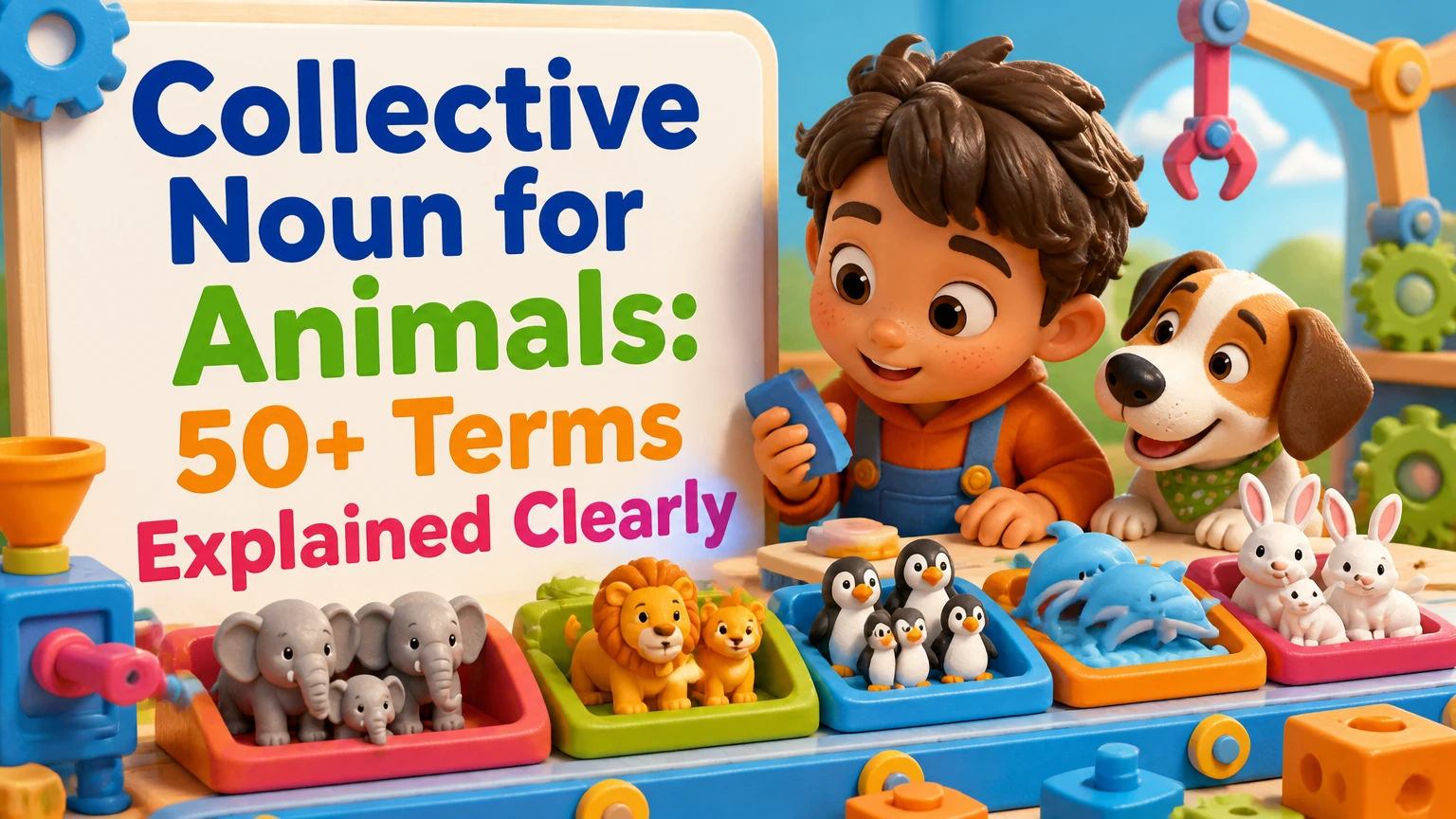
A collective noun for animals is a singular word or phrase that names a group of animals, such as herd, flock, pack, pod, or pride. The most accurate term depends on the species and sometimes the group’s activity or location, while poetic terms such as “murder of crows” are often literary rather than scientific.
Key Facts at a Glance
- Herd, flock, pack, school, and colony are widely understood general animal group nouns.
- A pride of lions, pod of dolphins, murmuration of starlings, and crash of rhinoceroses are species-specific terms.
- A collective noun can take a singular or plural verb in British English, depending on whether the group acts as one unit or as separate individuals.
- School usually describes fish moving together in a coordinated way; shoal can describe a looser group of fish.
- Many colorful terms of venery come from late-medieval English word lists, but some have limited historical evidence or are modern popular inventions.
- Formal scientific writing normally favors clear terms such as group, herd, colony, or population over rare poetic expressions.
What Is a Collective Noun for Animals?
A collective noun for animals names multiple individual animals as one grammatical or conceptual group. In “a herd of elephants,” herd is the collective noun, elephants identifies the species, and the complete noun phrase identifies the group.
Collective nouns do not always describe identical behavior. A flock may identify birds resting or flying, while a skein specifically describes geese in flight. A colony usually implies a stable breeding or living community, as with penguins, ants, or bats.
The most useful distinction is between ordinary group nouns and specialized or poetic terms. Ordinary terms are familiar and dependable. Specialized terms add imagery or cultural flavor, but they may be regional, old-fashioned, disputed, or unfamiliar to readers.
What Is a Term of Venery?
A term of venery is a traditional expression for a group of animals, especially one associated with medieval hunting and aristocratic vocabulary. Examples include a pride of lions, a parliament of owls, and a murder of crows.
The phrase is linked to the vocabulary of hunting, but the popular claim that every modern animal group term came from one authoritative medieval system is too strong. The Book of Saint Albans, printed in 1486 and traditionally associated with Dame Juliana Berners, helped preserve lists of hunting, hawking, and social terminology; it did not necessarily create or validate every term now found online.
Some expressions gained broad modern recognition through dictionaries, children’s books, quizzes, and popular reference lists. Others appear rarely outside trivia collections. Writers should therefore treat “term of venery” as a historical or literary label, not as proof that a word is standard zoological terminology.
How Were Animal Group Names Formed?
Animal collective nouns often arose from four associations:
| Association | Example | Interpretive link | Reliability note |
|---|---|---|---|
| Behavior | Shrewdness of apes | Perceived intelligence | Literary and traditional |
| Movement | Murmuration of starlings | Coordinated aerial motion | Widely recognized |
| Appearance | Flamboyance of flamingos | Striking color and shape | Popular modern usage |
| Sound or reputation | Murder of crows | Folklore and ominous symbolism | Conventional, not scientific |
These associations reveal human attitudes toward animals more than biological classification. A “murder” of crows does not mean crows commit murder, and a “parliament” of owls does not describe an actual governing structure.
What Are the Common Collective Nouns for Animals?
The most useful animal group nouns are herd, flock, pack, pod, school, colony, swarm, and troop. These terms are understood across most English-speaking contexts and are safer than rare expressions when clarity matters.
| General noun | Animals commonly associated with it | Typical context | Example |
|---|---|---|---|
| Herd | Cattle, elephants, deer, horses | Grazing, traveling, or living together | A herd of elephants crossed the road |
| Flock | Sheep, goats, birds | Ground, air, or managed groups | A flock of sheep entered the field |
| Pack | Wolves, dogs, coyotes | Social carnivores or domestic dogs | A pack of wolves moved through the forest |
| Pod | Whales, dolphins, seals | Marine mammals traveling together | A pod of dolphins surfaced |
| School | Fish, some marine animals | Coordinated swimming | A school of mackerel turned sharply |
| Colony | Ants, penguins, bats, seabirds | Established breeding or living site | A penguin colony occupied the shore |
| Swarm | Bees, insects | Dense, mobile group | A swarm of bees left the hive |
| Troop | Monkeys, apes, kangaroos | Social mammals | A troop of macaques rested in the trees |
A general noun is not automatically inferior. In a report about elephant conservation, elephant herd may communicate more efficiently than an uncommon poetic alternative. Precision means choosing a term that accurately conveys the intended setting, not selecting the strangest available word.
What Is a Group of Mammals Called?
Mammal groups use several familiar collective nouns, including herd, pack, troop, pride, crash, skulk, and mob. Species-specific terms are often memorable, but general terms remain correct when a specialized expression is uncertain or disputed.
| Animal | Common collective noun | Alternative or context-specific term | Usage status |
|---|---|---|---|
| Lions | Pride | Troop | Pride is widely recognized |
| Wolves | Pack | Route | Pack is standard; route is rare |
| Elephants | Herd | Parade | Herd is standard; parade is figurative |
| Dolphins | Pod | School, herd | Pod is widely used |
| Whales | Pod | Gam, herd | Pod is common; gam is specialized |
| Rhinoceroses | Crash | Herd | Crash is traditional; herd is clear |
| Foxes | Skulk | Leash, earth | Skulk is literary and less common |
| Kangaroos | Mob | Troop, court | Mob is widely recognized |
| Hippopotamuses | Herd | Bloat, thunder | Herd is safest in formal prose |
| Hyenas | Clan | Cackle | Clan reflects social structure; cackle is colorful |
| Bears | Sloth | Sleuth | Both are rare compared with group |
| Apes | Troop | Shrewdness | Troop is more natural in zoological writing |
A pride of lions is one of the strongest examples because the term is familiar, established, and frequently used in ordinary English. A crash of rhinoceroses is recognizable but more likely to appear in educational or playful writing than in a field report.
What Is a Group of Birds Called?
Bird groups are commonly called flocks, but species and activity can produce more specific expressions. A gaggle of geese usually refers to geese on land or water, whereas a skein of geese describes geese flying in formation.
| Bird | Collective noun | Activity or setting | Usage note |
|---|---|---|---|
| Crows | Murder | General group | Traditional and widely recognized |
| Ravens | Unkindness | General group | Literary and relatively rare |
| Starlings | Murmuration | Coordinated flight | Strong modern recognition |
| Owls | Parliament | General group | Popular traditional term |
| Geese | Gaggle | Ground or water | Common everyday expression |
| Geese | Skein | Flight | Specific and descriptive |
| Flamingos | Flamboyance | General group | Memorable, popular term |
| Peacocks | Ostentation | General group | Literary and humorous |
| Penguins | Colony | Breeding or living site | Zoologically useful |
| Swans | Bevy | General group | Traditional term |
| Crows or ravens | Flock | Any group | Safest neutral alternative |
| Ducks | Raft | Water | Common for floating ducks |
A murmuration of starlings refers to a large, coordinated flock performing rapid aerial movements. The term describes the visual phenomenon rather than a permanent social unit, so “murmuration” is most appropriate when the birds are actively flocking in the sky.
What Are Collective Nouns for Reptiles and Amphibians?
Reptile and amphibian group nouns include bask of crocodiles, army of frogs, knot of toads, and bale of turtles. These expressions vary more in familiarity and documentation than everyday terms such as group, nest, colony, or aggregation.
| Animal | Traditional term | Clear alternative | Reliability and context |
|---|---|---|---|
| Crocodiles | Bask | Group, congregation | Bask is traditional; often used near water |
| Frogs | Army | Chorus, aggregation | Army is playful; chorus emphasizes calling |
| Toads | Knot | Group, aggregation | Knot is rare |
| Snakes | Den | Nest, pit, bed | Den is common for overwintering snakes |
| Turtles | Bale | Nesting group, aggregation | Bale is traditional and uncommon |
| Tortoises | Creep | Group | Creep is rare and literary |
| Lizards | Lounge | Group | Lounge is popular but informal |
| Salamanders | Congress | Aggregation | Congress is rare; aggregation is scientific |
| Newts | Knot | Group | Knot is traditional but not universal |
The AI Overview’s “sakes” entry is incorrect. The animal name is snakes, and den, pit, or nest may be appropriate depending on species and setting. Scientific writing often uses aggregation when animals gather temporarily without forming a stable social group.
What Are Collective Nouns for Fish and Marine Animals?
Fish groups are commonly called a school or shoal, while marine mammals often form a pod. A school usually indicates coordinated movement in the same direction, whereas a shoal can mean any group of fish occupying the same area, including fish that are not synchronized.
| Animal | Collective noun | Context | Practical recommendation |
|---|---|---|---|
| Fish | School | Coordinated swimming | Use for synchronized movement |
| Fish | Shoal | Loose group or shared habitat | Use as the broader term |
| Sharks | Shiver | Traditional group term | Use in creative or educational writing |
| Dolphins | Pod | Traveling or social group | Natural and widely understood |
| Whales | Pod | Social or traveling group | Natural, especially for toothed whales |
| Jellyfish | Smack | Group in the water | Traditional and informal |
| Stingrays | Fever | Group | Rare, mainly trivia usage |
| Barracudas | Battery | Group | Rare and literary |
| Seals | Colony | Breeding or resting site | Pod may also appear in general usage |
| Salmon | Run | Seasonal migration | Run describes movement, not a stationary group |
The distinction between shoal and school is useful but not absolute in everyday English. Marine biologists may define schooling through coordinated behavior, while general dictionaries often record overlapping meanings. Use school for synchronized motion and shoal for a broader group when the behavior is unknown.
Are Collective Nouns Grammatically Singular?
Collective nouns can take singular or plural verbs depending on dialect and meaning. American English generally treats the group as a unit, as in “The pod of whales is migrating,” while British English can use a plural verb when emphasizing individual animals.
| Sentence | Variety or emphasis | Evaluation |
|---|---|---|
| The herd of deer is moving north. | Group as one unit | Standard in American English |
| The herd of deer are moving in different directions. | Individuals emphasized | Common in British English |
| A flock of geese was crossing the road. | One observed group | Clear and widely accepted |
| The flock were feeding separately. | Individual birds emphasized | More common in British usage |
| The school of fish is turning. | Coordinated unit | Natural in both varieties |
| The schools of fish are dispersing. | Multiple groups | Plural because the head noun is schools |
The verb agrees with the collective noun, not the following species noun. Therefore, “The pod of dolphins is approaching” is standard American usage, while “The pod of dolphins are approaching” follows a British plural-group interpretation.
For academic, business, or international writing, singular agreement is usually the least controversial choice when the group performs one coordinated action. A writer should not switch between singular and plural treatment without a change in meaning.
Which Animal Terms Are Standard and Which Are Poetic?
Standard collective nouns communicate reliably in formal writing; poetic terms create imagery but may require context. The best choice depends on audience, purpose, and whether the term describes a recognized biological group or merely a traditional expression.
| Term type | Examples | Recognition | Best setting |
|---|---|---|---|
| Widely standard | Herd, flock, pack, pod | High across English varieties | Reports, news, conversation |
| Common species-specific | Pride, colony, school, swarm | High to moderate | General education and fiction |
| Traditional poetic | Murder, parliament, ostentation | Moderate | Creative prose, quizzes, lessons |
| Rare venery | Bale, fever, battery, unkindness | Low | Trivia or historical writing |
| Scientific-neutral | Group, population, aggregation | High in technical contexts | Research and conservation |
| Figurative | Parade of elephants, raft of ducks | Context-dependent | Narrative and journalism |
A poetic term is not automatically more accurate. “A parliament of owls” adds personality, but “a group of owls” may be preferable in a wildlife survey where the number, location, and behavior matter more than wordplay.
When Should You Avoid a Rare Collective Noun?
Avoid a rare collective noun when readers may misunderstand the species, setting, or intended meaning. Use a neutral term if the expression appears only on unsourced listicles, conflicts across dictionaries, or describes an activity that the group is not performing.
The Oxford English Dictionary, major general dictionaries, specialist field guides, and reputable zoological sources provide stronger support than an unattributed online list. Even dictionary inclusion does not guarantee that a term is common. Frequency and audience familiarity still matter.
How Do Collective Nouns Differ by Context?
Animal group names can change with behavior, location, life stage, or purpose. The same animals may form a colony at a breeding site, a flock while feeding, or a flight while moving through the air.
| Animal or group | Context | Suitable term | Example |
|---|---|---|---|
| Geese | Resting on land | Gaggle | A gaggle of geese blocked the path |
| Geese | Flying overhead | Skein | A skein of geese crossed the moon |
| Ducks | Floating on water | Raft | A raft of ducks drifted near shore |
| Starlings | Coordinated aerial display | Murmuration | A murmuration formed at dusk |
| Penguins | Breeding settlement | Colony | The colony returned to the island |
| Fish | Synchronized movement | School | A school changed direction together |
| Fish | Loose local gathering | Shoal | A shoal gathered over the reef |
| Seals | Breeding or resting beach | Colony | A seal colony occupied the rocks |
Context-sensitive terms improve a sentence only when the context supports them. Calling every group of geese a “skein” is inaccurate if the birds are standing in a field, just as calling every group of fish a “school” may overstate coordinated behavior.
What Are the Most Common Mistakes?
The most common errors involve treating rare terms as universal rules, confusing a group noun with a habitat term, and assuming that every colorful expression has strong historical evidence. Clear alternatives usually solve the problem.
- Using “gaggle” for flying geese.
Use skein for geese in flight and gaggle for geese on the ground or water. - Treating “school” and “shoal” as identical.
Use school for coordinated movement and shoal for a broader or less synchronized gathering. - Assuming every term is scientifically official.
“Murder of crows” is a conventional English expression, not a taxonomic classification. - Using a plural verb automatically.
In American English, “The herd is grazing” is normally preferred when the herd acts as one unit. - Confusing a nesting site with a group noun.
Colony may describe an established breeding community, while aggregation can describe a temporary gathering. - Inventing a term in formal work.
If “a bunch of bears” sounds too casual, use a group of bears rather than an unsupported novelty.
A useful editorial rule is simple: if the term would distract a reader from the animal or event, replace it with a familiar noun.
How Can You Use These Terms in Different Types of Writing?
Use ordinary group nouns in scientific, legal, instructional, and news writing; reserve rare venery terms for creative, educational, historical, or recreational contexts. The decision should follow the reader’s need for clarity rather than the writer’s desire to display vocabulary.
| Audience or task | Recommended style | Example |
|---|---|---|
| Scientific report | Neutral and behavior-specific | An aggregation of turtles formed near the inlet |
| News report | Familiar and visual | A herd of elephants entered the village |
| Children’s lesson | Memorable but explained | A flamboyance of flamingos gathered by the lake |
| Fiction | Poetic when atmosphere matters | A skulk of foxes watched from the hedge |
| Trivia quiz | Traditional terms accepted | What is a group of ravens called? An unkindness |
| ESL classroom | High-frequency nouns first | Herd, flock, pack, pod, school |
A teacher can introduce one memorable term alongside its neutral equivalent. For example, “a murmuration of starlings” teaches vocabulary while “a flock of starlings” preserves everyday clarity.
Writers should also consider regional expectations. A term familiar in British children’s literature may sound unusual to an American reader, and a rare expression may need a nearby explanation.
How Can You Memorize Animal Collective Nouns?
Memorize animal collective nouns by grouping them into familiar categories, attaching each word to a visual image, and reviewing the terms with spaced repetition over several short sessions. A practical study set of 30-50 common terms can be learned in roughly 2-4 weeks with five-minute daily reviews.
Start with high-frequency categories:
- Mammals: pride, pack, herd, pod, troop, crash.
- Birds: flock, gaggle, skein, raft, murmuration, colony.
- Fish and marine life: school, shoal, pod, smack, shiver.
- Insects: swarm, hive, colony, kaleidoscope, army.
- Reptiles and amphibians: bask, knot, bale, den, chorus.
Use an image and a sentence rather than an isolated word. “A kaleidoscope of butterflies crossed the garden” is easier to retrieve than a flashcard containing only kaleidoscope.
Reference costs are optional. Free dictionary searches and library resources are sufficient for most learners; digital flashcard tools commonly cost $0-$25 per year, while illustrated reference books typically cost about $15-$50 depending on edition and format. No paid resource guarantees that a rare term is historically or scientifically dependable.
Are Animal Collective Nouns Always Historically Authentic?
Animal collective nouns are not always historically authentic, uniformly documented, or widely used. Some terms have medieval or early-modern attestations, while others became popular through twentieth-century compilations, children’s books, trivia pages, or modern internet repetition.
A responsible source check asks four questions:
- Does a reputable dictionary record the term?
- Does the source identify a historical citation or usage context?
- Do several independent reference works agree?
- Does the term describe the animal group’s actual setting or behavior?
Terms such as pride, pack, pod, flock, and school have strong practical legitimacy. Expressions such as fever of stingrays, battery of barracudas, and bale of turtles may be recognized traditional terms, but they are poor choices when the audience needs unambiguous technical communication.
The safest wording is often “a traditional term for a group of…” rather than “the official name for…”. Zoology does not maintain one universal authority that assigns a mandatory collective noun to every species.
Quick Reference: 50 Animal Group Names
| Animal | Collective noun | Animal | Collective noun |
|---|---|---|---|
| Apes | Troop, shrewdness | Ants | Colony, army |
| Bears | Sloth, sleuth | Bees | Swarm |
| Birds | Flock | Butterflies | Kaleidoscope |
| Barracudas | Battery | Caterpillars | Army |
| Cattle | Herd | Crows | Murder |
| Crocodiles | Bask | Deer | Herd |
| Dolphins | Pod | Ducks | Raft |
| Elephants | Herd, parade | Flamingos | Flamboyance |
| Foxes | Skulk | Frogs | Army, chorus |
| Geese | Gaggle, skein | Hippopotamuses | Herd, bloat |
| Hyenas | Clan, cackle | Jellyfish | Smack |
| Kangaroos | Mob | Lions | Pride |
| Locusts | Plague, swarm | Monkeys | Troop |
| Owls | Parliament | Peacocks | Ostentation |
| Penguins | Colony, rookery | Rhinoceroses | Crash |
| Salmon | Run | Sharks | Shiver |
| Snakes | Den, pit | Starlings | Murmuration |
| Stingrays | Fever | Swans | Bevy |
| Toads | Knot | Turtles | Bale |
| Whales | Pod, gam | Wolves | Pack |
| Zebras | Dazzle, herd | Seals | Colony |
The table includes both everyday and traditional terms. Dazzle of zebras, for example, is memorable but less dependable than herd of zebras in formal prose. “Rookery” can describe a breeding site for penguins and other colonial animals, so the surrounding context determines whether it means a location, a group, or both.
FAQ
What is the general word for a group of animals?
The general word is group, but the best familiar collective noun depends on the animal. Use herd for many hoofed mammals, flock for birds or sheep, pack for wolves and dogs, pod for dolphins and whales, school for coordinated fish, and colony for animals living or breeding together in one site.
What is the rarest animal collective noun?
No single term can be identified objectively as the rarest because usage frequency varies by region, source, and animal category. Battery of barracudas, fever of stingrays, and bale of turtles are much less common in ordinary prose than herd, flock, or group, so they are best treated as trivia or literary vocabulary.
Is a murder of crows grammatically correct?
Yes, a murder of crows is grammatically correct as a traditional collective noun. The expression is conventional and often used in creative or educational writing, although it does not describe a scientific behavior or imply that crows engage in murder. A flock of crows is the clearer neutral alternative.
What is a group of snakes called?
A group of snakes may be called a den, pit, nest, or bed, depending on the source and context. Den works especially well for snakes gathering in an overwintering shelter, while nest can describe a breeding or egg-laying context. A group of snakes remains the safest universal wording.
What is the difference between a herd and a flock?
A herd commonly refers to mammals such as cattle, horses, deer, and elephants, while a flock commonly refers to birds or sheep. English usage has exceptions, and the nouns reflect convention rather than a strict biological rule. When uncertain, identify the species and use group.
Should collective nouns be used in formal essays?
Use familiar collective nouns in formal essays when they improve precision, such as herd of elephants, colony of penguins, or school of fish. Avoid rare terms when they may confuse readers or lack reliable documentation. A scientific essay should prioritize measurable behavior, location, and population data over decorative vocabulary.
The Bottom Line
The best collective noun for animals depends on species, behavior, setting, audience, and dialect. Herd, flock, pack, pod, school, and colony provide dependable everyday choices, while pride, murmuration, murder, crash, and flamboyance add traditional or literary detail.
Use a rare term when its meaning is established and its effect helps the reader. If clarity matters more than wordplay, choose the familiar term. A collective noun for animals is useful language, not a compulsory zoological label.