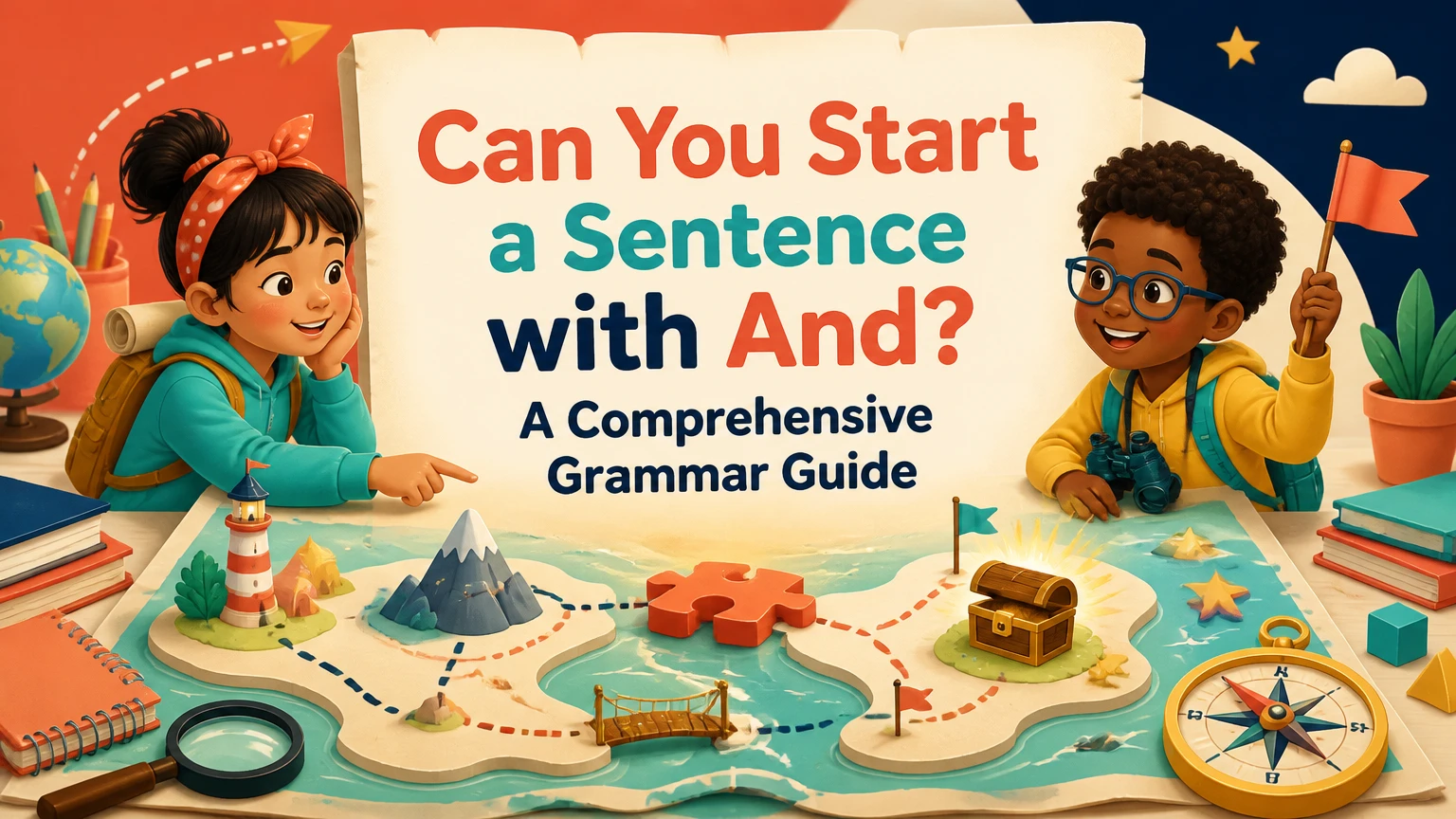
The question of whether one can begin a sentence with the word “and” is one of the most enduring myths in English grammar, often rooted in early classroom instructions designed to prevent simplistic writing. In reality, starting a sentence with a coordinating conjunction is a perfectly acceptable and stylistically effective practice used by professional writers, journalists, and novelists to create emphasis or improve flow. This linguistic technique involves using conjunctions like and, but, or, so, and yet at the beginning of a sentence to link it to the preceding thought. Understanding when and how to use this construction allows writers to control the rhythm of their prose, making it an essential skill for anyone looking to move beyond basic composition to more sophisticated, nuanced communication. By mastering this “rule-breaking” technique, students and professionals alike can develop a more engaging and conversational voice in their written work.
Table of Contents
- Definition and Linguistic Function
- The History of the “Rule”
- Structural Breakdown of Sentence-Starting Conjunctions
- Types and Categories of Usage
- Extensive Examples and Tables
- Usage Rules and Stylistic Guidelines
- Common Mistakes and How to Avoid Them
- Advanced Topics: Rhetoric and Rhythm
- Practice Exercises
- Frequently Asked Questions (FAQ)
- Conclusion
Definition and Linguistic Function
To understand why we can start a sentence with “and,” we must first define its primary role as a coordinating conjunction. A coordinating conjunction is a word that connects words, phrases, or clauses of equal grammatical importance. The most common acronym used to remember these is FANBOYS, which stands for For, And, Nor, But, Or, Yet, and So.
When “and” appears at the start of a sentence, it functions as a transitional element. Linguistically, this is known as an “initial conjunction.” Its purpose is to signal a continuation of the previous thought while providing a rhythmic break that a comma or a semicolon might not achieve. It creates a cumulative effect, suggesting that the information following “and” is an important addition or an afterthought that deserves its own sentence for emphasis.
In formal linguistics, this is often discussed in the context of “cohesion.” Cohesion refers to the grammatical and lexical linking within a text or sentence that holds a discourse together and gives it meaning. Using “and” at the start of a sentence is a cohesive device that points backward to the previous sentence while pushing the reader forward into the next. It bridges the gap between ideas without merging them into a single, potentially over-complicated sentence.
The History of the “Rule”
If starting a sentence with “and” is grammatically correct, why do so many people believe it is a mistake? The “rule” against it is what grammarians call a “superstition” or a “shibboleth.” It likely originated in the 19th century with schoolteachers who were trying to discourage children from writing repetitive, “stringy” sentences. Children often tell stories by saying, “And then we went to the park. And then we saw a dog. And then we had ice cream.”
By telling students they could never start a sentence with “and,” teachers forced them to use more complex sentence structures and varied transitions. Over time, this pedagogical shortcut was mistaken for an absolute rule of the English language. However, major style guides such as The Chicago Manual of Style, The Oxford English Dictionary, and Garner’s Modern American Usage all explicitly state that there is no historical or grammatical foundation for the prohibition.
Great writers throughout history have ignored this supposed rule. From the King James Bible to the works of William Shakespeare, Ernest Hemingway, and Virginia Woolf, the initial “and” has been used to create poetic resonance, biblical weight, or modern brevity. It is a tool of the trade, not a sign of poor education.
Structural Breakdown of Sentence-Starting Conjunctions
When we analyze the structure of a sentence starting with “and,” we look at how it relates to the surrounding text. Unlike a standard sentence that stands entirely on its own, a sentence starting with a conjunction is “context-dependent.” It requires the preceding sentence to make full sense to the reader.
Structurally, “And” acts as a bridge. If you have Sentence A and Sentence B, placing “And” at the start of Sentence B creates a stronger link than a period alone, but a more significant pause than a comma. It effectively turns Sentence B into a “supplementary” independent clause. While it is grammatically independent because it contains a subject and a verb, it is semantically dependent on what came before.
Another structural consideration is punctuation. A common question is whether a comma should follow “and” at the start of a sentence. In most cases, the answer is no. You should only use a comma after an initial “and” if it is followed by an intervening parenthetical phrase. For example: “And, despite the rain, we continued our walk.” Without that parenthetical phrase, the comma is unnecessary and interrupts the flow.
Types and Categories of Usage
Starting a sentence with “and” can serve several different rhetorical and stylistic purposes. Understanding these categories helps a writer decide when the technique is appropriate and when it might be overused.
1. Creating Emphasis
The most common reason to start a sentence with “and” is to give the following information more weight. By placing a period before the conjunction, the writer forces the reader to pause. This pause highlights the second idea as something distinct and important. For instance: “He lost his job, his house, and his car. And he didn’t care.” The separate sentence makes the lack of caring much more impactful.
2. Improving Readability
Sometimes, a sentence becomes too long and “leggy” if all related ideas are joined by commas and conjunctions. Breaking a long sentence into two, starting the second with “and,” can make the text easier to digest. This is particularly useful in complex technical writing or long narrative passages where the reader might lose track of the subject.
3. Conversational Tone
In modern blogging, email communication, and creative non-fiction, an initial “and” creates a friendly, accessible tone. It mimics the way people actually speak. In natural conversation, we frequently start thoughts with “and” or “but.” Using this in writing makes the author seem more relatable and less formal, which is often desirable in contemporary media.
4. Narrative Pacing
In fiction, the rhythm of sentences is crucial. Short sentences starting with “and” can speed up the pace of an action scene or create a sense of mounting tension. Conversely, they can be used in descriptive passages to create a sense of abundance or an “and-then-some” feeling, mimicking the way a person’s eyes might take in a scene bit by bit.
Extensive Examples and Tables
To truly master the use of “and” at the beginning of a sentence, it helps to see it in various contexts. The following tables provide a wide range of examples, comparing traditional structures with the more modern, emphatic “and” structure.
The table below demonstrates how breaking a compound sentence into two sentences using an initial “and” can change the tone and emphasis of the message. These examples are particularly useful for understanding the transition from academic to creative writing styles.
| Traditional Compound Sentence | Sentence Starting with “And” | Effect of the Change |
|---|---|---|
| The storm lasted all night, and the streets were flooded by morning. | The storm lasted all night. And the streets were flooded by morning. | Increases the sense of aftermath and drama. |
| She finished her degree, and she immediately applied for a PhD. | She finished her degree. And she immediately applied for a PhD. | Emphasizes her speed and determination. |
| We checked the map, and we realized we were completely lost. | We checked the map. And we realized we were completely lost. | Heightens the realization and the tension of the moment. |
| The cake looked delicious, and it tasted even better. | The cake looked delicious. And it tasted even better. | Adds a “bonus” feel to the second statement. |
| He promised to call, and he actually kept his word. | He promised to call. And he actually kept his word. | Highlights the surprise or reliability of the action. |
| The project was over budget, and it was three months late. | The project was over budget. And it was three months late. | Stresses the severity of the failure. |
| I opened the box, and a swarm of bees flew out. | I opened the box. And a swarm of bees flew out. | Creates a cinematic “cut” between the action and result. |
| They traveled to Paris, and they fell in love with the city. | They traveled to Paris. And they fell in love with the city. | Separates the journey from the emotional outcome. |
| The software is easy to use, and it is completely free. | The software is easy to use. And it is completely free. | Makes the “free” aspect stand out as a major selling point. |
| She looked at the clock, and she knew she was in trouble. | She looked at the clock. And she knew she was in trouble. | Emphasizes the moment of realization. |
| The sun began to set, and the sky turned a deep purple. | The sun began to set. And the sky turned a deep purple. | Slows the pace to appreciate the visual detail. |
| He studied for weeks, and he still failed the exam. | He studied for weeks. And he still failed the exam. | Accentuates the frustration and irony. |
| The movie was long, and it was incredibly boring. | The movie was long. And it was incredibly boring. | Separates length from quality for added impact. |
| We ate at the new bistro, and we had a wonderful time. | We ate at the new bistro. And we had a wonderful time. | Focuses on the positive experience as a distinct thought. |
| She saved every penny, and she finally bought the car. | She saved every penny. And she finally bought the car. | Highlights the culmination of a long process. |
| The dog barked at the mailman, and the mailman just laughed. | The dog barked at the mailman. And the mailman just laughed. | Contrasts the two actions more sharply. |
| I forgot my umbrella, and then it started to pour. | I forgot my umbrella. And then it started to pour. | Emphasizes the “bad luck” timing. |
| The team played well, and they won the championship. | The team played well. And they won the championship. | Celebrates the victory as a standalone achievement. |
| He spoke for an hour, and nobody understood a word. | He spoke for an hour. And nobody understood a word. | Draws attention to the futility of the speech. |
| The garden was messy, and the weeds were taking over. | The garden was messy. And the weeds were taking over. | Creates a sense of growing neglect. |
In the next table, we examine the use of “and” at the start of a sentence in various professional and creative contexts. This helps illustrate that the rule is not just for fiction but has a place in persuasive writing and journalism as well.
| Context | Example Sentence | Reasoning |
|---|---|---|
| Journalism | The mayor denied the allegations. And yet, the evidence continues to mount. | Creates a dramatic transition between a claim and a fact. |
| Advertising | Our new moisturizer hydrates your skin. And it smells like summer. | Highlights a secondary benefit in a punchy, memorable way. |
| Fiction | He walked into the dark hallway. And he heard a floorboard creak. | Increases suspense by isolating the scary sound. |
| Business Email | I have attached the report. And I look forward to your feedback. | Creates a polite but clear separation between the action and the request. |
| Academic Essay | The data suggests a correlation. And this finding aligns with previous studies. | Connects a specific result to the broader literature for emphasis. |
| Public Speaking | We must act now. And we must act together. | Uses rhetorical repetition (anaphora) for persuasive power. |
| Recipe Writing | Whisk the eggs until fluffy. And don’t forget the pinch of salt. | Ensures a crucial step isn’t missed in a long list of instructions. |
| Travel Blogging | The mountain was steep. And the view from the top was breathtaking. | Contrasts the struggle with the reward. |
| Legal Writing (Modern) | The defendant was present. And he was aware of the consequences. | Clearly delineates separate points of fact in a sequence. |
| Social Media | I just finished my first marathon! And I’m already planning the next one. | Conveys excitement and a “stream of consciousness” feel. |
| Technical Manual | Press the red button. And wait for the light to turn green. | Breaks down a process into distinct, manageable steps. |
| Personal Letter | I miss our long talks. And I hope we can see each other soon. | Gives the wish for a meeting its own emotional space. |
| Political Speech | We fought for freedom. And we won that freedom. | Reinforces a message through rhythmic structure. |
| Book Review | The plot is intricate. And the characters are deeply relatable. | Provides a balanced, two-part praise of the work. |
| Science Writing | The reaction was instantaneous. And the results were surprising. | Highlights the unexpected nature of the outcome. |
| Instructional Design | Read the chapter first. And then take the practice quiz. | Clearly sequences learning activities. |
| Opinion Column | The policy is flawed. And everyone knows it. | Adds a blunt, assertive punch to the argument. |
| Short Story | She waited by the window. And she watched the rain fall. | Creates a quiet, contemplative mood. |
| Product Description | This laptop is lightweight. And it has a 20-hour battery life. | Focuses on two key selling points individually. |
| Motivational Quote | Believe in yourself. And the world will believe in you. | Creates a cause-and-effect relationship with impact. |
The following table provides 20 additional examples where starting a sentence with “and” improves the flow and clarity of a narrative. This is particularly relevant for creative writers who want to avoid repetitive sentence structures.
| Narrative Sequence | Improved with “And” |
|---|---|
| The door opened. And a cold wind blew in. | The moon rose. And the wolves began to howl. |
| He took a deep breath. And he jumped. | The music stopped. And the room went silent. |
| She looked at the photo. And she started to cry. | The clock struck twelve. And the magic faded. |
| They reached the summit. And the world lay below them. | He turned the key. And the engine roared to life. |
| The letter arrived. And everything changed. | She closed her eyes. And she drifted off to sleep. |
| The fire crackled. And the shadows danced on the wall. | He whispered her name. And she turned around. |
| The rain stopped. And a rainbow appeared. | They walked for hours. And they never said a word. |
| The phone rang. And he knew it was bad news. | The curtains opened. And the audience cheered. |
| She found the lost ring. And she felt a sense of relief. | The bird took flight. And it soared into the blue. |
| He finished the race. And he collapsed in exhaustion. | The cake was ready. And the smell filled the house. |
Usage Rules and Stylistic Guidelines
While starting a sentence with “and” is grammatically correct, it should be used with intention. Like any stylistic device, it can lose its power if overused. Here are the core guidelines for using this construction effectively.
1. Ensure the Sentence is Complete
Even though the sentence starts with a conjunction, it must still be a complete sentence. This means it must contain a subject and a verb. For example, “And he ran” is a complete sentence (Subject: he, Verb: ran). However, “And running down the street” is a fragment because it lacks a finite verb and a clear subject performing the action. Always check that your “And” sentence can stand on its own grammatically, even if it depends on the previous sentence for context.
2. Use for Emphasis, Not Just Connection
Before starting a sentence with “and,” ask yourself: “Does this idea deserve its own sentence?” If the two ideas are closely related and of equal weight, a comma and “and” within a single sentence are often better. Use the sentence break when you want to create a dramatic pause or highlight the second point as a significant addition or a surprising twist.
3. Consider Your Audience and Medium
While the “rule” against starting with “and” is a myth, some very formal or traditional readers still perceive it as a mistake. If you are writing a strictly formal academic paper for a conservative professor, or a high-stakes legal document, you might choose to avoid this construction to prevent any bias from the reader. However, in journalism, business, fiction, and general non-fiction, it is widely accepted.
4. Avoid Overuse
If every third sentence in your paragraph starts with “and,” your writing will become repetitive and lose its impact. It will start to sound like the very “childlike” prose that teachers were trying to prevent. Use it sparingly—perhaps once or twice in a longer piece—to ensure that when you do use it, the reader takes notice.
Common Mistakes and How to Avoid Them
Even though the practice is allowed, there are several ways writers can go wrong when starting sentences with “and.” Recognizing these pitfalls is key to maintaining a professional writing style.
The most frequent mistake is the Sentence Fragment. Many writers forget that the word “and” doesn’t excuse them from basic sentence structure. If you write “And the red car,” you have a noun phrase, but no action. This is a fragment and should generally be avoided unless you are writing very experimental fiction.
Another mistake is Punctuation Errors. As mentioned earlier, many people feel the need to put a comma after “And” at the start of a sentence. Unless there is a specific reason for a pause (like a parenthetical phrase), this is incorrect. It creates an unnecessary stutter in the reader’s mind. “And, we went home” is incorrect; “And we went home” is correct.
| Incorrect/Weak Usage | Correct/Strong Usage | Explanation |
|---|---|---|
| I like apples. And oranges. | I like apples and oranges. | “And oranges” is a fragment. It’s better as one sentence. |
| And, he finally arrived. | And he finally arrived. | No comma is needed after “And” in this context. |
| We went to the store. And we bought milk. And we came home. And we ate. | We went to the store and bought milk. Then we came home and ate. | Overuse of “And” makes the writing sound repetitive and immature. |
| The sky was blue. And the sun was bright. | The sky was blue, and the sun was bright. | These ideas are too simple to require separate sentences for emphasis. |
| And the man with the hat. | And the man with the hat stepped forward. | Turned a fragment into a complete sentence with a verb. |
Advanced Topics: Rhetoric and Rhythm
For advanced writers, starting a sentence with “and” is less about grammar and more about rhetoric. Rhetoric is the art of persuasive or effective speaking and writing. In this context, the initial “and” is a tool for controlling the reader’s emotional response and the “music” of the prose.
Polysyndeton
Polysyndeton is a rhetorical technique where several coordinating conjunctions are used in succession in order to achieve an artistic effect. While often used within a single sentence (e.g., “I am taking history and math and science and art”), it can also be used across sentence boundaries. Starting several consecutive sentences with “and” can create a sense of overwhelm, a feeling of an endless list, or a biblical, authoritative tone. This is a sophisticated move that should be used with great care.
The “Breath” of the Sentence
In literary analysis, we often talk about the “breath” of a sentence—how long a reader can go before needing a mental pause. A period provides a full breath. When you start with “and,” you are giving the reader a full breath but then immediately re-establishing the connection to the previous thought. This creates a specific rhythmic “beat” that is different from the “half-breath” of a comma or the “balanced breath” of a semicolon. Mastering these micro-pauses is what separates good writers from great ones.
Breaking the “And” Habit in Revision
Advanced writers also know when to remove an initial “and.” During the revision process, if you find you’ve used an initial “and,” try reading the passage without it. Does the meaning change? Does the rhythm suffer? If the passage is just as strong without the “and,” it’s often better to remove it. This ensures that every “and” you keep is doing significant work for the text.
Practice Exercises
Test your understanding of the rules and stylistic nuances of starting a sentence with “and” with the following exercises. These are designed to help you distinguish between effective usage, fragments, and over-repetition.
Exercise 1: Fragment or Complete Sentence?
Identify whether the following “And” sentences are grammatically complete or are fragments.
| Sentence | Status (Complete/Fragment) |
|---|---|
| And the rain fell for three days. | Complete |
| And the dark, mysterious stranger in the corner. | Fragment |
| And she knew exactly what to do. | Complete |
| And because he was late to the meeting. | Fragment |
| And they lived happily ever after. | Complete |
| And the smell of fresh cookies. | Fragment |
| And he didn’t even say goodbye. | Complete |
| And to think we almost missed the flight! | Fragment (Infinitive phrase) |
| And the results were better than expected. | Complete |
| And running as fast as his legs would carry him. | Fragment |
Exercise 2: Improving Flow
Rewrite the following pairs of sentences to use “And” at the start of the second sentence for better emphasis. Then, explain why the change works.
- The mountain was tall. It was also very dangerous.
- She won the lottery. She gave half the money to charity.
- The coffee was cold. It tasted like burnt rubber.
- He forgot his keys. He also forgot his wallet.
- The movie ended. The audience sat in silence.
Exercise 3: Punctuation Correction
Correct the punctuation in the following sentences. Some may be correct as they are.
- And, then the lights went out.
- And despite the cold we went for a swim.
- And, surprisingly, she arrived on time.
- And I told him, that I was leaving.
- And the dog barked, all night long.
Frequently Asked Questions (FAQ)
1. Is it ever “wrong” to start a sentence with and?
Grammatically, no. Stylistically, yes. It is “wrong” if it creates a sentence fragment (a sentence without a subject or verb) or if it is overused to the point of making the writing sound repetitive and immature. It may also be considered “wrong” in extremely formal or old-fashioned academic environments where the “no-and-at-the-start” superstition is still strictly enforced.
2. Should I put a comma after “And” at the beginning of a sentence?
In most cases, no. You should only use a comma if it is necessary for a parenthetical or introductory phrase that follows. For example: “And, to be honest, I was relieved.” If the sentence is straightforward, like “And he left,” no comma is needed. Adding an unnecessary comma creates a clunky, unnatural pause.
3. What is the difference between starting a sentence with “And” and “But”?
Both are coordinating conjunctions and follow the same rules. “And” suggests addition or continuation, while “But” suggests contrast or contradiction. Both are effective for creating emphasis. Starting with “But” is often even more common in professional writing because it signals a sharp turn in the argument or narrative.
4. Can I use “And” at the start of a paragraph?
Yes, you can. Starting a paragraph with “And” is a very strong stylistic choice. it suggests that the entire upcoming paragraph is an extension or an “extra” point related to the previous paragraph. It is often used in persuasive writing to build momentum or in storytelling to show a significant shift in time or perspective while maintaining a thematic link.
5. Why did my teacher tell me not to do this?
Teachers often use “simplified rules” to help students avoid common mistakes. When you are learning to write, you might rely too heavily on “and” to connect every thought. By banning the practice, teachers force you to learn more complex ways of connecting ideas, such as using “furthermore,” “moreover,” or “consequently.” Once you have mastered those, you can return to using “and” with more skill and intention.
6. Are there better words to use than “And” at the start of a sentence?
It depends on the context. If you want to sound more formal, you might use “Furthermore,” “In addition,” “Additionally,” or “Moreover.” If you want to sound more conversational or create more dramatic impact, “And” is often the better choice. The key is to choose the word that best fits the tone of your writing.
7. Does this rule apply to other conjunctions like “Or” or “So”?
Yes. All coordinating conjunctions (FANBOYS) can technically start a sentence. “So” is very common in conversational writing (“So, what happened next?”). “Or” is frequently used in rhetorical questions or to offer a dramatic alternative (“Or was it all a dream?”). The same guidelines for emphasis and avoiding fragments apply to all of them.
8. Is this practice common in British English as well as American English?
Yes, starting a sentence with a conjunction is a standard feature of the English language globally. While some regional style guides might have slight preferences, the major authorities in both the UK and the US agree that the prohibition is a myth. You will find it in the works of Charles Dickens and Winston Churchill just as often as in American literature.
Conclusion
In summary, the idea that you cannot start a sentence with “and” is a persistent grammar myth rather than a rule of the English language. When used correctly, an initial “and” is a powerful tool for creating emphasis, controlling narrative pacing, and establishing a conversational tone. It allows writers to break up long, complex thoughts while maintaining a clear cohesive link to the preceding context. However, like any stylistic device, it requires a balance of subject-verb agreement and a keen sense of rhythm. By understanding the history of this “rule” and the practical benefits of breaking it, you can write with more confidence and clarity. Remember to avoid fragments, use the construction sparingly for maximum impact, and always consider the expectations of your specific audience. Mastery of the initial “and” is a sign of a writer who understands not just the rules of grammar, but the art of communication.