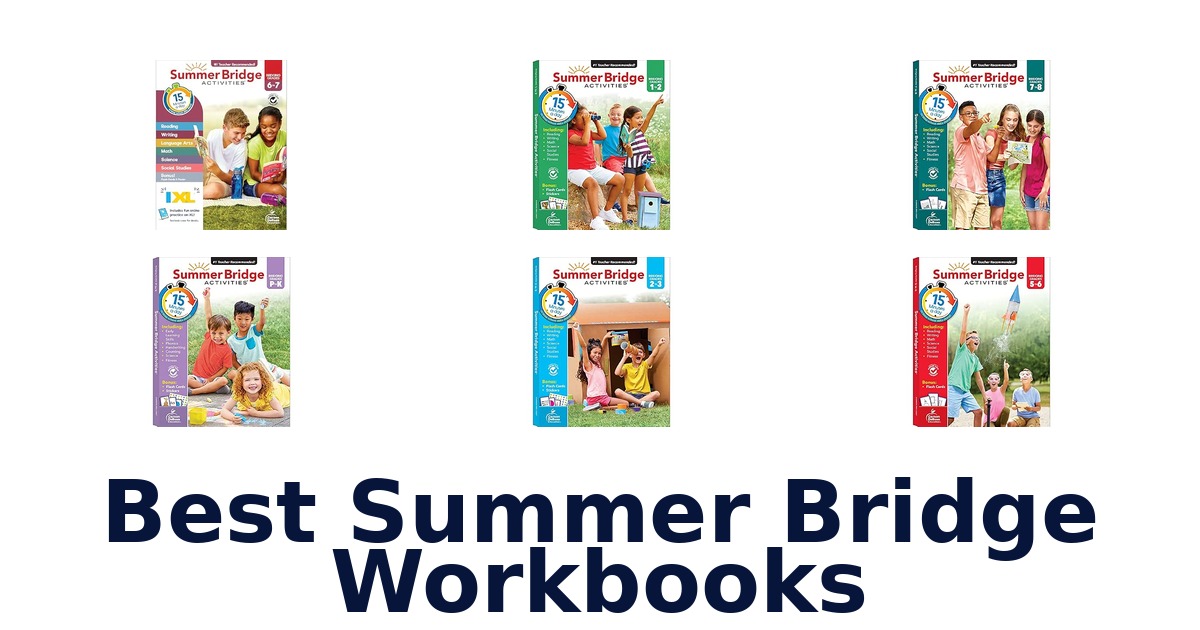
A strong summer bridge workbook keeps a student practicing across the summer while matching the grade they are about to enter. This Summer Bridge Activities selection covers transitions from preschool to kindergarten through seventh to eighth grade, with options spanning core subjects and extras such as flash cards, stickers, and fitness activities. The listed materials describe a goal of 15 minutes of learning a day, which can help families plan a short, regular routine.
Grade fit matters most: the right title is the one written for your child’s next transition, not simply the one with the longest subject list. Use the comparison below to narrow the choices by incoming grade, then check the specific subject coverage and components listed for that edition before buying.
For a broad, early-elementary option, Summer Bridge Kindergarten to 1st Grade is the best overall choice in this group. Its listed coverage includes math, phonics, science, social studies, writing practice, and fitness, plus flash cards and stickers. The series describes a 15-minutes-a-day summer learning approach.
Choose it for a child moving from kindergarten into first grade; students entering a different grade should use the matching transition workbook instead, since these books are organized around specific grade changes.
Our Top Picks
 Best Overall
Summer Bridge Kindergarten to 1st Grade
Covers math, phonics, science, social studies, writing practice, and fitness, with flash cards and stickers for the kindergarten-to-first-grade transition.
View on Amazon Best Early Elementary
Summer Bridge 1st to 2nd Grade
Combines math, language arts, reading comprehension, science, social studies, writing, and fitness with flash cards and stickers.
View on Amazon Best Subject Range
Summer Bridge 2nd to 3rd Grade
Offers math, reading comprehension, science, social studies, writing practice, and fitness, plus flash cards for students moving into third grade.
View on Amazon- Best Fifth-Grade Prep Summer Bridge 4th to 5th Grade Volume 6
- Best Middle-School Bridge Summer Bridge 5th to 6th Grade
Compare These Summer Bridge Workbooks by Grade Transition
| # | Product | Buy |
|---|---|---|
| 1 | 1. Summer Bridge Kindergarten to 1st GradeBest Overall | View on Amazon |
| 2 | 2. Summer Bridge 1st to 2nd GradeBest Early Elementary | View on Amazon |
| 3 | 3. Summer Bridge 2nd to 3rd GradeBest Subject Range | View on Amazon |
| 4 |  4. Summer Bridge 3rd to 4th GradeFor the Grade 3-to-4 transition 4. Summer Bridge 3rd to 4th GradeFor the Grade 3-to-4 transition | View on Amazon |
| 5 | 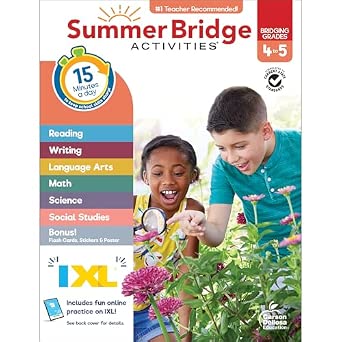 5. Summer Bridge 4th to 5th Grade Volume 5For rising fifth graders 5. Summer Bridge 4th to 5th Grade Volume 5For rising fifth graders | View on Amazon |
| 6 |  6. Summer Bridge 4th to 5th Grade Volume 6Best Fifth-Grade Prep 6. Summer Bridge 4th to 5th Grade Volume 6Best Fifth-Grade Prep | View on Amazon |
| 7 |  7. Summer Bridge 5th to 6th GradeBest Middle-School Bridge 7. Summer Bridge 5th to 6th GradeBest Middle-School Bridge | View on Amazon |
| 8 |  8. Summer Bridge 6th to 7th GradeFor rising seventh graders 8. Summer Bridge 6th to 7th GradeFor rising seventh graders | View on Amazon |
| 9 |  9. Summer Bridge 7th to 8th GradeFor rising eighth graders 9. Summer Bridge 7th to 8th GradeFor rising eighth graders | View on Amazon |
| 10 |  10. Summer Bridge Preschool to KindergartenFor preschool-to-kindergarten practice 10. Summer Bridge Preschool to KindergartenFor preschool-to-kindergarten practice | View on Amazon |
Detailed Reviews: Best Summer Bridge Workbooks
#1 · Best Overall
1. Summer Bridge Kindergarten to 1st Grade
Best for: For the kindergarten-to-first bridge.
Why it ranks #1: Covers math, phonics, science, social studies, writing practice, and fitness, with flash cards and stickers for the kindergarten-to-first-grade transition.
Phonics is a defining part of this kindergarten-to-first-grade workbook, alongside math, science, social studies, writing practice, fitness, flash cards, and stickers. Its 15-minute-a-day summer approach gives families a straightforward structure for a soon-to-be first grader’s activities across early academic subjects and more.
The 15-minutes-a-day approach provides a clear scale for summer sessions, and the combination of phonics and math speaks directly to early academic practice. Science and social studies extend the subject mix, while writing practice adds another skill area. Fitness introduces an activity beyond desk work, and flash cards and stickers offer additional materials within the workbook’s listed scope. Its kindergarten-to-first-grade focus makes it especially relevant to that school transition.
- Targets the kindergarten-to-first-grade transition
- Includes phonics and math
- Adds science, social studies, and writing practice
- Includes fitness, flash cards, and stickers
- Its grade focus is limited to the kindergarten-to-first-grade transition.
Skip it if you need a workbook for a later grade; this one is targeted to the kindergarten-to-first-grade bridge.
Choose this for a soon-to-be first grader who needs summer activities in phonics, math, and other listed subjects. Its best fit is the kindergarten-to-first-grade transition, not practice aimed at older students.
View on Amazon#2 · Best Early Elementary
2. Summer Bridge 1st to 2nd Grade
Best for: For rising second graders.
Why it ranks #2: Combines math, language arts, reading comprehension, science, social studies, writing, and fitness with flash cards and stickers.
The Grade 1-to-2 workbook combines writing practice and flash cards with math, language arts, reading comprehension, science, social studies, and fitness. Its 15-minute-a-day summer approach gives families a defined way to fit varied activities into the transition toward second grade.
A 15-minutes-a-day format offers a manageable framework for summer learning, while the listed math, language arts, and reading comprehension activities cover several academic areas in one workbook. Science and social studies widen that mix, and writing practice adds a dedicated literacy component. Fitness gives children an activity beyond academic practice; flash cards and stickers provide additional formats. The content is targeted to the move from first grade into second grade.
- Targets the Grade 1-to-2 transition
- Includes math, language arts, and reading comprehension
- Covers science, social studies, and writing practice
- Adds fitness, flash cards, and stickers
- Its grade focus is limited to the first-to-second-grade transition.
Skip it if you need summer activities for a different grade span; this workbook targets children moving from first to second grade.
Consider it for a soon-to-be second grader whose summer practice should span academics, writing, and fitness. Its grade-specific content fits the move from first grade to second, rather than a broader age range.
View on Amazon#3 · Best Subject Range
3. Summer Bridge 2nd to 3rd Grade
Best for: For rising third graders.
Why it ranks #3: Offers math, reading comprehension, science, social studies, writing practice, and fitness, plus flash cards for students moving into third grade.
Reading comprehension and flash cards headline this Grade 2-to-3 workbook’s mix, which also includes math, science, fitness, social studies, and writing practice. The 15-minute-a-day approach gives families a defined summer routine for a child preparing to enter third grade.
The suggested 15 minutes a day gives summer practice a clear, compact structure, while math and reading comprehension cover two core areas in the same workbook. Science and social studies broaden the academic mix, and writing practice adds a separate literacy activity. Fitness offers variety beyond academic pages, with flash cards providing another way to review. The grade-specific content is aimed at children moving from second grade into third.
- Targets the Grade 2-to-3 transition
- Includes math and reading comprehension
- Covers science, social studies, and writing practice
- Adds fitness activities and flash cards
- Its grade focus is limited to the second-to-third-grade transition.
Skip it if you need summer practice for another grade transition; this workbook targets children moving from second to third grade.
This suits a soon-to-be third grader whose family wants short daily sessions across academic subjects, fitness, and flash cards. Its defined fit is the summer bridge from second grade to third.
Listed on Amazon as: Summer Bridge Activities 2nd to 3rd Grade Workbooks, Activity Book with Math, Reading Comprehension, Science, Fitness, Social Studies, Writing Practice, and Flash Cards (Volume 4)
View on Amazon#4
4. Summer Bridge 3rd to 4th Grade
Best for: For the Grade 3-to-4 transition.
Why it ranks #4: Pairs math and reading comprehension with science, fitness, social studies, writing practice, and flash cards for the fourth-grade transition.
A 15-minute-a-day format gives this Grade 3-to-4 workbook a clear summer routine, while its subject mix reaches beyond math and reading. It combines reading comprehension, science, social studies, writing practice, fitness, and flash cards for families seeking varied activities as a child prepares for fourth grade.
The stated 15-minutes-a-day approach offers a manageable way to fit practice into summer days, and the mix of math, reading comprehension, science, and social studies gives the routine several academic areas to cover. Writing practice and fitness add variety, while flash cards provide another format for review. Its grade-specific focus makes it a fit for a child moving from third to fourth grade, rather than a general-purpose workbook for several grade levels.
- Covers the Grade 3-to-4 transition
- Includes math and reading comprehension
- Adds science, social studies, and writing practice
- Includes fitness activities and flash cards
- Its grade focus is limited to the third-to-fourth-grade transition.
Skip it if you need activities for a different grade transition; this workbook is specifically for children moving from third to fourth grade.
Choose it for a soon-to-be fourth grader who can use a short daily routine spanning core subjects, fitness, and flash cards. Its clearest fit is the summer between third and fourth grade, not other grade transitions.
Listed on Amazon as: Summer Bridge Activities 3rd to 4th Grade Workbook, Activity Book with Math, Reading Comprehension, Science, Fitness, Social Studies, Writing Practice, and Flash Cards (Volume 5)
View on Amazon#5
5. Summer Bridge 4th to 5th Grade Volume 5
Best for: For rising fifth graders.
Why it ranks #5: Covers math, language arts, reading comprehension, science, social studies, writing, and fitness, with flash cards and stickers.
Writing practice and stickers distinguish this Grade 4-to-5 workbook’s listed mix, which also spans math, language arts, reading comprehension, science, social studies, and fitness. A 15-minute-a-day summer approach gives families a practical structure for engaging a soon-to-be fifth grader without limiting activities to one subject.
A short, 15-minutes-a-day routine can make summer practice easier to schedule, and the combination of math, language arts, and reading comprehension provides several academic entry points. Science and social studies broaden the subject coverage, while writing practice adds a specific way to work on written skills. Fitness contributes a different activity type, and flash cards and stickers add variety. Its grade focus is the transition from fourth to fifth grade.
- Targets the Grade 4-to-5 transition
- Includes math, language arts, and reading comprehension
- Adds science, social studies, and writing practice
- Includes fitness, flash cards, and stickers
- Its grade focus is limited to the fourth-to-fifth-grade transition.
Skip it if you need practice for a different grade transition; this workbook is aimed at children moving from fourth to fifth grade.
Pick this for a soon-to-be fifth grader who benefits from a varied summer routine with writing, academics, fitness, and activity extras. It is specifically aligned to the fourth-to-fifth-grade transition.
Listed on Amazon as: Summer Bridge Activities 4th to 5th Grade Workbooks All Subjects, Math, Language Arts, Reading Comprehension, Science, Social Studies, Writing, Fitness, Flash Cards, Stickers and More
View on Amazon#6 · Best Fifth-Grade Prep
6. Summer Bridge 4th to 5th Grade Volume 6
Best for: For fourth-to-fifth-grade summer study.
Why it ranks #6: Provides the same broad listed subject coverage for the fourth-to-fifth-grade transition, including writing, fitness, flash cards, and stickers.
This Grade 4-to-5 workbook pairs writing practice with a broad set of subjects: math, language arts, reading comprehension, science, social studies, and fitness. Flash cards and stickers add activity variety, while the 15-minute-a-day approach offers a defined summer routine for a soon-to-be fifth grader.
The 15-minutes-a-day format gives families a practical way to schedule summer work, and math, language arts, and reading comprehension provide multiple academic areas within that routine. Science and social studies extend the subject range, while writing practice supports a distinct literacy activity. Fitness adds a different kind of engagement, and flash cards and stickers offer variety in the listed materials. The content is specifically aimed at the fourth-to-fifth-grade transition.
- Targets the Grade 4-to-5 transition
- Includes math, language arts, and reading comprehension
- Covers science, social studies, and writing practice
- Adds fitness, flash cards, and stickers
- Its grade focus is limited to the fourth-to-fifth-grade transition.
Skip it if you need content for a different grade span; this workbook focuses on children moving from fourth grade to fifth.
This is a fit for a soon-to-be fifth grader whose summer work should reach across academic subjects, writing, and fitness. Choose it for the fourth-to-fifth-grade bridge, not another grade transition.
View on Amazon#7 · Best Middle-School Bridge
7. Summer Bridge 5th to 6th Grade
Best for: For the middle-school transition.
Why it ranks #7: Targets the move into sixth grade with math, language arts, reading comprehension, science, social studies, fitness, and flash cards.
The Grade 5-to-6 workbook combines middle-school-bound subject coverage with a 15-minute-a-day summer approach. Math, language arts, reading comprehension, science, social studies, and fitness are listed, with flash cards adding another practice format for a soon-to-be sixth grader.
The 15-minutes-a-day approach gives families a defined framework for summer sessions, and the inclusion of math, language arts, and reading comprehension lets a routine cover several academic areas. Science and social studies broaden the mix beyond literacy and math, while fitness adds a different activity type. Flash cards provide an additional format for practice. Its grade range makes it specific to the transition from fifth grade into sixth grade.
- Targets the Grade 5-to-6 transition
- Includes math, language arts, and reading comprehension
- Covers science and social studies
- Combines fitness with flash cards
- Its grade focus is limited to the fifth-to-sixth-grade transition.
Skip it if you need a different grade span; this workbook is targeted to students moving from fifth grade into sixth.
Choose it for a soon-to-be sixth grader who needs a compact summer routine spanning academics, fitness, and flash cards. Its specific fit is the transition from fifth grade to sixth.
View on Amazon#8
8. Summer Bridge 6th to 7th Grade
Best for: For rising seventh graders.
Why it ranks #8: Covers math, language arts, reading comprehension, science, social studies, and fitness, with flash cards for the seventh-grade transition.
Middle-school subject coverage is the central draw of this Grade 6-to-7 workbook: math, language arts, reading comprehension, science, social studies, and fitness all appear in its listed contents. Its 15-minute-a-day summer approach gives families a defined daily framework for keeping a rising seventh grader engaged across several areas.
The 15-minutes-a-day format supports a short, repeatable summer study session, while the broad subject list allows that time to include both math and language arts alongside science and social studies. Reading comprehension adds a distinct literacy focus, and fitness brings an activity beyond academic subjects. Flash cards offer another practice format. The grade-specific scope suits students moving into seventh grade, particularly families looking for more than a math-only workbook.
- Targets the Grade 6-to-7 transition
- Includes math, language arts, and reading comprehension
- Covers science and social studies
- Combines fitness and flash cards with academic work
- Its grade focus is limited to the sixth-to-seventh-grade transition.
Skip it if you need a workbook for another grade span; this one targets students moving from sixth to seventh grade.
This fits families preparing a soon-to-be seventh grader who want a short daily summer routine across middle-school subjects. Choose it for the sixth-to-seventh-grade bridge; its listed grade range is the key boundary.
View on Amazon#9
9. Summer Bridge 7th to 8th Grade
Best for: For rising eighth graders.
Why it ranks #9: Serves students entering eighth grade with math, language arts, science, social studies, fitness, and flash cards.
The Grade 7-to-8 workbook’s listed mix covers math, language arts, science, social studies, and fitness, with flash cards and eBooks also named. Its 15-minute-a-day summer approach gives families a defined routine for a soon-to-be eighth grader preparing for the next school year.
A 15-minutes-a-day routine offers a clear framework for summer practice, while math and language arts cover two central academic areas. Science and social studies widen the subject mix, and fitness adds an activity beyond academic work. Flash cards and eBooks provide additional formats named in the title, which can give the routine more than one kind of material. Its targeted grade range suits students moving from seventh to eighth grade.
- Targets the Grade 7-to-8 transition
- Includes math and language arts
- Covers science and social studies
- Lists fitness, flash cards, and eBooks
- Its listed subject mix does not name reading comprehension or writing practice.
Skip it if you want explicitly listed reading-comprehension or writing-practice activities; this title names math and language arts but not those specific skills.
This fits a soon-to-be eighth grader whose summer routine should cover math, language arts, science, social studies, and fitness. Check the listed subject scope against any need for specific reading or writing practice.
View on Amazon#10
10. Summer Bridge Preschool to Kindergarten
Best for: For preschool-to-kindergarten practice.
Why it ranks #10: Targets the preschool-to-kindergarten transition with math, phonics, handwriting practice, fitness, and flash cards, though its listed subject range is narrower.
Handwriting practice sets this preschool-to-kindergarten workbook apart within its listed mix of math, phonics, fitness, flash cards, and stickers. Its 15-minute-a-day summer approach gives families a defined routine for a soon-to-be kindergartener working across early learning activities.
A 15-minutes-a-day structure can help families plan short summer sessions, while phonics and math provide two distinct early-learning areas to practice. Handwriting practice adds focused written work, and fitness offers a different kind of activity. Flash cards and stickers extend the range of listed materials. The workbook is described for the kindergarten transition, making it a targeted choice for a soon-to-be kindergartener rather than a later-grade workbook.
- Targets the preschool-to-kindergarten transition
- Includes phonics and math
- Features handwriting practice
- Adds fitness, flash cards, and stickers
- Its listed subject mix does not include science or social studies.
Skip it if you want science and social studies in the listed subject mix; this workbook focuses on early skills such as phonics and handwriting.
Choose it for a soon-to-be kindergartener who needs practice in phonics, math, and handwriting, with fitness and activity extras. Its preschool-to-kindergarten focus is the relevant boundary for choosing it.
Listed on Amazon as: Summer Bridge Activities Preschool to Kindergarten Workbook, Activity Book Ages 4-6 With Math, Phonics, Handwriting Practice, Fitness, Flash Cards, Stickers, and More (Volume 1)
View on AmazonAvoid the grade-transition mismatch
The most common selection mistake is choosing by the grade a child has finished instead of the transition named on the workbook. These titles are labeled for moves such as kindergarten to first grade and sixth to seventh grade, so check both ends of the transition before ordering. A student entering kindergarten has two distinct options in this set: Preschool to Kindergarten and Kindergarten to 1st Grade.
Those are not interchangeable; the first lists phonics and handwriting practice, while the second lists writing practice and additional subjects including science and social studies. There are also two Fourth-to-Fifth Grade editions, Volumes 5 and 6, with very similar listed subjects and components.
The product details do not explain how their lesson content differs, so do not assume the volume number indicates a higher difficulty level. Confirm the exact title and edition against the student’s next grade.
Keep a short routine from becoming a worksheet marathon
A short, regular session is more consistent with the series’ stated 15-minutes-a-day approach than asking a child to complete a large amount of work at once. The listed subjects vary by transition, but many editions combine academic practice with fitness activities, and several include flash cards or stickers. Treat those extras as possible ways to vary the routine, not as proof that every child will find the workbook engaging.
A practical failure mode is trying to cover every listed subject every day: the product details do not prescribe a daily schedule, and the subject lists are broad. Instead, choose a manageable session and rotate among the workbook’s listed areas.
For preschool learners, note the distinct emphasis on phonics and handwriting in the Preschool to Kindergarten title; for older students, check the specific edition’s subject list rather than assuming every grade includes the same content.
How to Choose a Summer Bridge Workbook
Match the grade transition
Start by matching the workbook’s full transition label to the grade your child will enter. This set ranges from Preschool to Kindergarten through 7th Grade to 8th Grade, with separate books for kindergarten-to-first, first-to-second, and other consecutive transitions. The incoming-grade match is the clearest way to narrow the list because the books are presented as preparation for a specific next grade.
For a child starting kindergarten, compare the preschool and kindergarten editions rather than choosing based on age alone. For students entering middle school, the 5th-to-6th, 6th-to-7th, and 7th-to-8th options each target a different step.
The correct choice depends on the student’s next grade; the supplied details do not establish that one edition is suitable across multiple transitions.
Check the listed subject coverage
Look for the subjects that matter to your child instead of assuming every title covers the same material. The preschool-to-kindergarten workbook lists math, phonics, handwriting practice, and fitness. Kindergarten-to-first adds science, social studies, and writing practice, while many later titles list math, language arts or reading comprehension, science, social studies, and writing.
The 3rd-to-4th and 2nd-to-3rd editions specifically list reading comprehension and writing practice. If a particular subject is a priority, select a title whose product details name it.
Families seeking broad listed coverage may prefer the early-elementary or 4th-to-5th editions, while a preschool learner may be better served by the phonics and handwriting emphasis in the preschool edition.
Choose useful extras, not just a longer list
Consider whether the included components fit how your child likes to practice. Flash cards appear in all ten supplied product descriptions, while stickers are listed for the kindergarten-to-first and two fourth-to-fifth editions. The 7th-to-8th title also mentions eBooks, but the supplied details do not explain access or format requirements.
The series describes learning in 15 minutes a day, which provides a stated routine target, but no daily lesson schedule is provided in the product facts. Families who want variety alongside workbook exercises can prioritize titles listing fitness, flash cards, or stickers.
Those who mainly need a grade-specific workbook should put the transition and subjects first. Verify details for the exact edition, especially when considering extras whose use or availability is not fully described.
Which Summer Bridge Workbook Should I Choose?
Choose the workbook labeled for the grade your child will enter. For kindergarten-to-first-grade learners who want a broad list of subjects and extras, Summer Bridge Kindergarten to 1st Grade leads with math, phonics, science, social studies, writing practice, fitness, flash cards, and stickers. For a preschooler, Summer Bridge Preschool to Kindergarten focuses on math, phonics, handwriting practice, and fitness.
Students entering second or third grade can use Summer Bridge 1st to 2nd Grade or Summer Bridge 2nd to 3rd Grade, respectively. For the fourth-to-fifth transition, compare Summer Bridge 4th to 5th Grade Volume 5 and Summer Bridge 4th to 5th Grade Volume 6; their listed coverage is very similar.
Older students should choose the matching 5th-to-6th, 6th-to-7th, or 7th-to-8th edition.
Frequently Asked Questions
How much time should a child spend on a summer bridge workbook each day?
About 15 minutes a day is a practical starting point for the Summer Bridge series, which describes that daily approach. Keep sessions manageable and consistent, then adjust to your child’s attention and response. If practice starts feeling tiring, pause or shorten it rather than turning summer learning into a struggle.
Should I choose a workbook for the grade my child finished or the grade they will enter?
Choose the workbook labeled for the grade your child will enter. These books are organized around specific grade transitions, so a child moving from kindergarten into first grade should use the kindergarten-to-first-grade edition. For other transitions, select the matching workbook, such as first-to-second or fifth-to-sixth grade.
How can I keep summer workbook practice from feeling like extra school?
Keep practice brief and make it part of a relaxed daily routine rather than a long assignment. Let your child choose when to work, and connect activities with their interests when possible. The series describes a 15-minutes-a-day approach; pause or adjust if the routine begins to feel frustrating.
How do I choose which subjects matter most in a workbook?
Start with the areas you want your child to practice, then compare those with each title’s listed coverage. The kindergarten-to-first-grade workbook includes math, phonics, science, social studies, writing practice, and fitness. The preschool-to-kindergarten option lists math, phonics, handwriting practice, and fitness.
How should I choose between the two fourth-to-fifth-grade editions?
Compare their listed coverage and choose the edition that best fits your preference. The fourth-to-fifth-grade Volume 5 and Volume 6 titles list very similar subjects, including math, language arts, reading comprehension, science, social studies, writing, and fitness. Their titles also mention flash cards and stickers.
Final Words
Choose by the grade your child will enter, not simply the grade they have finished. For a kindergarten-to-first-grade transition, the broad subject coverage and listed extras make that edition the group’s best overall choice. For any other transition, match the workbook to the upcoming grade.
If you are choosing between the two fourth-to-fifth-grade editions, their listed coverage is very similar, so either can be a reasonable fit.