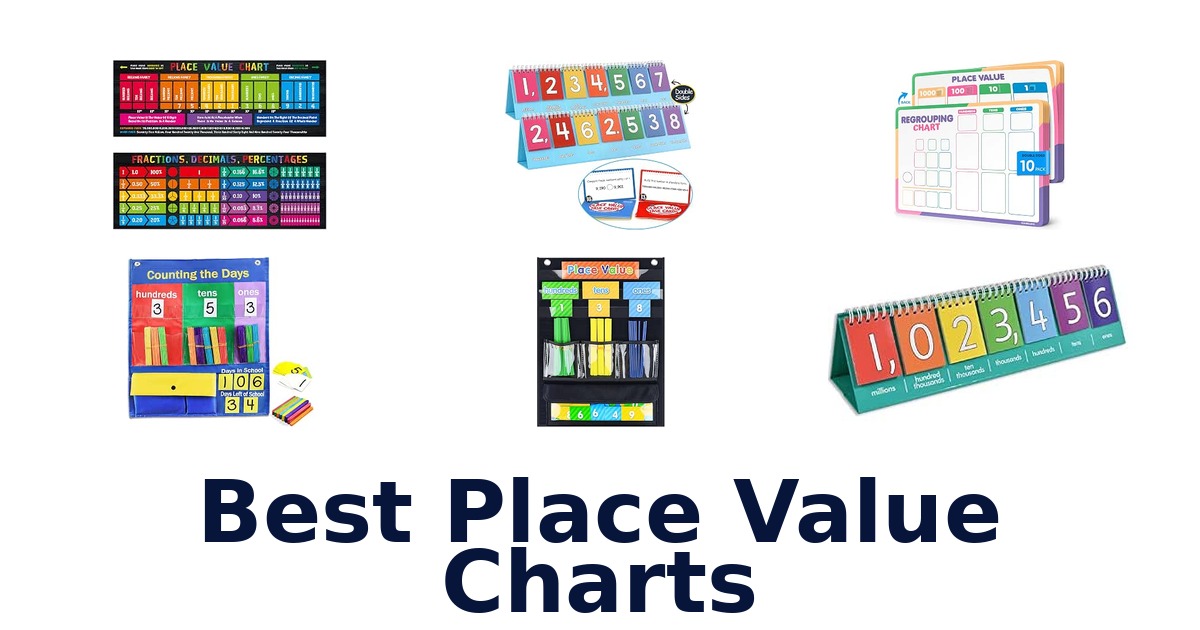
A strong place value chart makes number positions visible, supports the way a child learns, and suits the available teaching space. For students who need a freestanding visual aid covering whole numbers and decimals, edxeducation Student Flip Chart, Millions is a particularly complete option. This lineup also includes double-sided flip charts, wall posters, pocket charts with counting pieces, and reusable dry-erase practice sheets.
Those formats serve different jobs: a flip chart helps demonstrate digit positions, while a pocket chart adds physical counting and a writing board supports repeated individual practice. Compare the number range, display style, size, and included pieces before choosing.
The right match depends on whether you need a shared classroom display, a portable desk resource, or a hands-on activity for building numbers.
edxeducation Student Flip Chart, Millions leads because it is a freestanding, double-sided chart with seven color-coded digit sets. One side shows numbers 0–9, while the reverse covers decimals to the thousandths place. Its stated dimensions are 14.75 x 6.38 x 0.5 inches, and the additional product details describe it as fitting a learning area.
Choose it for a student-facing or group-learning reference that spans whole-number and decimal place value; choose a pocket chart or dry-erase board instead when students need to manipulate pieces or write answers.
Our Top Picks
 Best Overall
edxeducation Student Flip Chart
Its freestanding, double-sided format covers millions through ones and decimals to thousandths, with seven color-coded digit sets for clear demonstrations.
View on Amazon Best Seven-Digit Range
The double-sided desktop flip chart represents place value to millions, and its cards support digits from 0 to 9 for school or home.
View on Amazon Best Counting Set
This 18.7 x 15.6-inch pocket chart includes 200 sticks, 43 number cards, and 20 rubber bands for hands-on ones, tens, and hundreds.
View on Amazon- Best Regrouping Board Aizweb Double-Sided Board
- Best Card Set Amnbrei Place Value Cards
Compare Formats and Classroom Uses
| # | Product | Weight | Material Type | Buy |
|---|---|---|---|---|
| 1 | 1. edxeducation Student Flip ChartBest Overall | 8.4 oz | — | View on Amazon |
| 2 | 2. Aizweb Place Value Flip ChartBest Seven-Digit Range | — | Paper | View on Amazon |
| 3 | 3. Godery Counting Caddie ChartBest Counting Set | 1.03 lb | Plastic, Polyester | View on Amazon |
| 4 |  4. EAMAY Counting Caddy ChartHanging Classroom Counting Chart | 8.1 oz | Nylon | View on Amazon |
| 5 |  5. Aizweb Double-Sided BoardBest Regrouping Board | 2.4 oz | Wood | View on Amazon |
| 6 |  6. Amnbrei Place Value CardsBest Card Set | — | — | View on Amazon |
| 7 |  7. Gethelud Math Poster SetClassroom Wall Reference | 0.22 kg | — | View on Amazon |
| 8 |  8. Scribbledo Place Value SheetsReusable Small-Group Practice | 0.3 kg | Dry Erase Sheet | View on Amazon |
| 9 |  9. Scribbledo Regrouping SheetsReusable Regrouping Practice | — | Dy Erase Sheets | View on Amazon |
| 10 |  10. PraxiKidy Dry-Erase CardsTwo-Sided Regrouping Workmats | — | Paper | View on Amazon |
Detailed Reviews: Best Place Value Charts
#1 · Best Overall
1. edxeducation Student Flip Chart
- Weight: 8.4 oz
Best for: Freestanding Flip-Chart Lessons.
Why it ranks #1: Its freestanding, double-sided format covers millions through ones and decimals to thousandths, with seven color-coded digit sets for clear demonstrations.
Seven color-coded flip-tab sets show whole-number places through millions on one side and decimal places through thousandths on the other. The freestanding chart lets an instructor change digits during a demonstration, giving students a visual way to compare how a number changes across place values.
The chart’s seven sets of tabs display digits 0 through 9 on one side and decimal places on the reverse, allowing a lesson to move from millions and thousands to decimals without changing materials. Color coding helps distinguish the places as the teacher flips digits to build examples. Its freestanding format and 14.2-by-3.5-inch dimensions suit a desk or learning area for group demonstrations, individual practice, or homework help. Decimal coverage reaches thousandths, as far as the listed chart specifies.
- Seven color-coded digit sets support place-value demonstrations
- One side shows numbers 0 through 9
- Reverse covers decimal places through thousandths
- Freestanding format fits a learning area
- Its seven flip-tab sets cover decimals through thousandths, not a broader decimal range.
Skip it if you need students to write regrouping work or draw base-ten models; the chart changes digits with flip tabs instead.
A fit for elementary teachers, students, and families who want a freestanding visual for building numbers through millions and teaching decimals to thousandths. Its compact display suits desks and demonstrations, but it is not a written-work surface.
Full product details
| Brand | edxeducation |
|---|---|
| Item Weight | 8.4 ounces |
| Item model number | 7447 |
| Manufacturer | Learning Advantage |
| Dimensions | 14.75 x 6.38 x 0.5 inches |
| Additional Information | Important Information Toy Safety Our recommended age: Manufacturer's minimum age: 3 years not_suitable_under_36_months |
Listed on Amazon as: edxeducation Student Place Value Flip Chart, Millions
View on Amazon#2 · Best Seven-Digit Range
2. Aizweb Place Value Flip Chart
- Material Type: Paper
Best for: Seven-Digit Desk Demonstrations.
Why it ranks #2: The double-sided desktop flip chart represents place value to millions, and its cards support digits from 0 to 9 for school or home.
Seven flip-card columns show numbers through the millions and decimals, letting early learners change digits and see how a number’s places relate. The double-sided desktop chart brings whole-number and decimal practice together in a compact format suited to student desks and classroom math centers.
Each section has cards numbered 0 through 9, so students can construct different numbers by changing individual digits rather than rewriting an entire example. The double-sided layout covers whole numbers and decimals, supporting a transition between the two topics on one chart. At about 14 by 6 inches, it is sized for desk use and can stay accessible in a classroom math center. The recommended age is six and up; the listing warns of small parts for younger children.
- Seven-digit coverage reaches the millions
- Double-sided format includes whole numbers and decimals
- 0-to-9 flip cards allow students to build numbers
- Desktop size suits desks and classroom math centers
- The recommended minimum age is six, and the listing warns that small parts are unsuitable for children under three.
Skip it if you need students to write regrouping steps on a board; this chart focuses on changing digit cards rather than written operations.
A fit for elementary teachers and families introducing whole-number and decimal place value through hands-on digit changes. Its seven-digit desktop format works for individual viewing, while the small-part warning and age guidance matter when younger children share the lesson.
Full product details
| Brand | Aizweb |
|---|---|
| Item Dimensions | 14 x 6 x 0.6 inches |
| Item Dimensions L x W | 4"L x 15"W |
| Manufacturer | Wenzhou Chengyu Packing Material Co., Ltd |
| Part Number | TL-01 |
| Manufacturer recommended age | 6 years and up |
| Material | Paper |
| Model Number | 7 digits |
| Size | Medium |
| Additional Information | Important Information Toy Safety Our recommended age: Manufacturer's minimum age: 6 years Small parts. Not for children under 3 yrs. |
#3 · Best Counting Set
3. Godery Counting Caddie Chart
- Weight: 1.03 lb
- Material Type: Plastic, Polyester
Best for: Hands-On Counting-Caddy Lessons.
Why it ranks #3: This 18.7 x 15.6-inch pocket chart includes 200 sticks, 43 number cards, and 20 rubber bands for hands-on ones, tens, and hundreds.
A pocket chart paired with 200 counting sticks turns ones, tens, and hundreds into a physical counting routine. Students can place sticks and number cards into the chart’s pockets, making it useful for calendar counts, school-day totals, and early classroom lessons that connect quantities with place value.
The 18.7-by-15.6-inch polyester chart has place-value pockets and two storage pockets at the bottom, giving a teacher a place to organize both the activity and its pieces. Its package includes 200 sticks, 43 number cards, and 20 rubber bands, supporting concrete counting and grouping exercises without assembling materials from several sets. The plastic and 420D polyester construction is described as long-lasting. This is a hanging pocket-chart workflow, rather than a student writing surface.
- Includes 200 counting sticks for quantity-building activities
- 43 number cards support number identification and chart work
- Place-value pockets plus two bottom storage pockets organize materials
- 18.7-by-15.6-inch chart supports classroom counting routines
- The chart focuses on ones, tens, and hundreds, so it does not cover the broader place-value range of millions or decimals.
Skip it if you need a student-sized dry-erase surface for decimal work; this chart centers on counting ones, tens, and hundreds with physical pieces.
Choose this for kindergarten or early elementary teachers who want a shared, tactile counting routine or calendar-time display. Its pockets and included manipulatives suit group demonstrations, but its stated place-value focus is limited to hundreds, tens, and ones.
Full product details
| Brand | Godery |
|---|---|
| Color | Colorful |
| Item Weight | 1.03 pounds |
| Item model number | Godery-Count |
| Manufacturer | Godery |
| Part Number | Godery-Count |
| Material | Plastic, Polyester |
| Dimensions | 18.7 x 15.6 x 0.16 inches |
Listed on Amazon as: Place Value Charts & Counting Caddie Pocket Chart for Classroom (Hundreds, Tens, Ones)
View on Amazon#4
4. EAMAY Counting Caddy Chart
- Weight: 8.1 oz
- Material Type: Nylon
Best for: Hanging Classroom Counting Chart.
Why it ranks #4: The 12.8 x 18-inch nylon hanging chart uses clear-view pockets and number cards with counting straws to illustrate ones, tens, and hundreds.
Clear-view pockets at the bottom let learners match counting straws to ones, tens, and hundreds on a hanging nylon chart. The step-by-step setup places title, value, and number cards in rows, making this a practical shared display for counting school days or reinforcing early math concepts.
The 12.8-by-18-inch chart hangs on a bulletin board or chart stand, giving a teacher a visible shared workspace for classroom counting. Place-value and number cards slide into rows, while corresponding numbers of straws go into the large clear-view pockets below. That arrangement connects a written numeral to a physical quantity and supports routines such as counting days of the school year. The instructions say to cut the cards apart before use, an advance setup step for the teacher.
- Hangs on a bulletin board or chart stand
- Clear-view pockets hold counting straws beneath the card rows
- Supports ones, tens, and hundreds lessons
- Useful for counting school days and other classroom routines
- The cards must be cut apart before the chart is ready to use.
Skip it if you need a ready-to-use student writing board for individual calculations; this hanging chart uses cards and counting straws for group lessons.
Choose this for teachers or homeschoolers who want a visible, hands-on group chart for early counting and place value. It works as a hanging classroom routine, with card-cutting required before setup and the listed focus on hundreds, tens, and ones.
Full product details
| Brand | EAMAY |
|---|---|
| Color | Black |
| Item Weight | 8.1 ounces |
| Item model number | ExssgaN-2 |
| Manufacturer | EAMAY |
| Part Number | ExssgaN-2 |
| Material | Nylon |
| Dimensions | 12.8 x 18 x 0.8 inches |
Listed on Amazon as: Eamay Counting Caddy & Place Value Pocket Chart for Classroom and Homeschool(Black)
View on Amazon#5 · Best Regrouping Board
5. Aizweb Double-Sided Board
- Weight: 2.4 oz
- Material Type: Wood
Best for: Double-Sided Writing Practice.
Why it ranks #5: Its 12 x 9-inch wooden board pairs a place value side spanning decimals to billions with a reverse regrouping chart for written practice.
One side supports standard, word, and expanded number forms from decimals to billions, while the reverse provides a regrouping chart. This 9-by-12-inch double-sided wooden dry-erase board lets students move between representing a number and modeling an operation without changing tools.
The place-value side links standard, word, and expanded forms, giving students several ways to express the same number across the listed range from decimals to billions. Turning the wooden board over reveals a regrouping chart, which supports visual representation of numbers in a problem. Its 9-by-12-inch size and lightweight 2.4-ounce specification make it portable between home and school. The two-sided workflow keeps number-form practice and regrouping within reach on one board.
- Double-sided layout combines place value and regrouping
- Supports standard, word, and expanded number forms
- Coverage runs from decimals to billions
- Lightweight 9-by-12-inch board is portable between home and school
- The supplied details do not list a marker or eraser among the included components.
Skip it if you want a complete write-and-wipe kit with a listed marker and duster; Scribbledo’s double-sided 10-pack includes both.
A fit for students who need to switch between number forms and regrouping on one portable surface. Its wooden, double-sided format supports home or school practice, though buyers should account for the separately unspecified writing and erasing supplies.
Full product details
| Brand | Aizweb |
|---|---|
| Color | Multi-color |
| Frame Material | Wood |
| Item Dimensions W x H | 12"W x 9"H |
| Item Weight | 2.4 ounces |
| Manufacturer | Wenzhou Chengyu Packing Material Co., Ltd |
| Part Number | BB-01 |
| Material | Wood |
| Model Number | BB-01 |
| Recommended Uses | Home, School |
Listed on Amazon as: Dry Erase Place Value Whiteboard,9" x 12" Double Sided Dry Erase Boards for Kids for Teaching Place Values from Billions to Decimal Numbers,Math Manipulatives White Board for Students
View on Amazon#6 · Best Card Set
6. Amnbrei Place Value Cards
Best for: Movable Number-Building Cards.
Why it ranks #6: The 35-card set combines 15 digit cards and 20 colorful place value cards for building numbers from ones through billions and decimal fractions.
Fifteen digit cards and 20 place-value cards let students assemble numbers physically, extending from ones and tens through billions and decimal fractions. This 35-card set turns a place-value lesson into a card-arranging activity, helping learners see how digits occupy different positions as they build numbers.
The set’s 15 digit cards pair with 20 colorful place-value cards, giving learners separate pieces to arrange when constructing numbers. The listed range includes ones, tens, hundreds, thousands, billions, and decimal fractions, so the cards can support work beyond basic whole numbers. At 11 by 7 inches, the set has a compact footprint for a desk or classroom activity area. Its hands-on format favors moving and organizing cards over writing directly on a reusable board.
- 35 cards provide a hands-on number-building activity
- Includes 15 digit cards and 20 place-value cards
- Coverage extends to billions and decimal fractions
- 11-by-7-inch size suits desk-based activities
- Learners must arrange physical cards to build numbers rather than write directly on a chart.
Skip it if you need a write-on surface for repeated written calculations; these materials are cards for arranging numbers, not a dry-erase board.
Choose this for teachers or families who want learners to manipulate digits while exploring place values through billions and decimal fractions. The compact card format supports hands-on desk activities, but it is not a substitute for a writing surface.
Full product details
| Brand | Amnbrei |
|---|---|
| Color | Rainbow |
| Item Dimensions L x W | 11"L x 7"W |
| Manufacturer | Amnbrei |
| Dimensions | 11"L x 7"W |
Listed on Amazon as: Place Value Chart for Classroom Wall – 35Pcs Math Skip Counting Posters for Bulletin Board Data Charts Back to School Supplies
View on Amazon#7
7. Gethelud Math Poster Set
- Weight: 0.22 kg
Best for: Classroom Wall Reference.
Why it ranks #7: Two 38.6 x 14-inch posters combine a place value chart with fraction, decimal, and percentage content for a classroom wall display.
Two 38.6-by-14-inch posters combine place value with fractions, decimals, and percentages, giving classrooms a broad visual reference across connected math topics. Large fonts and vibrant printing make the banners suitable for bulletin boards, where students can consult several concepts without switching between separate wall charts.
The pair of long paper posters covers place value, fractions, decimals, and percentages, so one wall area can support reference across related lessons. Their 38.6-by-14-inch size provides a wide display, while the thick paper and PET-film coating are described as durable and waterproof. The coating also allows cleaning with a damp cloth. These are fixed visual references rather than movable practice cards, making them better suited to classroom display than individual written exercises.
- Two posters cover four related math topics
- 38.6-by-14-inch dimensions provide a broad wall display
- PET-film coating is waterproof and can be cleaned with a damp cloth
- Large fonts and vibrant colors support visual reference
- These are wall posters, not interactive cards or a write-on practice chart.
Skip it if you want each learner to manipulate digits or write directly on a chart; these posters provide a fixed classroom reference.
A practical fit for teachers decorating a bulletin board with a reference spanning place value, fractions, decimals, and percentages. The large banners serve as visual reminders, but lessons requiring student-written answers or movable digits call for a practice tool instead.
Full product details
| Brand | Gethelud |
|---|---|
| Color | Fraction/Decimal/Percentage |
| Color Family | Miscellaneous |
| Cover Material | Paper |
| Frame Material | Plastic |
| Item Dimensions L x W | 3.35"L x 15.04"W |
| Item Weight | 0.22 kg |
| Material | Paper |
| Product Style | Fraction/Decimal/Percentage |
| Recommended Uses | Classroom decoration, teaching arithmetical knowledge, place value, decimals, fractions, percentages, classroom banner, bulletin board decoration, classroom supply |
| Size | 38.6 x 14 inches |
| Special Features | Durable |
#8
8. Scribbledo Place Value Sheets
- Weight: 0.3 kg
- Material Type: Dry Erase Sheet
Best for: Reusable Small-Group Practice.
Why it ranks #8: The pack supplies ten 9 x 12-inch dry-erase sheets for reusable place value practice, though the listing does not specify a number range.
Ten 9-by-12-inch dry-erase sheets give a class multiple place-value practice surfaces rather than a single shared chart. Their compact size suits individual desks and small-group work, while the wipe-clean format supports repeated written exercises at school or during homeschool lessons.
Each sheet measures 9 by 12 inches, a desk-friendly footprint that gives one learner room to work without taking over a table. The pack contains 10 sheets, so students can practice at the same time instead of waiting to use one board. Because the material is a dry-erase sheet, learners can write, clear, and repeat place-value exercises. The listing identifies school as the recommended use and does not describe a separate flip-chart or wall-display format.
- Pack of 10 supports simultaneous student practice
- 9-by-12-inch format fits individual desks
- Dry-erase material allows repeated written exercises
- Suitable for school use and homeschool practice
- These are flexible sheets rather than rigid boards, so they do not provide a firm writing surface on their own.
Skip it if you need a freestanding visual for whole-class demonstrations; the student-sized sheets are intended for individual practice.
Choose these for teachers or homeschoolers who want several compact, reusable place-value writing surfaces for desk work. They suit individual practice better than a standing classroom display, and the flexible sheets do not provide a rigid backing.
Full product details
| Brand | Scribbledo |
|---|---|
| Color | White |
| Frame Material | Plastic |
| Included Components | 10 Place Value Sheets |
| Item Dimensions W x H | 9"W x 12"H |
| Item Weight | 0.3 kg |
| Manufacturer | SCRIBBLEDO |
| Part Number | 10 Place Value Sheets |
| Material | Dry Erase Sheet |
| Model Number | 10 Place Value Sheets |
| Recommended Uses | School |
Listed on Amazon as: SCRIBBLEDO Place Value Chart Math Practice 9”x12” Small White Board Dry Erase Sheets Math Manipulatives Math Supplies Homeschool Teacher Students Classroom Pack of 10 Sheets
View on Amazon#9
9. Scribbledo Regrouping Sheets
- Material Type: Dy Erase Sheets
Best for: Reusable Regrouping Practice.
Why it ranks #9: Ten double-sided dry-erase sheets combine a place value chart with regrouping practice for base ten addition and subtraction.
A place-value chart on one side and a regrouping chart on the other make these sheets useful for base-ten addition and subtraction in a single flip. The 10-pack supports repeated practice with number sense, carrying, and borrowing, and includes a marker and duster for classroom or home use.
The double-sided sheets pair place-value work with regrouping, so students can turn the same surface over when moving from representing a number to solving an operation. The listed skills include base ten, addition, subtraction, number sense, carrying, borrowing, and multi-digit operations. Because the flexible sheets work like mini whiteboards, learners can write, erase, and repeat exercises. Ten sheets allow multiple students to practice together, and the included marker and duster provide the listed writing and cleanup accessories.
- Double-sided sheets combine place value and regrouping
- Supports base-ten addition and subtraction practice
- 10-pack allows concurrent classroom use
- Marker and duster are included
- The supplied details do not specify the sheets’ dimensions.
Skip it if you need a stated desk footprint before choosing a practice surface; this listing identifies dry-erase sheets but gives no dimensions.
A fit for teachers and families practicing multi-digit addition, subtraction, carrying, and borrowing with reusable surfaces. The included marker and duster support ready practice, while buyers needing a precisely sized board should note that dimensions are not supplied.
Full product details
| Brand | Scribbledo |
|---|---|
| Color | White |
| Frame Material | Dry-Erase |
| Included Components | Duster, Marker |
| Manufacturer | SCRIBBLEDO |
| Part Number | Regrouping |
| Material | Dy Erase Sheets |
| Recommended Uses | Math Classroom |
Listed on Amazon as: Scribbledo Place Value Chart & Regrouping Dry Erase Sheets Base Ten, Addition & Subtraction Math Practice for Kids, Classroom Supplies, Double Sided 10 Pack
View on Amazon#10
10. PraxiKidy Dry-Erase Cards
- Material Type: Paper
Best for: Two-Sided Regrouping Workmats.
Why it ranks #10: The 12-pack offers a chart to the thousandths place and a reverse regrouping side, but its listed material is paper rather than a freestanding display.
Twelve 9-by-12-inch cards pair a place-value side reaching thousandths with a reverse for addition and subtraction regrouping. Students can write numerals in their places, draw base-ten representations, then turn a card over to work through one-, two-, or three-digit operations.
On the place-value side, learners can place numerals through thousandths and draw thousands, hundreds, tens, and ones, connecting written values with visual quantities. The reverse provides space for regrouping strategy in addition or subtraction using one-, two-, or three-digit numbers. A 12-card set gives a class multiple work surfaces, and the supplied directions call for dry-erase markers and wiping with a dry cloth or eraser. The listed paper material makes care instructions especially relevant to repeated use.
- 12 cards provide multiple student work surfaces
- Place-value side extends to thousandths
- Reverse supports regrouping in addition and subtraction
- Students can draw thousands, hundreds, tens, and ones
- The cards are listed as paper, so follow the specified dry-cloth or eraser cleaning method.
Skip it if you want a wooden board for frequent handling; Aizweb’s double-sided wooden place-value board offers a rigid surface for home or school.
Choose these for teachers working on place value through thousandths alongside regrouping in early-grade arithmetic. The two-sided 9-by-12-inch format supports individual or group practice, while its listed paper material makes careful dry cleaning an important consideration.
Full product details
| Brand | PraxiKidy |
|---|---|
| Included Components | flash card |
| Item Dimensions | 12 x 9 x 0.1 inches |
| Item Dimensions L x W | 12"L x 9"W |
| Manufacturer | Guangzhou Wenhao Crafts Co., Ltd. |
| Part Number | PRA16 |
| Manufacturer recommended age | 3 years and up |
| Material | Paper |
| Size | 12 inches x 9 inches x 0.1 inches |
| Additional Information | Important information Safety Information no Directions 1. Use dry-erase markers to write on the cards. 2. Wipe clean with a dry cloth or eraser for reuse. 3. Use for group work or individual learning to teach math concepts like place value, addition, and subtraction. |
Listed on Amazon as: 12 Pack Place Value Chart Dry Erase Flash Cards,9" x 12" Base Ten Addition and Subtraction Regrouping Math Manipulatives 1st 2nd 3rd Grade Classroom Must Haves Teacher Homeschool Supplies
View on AmazonAvoid the chart-versus-practice mismatch
The main mismatch to avoid is buying a display when students need to work out numbers themselves, or a worksheet-style board when the goal is a shared visual reference. edxeducation Student Flip Chart and Aizweb Place Value Flip Chart present digit positions through flip tabs, making them suited to demonstrations and desk-side reference. Godery Counting Caddie Chart and EAMAY Counting Caddy Chart add pockets and physical counting pieces, which suit lessons where learners build or count quantities.
Aizweb Double-Sided Board and the Scribbledo sheets instead give students a surface for written practice; the board also lists a regrouping side. Check the product description for the precise activity: some charts cover only ones, tens, and hundreds, while others state millions or decimal places.
A broad range does not by itself mean a product includes manipulatives, and a reusable writing surface does not necessarily work as a wall display.
Check display size and classroom setup
A chart’s stated size and setup determine whether it will work at a desk, on a wall, or in a group lesson. The compact Aizweb Place Value Flip Chart is listed at 14 x 6 x 0.6 inches, while the edxeducation Student Flip Chart is listed at 14.75 x 6.38 x 0.5 inches and is described as freestanding. For larger wall or group use, Godery Counting Caddie Chart measures about 18.7 x 15.6 inches, and EAMAY Counting Caddy Chart measures 12.8 x 18 inches and is described as hanging.
Gethelud Math Poster Set has two long 38.6 x 14-inch posters, so confirm that the display area can accommodate them. Dimensions may be stated in different orders across listings, and a poster’s length is not comparable to a flip chart’s footprint.
Check how the item is meant to be positioned before assuming it includes a stand or mounting hardware.
How to Choose a Place Value Chart
Number range and decimal coverage
Look for a chart whose stated place range matches the lesson, rather than assuming every chart covers the same digits. edxeducation Student Flip Chart reaches millions and decimals to thousandths, and Aizweb Place Value Flip Chart is described as a seven-digit chart extending to millions. Aizweb Double-Sided Board states coverage from decimals to billions, while Godery Counting Caddie Chart focuses on ones, tens, and hundreds.
PraxiKidy Dry-Erase Cards explicitly chart through thousandths. For early counting and basic number construction, a narrower hundreds chart may be enough; for expanded form, decimals, or larger numbers, favor a product with those positions specified.
Some listings do not state a complete range, so verify the described chart rather than inferring coverage from its title.
Display or student practice format
Choose the format according to whether learners will view, manipulate, or write on the chart. edxeducation Student Flip Chart is freestanding and double-sided, while Gethelud Math Poster Set includes two large 38.6 x 14-inch posters for classroom display. Godery Counting Caddie Chart measures about 18.7 x 15.6 inches and comes with sticks and number cards; EAMAY Counting Caddy Chart is a hanging nylon pocket chart.
For individual work, Aizweb Double-Sided Board measures 12 x 9 inches, and Scribbledo Place Value Sheets come as ten 9 x 12-inch sheets. A shared lesson favors a visible display or manipulatives; desk practice favors a compact board or sheets.
Check the space and setup before choosing a format.
Included pieces and reuse
Check what comes with the chart and whether its surface supports repeat practice. Godery Counting Caddie Chart includes 200 sticks, 43 number cards, and 20 rubber bands, while Amnbrei Place Value Cards includes 15 digit cards and 20 place value cards. Those listed pieces make physical number building possible.
Scribbledo Place Value Sheets are a ten-sheet dry-erase pack, and Scribbledo Regrouping Sheets also offers ten double-sided sheets with a duster and marker listed among included components. PraxiKidy Dry-Erase Cards is a 12-pack, with directions that say to write using dry-erase markers and wipe clean.
For activities with physical counters, favor a set that lists those components; for repeated written practice, prioritize the described reusable surface and check whether a marker or eraser is included.
Which Place Value Chart Should I Choose?
For a freestanding reference that covers whole numbers and decimals, choose edxeducation Student Flip Chart; its double-sided, color-coded tabs span millions through thousandths. If you want a desktop flip chart focused on seven-digit whole-number work, Aizweb Place Value Flip Chart is a close alternative. For hands-on counting with supplied pieces, pick Godery Counting Caddie Chart, which includes 200 sticks and 43 number cards; EAMAY Counting Caddy Chart is another hanging pocket format.
Choose Aizweb Double-Sided Board for individual writing and regrouping practice. For large wall display, Gethelud Math Poster Set combines place value with fraction, decimal, and percentage content.
Amnbrei Place Value Cards supports movable number building. For reusable student sheets, select Scribbledo Place Value Sheets or the regrouping-focused Scribbledo Regrouping Sheets; PraxiKidy Dry-Erase Cards adds a thousandths chart and regrouping side.
Frequently Asked Questions
How can I teach place value with a chart rather than a worksheet?
Use the chart as a shared reference while students build or read numbers aloud. Point to each place, name its value, and ask what changes when a digit moves. For active practice, choose a format that lets students move pieces or write answers; a fixed chart works well as a visual guide.
What chart format works best for whole-class demonstrations?
A large wall poster or a chart that stands upright can make place values easier to see during a group lesson. Choose a display format for pointing and discussion, and keep a smaller board or sheet available when students need to record their own answers.
Are these charts suitable for teaching decimals and regrouping?
Some listed options cover decimals, while others focus on whole numbers or regrouping practice. Check the product title and chart layout for the skills you plan to teach. The edxeducation flip chart covers decimals through thousandths; dry-erase boards and sheets offer formats for written practice.
How do I choose between a wall chart and a student-size chart?
Choose a wall chart when the goal is a visible classroom reference for group instruction. Student-size sheets or boards suit individual practice and can be used at a desk. Consider whether learners need to see a shared example, write answers, or manipulate pieces as they work.
What should I look for in a hands-on place-value chart?
Look for a format that supports the actions students will practice, such as moving number cards, counting pieces, or writing digits. Pocket charts and counting caddies are suited to movable materials; dry-erase boards support written answers. Check the product listing to confirm which pieces are included.
Final Words
For a freestanding reference spanning whole numbers and decimals, choose the edxeducation Student Flip Chart. Pick the Aizweb flip chart for seven-digit whole-number work, or a pocket chart with counting pieces when students need hands-on number building. For individual writing and regrouping, use a dry-erase board or practice sheets.
A large poster suits wall display. Let the lesson format—reference, manipulation, or written practice—guide your choice.