
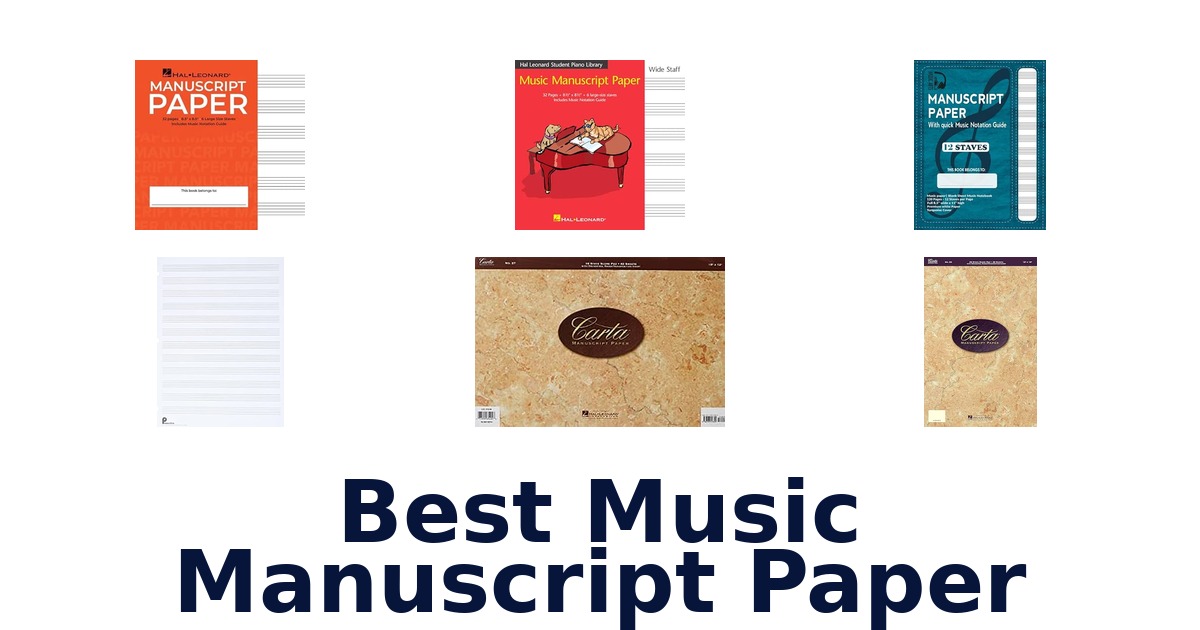
A strong music manuscript book gives you staff spacing suited to your notation, enough room for the work, and a format that fits how you write. The Best Music Manuscript Paper here ranges from wide-staff books for piano learners to 12-stave spiral notebooks and score pads with 16 or 26 staves. Hal Leonard’s Standard Wirebound is the most versatile starting point: its 96 pages, 12 staves per page, spiral binding, and notation guide suit routine composing, teaching, and study.
For orchestral writing, a Carta score pad may be a better match because it includes a range and transposition chart. Compare the number and size of staves, page or sheet count, binding, and any reference material before choosing; the right fit depends on the score you need to put on paper.
Hal Leonard Standard Wirebound is the best all-around choice because it combines 96 pages, 12 staves per page, spiral binding, and an included notation guide. That layout suits a broad range of composing, teaching, and student work without specializing in only piano or orchestral scores. Choose a wide-staff book for easier-to-read piano notation, or a Carta score pad if you need more staves per page and its orchestral range and transposition chart.
Our Top Picks
 Best Overall
Hal Leonard Standard Wirebound
Its 96 pages, 12 staves per page, spiral binding, and notation guide make it a versatile fit for composers, students, and teachers.
View on Amazon Best 16-Stave Pad
The 16-stave layout and 40 sheets suit fuller score work, while the orchestral range and transposition chart add a useful reference.
View on Amazon Most Staves Per Page
Its 26-stave score-pad layout accommodates dense notation, and the included orchestral range and transposition chart supports score preparation.
View on Amazon- Best Wide Staff Hal Leonard Wide Staff Red Cover
Compare the Manuscript Paper Options
| # | Product | Buy |
|---|---|---|
| 1 | 1. Hal Leonard Standard WireboundBest Overall | View on Amazon |
| 2 | 2. Carta No. 27 Score PadBest 16-Stave Pad | View on Amazon |
| 3 | 3. Carta No. 23 ProfessionalMost Staves Per Page | View on Amazon |
| 4 |  4. Hal Leonard Wide Staff Red CoverBest Wide Staff | View on Amazon |
| 5 |  5. Hal Leonard Deluxe Pink WireboundWirebound twelve-staff composition | View on Amazon |
| 6 |  6. Deluxe Gold WireboundPremium wirebound twelve-staff writing | View on Amazon |
| 7 |  7. Passantino Spiral 12-StaveSpiral-bound 12-stave practice | View on Amazon |
| 8 |  8. MusicArts 120-Page NotebookHigh-page-count soft-cover notebook | View on Amazon |
| 9 |  9. Hal Leonard Student Piano Wide StaffPiano students needing wide staves | View on Amazon |
| 10 |  10. Hal Leonard Manuscript PaperPaperback format buyers | View on Amazon |
Detailed Reviews: Best Music Manuscript Paper
#1 · Best Overall
1. Hal Leonard Standard Wirebound
Best for: Wirebound twelve-staff writing.
Why it ranks #1: Its 96 pages, 12 staves per page, spiral binding, and notation guide make it a versatile fit for composers, students, and teachers.
Twelve staves on each of its 96 pages give this Hal Leonard wirebound notebook room for more notation per page than a wide-staff layout. The spiral binding suits users who prefer a bound manuscript book, and the included notation guide puts a reference in the same notebook as the writing paper.
The 12-stave page count accommodates broader scoring needs than a six-stave page, making the layout useful for composers, students, and teachers writing multiple parts. Its 96 pages provide a defined amount of manuscript paper in one notebook, while spiral binding provides a wirebound format for working through the pages. The notation guide is a useful companion during writing or instruction, though the listing does not specify paper dimensions or staff size.
- 12 staves per page
- 96 pages
- Spiral-bound format
- Includes a notation guide
- The listing does not specify staff size or page dimensions.
Skip it if you need large six-stave pages for beginner notation; Hal Leonard Wide Staff Manuscript Paper offers that layout.
Consider this for composers, students, and teachers who want 12 staves per page in a spiral-bound 96-page notebook. It is less suited to buyers whose priority is explicitly large staff spacing or specified page dimensions.
View on Amazon#2 · Best 16-Stave Pad
2. Carta No. 27 Score Pad
Best for: Composers using orchestral ranges.
Why it ranks #2: The 16-stave layout and 40 sheets suit fuller score work, while the orchestral range and transposition chart add a useful reference.
Sixteen staves across each score-pad page make the Carta Manuscript Paper No. 27 a substantial layout for writing multi-part music. Its 40 sheets are paired with an orchestral range and transposition chart, giving composers, arrangers, and students a reference relevant to score preparation alongside the manuscript paper.
The 16-stave layout gives composers and arrangers room to place more parts on a page than a 12-stave notebook. Forty sheets define the pad's working supply, while the orchestral range and transposition chart can help users consult instrument information during arranging. The product is listed as a paperback score pad, rather than a spiral-bound notebook, so the format is worth considering when choosing how you want to handle pages at a desk.
- 16 staves per page
- 40 sheets
- Orchestral range and transposition chart included
- Score-pad format for composers and arrangers
- The 40-sheet supply is more limited than a 96-page notebook.
Skip it if you need a larger stated page count in spiral-bound form; Hal Leonard Standard Wirebound has 96 pages and 12 staves per page.
A fitting option for composers, arrangers, or students who want 16-stave score pages and an orchestral reference chart. Its 40-sheet pad format may not suit those seeking a higher page count in a spiral notebook.
View on Amazon#3 · Most Staves Per Page
3. Carta No. 23 Professional
Best for: Dense orchestral score drafting.
Why it ranks #3: Its 26-stave score-pad layout accommodates dense notation, and the included orchestral range and transposition chart supports score preparation.
Twenty-six staves make the Carta Manuscript Paper No. 23 a particularly dense score-pad layout for orchestral writing. The included orchestral range and transposition chart adds a reference directly associated with scoring, while the product title names music educators, composers, and students as intended users.
The 26-stave page count accommodates dense multi-part notation, making this layout relevant to orchestral score work rather than sparse, large-staff writing. Its orchestral range and transposition chart provides a companion reference for users dealing with instrument ranges and transposition. Listed as a professional score pad in paperback format, it differs from spiral-bound notebooks; the supplied details do not state sheet count or dimensions, so those remain important unknowns for planning use.
- 26 staves per page
- Orchestral range and transposition chart
- Professional score-pad format
- Named for educators, composers, and students
- The supplied listing does not state sheet count or page dimensions.
Skip it if you need a stated sheet count; Carta Manuscript Paper No. 27 specifies 40 sheets and also includes an orchestral chart.
This is aimed at educators, composers, and students who need a dense 26-stave score layout with an orchestral reference. Consider the unspecified sheet count and dimensions before making it the basis of a long project.
Listed on Amazon as: Carta Manuscript Paper No. 23 Professional | 26-Stave Score Pad with Orchestral Range and Transposition Chart | Staff Paper for Music educators, Composers, and Students
View on Amazon#4 · Best Wide Staff
4. Hal Leonard Wide Staff Red Cover
Best for: Large-staff learning and drafting.
Why it ranks #4: Six large staves per page favor readable notation, making this a sensible choice for learners or writers who want more writing room.
Six large staves per page are the key distinction of this Hal Leonard manuscript notebook, giving students, teachers, and composers a spacious page for writing notation. Its paperback format keeps the book in a familiar bound-notebook form, while the included notation guide offers a reference alongside the blank music paper.
The six-stave layout prioritizes room around each staff, which can make handwritten notation easier to place and read during lessons or early composition work. The included notation guide provides a nearby reference, so users can consult it while writing rather than relying on the paper alone. As a paperback notebook, it suits bound-page use; its six-stave count also means it offers fewer staves per page than standard 12-stave formats, a relevant tradeoff for denser scores.
- Six large staves per page
- Includes a notation guide
- Paperback notebook format
- Aimed at students, teachers, and composers
- Six staves per page leave less room for multi-staff scoring than 12-stave paper.
Skip it if you need 12 staves on each page for denser writing; Hal Leonard Standard Wirebound offers that layout.
A practical match for piano students, teachers, and composers who value large staff spacing and a notation reference. Choose another format if your work needs many staves on each page or a wirebound notebook.
View on Amazon#5
5. Hal Leonard Deluxe Pink Wirebound
Best for: Wirebound twelve-staff composition.
Why it ranks #5: This spiral-bound book provides 12 staves per page, a practical standard layout for music notation and composition.
Twelve staves per page and spiral binding give this Hal Leonard Deluxe Music Manuscript Paper book a straightforward setup for music notation and composition. The blank sheet music format serves students and professionals, while the wirebound construction distinguishes it from paperback manuscript books.
The 12-stave layout gives writers space for multiple lines of notation per page, a useful fit for composition work by students and professionals. Spiral binding provides a wirebound book format for working through its pages, while the blank manuscript paper keeps the focus on writing rather than printed music. The listing does not state a page count or page dimensions, so buyers who need a specific supply or size should weigh that missing detail.
- 12 staves per page
- Spiral-bound format
- Blank sheet music for notation and composition
- Listed for students and professionals
- The listing does not specify page count or dimensions.
Skip it if you need a stated 96-page total; Hal Leonard Standard Wirebound identifies its page count and 12-stave layout.
A reasonable fit for students and professionals seeking wirebound, blank paper with 12 staves per page. Its layout is clear, but buyers who plan around page quantity or dimensions will need a listing that specifies them.
View on Amazon#6
6. Deluxe Gold Wirebound
Best for: Premium wirebound twelve-staff writing.
Why it ranks #6: Its wirebound format and 12 staves per page suit general notation work, though the listing gives no page count or included guide.
Twelve staves per page and spiral binding define this Deluxe Wirebound Super Premium manuscript book as a blank writing option for musicians and composers. Its gold cover identifies the book visually, while the wirebound format and stated staff layout provide the more practical details for choosing it.
The 12-stave pages allow several lines of notation on each sheet, which suits users writing music rather than working from preprinted scores. Spiral binding supplies a wirebound notebook format for moving through the pages during composing or practice. The listing calls the paper super premium and identifies musicians and composers as users, but provides no page count or dimensions, so those specifics cannot be used to assess project capacity or page fit.
- 12 staves per page
- Spiral-bound format
- Blank manuscript paper
- Listed for musicians and composers
- The listing does not specify page count or dimensions.
Skip it if you need a stated page total; Passantino Spiral Book 12-Stave Manuscript Paper specifies 96 pages with 12 staves per page.
A fit for musicians and composers seeking blank 12-stave paper in a spiral-bound format. The core layout is stated, but check whether the unspecified page count and dimensions match the scale of your writing project.
Listed on Amazon as: Deluxe Wirebound Super Premium Manuscript Paper Gold Cover | Music Notation Book for Musicians and Composers | Staff Paper with 12 Staves per Page | Blank Sheet Music Notebook
View on Amazon#7
7. Passantino Spiral 12-Stave
Best for: Spiral-bound 12-stave practice.
Why it ranks #7: The 96-page spiral book provides 12-stave manuscript paper, a straightforward option for students, teachers, and composers.
Twelve-stave pages across 96 pages give this Passantino spiral book a clearly stated format for manuscript writing. The spiral binding and high-quality staff paper are listed alongside use by composers, students, and teachers, making its page layout and binding the most concrete points for choosing it.
The 12-stave layout provides space for multiple lines of notation, while 96 pages set the amount of paper available in the book. Spiral binding identifies this as a wirebound-style option for users who prefer that format as they write or practice. The listing describes the paper as high-quality and names composers, students, and teachers, but it does not specify page dimensions or include a notation guide, so those details cannot guide the choice.
- 12 staves per page
- 96 pages
- Spiral-bound
- Listed for composers, students, and teachers
- The listing does not specify page dimensions or include a notation guide.
Skip it if you need an included notation guide or stated wide staves; Hal Leonard Wide Staff Manuscript Paper includes a guide and wide staff format.
Choose this Passantino book if you want 12-stave manuscript paper in a 96-page spiral-bound format. It fits varied writing and practice use, but not buyers who require stated dimensions or a listed notation guide.
View on Amazon#8
8. MusicArts 120-Page Notebook
Best for: High-page-count soft-cover notebook.
Why it ranks #8: It offers 120 pages with 12 staves per page and a stated 8.5-by-11-inch page size, though the listing does not mention a guide.
A stated 120 pages with 12 staves per page gives this MusicArts notebook a clear combination of page quantity and writing layout. Its full 8.5-by-11-inch dimensions identify the page size, while the turquoise soft cover and vintage-looking appearance distinguish its presentation from unspecified-cover manuscript books.
The 12-stave layout supports writing several lines of music on each page, and the 120-page count supplies a defined amount of paper for ongoing work. Full 8.5-by-11-inch dimensions help buyers assess its page size before choosing it for a desk or music-writing routine. The soft cover identifies a flexible paperback format, while the listing's vintage-looking cover and paper are descriptive presentation details rather than substitutes for a specified notation guide.
- 120 pages
- 12 staves per page
- Full 8.5-by-11-inch dimensions
- Soft cover with vintage-looking cover and paper
- No notation guide is listed.
Skip it if you require an included notation guide; Hal Leonard Standard Wirebound lists one with its 12-stave pages.
This suits writers who prioritize a stated 120-page count, 12 staves per page, and full 8.5-by-11-inch dimensions. Choose another notebook if a notation guide or spiral binding is a required part of your workflow.
Listed on Amazon as: Manuscript Paper | Blank sheet Music Notebook | 120 Pages 12 Staves per Page | Full 8,5'' wide x 11'' high | Elegant vintage looking cover & paper: Turquoise Soft Cover
View on Amazon#9
9. Hal Leonard Student Piano Wide Staff
Best for: Piano students needing wide staves.
Why it ranks #9: Wide staff paper and a notation guide target piano students, but its narrower piano-specific positioning is less versatile for general scoring.
Wide staff manuscript paper gives this Hal Leonard notebook a clear piano-student focus, with a notation guide accompanying the blank pages. The paperback format makes it a bound option for lessons or composing, while the product title also identifies composers among its intended users.
The wide-staff format is the central fit for piano students who want room to write notation, and it distinguishes this book from standard-staff options. A music notation guide supplies a reference alongside the manuscript paper, which can support lesson work without making the guide a separate listed purchase. Its paperback binding keeps the pages in book form; the listing does not give a page count or the number of staves per page.
- Wide staff manuscript paper
- Identified for piano students
- Includes a music notation guide
- Paperback format
- The listing does not specify page count or staves per page.
Skip it if you need a stated 12-stave page count and spiral binding; Hal Leonard Standard Wirebound supplies both details.
This suits piano students and composers who want wide staff paper with a notation guide in paperback form. Look elsewhere if a fixed page count, staff count, or wirebound format is essential to your workflow.
Listed on Amazon as: Hal Leonard Student Piano Library – Wide Staff Manuscript Paper | Music Notebook for Piano Students and Composers | with Music Notation Guide
View on Amazon#10
10. Hal Leonard Manuscript Paper
Best for: Paperback format buyers.
Why it ranks #10: The available listing gives only paperback format and author information, so staff count, page quantity, and other selection details are unavailable.
Paperback format is the only concrete product detail supplied for this listing, so it can be considered by buyers specifically seeking a manuscript-paper item in book form. The available information does not identify a staff count, page count, notation guide, or intended user group, limiting how precisely its writing layout can be assessed.
The paperback specification indicates a book-style format, which may help shoppers narrow their choice if binding type is the main requirement. However, no title, staff layout, page total, or included reference material is provided in the listing details supplied here. That leaves practical questions about score density and writing workflow unanswered. Treat this as a format-level option rather than choosing it for a particular number of staves, a guide, or a defined amount of paper.
- Listed in paperback format
- Identified as a Hal Leonard Corp. author listing
- Can be screened by binding format
- No unsupported staff or page specifications are assumed
- The supplied listing gives no title, staff count, or page count.
Skip it if you need a confirmed staff layout or page quantity; Hal Leonard Standard Wirebound lists 12 staves per page and 96 pages.
This is only a cautious fit for shoppers willing to choose from the paperback detail alone. Buyers who need a known staff count, page quantity, or included notation guide should prefer a listing that states those specifics.
View on AmazonAvoid choosing staff density by title alone
A high stave count is useful only if the notation remains legible at the size you write. The listings span six large staves per page in Hal Leonard Wide Staff Red Cover, 12 staves in several standard books, 16 in Carta No. 27 Score Pad, and 26 in Carta No.
23 Professional. That range is a real trade-off: more staves can help fit a larger ensemble or a denser score on a page, while fewer, larger staves leave more room for handwriting.
Do not assume that every 12-stave book has the same staff dimensions; the product details do not provide measurements for most options. If you routinely write large notes, chords, or annotations, the six-stave wide layout may be more comfortable. If you need multiple parts visible together, consider a higher count, but check whether the resulting writing area matches your notation habits.
Choose a score pad or notebook for the way you work
Binding and layout can affect how practical a manuscript book feels during a writing session. Spiral-bound options such as Hal Leonard Standard Wirebound and Passantino Spiral 12-Stave can open around their binding, while the Carta products are described as score pads and the wide-staff books as paperbacks. The supplied details do not confirm whether any book lies completely flat, so treat binding style as a clue rather than a guarantee.
A score pad can suit work organized as separate sheets, but the listings do not specify whether sheets are perforated or easy to remove. Likewise, a bound notebook keeps pages together but may be less convenient if you want loose pages for rearranging parts.
Before choosing, consider whether you compose at a desk, carry pages between lessons, or need to keep drafts in sequence. These practical differences can matter as much as stave count, especially for unfinished scores.
How to Choose Music Manuscript Paper
Staff count and spacing
Start with the staff count and whether the product explicitly calls its staves large. The choices range from six large staves per page in Hal Leonard Wide Staff Red Cover, through 12 staves in several notebooks, to 16 in Carta No. 27 Score Pad and 26 in Carta No.
23 Professional. A lower count can give handwriting more room; a higher count can place more parts on a page.
The listings do not provide staff measurements, so the count alone cannot establish exact spacing. Piano learners or writers who annotate heavily may prefer the six-stave wide format. Composers fitting many lines into a score may favor 16 or 26 staves, provided their notation stays readable.
Page quantity and format
Look for a stated page or sheet quantity when you need to estimate how much writing space the book provides. Hal Leonard Standard Wirebound and Passantino Spiral 12-Stave each list 96 pages; MusicArts lists 120 pages; Carta No. 27 Score Pad lists 40 sheets.
Those figures are not necessarily directly comparable because pages and sheets are different terms, and the other listings do not state a quantity. A higher stated page count can suit frequent practice or ongoing drafts, while a score pad with fewer sheets may fit focused score work.
MusicArts also specifies an 8.5-by-11-inch page, but dimensions are not supplied for most alternatives. Choose using the details that are actually listed rather than assuming all books have the same size or usable page area.
Binding and reference material
Consider whether spiral or wire binding, paperback format, or a score pad better fits how you handle written pages, and check for an included reference. The Standard Wirebound and Passantino books are spiral-bound; Hal Leonard Deluxe Pink Wirebound is spiral-bound; the wide-staff options are paperback; and the Carta products are score pads. A notation guide is listed with both wide-staff Hal Leonard books and Standard Wirebound, while both Carta pads include an orchestral range and transposition chart.
These extras support different needs rather than serving as interchangeable bonuses. Students learning notation may value the guide; composers arranging for orchestral instruments may find the chart more relevant.
If you need loose pages or a book that opens in a particular way, confirm details beyond the listing because removability and flat-opening behavior are not stated.
Which Music Manuscript Paper Should You Choose?
For a dependable general-purpose notebook, choose Hal Leonard Standard Wirebound: its 96 pages, 12 staves per page, spiral binding, and notation guide make it the strongest all-around match. For orchestral score work, Carta No. 27 Score Pad gives you 16 staves per page and a range and transposition chart; Carta No.
23 Professional pushes density to 26 staves when fitting more parts matters. If you need roomier notation for piano study or handwriting, Hal Leonard Wide Staff Red Cover offers six large staves per page, while Hal Leonard Student Piano Wide Staff also pairs wide staves with a notation guide.
For a stated higher page count in a standard 12-stave format, consider MusicArts 120-Page Notebook. Passantino Spiral 12-Stave is another 96-page spiral choice.
Frequently Asked Questions
How do I choose staff size for handwriting versus smaller, denser scores?
Choose larger staves when handwriting legibility and roomier notation matter; the wide-staff options here are suited to that use, including piano study. For denser writing, consider a higher-stave-count format: Carta No. 27 has 16 staves per page, and Carta No.
23 has Match the layout to the amount of notation you need.
Will a 12-stave manuscript book work for a full ensemble score?
It can work if 12 staves accommodate the parts you need to show together, but the format may not suit a larger ensemble score. The listed Carta No. 27 provides 16 staves per page and an orchestral range and transposition chart; Carta No.
23 offers 26 staves per page for denser scoring.
Are manuscript-paper books suitable for printing or scanning written music?
They are described as blank manuscript-paper books, but the supplied product details do not confirm printer compatibility or scanning results. If you plan to print on pages or scan completed notation, check the specific book’s paper and binding details and your equipment’s requirements before choosing. Handwritten use is the stated purpose.
Should I choose a spiral-bound book or a score pad?
Choose based on the format and layout you need: the Hal Leonard Standard and Passantino options are spiral-bound books, while the Carta No. 27 and No. 23 are score pads.
The standard Hal Leonard is the all-around pick in this roundup; Carta pads offer higher stave counts for orchestral or denser scoring.
Which option is best for a general-purpose composing notebook?
The Hal Leonard Standard Wirebound is the strongest general-purpose choice in this roundup. It combines 96 pages, 12 staves per page, spiral binding, and an included notation guide, making it suitable for a broad range of composing, teaching, and student work rather than specializing in piano or orchestral scores.
Final Words
For a dependable general-purpose notebook, choose the Hal Leonard Standard Wirebound: its 96 pages, 12 staves per page, spiral binding, and notation guide make it the strongest all-around match. For orchestral scoring, consider Carta No. 27 for 16 staves and its range and transposition chart, or Carta No.
23 for 26 staves. Choose a wide-staff option when roomier piano notation matters.