
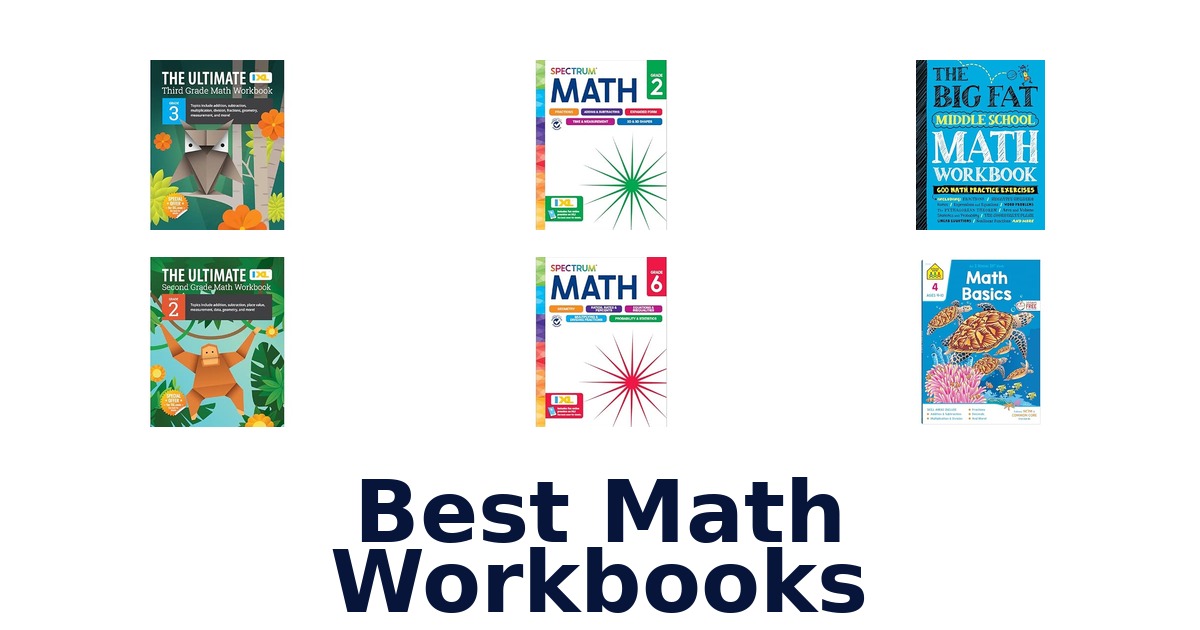
A strong math workbook matches the learner’s current level, gives focused practice across relevant topics, and suits how much structure they need. This selection includes elementary books for specific grades, a middle school workbook with 600 exercises, and options for adults reviewing foundational math. Grade-specific titles cover skills such as addition, fractions, geometry, decimals, and algebra preparation, while the adult-focused books address basic math and pre-algebra or essential math review.
Because the books serve different ages and learning goals, the best choice is not simply the one with the broadest title: check the grade or age range and topic coverage first. The picks below distinguish classroom-style practice from broader review so families, students, and adult learners can narrow their search.
The IXL 3rd Grade Workbook leads because it is designed for ages 8–9 and covers a broad mix of elementary skills, including addition, subtraction, multiplication, division, fractions, and geometry. Its colorful pages include thoughtfully crafted problems, illustrations, and varied activities. For other learners, the list also includes a 600-exercise middle school workbook, grade-specific Spectrum and School Zone books, and adult-focused math review options.
Choose by learner level and the topics they need to practice.
Our Top Picks
 Best Overall
Its ages 8–9 focus and coverage of addition, multiplication, fractions, geometry, and more make it a broad, clearly leveled elementary pick.
View on Amazon Most Exercises
The 600 practice exercises suit middle school review, and the series states that its books meet Common Core and other listed standards.
View on Amazon Best for 5th Grade
Its ages 10–11 scope combines geometry, fractions, decimals, and algebra preparation for a distinct upper-elementary practice mix.
View on Amazon- Best for 6th Grade Spectrum 6th Grade Math
- Best for Pre-Algebra For Dummies Basic Math Workbook
Compare These Math Workbooks by Learner and Focus
| # | Product | Buy |
|---|---|---|
| 1 | 1. IXL 3rd Grade WorkbookBest Overall | View on Amazon |
| 2 | 2. Big Fat Middle School MathMost Exercises | View on Amazon |
| 3 | 3. Spectrum 5th Grade MathBest for 5th Grade | View on Amazon |
| 4 |  4. IXL 2nd Grade WorkbookSecond-grade illustrated activities | View on Amazon |
| 5 |  5. Spectrum 6th Grade MathBest for 6th Grade | View on Amazon |
| 6 |  6. IXL 1st Grade WorkbookIllustrated first-grade foundations | View on Amazon |
| 7 |  7. School Zone Math Basics 4Fourth-grade focused workbook | View on Amazon |
| 8 |  8. Spectrum 2nd Grade MathSecond-grade home or classroom practice | View on Amazon |
| 9 |  9. For Dummies Basic Math WorkbookBest for Pre-Algebra | View on Amazon |
| 10 |  10. Math Refresher for AdultsAdult essential-math refresher | View on Amazon |
Detailed Reviews: Best Math Workbooks
#1 · Best Overall
1. IXL 3rd Grade Workbook
Best for: Third-grade topic-spanning practice.
Why it ranks #1: Its ages 8–9 focus and coverage of addition, multiplication, fractions, geometry, and more make it a broad, clearly leveled elementary pick.
Colorful pages pair thoughtfully crafted problems with vibrant illustrations and varied activities, giving children ages 8–9 several ways to engage with third-grade math. The stated coverage ranges from addition, subtraction, multiplication, and division to fractions and geometry, making this a broad grade-level activity book rather than a single-skill workbook.
For families seeking practice across several math areas, the listed mix of arithmetic, fractions, and geometry creates room to work on different skills in one workbook. Vibrant illustrations and a variety of activities give the pages visual and task variety, while the age and grade labeling helps identify its intended learner. It is a paperback activity book, so it offers a physical workbook format for working through its problems rather than an identified digital platform.
- Covers addition, subtraction, multiplication, and division
- Includes fractions and geometry
- Colorful pages use vibrant illustrations
- Offers a variety of activities
- Its stated age range and topics make it a grade-specific choice, not a broad middle-school refresher.
Skip it if you need middle-school-level practice or a workbook centered on pre-algebra; Basic Math & Pre-Algebra Workbook For Dummies names that older level.
A good fit for families looking for colorful, varied math activities for an 8–9-year-old across several third-grade topics. Its listed grade level is the key boundary: choose a different workbook if the learner needs older-grade or pre-algebra practice.
View on Amazon#2 · Most Exercises
2. Big Fat Middle School Math
Best for: Middle-school exercise volume.
Why it ranks #2: The 600 practice exercises suit middle school review, and the series states that its books meet Common Core and other listed standards.
A total of 600 math practice exercises gives middle-school learners a substantial set of problems to work through. The Big Fat Middle School Math Workbook is positioned for middle and high school students, and its publisher information says the Big Fat Notebooks meet Common Core State Standards, offering curriculum alignment alongside its exercise-focused format.
The 600 exercises make this a fit for learners who want a sizable collection of math practice rather than a workbook identified with just one grade. Its middle- and high-school positioning can suit students seeking material at those stages, while the stated Common Core alignment offers a curriculum reference for families and educators. The paperback format supports written workbook use. The supplied facts identify exercise quantity and audience, but do not specify individual math topics.
- Contains 600 math practice exercises
- Positioned for middle school and high school
- Big Fat Notebooks meet Common Core State Standards
- Paperback workbook format
- The supplied product information does not name specific math topics covered in its exercises.
Skip it if you need a listed topic-by-topic scope or a clearly identified grade workbook; Spectrum 6th Grade Math Workbook names geometry, ratios, and fraction operations.
Consider it for a middle- or high-school learner who wants a large exercise set and values the stated Common Core alignment. If choosing by specific math topic or exact grade, the supplied product details offer less guidance than a named grade workbook.
Listed on Amazon as: The Big Fat Middle School Math Workbook: 600 Math Practice Exercises (Big Fat Notebook)
View on Amazon#3 · Best for 5th Grade
3. Spectrum 5th Grade Math
Best for: Fifth-grade skills across domains.
Why it ranks #3: Its ages 10–11 scope combines geometry, fractions, decimals, and algebra preparation for a distinct upper-elementary practice mix.
Geometry, fractions, decimals, and algebra preparation give this Spectrum workbook a clearly varied fifth-grade math scope for children ages 10–11. Its classroom-and-homeschool positioning makes it relevant to different learning settings, while the grade label helps families select practice aimed at a specific point in the school sequence.
The named combination of geometry, fractions, and decimals supports practice across several fifth-grade areas in one workbook, with algebra preparation extending its listed scope toward a later math skill. Spectrum describes its workbooks as offering support for individual learner needs from classroom to kitchen table, which fits both school and home use. The age and grade labeling helps with selection, while the paperback workbook format offers a physical activity book for practice.
- Covers geometry, fractions, and decimals
- Includes algebra preparation
- Labeled for fifth grade and ages 10–11
- Positioned for classroom or homeschool use
- Its fifth-grade focus may not match learners seeking a different grade level.
Skip it if you need sixth-grade ratios and fraction operations; Spectrum 6th Grade Math Workbook lists those topics for the next grade level.
A fit for families and educators seeking fifth-grade practice spanning geometry, fractions, decimals, and algebra preparation. Its strongest boundary is the grade-specific scope, so choose another level when the learner’s current math work is not fifth grade.
Listed on Amazon as: Spectrum 5th Grade Math Workbooks, Mathematics Activity Book for Kids Ages 10-11, Geometry, Fractions, Decimals, Algebra Prep, and More, Classroom and Homeschool Curriculum
View on Amazon#4
4. IXL 2nd Grade Workbook
Best for: Second-grade illustrated activities.
Why it ranks #4: This ages 7–8 workbook covers addition, subtraction, place value, geometry, and measuring, with colorful pages and varied activities.
Vibrant illustrations and a variety of activities bring visual variety to this IXL second-grade math workbook for children ages 7–8. Its named coverage includes addition, subtraction, place value, geometry, and measuring, so it can support practice across several foundational skills in one paperback activity book.
The combination of basic operations with place value gives families a workbook spanning more than one foundational math area, while geometry and measuring broaden the named practice scope. Colorful pages, vibrant illustrations, and varied activities can make the practice format less uniform from page to page. Its grade and age labeling help identify the intended learner, and the paperback format provides a physical place to work through activities without relying on a specified digital component.
- Covers addition and subtraction
- Includes place value
- Names geometry and measuring
- Uses colorful pages, illustrations, and varied activities
- Its second-grade scope is not intended as a workbook for older-grade math topics.
Skip it if you need fifth-grade fractions, decimals, or algebra preparation; Spectrum 5th Grade Math Workbooks lists those areas for older learners.
This suits families seeking an illustrated, varied workbook for a 7–8-year-old practicing second-grade foundations. The grade-specific topic range is an important fit consideration; learners ready for later-grade material should choose a workbook labeled for that level.
Listed on Amazon as: The IXL Ultimate 2nd Grade Math Workbook, Activity Book for Kids Ages 7-8 Covering Addition, Subtraction, Place Value, Geometry, Measuring, and More Mathematics (IXL Ultimate Workbooks)
View on Amazon#5 · Best for 6th Grade
5. Spectrum 6th Grade Math
Best for: Sixth-grade fractions and ratios.
Why it ranks #5: Designed for ages 11–12, it addresses geometry, ratios, equations, and multiplication and division of fractions for middle school practice.
Ratios, geometry, equations, and multiplying and dividing fractions give this Spectrum workbook a clearly sixth-grade focus for ages 11–12. Its classroom-or-homeschool positioning suits more than one learning setting, while its named topics help families assess whether the workbook aligns with a learner’s current math work.
The topic list connects geometry and ratios with equations and fraction multiplication and division, offering practice across several named sixth-grade areas in one activity book. Spectrum describes its workbooks as supporting individual learner needs from the classroom to the kitchen table, matching both school and homeschool use. The sixth-grade and age labeling helps narrow the intended audience. As a paperback workbook, it provides a physical format for working through the activities.
- Covers geometry and ratios
- Includes mathematics equations
- Names multiplication and division of fractions
- Labeled for sixth grade and ages 11–12
- Its sixth-grade topic range is not aimed at elementary-level math practice.
Skip it if you need second-grade addition, subtraction, fractions, and telling time; Spectrum 2nd Grade Math Workbook names that younger scope.
This suits sixth graders ages 11–12 who want practice across geometry, ratios, equations, and fraction operations at home or in class. The specific grade focus is the key boundary for learners who need elementary foundations or a different level.
View on Amazon#6
6. IXL 1st Grade Workbook
Best for: Illustrated first-grade foundations.
Why it ranks #6: Its ages 6–7 audience and coverage of counting money, place value, addition, subtraction, and geometry target early elementary math.
Colorful pages, vibrant illustrations, and varied activities give this IXL workbook a visual approach to first-grade math for children ages 6–7. Its named areas include addition, subtraction, place value, geometry, and counting money, bringing several foundational topics into one activity book.
The combination of addition and subtraction with place value supports practice across foundational number skills, while geometry and counting money broaden the stated first-grade scope. Colorful pages and vibrant illustrations add visual variety, and the range of activities offers more than one task style. Its age and grade labeling helps families identify the intended learner. The paperback format makes it a physical workbook for working through activities rather than a digital-only resource.
- Covers addition and subtraction
- Includes place value and geometry
- Names counting money
- Uses colorful pages, vibrant illustrations, and varied activities
- Its first-grade scope is aimed at ages 6–7, not older learners.
Skip it if you need more advanced fraction and decimal practice; Spectrum 5th Grade Math Workbooks lists those topics for older students.
A fit for families seeking colorful, varied foundational math activities for a 6–7-year-old, including counting money. Its first-grade audience is the main consideration; learners ready for more advanced topics will need a workbook labeled for a later grade.
View on Amazon#7
7. School Zone Math Basics 4
Best for: Fourth-grade focused workbook.
Why it ranks #7: The 4th-grade book has 64 pages and names multiplication, division, symmetry, decimals, and equivalent fractions as practice topics.
A compact 64-page format brings fourth-grade practice in multiplication, division, symmetry, decimals, and equivalent fractions into one School Zone workbook. Labeled for ages 9–10, it offers families a specific grade-level activity book whose named skills span arithmetic and other core math areas.
The stated 64-page length gives buyers a clear sense of the workbook’s size, while the topic list makes its fourth-grade focus easy to assess. Multiplication and division sit alongside symmetry, decimals, and equivalent fractions, allowing practice across several listed skills in one book. School Zone’s product information notes that writing in workbook pages can help children focus and learn, which supports choosing this paper-based format for hands-on practice rather than typing.
- 64-page workbook
- Covers multiplication and division
- Includes symmetry, decimals, and equivalent fractions
- Labeled for fourth grade and ages 9–10
- Its 64-page length is shorter than a large exercise collection.
Skip it if you want 600 math exercises for middle or high school; The Big Fat Middle School Math Workbook specifies that larger practice set.
A practical fit for families seeking a fourth-grade paper workbook with a defined 64-page length and several named skills. The compact page count and grade-specific scope are important considerations for learners seeking a much larger or older-grade practice collection.
Listed on Amazon as: School Zone Math Basics 4 Workbook: 64 Pages, 4th Grade, Multiplication, Division Symmetry, Decimals, Equivalent Fractions, Ages 9-10 (I Know It! Book Series)
View on Amazon#8
8. Spectrum 2nd Grade Math
Best for: Second-grade home or classroom practice.
Why it ranks #8: This ages 7–8 activity book practices addition, subtraction, fractions, and telling time, with classroom or homeschool use specified.
Addition, subtraction, fractions, and telling time anchor this Spectrum workbook’s second-grade scope for children ages 7–8. Its classroom-or-homeschool positioning gives families and educators a named grade-level math activity book for settings ranging from school desks to home practice.
The listed topics combine foundational arithmetic with fractions and telling time, giving learners several kinds of second-grade practice in one workbook. Spectrum describes its workbooks as supporting individual learner needs from the classroom to the kitchen table, which aligns with its stated classroom and homeschool use. The grade and age labels help buyers assess whether the material suits the learner, and the paperback activity-book format supports written practice on the page.
- Covers addition and subtraction
- Includes fractions and telling time
- Labeled for second grade and ages 7–8
- Identified for classroom or homeschool use
- Its listed focus is second-grade material rather than adult math review.
Skip it if you are an adult returning to essential math skills; Math Refresher for Adults: The Perfect Solution is positioned for adult learners.
Choose this for a 7–8-year-old who needs second-grade practice with arithmetic, fractions, and telling time in a classroom or homeschool setting. Its grade-specific scope is the main fit boundary for buyers seeking older-level or adult material.
Listed on Amazon as: Spectrum 2nd Grade Math Workbook, Mathematics Activity Book for Kids Ages 7-8, Addition, Subtraction, Fractions, Telling Time, and More, Classroom or Homeschool Curriculum
View on Amazon#9 · Best for Pre-Algebra
9. For Dummies Basic Math Workbook
Best for: Step-by-step pre-algebra practice.
Why it ranks #9: It pairs plain-English explanations and step-by-step examples with hundreds of sample problems and quizzes in basic math and pre-algebra.
Plain-English explanations and step-by-step examples make this workbook’s basic math and pre-algebra material approachable for learners who want guidance as well as practice. It also includes hundreds of sample problems and quizzes, giving students opportunities to apply the explained concepts and check their skills in a paperback format.
The plain-English explanations pair with step-by-step examples, helping readers follow how a problem is approached before trying related work themselves. Hundreds of sample problems and quizzes extend that workflow with practice and skill checks across basic math and pre-algebra. The workbook is identified as a companion to Basic Math & Pre-Algebra For Dummies, which may make it a natural choice for someone using that title. Its stated subject scope is more specific than an all-grade workbook.
- Plain-English explanations cover basic math and pre-algebra
- Provides step-by-step examples
- Includes hundreds of sample problems and quizzes
- Identified as a companion to Basic Math & Pre-Algebra For Dummies
- Its stated scope is basic math and pre-algebra, not a grade-specific elementary workbook.
Skip it if you need practice specifically labeled for elementary school grades; IXL Ultimate 3rd Grade Math Workbook identifies a younger, grade-level audience.
A suitable choice for learners who want explained examples alongside substantial basic-math and pre-algebra practice. Its companion-book positioning and subject focus make it less suited to shoppers seeking an elementary grade workbook or a listed topic-by-topic grade curriculum.
Listed on Amazon as: Basic Math & Pre-Algebra Workbook For Dummies with Online Practice (For Dummies (Lifestyle))
View on Amazon#10
10. Math Refresher for Adults
Best for: Adult essential-math refresher.
Why it ranks #10: Its adult-review focus fits learners refreshing essential math, but the supplied product details do not specify topics, exercises, or other components.
Its title identifies adults as the audience and frames the book as a refresher in essential math skills, making it a distinct option for learners returning to foundational mathematics. Math Refresher for Adults: The Perfect Solution is a paperback by Richard W. Fisher, rather than a workbook labeled for a school grade.
The adult-focused positioning separates this title from the roundup’s grade-level children’s workbooks, which can help adult learners choose material aimed at their situation. Its stated purpose is refreshing essential math skills, so it is a fit for someone seeking a general return to math rather than a workbook explicitly named for a particular school grade. The paperback format supports keeping a physical book for study. The supplied title does not identify a more specific subject list.
- Explicitly identifies adults as its audience
- Positions itself as a math refresher
- Focuses on essential math skills
- Paperback format
- Its title does not identify particular math topics or a school-grade level.
Skip it if you need named elementary topics and a grade-level sequence; IXL Ultimate 2nd Grade Math Workbook lists specific skills for ages 7–8.
This is a straightforward option for adults seeking a general refresher in essential math skills. Buyers who need named topic coverage, a particular grade level, or a stated exercise count should consider those details before choosing this broadly positioned title.
Listed on Amazon as: Math Refresher for Adults: The Perfect Solution (Mastering Essential Math Skills)
View on AmazonAvoid the grade-label mismatch
A grade or age label is a starting point, not proof that every exercise will match a learner’s current ability. This list spans IXL books for ages 6–7, 7–8, and 8–9; Spectrum books for ages 7–8, 10–11, and 11–12; and a School Zone title identified as 4th grade and ages 9–The different labels and grade steps make it easy to choose by age alone and overlook what the learner already knows.
Compare the listed topics with the skills they need: for example, Spectrum 5th Grade Math includes decimals and algebra preparation, while IXL 2nd Grade Workbook lists place value and measuring. If a learner is between levels, the supplied descriptions do not establish difficulty or progression, so use the topic lists as a screening tool rather than assuming adjacent grades are interchangeable.
Practice workbooks and teaching guides serve different roles
A workbook built around exercises may not provide the same kind of instruction as one that emphasizes explanations. Big Fat Middle School Math specifies 600 practice exercises, while For Dummies Basic Math Workbook describes plain-English explanations, step-by-step examples, hundreds of sample problems, quizzes, and online practice. The IXL and Spectrum descriptions emphasize activities or topic coverage, but the supplied details do not specify answer keys, lesson plans, or a complete teaching sequence.
That matters if a learner needs someone to explain a new concept rather than simply assign more practice. A family choosing among these titles should decide whether the main need is repetition, guided explanations, or a mix.
The available information supports those distinctions, but does not establish that any one book can replace classroom instruction or function as a complete standalone curriculum.
How to Choose a Math Workbook
Match the grade and age range
Start with the learner’s grade or age, then check whether the named topics fit their current skills. The options range from IXL 1st Grade Workbook for ages 6–7 through Spectrum 6th Grade Math for ages 11–12; several choices cover ages 7–8 or nearby grades. The product descriptions do not provide a shared difficulty scale, so grade labels cannot guarantee an exact match.
Younger learners may prefer an early-grade option such as IXL 1st Grade Workbook, while older elementary students can consider Spectrum 5th Grade Math. For middle school, Big Fat Middle School Math is the broad exercise-based option, while Spectrum 6th Grade Math specifies a 6th-grade level.
Adult learners should look to the adult-focused titles rather than selecting by school grade.
Check the specific math topics
Choose a book whose listed topics address the skills the learner needs to practice. The elementary titles range from counting money and place value in IXL 1st Grade Workbook to fractions, decimals, geometry, and algebra preparation in Spectrum 5th Grade Math. Spectrum 6th Grade Math names ratios, equations, and fraction multiplication and division; School Zone Math Basics 4 lists symmetry and equivalent fractions.
The two adult options target basic math and pre-algebra or essential math review, though Math Refresher for Adults does not detail its topic list in the supplied facts. A learner reviewing one particular skill should favor a title that names it, while someone seeking broader coverage may prefer a book that lists several topic areas.
Decide how much structure you need
Look at whether the book is described as practice, activities, or instruction with explanations. Big Fat Middle School Math specifies 600 exercises, and the IXL descriptions mention problems, illustrations, and varied activities. For Dummies Basic Math Workbook is the clearest option for guided explanation: its facts include plain-English explanations, step-by-step examples, hundreds of sample problems, quizzes, and online practice.
Spectrum titles are presented as classroom or homeschool workbooks, but the supplied details do not specify lesson plans or answer keys. Learners who mainly need repetition may favor the exercise-rich middle school book; those who need help understanding concepts may prefer the For Dummies approach.
For adult review, compare its basic math and pre-algebra focus with the more generally described Math Refresher for Adults.
Which Math Workbook Should You Choose?
For a broad elementary choice, pick IXL 3rd Grade Workbook: its ages 8–9 scope includes operations, fractions, geometry, and varied activities. For middle school learners who want lots of practice, Big Fat Middle School Math specifies 600 exercises. Choose Spectrum 5th Grade Math for ages 10–11 and topics including decimals and algebra preparation, or Spectrum 6th Grade Math for ratios, equations, and fraction operations.
For younger children, IXL 1st Grade Workbook and IXL 2nd Grade Workbook identify their age ranges and topic coverage; Spectrum 2nd Grade Math is another ages 7–8 option. School Zone Math Basics 4 offers a 64-page 4th-grade alternative.
Adults seeking explanations and online practice can choose For Dummies Basic Math Workbook; Math Refresher for Adults is a general essential-math review option with fewer supplied details.
Frequently Asked Questions
How can I tell whether a workbook’s grade level is right for a learner who is ahead or behind?
Use the listed age range, grade, and topics as a starting point, then check whether the learner can attempt the exercises without constant help. A learner who is ahead may benefit from a book covering newer skills; one who is behind may prefer familiar topics for review. Adjust based on confidence and progress.
Should a math workbook supplement classwork or serve as a standalone curriculum?
Treat a workbook as practice or review unless its description clearly establishes it as a complete curriculum. These titles vary in scope: some focus on a grade and selected topics, while adult options emphasize review. Match the book to the learner’s current instruction, and use it to reinforce skills or target areas needing extra practice.
How often should learners practice in a math workbook?
A regular, manageable routine is more useful than occasional long sessions. Set a frequency that fits the learner’s schedule and attention, and focus on understanding each problem rather than completing pages quickly. Review mistakes together and adjust the amount of practice if the work becomes frustrating or no longer offers a useful challenge.
Which topics should I check before choosing a workbook?
Start with the skills the learner needs to practice, then compare them with each book’s listed coverage. The options include operations, fractions, geometry, decimals, algebra preparation, ratios, and more. For example, Spectrum 6th Grade Math lists ratios and fraction operations, while the IXL 3rd Grade workbook spans several elementary topics.
How should adults choose between the two adult-focused options?
Choose For Dummies Basic Math & Pre-Algebra Workbook if explanations and online practice are priorities, as its title identifies both. Math Refresher for Adults is presented as a general essential-math review option, with fewer supplied details. Compare the descriptions against the skills you want to refresh before deciding.
Final Words
Choose by matching the learner’s current level and target skills to the workbook’s stated grade, age, and topic coverage. The IXL 3rd Grade Workbook is the broad elementary pick, while Big Fat Middle School Math offers 600 exercises. For other needs, consider the grade-specific Spectrum, School Zone, or IXL books, or an adult-focused review option.
If level is uncertain, begin with familiar topics and adjust as the learner progresses.