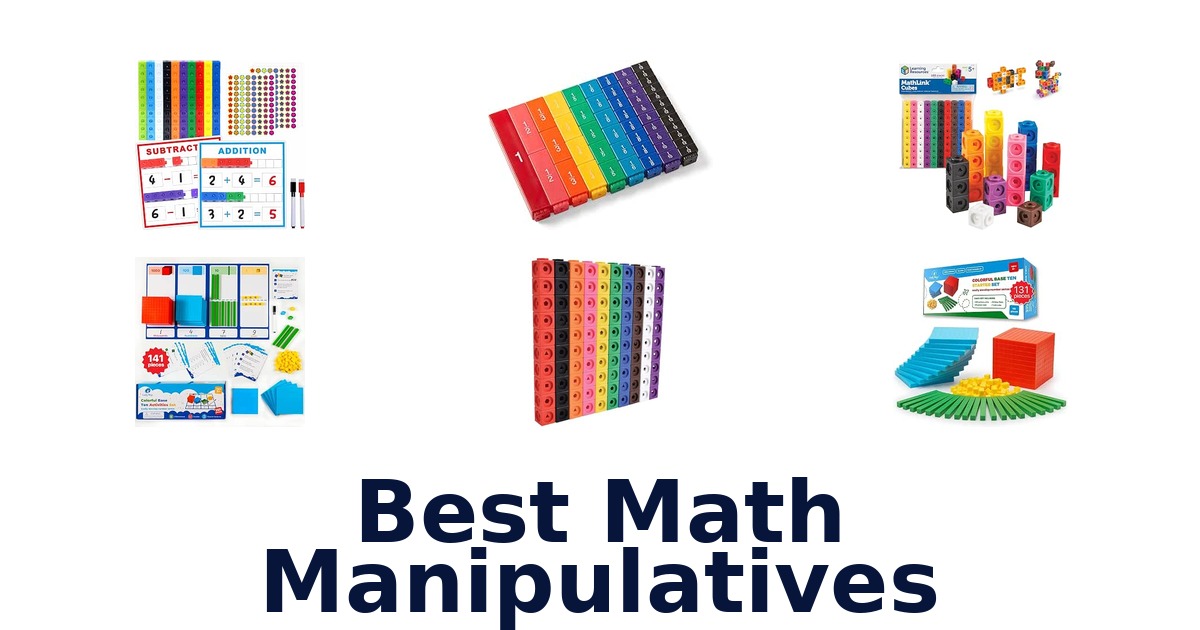
A strong set of math manipulatives makes abstract number concepts visible and gives young learners practical ways to count, sort, build patterns, and model operations. Learning Resources MathLink Cubes is the best all-around starting point here: its 100 connecting cubes support a broad range of early math activities, from counting and patterning to addition and subtraction. The list also includes more specialized options, such as base-ten blocks for place value, fraction towers for fraction work, and counters for sorting or probability.
For families who want several formats together, a K–3 kit bundles tools such as ten-frames, a number line, and pattern blocks. Compare the intended skill, age guidance, piece count, and included activity materials to choose a set that fits your lessons.
Learning Resources MathLink Cubes is the best overall choice because its 100 cubes connect on all sides and support counting, sorting, patterning, measurement, addition, and subtraction. The included activity guide provides 30 learning challenges, making the set useful for varied early-math practice rather than just one narrow skill. Choose a more specialized option if your priority is place value, fractions, or a mixed-format K–3 toolkit.
Our Top Picks
 Best Overall
Learning Resources MathLink Cubes
Its 100 cubes connect on all sides and support counting, patterns, measurement, addition, and subtraction; the included guide adds 30 learning challenges.
View on Amazon Best Multi-Format Kit
This K–3 assortment combines ten-frames, counters, base-ten pieces, a number line, a 120-chart, and pattern blocks for varied early math.
View on Amazon Best Shape-Stamped Cubes
Its 100 linking cubes come in 10 colors, connect on all six sides, and show five geometric shapes on their faces.
View on Amazon- Best for Fractions hand2mind Rainbow Fraction Towers
- Best Sorting Counters Learning Resources Baby Bear Counters
Compare the Math Manipulatives by Best Use
| # | Product | Dimensions | Weight | Material Type | Buy |
|---|---|---|---|---|---|
| 1 | 1. Learning Resources MathLink CubesBest Overall | 9 x 9 x 1 in | 376 g | Plastic | View on Amazon |
| 2 |  2. Simply Magic Base Ten ActivitiesGuided Place-Value Activities | 12.6 x 5 x 4.7 in | — | Plastic | View on Amazon |
| 3 | 3. Aizweb K–3 Math KitBest Multi-Format Kit | — | 8.4 oz | — | View on Amazon |
| 4 | 4. edxeducation Math CubesBest Shape-Stamped Cubes | 8 x 8 x 0.9 in | 14.39 oz | Plastic | View on Amazon |
| 5 |  5. hand2mind Rainbow Fraction TowersBest for Fractions | 8 x 6.8 x 0.8 in | 6.4 oz | Plastic | View on Amazon |
| 6 |  6. Learning Resources Baby Bear CountersBest Sorting Counters | 6.25 x 6.25 x 3.4 in | 0.48 kg | Plastic | View on Amazon |
| 7 |  7. SpriteGru Math Linking CubesReusable Cube Activity Kit | — | 0.4 kg | Plastic | View on Amazon |
| 8 |  8. Simply Magic Base Ten BlocksHands-On Base-Ten Place Value | — | — | Plastic | View on Amazon |
| 9 |  9. hand2mind Foam CountersQuiet Two-Color Counting | 10 x 7.75 x 1 in | 22.68 g | Foam | View on Amazon |
| 10 |  10. JUNWRROW Bingo Counting ChipsHigh-Quantity Bingo and Sorting Chips | 0.75"L x 0.75"W | 5.6 oz | Plastic | View on Amazon |
Detailed Reviews: Best Math Manipulatives
#1 · Best Overall
1. Learning Resources MathLink Cubes
- Dimensions: 9 x 9 x 1 in
- Weight: 376 g
- Material Type: Plastic
Best for: Kindergarten Counting and Patterns.
Why it ranks #1: Its 100 cubes connect on all sides and support counting, patterns, measurement, addition, and subtraction; the included guide adds 30 learning challenges.
The 100 cubes connect on all sides, letting children build visible number models instead of handling separate counters. Their multicolor design supports sorting, color and shape identification, and patterning, while the included guide adds 30 learning challenges for structured practice at home or in class.
At 3/4 inch each, the plastic cubes are sized for linking into towers and other arrangements that make counting, grouping, comparison, addition, and subtraction tactile. Connecting on every side gives children a way to represent sequences and patterns as well as quantities. The activity guide supplies 30 challenges, so caregivers and teachers have prompts for getting started. With 100 cubes in a compact 9-by-9-by-1-inch package, the set suits table activities and straightforward storage between lessons.
- 100 cubes connect on all sides
- Supports counting, addition, subtraction, grouping, and graphing
- Includes a guide with 30 learning challenges
- Multicolor cubes support sorting and patterning
- The listed age recommendation is 5–10, limiting its fit for younger learners.
Skip it if you need a broad assortment of distinct manipulatives; Aizweb’s K–3 kit includes counters, base-ten pieces, a number line, and pattern blocks.
A good fit for kindergarten learners who benefit from building and handling number models during counting, pattern, or operations practice. Choose it when linking cubes are the priority; the activity guide and 100-piece set do not replace a broader range of manipulatives.
Full product details
| Brand | Learning Resources |
|---|---|
| Color | Multicolor |
| Included Components | Counter toys |
| Item Dimensions | 9 x 9 x 1 inches |
| Item Weight | 376 g |
| Manufacturer | Learning Resources |
| Part Number | LER4285 |
| Manufacturer Warranty Description | No Warranty |
| Manufacturer recommended age | 5 – 10 years |
| Material | Plastic |
| Model | MathLink Cubes |
| Model Number | LER4285 |
| Model Year | 2011 |
| Operation Mode | Manual |
| Size | 3/4in |
| Sub Brand | Learning Resources |
| Additional Information | Important information Safety Information true Directions Included activity guide with 30 learning challenges and sequencing, math skills activities. |
Listed on Amazon as: Learning Resources MathLink Cubes – Set of 100 Cubes, Ages 5+ Kindergarten, STEM Activities, Math Manipulatives, Homeschool Supplies, Teacher Supplies
View on Amazon#2
2. Simply Magic Base Ten Activities
- Dimensions: 12.6 x 5 x 4.7 in
- Material Type: Plastic
Best for: Guided Place-Value Activities.
Why it ranks #2: The 141-piece set pairs base-ten blocks with a place-value mat, three dice, a marker, and 15 cards containing 30 activities.
A place-value mat, dry-erase marker, three dice, and 15 cards with 30 activities accompany the base-ten pieces, so learners have tools for guided practice as well as blocks. The set includes units, tens rods, hundred flats, and a thousand cube for making place-value concepts visible.
The blocks represent ones through thousands, giving children concrete pieces to arrange while working on base-ten concepts and number sense. The mat provides a surface for organizing those pieces by place, while the dry-erase marker, dice, and activity cards add ways to structure practice. With 15 cards offering 30 activities, the set can support a sequence of guided tasks rather than relying only on free construction. The lightweight, washable plastic pieces are suitable for repeated hands-on use.
- Includes a place-value mat and dry-erase marker
- 15 cards provide 30 activities
- Base-ten pieces cover units through a thousand cube
- Lightweight, washable plastic pieces
- The small-parts warning excludes children under three.
Skip it if you only need a simple set of bear counters for sorting; Learning Resources Baby Bear Counters provide 102 colorful pieces and a storage bucket.
A strong fit for caregivers or teachers seeking guided place-value practice with blocks and activity prompts in one kit. The included mat and cards support organized lessons, while the small-parts warning means it is not suitable for children under three.
Full product details
| Brand | Simply magic |
|---|---|
| Color | Multicolor |
| Included Components | 100 ones 20 tens rods 10 flats hundreds 1 cube thousand 1 place value mat 1 dry erase marker 3 place value duce 15 activity cards with 30 activities. |
| Item Dimensions | 12.6 x 5 x 4.7 inches |
| Manufacturer | China |
| Part Number | 850042656136 |
| Manufacturer recommended age | 5 years and up |
| Material | Plastic |
| Model | Base Ten Blocks and Activities |
| Model Year | 2021 |
| Operation Mode | Manual |
| Size | 12.6 x 5 x 4.7 inches |
| Additional Information | Important Information Toy Safety Our recommended age: Manufacturer's minimum age: 5 years Small parts. Not for children under 3 yrs. |
Listed on Amazon as: Simply magic 141 PCS Base Ten Blocks for Math – Place Value Number Cubes
View on Amazon#3 · Best Multi-Format Kit
3. Aizweb K–3 Math Kit
- Weight: 8.4 oz
Best for: K–3 Multi-Skill Math Kit.
Why it ranks #3: This K–3 assortment combines ten-frames, counters, base-ten pieces, a number line, a 120-chart, and pattern blocks for varied early math.
This kit combines ten-frames, counters, base-ten pieces, a number line, a 120-chart, and pattern blocks, letting learners move among several early-math models. Its mix supports addition, subtraction, place value, measurement, and geometry for individual or small-group activities at home or in a classroom.
Two ten-frames and 20 double-sided counters provide pieces for organizing quantities, while 10 tens rods and 25 ones cubes offer a separate route into place value. The dry-erase number line and 120-chart add visual references for number work, and 13 pattern blocks address geometric concepts. Together, these tools cover more than one type of activity without requiring a single manipulative to serve every lesson. The kit is listed for K–3 and includes small parts unsuitable for children under three.
- Includes two ten-frames and 20 double-sided counters
- Provides tens rods and ones cubes for place value
- Includes a dry-erase number line and 120-chart
- 13 pattern blocks support geometry activities
- Small parts make the kit unsuitable for children under three.
Skip it if you need 100 linking cubes for building long number models; Learning Resources MathLink Cubes connect on all sides and include 30 challenges.
This kit fits K–3 learners who need varied tools for number operations, place value, measurement, and geometry, especially for home support or small groups. Its broad assortment is useful when lessons vary, but the small-parts warning excludes children under three.
Full product details
| Brand | Aizweb |
|---|---|
| Item Weight | 8.4 ounces |
| Item model number | JZ-01 |
| Manufacturer | Wenzhou Chengyu Packing Material Co., Ltd |
| Part Number | TZ-01 |
| Package Dimensions | 8.23 x 6.06 x 1.65 inches |
| Additional Information | Important Information Small parts. Not for children under 3 yrs. |
#4 · Best Shape-Stamped Cubes
4. edxeducation Math Cubes
- Dimensions: 8 x 8 x 0.9 in
- Weight: 14.39 oz
- Material Type: Plastic
Best for: Shape-Aware Linking Cube Practice.
Why it ranks #4: Its 100 linking cubes come in 10 colors, connect on all six sides, and show five geometric shapes on their faces.
Five geometric shapes embossed on each cube add shape recognition to ordinary counting and stacking. With 100 cubes in 10 colors and connections on all six sides, children can build pattern sequences and math models while also sorting by color or noticing circles, squares, triangles, pentagons, and hexagons.
The soft-click connections are described as easy for small hands to manage, supporting repeated joining and separating as children make towers or linked quantities. Because cubes connect on all sides, models can extend in different directions rather than only upward. Ten colors offer another sorting and patterning dimension, while the embossed shapes on five sides bring geometry into play. The 100-piece set suits home or classroom activities; its small parts are not for children under three.
- 100 cubes in 10 colors
- Connects on all six sides with a soft click
- Five embossed geometric shapes per cube
- Supports stacking, math models, and pattern sequences
- Small parts make this unsuitable for children under three.
Skip it if you want fraction values printed on linking pieces; hand2mind Rainbow Fraction Tower Cubes are marked for comparing and modeling fractions.
Choose these for young learners who can use small linking cubes to combine color sorting, shape identification, and early math models. They fit home or classroom activities, but the stated small-parts warning rules them out for children under three.
Full product details
| Brand | edxeducation |
|---|---|
| Color | Multicolor |
| Included Components | Red cubes x 10;Yellow cubes x 10;Blue cubes x 10;Green cubes x 10;Orange cubes x 10;Purple cubes x 10;Black cubes x 10;Pink cubes x 10;White cubes x 10;Brown cubes x 10 |
| Item Dimensions | 8 x 8 x 0.9 inches |
| Item Weight | 14.39 ounces |
| Manufacturer | Learning Advantage |
| Part Number | 12710 |
| Manufacturer Warranty Description | No warranty |
| Manufacturer recommended age | 5 months – 10 years |
| Material | Plastic |
| Model | Math Cubes |
| Model Number | 12710 |
| Model Year | 2017 |
| Operation Mode | Manual |
| Sub Brand | Math Cubes |
| Additional Information | Important Information Toy Safety Our recommended age: Manufacturer's minimum age: 5 months not_suitable_under_3_years Small parts. Not for children under 3 yrs. |
Listed on Amazon as: edxeducation Math Cubes, Set of 100 Counting Blocks, 5 Shapes and 10 Colors
View on Amazon#5 · Best for Fractions
5. hand2mind Rainbow Fraction Towers
- Dimensions: 8 x 6.8 x 0.8 in
- Weight: 6.4 oz
- Material Type: Plastic
Best for: Elementary Fraction Comparisons.
Why it ranks #5: The 51 interlocking cubes represent nine fraction values and support comparing, ordering, and modeling fraction and decimal concepts.
Fraction labels on color-coded interlocking cubes let students compare represented values by joining pieces into towers. The 51-piece set covers nine fraction values and supports naming fractions and decimals, ordering fractions, and modeling improper fractions, mixed numbers, and operations, making it a focused aid for elementary fraction lessons.
The nine values represented by the cubes give learners physical pieces to compare, while interlocking them lets students examine how fractional parts relate when combined. Fraction markings appear on one side, with the other three sides blank, so learners can use the labeled face for identification and the remaining faces for handling. The plastic cubes are described as durable and easy to clean, which supports repeated classroom use. The recommended age range is eight to eleven; small parts are a safety consideration.
- 51 interlocking fraction cubes
- Nine color-coded fraction values
- Supports comparing, ordering, and modeling fraction operations
- Durable plastic cubes are easy to clean
- The small-parts warning makes the set unsuitable for young children.
Skip it if you are teaching basic color sorting rather than fractions; Learning Resources Baby Bear Counters offer 102 pieces for counting and grouping by color.
Choose this set for students ready to explore fraction equivalence, ordering, mixed numbers, and operations with marked, interlocking pieces. It is a focused fraction resource, not a general counting assortment, and its small-parts warning calls for age-appropriate use.
Full product details
| Brand | hand2mind |
|---|---|
| Color | Multi |
| Included Components | 51 Fraction Tower Cubes |
| Item Dimensions | 8 x 6.8 x 0.8 inches |
| Item Weight | 6.4 ounces |
| Manufacturer | hand2mind |
| Part Number | 5261 |
| Manufacturer Warranty Description | Standard manufacturer warranty applies |
| Manufacturer recommended age | 8 – 11 years |
| Material | Plastic |
| Model Number | 5261 |
| Operation Mode | Manual |
| Additional Information | Important information Safety Information This product may contain small parts that are unsafe for small children. |
Listed on Amazon as: hand2mind Rainbow Fraction Tower Cubes, Fraction Equivalency, Montessori Math Blocks Materials for Kids, Math Manipulatives 4th Grade, Elementary Teacher Must Haves (Set of 51)
View on Amazon#6 · Best Sorting Counters
6. Learning Resources Baby Bear Counters
- Dimensions: 6.25 x 6.25 x 3.4 in
- Weight: 0.48 kg
- Material Type: Plastic
Best for: Preschool Sorting and Counting.
Why it ranks #6: The set supplies 102 one-inch bears in six colors, plus a storage bucket and activity guide, for hands-on counting and sorting.
A set of 102 bear counters in six colors makes early quantities tangible while inviting children to sort by color. Each one-inch bear is easy to distinguish as a counting piece, and the storage bucket includes an activity guide printed inside for a ready reference during play.
The 102 plastic bears support counting, sorting, and color recognition through hands-on activities, while their bear shape can also encourage imaginative play. Six vivid colors give learners a clear way to group pieces before counting or comparing sets. The bucket keeps the pieces together between sessions, and its printed activity guide provides prompts without a separate booklet to store. The manufacturer lists a preschool-age starting point, with a small-parts warning to keep in mind for younger children.
- 102 bear counters in six colors
- Supports counting, sorting, and color recognition
- One-inch pieces are easy to distinguish during activities
- Storage bucket has the activity guide printed inside
- The small-parts warning makes the set unsuitable for children under three.
Skip it if you need cubes that link into number towers; Learning Resources MathLink Cubes connect on all sides for building quantities and patterns.
A practical match for preschool counting and sorting activities where colorful, recognizable pieces help children form groups. The bucket and printed guide support repeat use, but the small-parts warning matters when choosing materials for households or groups with children under three.
Full product details
| Brand | Learning Resources |
|---|---|
| Color | Multicolor |
| Included Components | Counter toys |
| Item Dimensions | 6.25 x 6.25 x 3.4 inches |
| Item Weight | 0.48 kg |
| Manufacturer | ['STEMfinity'] |
| Part Number | LER0729 |
| Manufacturer Warranty Description | We want to exceed your expectations. We work hard to ensure that our products are of the highest quality, and that kids feel happy, confident and inspired after playing with them. If the product you’ve purchased is not giving your child an exceptional experience, then you can simply return it and yo |
| Manufacturer recommended age | 36 months – 10 years |
| Material | Plastic |
| Model Number | LER0729 |
| Operation Mode | Manual |
| Size | 102 Pieces (1 Pack) |
| Additional Information | Important information Safety Information Small Parts Warning |
Listed on Amazon as: Learning Resources Baby Bear Counters – 102 Pieces, Ages 3+ | Grades Pre-K+ Toddler Learning Toys, Counters for Kids, Counting Manipulatives, Teddy Bear Counters
View on Amazon#7
7. SpriteGru Math Linking Cubes
- Weight: 0.4 kg
- Material Type: Plastic
Best for: Reusable Cube Activity Kit.
Why it ranks #7: Its 100 cubes come with a reusable double-sided activity card, two dry-erase markers, and stickers for additional counting and pattern activities.
A reusable double-sided activity card comes with 100 linking cubes, two dry-erase markers, and 1,600 star stickers, adding several ways to engage with number and pattern work. The colorful cubes link into quantities and sequences, while the card and markers support guided activities for home or classroom use.
Linking cubes can make color, quantity, height, and multiples easier to see by turning them into physical arrangements. The double-sided card and two dry-erase markers give children a surface for activities, and the supplied directions suggest linking cubes into numbers or patterns before using the card. Star stickers offer another way to interact with the cubes. The set is listed for ages four to six and includes 100 cubes in 10 colors for repeated hands-on practice.
- 100 cubes in 10 vibrant colors
- Includes a reusable double-sided activity card
- Two dry-erase markers support card activities
- Includes 1,600 star stickers
- The listed age range is four to six, so it may not suit older learners seeking advanced manipulatives.
Skip it if you need marked pieces for comparing fraction values; hand2mind Rainbow Fraction Tower Cubes represent nine fraction values with color-coded cubes.
This kit suits younger learners who enjoy linking colorful cubes and using a reusable card, markers, and stickers during math activities. Its listed age range is four to six, so consider that boundary when selecting it for older children.
Full product details
| Brand | SpriteGru |
|---|---|
| Color | Multicolor |
| Item Weight | 0.4 kg |
| Manufacturer | SpriteGru |
| Part Number | Gru240 |
| Manufacturer recommended age | 4 – 6 years |
| Material | Plastic |
| Operation Mode | Manual |
| Size | Small |
| Additional Information | Important information Directions Link the cubes together to form numbers or patterns. Use the double-sided card and markers for activities. Insert star stickers onto the cubes for additional fun. |
Listed on Amazon as: SpriteGru Math Linking Cubes, Math Cubes Manipulatives with Activity Cards Linking Cube Math Counters for Kids Kindergarten Learning Activities
View on Amazon#8
8. Simply Magic Base Ten Blocks
- Material Type: Plastic
Best for: Hands-On Base-Ten Place Value.
Why it ranks #8: The 131-piece plastic set includes ones, tens, hundreds, and a thousand cube for modeling place value and number sense.
The set pairs 100 unit cubes with 20 tens rods, 10 hundred flats, and one thousand cube, giving learners concrete pieces for seeing base-ten groupings. This differentiated assortment supports place-value and number-sense lessons at home or in a classroom, with plastic blocks that can be cleaned after use.
The varied block forms let a learner move from individual units to tens rods, hundred flats, and a thousand cube, making the structure of base ten visible rather than purely abstract. That progression supports explaining place value and developing number sense, the uses named for the set. The 131-piece assortment is made of plastic and described as easy to clean, which helps when blocks are shared across lessons. Its listed age recommendation begins at six years.
- 131 pieces across four base-ten denominations
- Includes 100 units, 20 tens rods, 10 hundred flats, and one thousand cube
- Supports place value and number sense
- Plastic blocks are described as easy to clean
- The listed minimum age is six years, so it is not specified for younger learners.
Skip it if you want included activity cards and a writing mat; Simply Magic’s 141-piece set adds those tools to its base-ten blocks.
Consider this set for learners ready to explore base-ten groupings with physical units, rods, flats, and a thousand cube. It focuses on those blocks rather than a supplied activity-card system, and its listed age recommendation starts at six.
Full product details
| Brand | Simply magic |
|---|---|
| Color | Assorted |
| Included Components | 1 cube thousand, 10 flats hundreds, 100 ones units, 20 tens rods |
| Manufacturer | Simply Magic |
| Part Number | 18042020 |
| Manufacturer recommended age | 6 years and up |
| Material | Plastic |
| Model | Base Ten Blocks |
| Model Year | 2021 |
| Operation Mode | Manual |
| Size | Small |
| Additional Information | Important Information Toy Safety Our recommended age: Manufacturer's minimum age: 6 years |
Listed on Amazon as: Simply magic 131 PCS Base Ten Blocks for Math – Math Counters – Math Cubes
View on Amazon#9
9. hand2mind Foam Counters
- Dimensions: 10 x 7.75 x 1 in
- Weight: 22.68 g
- Material Type: Foam
Best for: Quiet Two-Color Counting.
Why it ranks #9: These 200 one-inch foam counters have red and yellow sides, supporting counting, sorting, and probability with a softer, quieter format.
Soft foam counters show red on one side and yellow on the other, offering a quiet way to represent two outcomes or flip pieces during counting. The 200 one-inch circles also work for sorting and probability activities, giving teachers and families a simple, reusable format for early math practice.
The two-sided color contrast makes it possible to sort counters or count how many show each color, while the soft foam material keeps handling quieter than harder pieces. At one inch in diameter, the counters are substantial circular tokens for table activities and can also serve as bingo chips or game tokens. The 200-piece quantity supports larger groups and repeated exercises. The product is listed for ages three to ten, with a small-parts warning for children under three.
- 200 soft foam counters
- Red on one side and yellow on the other
- Supports counting, sorting, and probability activities
- Can also serve as bingo chips or game tokens
- The small-parts warning makes these unsuitable for children under three.
Skip it if you want pieces that connect into towers; edxeducation Math Cubes link on all sides for building quantities and patterns.
A useful choice for early counting, sorting, probability, or quiet classroom games where two contrasting sides make outcomes visible. These are flat foam counters rather than linking blocks, and the small-parts warning excludes children under three.
Full product details
| Brand | hand2mind |
|---|---|
| Color | Original Version |
| Included Components | Qty 200 foam counters |
| Item Dimensions | 10 x 7.75 x 1 inches |
| Item Weight | 22.68 g |
| Manufacturer | hand2mind |
| Part Number | 343B |
| Manufacturer Warranty Description | No warranty. |
| Manufacturer recommended age | 36 months – 10 years |
| Material | Foam |
| Model Number | 343B |
| Operation Mode | Manual |
| Size | Set of 200 |
| Additional Information | Important Information Toy Safety Our recommended age: Manufacturer's minimum age: 3 years Small parts. Not for children under 3 yrs. |
Listed on Amazon as: hand2mind Foam Two Color Counters, Set of 200
View on Amazon#10
10. JUNWRROW Bingo Counting Chips
- Dimensions: 0.75"L x 0.75"W
- Weight: 5.6 oz
- Material Type: Plastic
Best for: High-Quantity Bingo and Sorting Chips.
Why it ranks #10: The 500 translucent chips suit counting, sorting, bingo, and sensory bins, but their product guidance lists a minimum age of 13 years.
Five hundred translucent chips in six colors provide a large supply for counting, sorting, bingo, or sensory-bin activities. Each 3/4-inch plastic piece can cover a number while leaving it visible, and the included black bag gives the mixed-color chips a designated place for storage between uses.
The translucent plastic lets numbers remain visible when chips are placed over them, supporting activities that use covered number charts or other surfaces. Six colors provide options for sorting and color-based groupings, while the 500-piece quantity can serve larger activities. Their 3/4-inch diameter makes them easy to maneuver, and the black bag helps keep the reusable chips together after play. The listing describes use for classroom counting, bingo, and sensory bins, and gives a manufacturer age recommendation of 13 and up.
- 500 translucent plastic chips
- Six colors support sorting and grouping
- Numbers remain visible when covered
- Includes a black storage bag
- The manufacturer lists an age recommendation of 13 and up.
Skip it if you need chunky, one-inch bears for preschool counting; Learning Resources Baby Bear Counters offer recognizable pieces and an activity guide.
Consider these for users needing a large supply of small chips for bingo, sorting, number-covering, or sensory-bin use. The bag helps with storage, but the manufacturer’s listed age recommendation is 13 and up, an important boundary for younger learners.
Full product details
| Brand | JUNWRROW |
|---|---|
| Color | 6 Colors 500 |
| Container Type | Bag |
| Included Components | Chips |
| Item Dimensions L x W | 0.75"L x 0.75"W |
| Item Weight | 5.6 ounces |
| Manufacturer | JUNWRROW |
| Part Number | BGCHIP-6C |
| Manufacturer recommended age | 13 years and up |
| Material | Plastic |
| Model Number | BGCHIP-6C |
| Operation Mode | manual |
| Size | 3/4 inch |
| Additional Information | Important Information Toy Safety Our recommended age: Manufacturer's minimum age: 13 years |
Listed on Amazon as: JUNWRROW 500 PCS 3/4 inch Transparent 6 Color Bingo Counting Chips with Bag
View on AmazonAvoid the Small-Piece Age Trap
Check the age guidance and plan supervision before choosing small manipulatives for a young child. The product details vary: Learning Resources MathLink Cubes are recommended for ages 5–10, Baby Bear Counters for ages 3 and up, and the edxeducation cubes list a manufacturer minimum of five months while warning that they are not suitable for children under three because of small parts. JUNWRROW Bingo Counting Chips list a manufacturer minimum age of 13 years, despite also describing the chips as suitable for ages five and up.
That discrepancy makes the stated age information especially important to review rather than assuming that a classroom-style counter is automatically appropriate for every child. Keep small pieces out of reach of children who may mouth them, and supervise use when the age guidance or small-parts warning calls for it.
A larger piece or a different activity format may be a better fit for a younger learner.
Match the Manipulative to the Math Job
Choose a format that makes the target concept easy to see and handle. Linking cubes are versatile because children can connect them into towers, patterns, and number models; both Learning Resources MathLink Cubes and edxeducation Math Cubes have 100 pieces. Their shared cube format does not make them identical: edxeducation adds geometric shapes embossed on five sides, while MathLink includes a guide with 30 learning challenges.
Fraction Tower Cubes are a more focused choice, with pieces representing nine fraction values that can be interlocked and compared. Base-ten blocks make units, tens, hundreds, and a thousand visually distinct, while foam counters flip between red and yellow sides.
A common mismatch is buying a versatile counter set when the lesson requires a specific representation, such as fraction equivalence or place value. Start with the skill to teach, then select the format that models it directly.
How to Choose Math Manipulatives
Target Math Skill
Choose manipulatives that directly show the skill your learner is practicing. MathLink and edxeducation each offer 100 connecting cubes for counting, building, and patterns; the former also lists addition, subtraction, measurement, and graphing among its uses. For place value, Simply Magic Base Ten Activities includes ones, tens, hundreds, and a thousand cube, plus a mat and activity cards.
For fractions, hand2mind Rainbow Fraction Towers represents nine fraction values. The Aizweb K–3 kit spreads across several early skills with ten-frames, base-ten pieces, a number line, a chart, counters, and pattern blocks.
A broad early-math learner may benefit from cubes or a mixed kit, while a child working on one topic may gain more from a purpose-built set.
Piece Count and Format
Look at both the number of pieces and what each piece lets a child model. This selection ranges from 51 fraction cubes to 500 counting chips; more pieces can support larger groups, but do not necessarily teach more concepts. The 100-cube sets connect to form towers and patterns, whereas hand2mind Foam Counters supplies 200 loose, double-sided pieces and JUNWRROW provides 500 translucent chips.
The 102 Baby Bear Counters add six colors and a storage bucket. Choose linking cubes when building and comparing lengths is useful, loose counters for sorting or probability, and a larger quantity when activities involve many pieces or a group.
Match the physical format to the activity and the learner’s ability to handle and keep track of pieces.
Age Guidance and Activity Support
Check the manufacturer’s age guidance and included teaching aids before choosing a set. Listed recommendations range from age three and up for Baby Bear Counters to ages eight through eleven for Rainbow Fraction Towers; Simply Magic Base Ten Activities lists age five and up, while the 131-piece Base Ten Blocks lists age six and up. Activity support also varies: Learning Resources MathLink Cubes includes 30 learning challenges, and the 141-piece Simply Magic set includes 15 cards with 30 activities, a mat, dice, and a marker.
The SpriteGru set adds a double-sided card and markers. Families who want ready-to-use prompts may prefer those bundles; experienced teachers or learners with a defined activity may be content with a simpler set.
Follow small-parts warnings and supervise accordingly.
Which Math Manipulatives Should You Choose?
For one versatile early-math set, choose Learning Resources MathLink Cubes: its 100 connecting pieces cover a wide range of counting and number activities, and the guide supplies 30 challenges. For place-value lessons that benefit from prompts and tools, Simply Magic Base Ten Activities combines base-ten pieces, a mat, dice, and activity cards. If you want multiple formats in one package for K–3 practice, Aizweb K–3 Math Kit includes ten-frames, counters, base-ten pieces, a number line, chart, and pattern blocks.
Choose hand2mind Rainbow Fraction Towers for fraction comparisons, Learning Resources Baby Bear Counters for colorful sorting, or hand2mind Foam Counters for soft, two-color counting pieces. For a narrower classroom-style option, edxeducation Math Cubes add shape markings; check age guidance before choosing any small-piece set.
Related Buying Guides
Frequently Asked Questions
How should math manipulatives be introduced without turning practice into play-only time?
Start with one clear math goal, such as making a pattern or representing a number. Model how each piece supports that goal, then give children a focused task and ask them to explain their choices. Keep free exploration separate from practice, and finish by connecting the hands-on activity to spoken or written math.
What is the safest way to store and supervise small math counters?
Keep small counters in a closed container between activities and supervise children while they use them, especially if they may put objects in their mouths. Check the age guidance for the specific set before choosing it. After practice, count pieces back into storage and keep them out of reach of younger children.
Can manipulatives replace written math practice, or should children use both?
Use both: manipulatives make quantities and relationships easier to see, while drawings and written work help children record and apply what they understand. For example, a child can build a number with cubes, sketch the arrangement, and then write the matching equation. Adjust the balance to the skill and the learner.
Which option supports place-value lessons?
Choose a base-ten set for place-value practice. The Simply Magic Base Ten Activities option is described as combining base-ten pieces with a mat, dice, and activity cards, giving learners tools and prompts for lessons. A mixed-format K–3 kit is another option if you also want ten-frames, a number line, and pattern blocks.
How can I choose between a broad set and a skill-specific set?
Match the set to the math you plan to practice most. MathLink Cubes support varied early-math activities, including counting, sorting, patterning, measurement, addition, and subtraction. For a narrower focus, choose fraction towers for fraction comparisons or a base-ten set for place value; check age guidance for small-piece sets.
Final Words
For one versatile early-math choice, Learning Resources MathLink Cubes stand out: the 100 pieces connect on all sides, support several foundational skills, and come with 30 learning challenges. Choose a focused alternative when lessons center on place value or fractions, or select the Aizweb kit for multiple formats across K–3 practice. Before deciding, match the set to the child’s age and your intended activities, and plan supervised storage for small pieces.