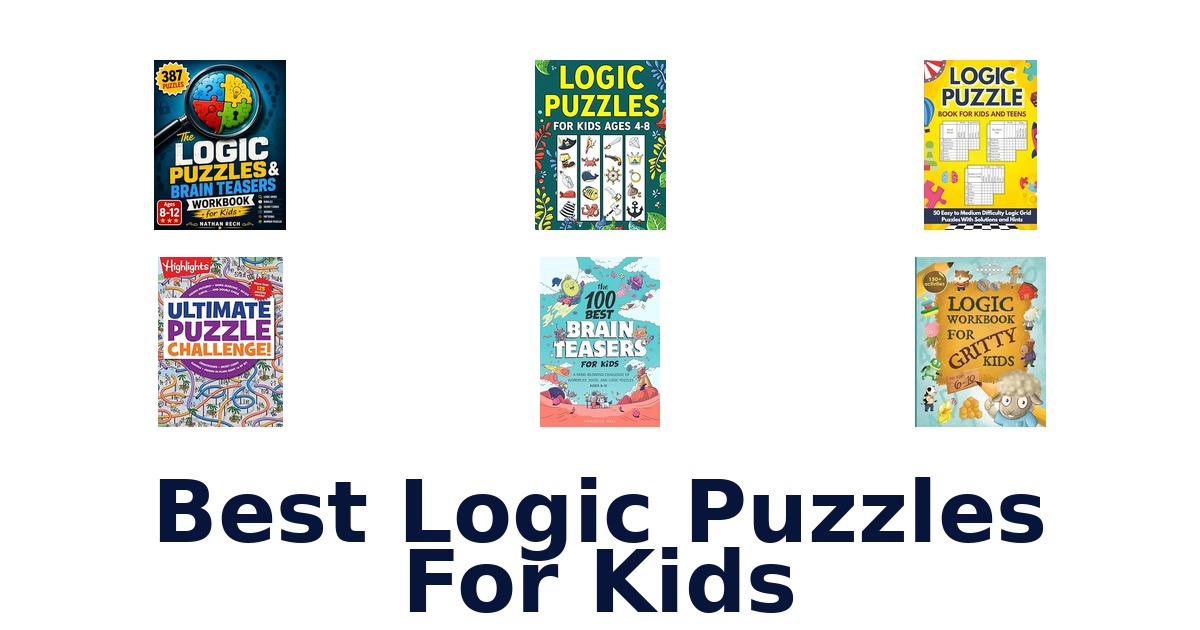
A strong choice gives kids puzzles suited to their age and challenge level, with enough variety or guidance to keep them reasoning rather than guessing. This roundup compares ten paperbacks, from visual activities for ages 4–6 to logic grids, codes, riddles, and mixed brain-game collections for older children. The most focused options teach clue-based deduction, while broader workbooks add spatial reasoning, math, word games, mazes, or hidden-picture activities.
Some include solutions or hints; others emphasize activity volume or an age-specific entry point. Match the book to the child’s current reading and puzzle experience, not just the number of activities.
The picks below highlight what each title actually offers so you can choose a focused logic challenge or a more varied workbook.
The Logic Puzzles & Brain Teasers Workbook for Kids is the best overall choice for families seeking a broad, logic-focused collection: its 387 games include riddles, logic grids, and secret codes, and its stated age range is 8–For children who benefit from explicit worked answers, Logic Puzzle Book for Kids and Teens offers 50 easy-to-medium logic grid puzzles with detailed solutions. The right pick depends on whether you want breadth, step-by-step grid practice, or activities tailored to younger ages.
Our Top Picks
 Best Overall
Logic Puzzles & Brain Teasers Workbook
Its 387 games combine riddles, logic grids, and secret codes for ages 8–12, making it a broad, directly relevant choice for growing solvers.
View on Amazon Best Grid Practice
Feline Puzzles Logic Grid Book
Fifty easy-to-medium grid puzzles use smaller grids for young readers, and detailed solutions show how each answer follows from the clues.
View on Amazon Best Mystery Mix
More than 150 puzzles span logic grids, cypher codes, rebuses, and crosswords, wrapped in a mystery with character hints and tips.
View on Amazon- Best for Ages 4–6 My First Logic Workbook
- Best Activity Variety Logic Workbook for Gritty Kids
Compare the logic puzzle books by activity and age range
| # | Product | Buy |
|---|---|---|
| 1 | 1. Logic Puzzles & Brain Teasers WorkbookBest Overall | View on Amazon |
| 2 | 2. Feline Puzzles Logic Grid BookBest Grid Practice | View on Amazon |
| 3 | 3. Codebreakers Club Puzzle BookBest Mystery Mix | View on Amazon |
| 4 |  4. My First Logic WorkbookBest for Ages 4–6 | View on Amazon |
| 5 | 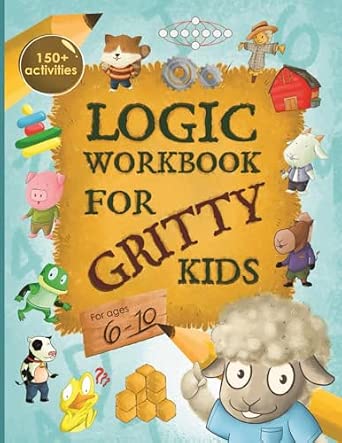 5. Logic Workbook for Gritty KidsBest Activity Variety | View on Amazon |
| 6 |  6. Activity Wizo Logic PuzzlesFor early pattern practice | View on Amazon |
| 7 |  7. 100 Best Brain TeasersFor wordplay and riddles | View on Amazon |
| 8 |  8. Totally Awesome Logic PuzzlesFor ages 4–8 activity variety | View on Amazon |
| 9 |  9. brainPLAY Trickiest Puzzles EverFor advanced puzzle fans | View on Amazon |
| 10 |  10. Ultimate Puzzle ChallengeFor a jumbo activity mix | View on Amazon |
Detailed Reviews: Best Logic Puzzles For Kids
#1 · Best Overall
1. Logic Puzzles & Brain Teasers Workbook
Best for: For detective-style reasoning.
Why it ranks #1: Its 387 games combine riddles, logic grids, and secret codes for ages 8–12, making it a broad, directly relevant choice for growing solvers.
Step-by-step logic grids teach kids ages 8–12 to reason from clues, giving the workbook a clear deduction focus within its 387 brain games. Riddles, secret codes, and tricky teasers broaden the challenge, while the kid-friendly prompts encourage a second look or a new angle when the first approach does not work.
The grid puzzles offer guided practice in connecting clues, a useful format for children learning to make deductions methodically. Riddles and teasers add a different kind of problem-solving, asking kids to reconsider what a question or scenario means. Secret codes extend the variety beyond ordinary riddles and grids. With 387 games listed and an age range of 8–12, the book offers a sizeable set of activities for children ready to move among several reasoning styles.
- 387 brain games
- Step-by-step logic grids reason from clues
- Includes riddles, logic grids, and secret codes
- Teasers encourage a fresh angle or second look
- The stated age range is 8–12, so it does not target preschool and early-elementary ages.
Skip it if you need activities specifically aimed at ages 4–6, including picture completion and symmetry; My First Logic Workbook for Gritty Kids covers that younger range.
A suitable pick for ages 8–12 who want clue-based grids alongside riddles and codes. Its stated age range makes it a better fit for older children than preschoolers or early elementary beginners.
Listed on Amazon as: The Logic Puzzles & Brain Teasers Workbook for Kids: 387 Brain Games, Riddles, Logic Grids & Secret Codes to Boost Critical Thinking & Problem-Solving (Ages 8–12)
View on Amazon#2 · Best Grid Practice
2. Feline Puzzles Logic Grid Book
Best for: For growing logic-grid solvers.
Why it ranks #2: Fifty easy-to-medium grid puzzles use smaller grids for young readers, and detailed solutions show how each answer follows from the clues.
Smaller grids make these 50 logic puzzles approachable for young readers while still offering easy-to-medium challenges. The step-by-step rise in complexity lets kids build confidence as they practice deduction, and detailed solutions show how each answer follows from the clues, supporting independent puzzle-solving rather than guesswork.
The smaller grids suit readers who are still getting comfortable tracking several clues, while the easy-to-medium range gives them room to stretch without jumping straight to harder puzzles. New layers of complexity can help make progress feel gradual, and the detailed solutions provide a way to review the reasoning after each attempt. As a paperback puzzle book, it offers an unplugged activity for curious kids and teens who want practice they can work through at their own pace.
- 50 logic grid puzzles in easy-to-medium difficulty
- Smaller grids aimed at young readers
- Complexity increases in steps
- Detailed solutions explain how puzzles are solved
- The puzzle selection is focused on logic grids rather than a broad mix of activity types.
Skip it if you want a workbook centered on spatial reasoning, word games, and two-player activities; Logic Workbook for Gritty Kids covers those categories.
A good match for young readers and teens who want a gradual introduction to logic-grid deduction, especially if worked solutions matter. Choose another format if you want varied puzzle categories or activities for two players.
Listed on Amazon as: Logic Puzzle Book for Kids and Teens: 50 Easy to Medium Difficulty Logic Grid Puzzles: Designed for Young Readers With Smaller Grids and Detailed Solutions
View on Amazon#3 · Best Mystery Mix
3. Codebreakers Club Puzzle Book
Best for: For mystery-loving codebreakers.
Why it ranks #3: More than 150 puzzles span logic grids, cypher codes, rebuses, and crosswords, wrapped in a mystery with character hints and tips.
A missing-puzzle-professor mystery links more than 150 logic puzzles, giving young solvers a story to follow as they work through crosswords, logic grids, rebuses, word searches, and cipher codes. Character-provided hints and tips offer support along the way, while history, science, geography, and pop culture supply varied puzzle topics.
The mystery premise gives the assortment of puzzle formats a shared purpose, which can help keep readers engaged between activities. Crosswords, grids, rebuses, word searches, and cipher codes call for different kinds of reasoning, so the book offers more than one route into problem-solving. Hints and tips from characters can assist when a puzzle stalls, while its history, science, geography, and pop-culture themes make the subject matter varied rather than limited to one topic.
- More than 150 logic puzzles
- Includes grids, rebuses, crosswords, word searches, and cipher codes
- Fast-paced missing-professor mystery
- Character hints and tips accompany varied subject matter
- The story-led puzzle assortment may be less direct for children who want standalone activities without a mystery.
Skip it if you prefer a large activity collection spanning mazes, Hidden Pictures, and crosswords without a central mystery; Ultimate Puzzle Challenge! includes that broader mix.
A strong fit for kids who like mysteries and want to try several kinds of reasoning in one book. It suits readers who enjoy a narrative thread, but is less direct for standalone puzzle practice.
Listed on Amazon as: The Codebreakers Club Solve the Mystery of the Missing Puzzle Professor: 150+ Logic Puzzles
View on Amazon#4 · Best for Ages 4–6
4. My First Logic Workbook
Best for: For preschool visual puzzles.
Why it ranks #4: More than 100 age-targeted activities cover visual reasoning, including picture completion, symmetry, pathways, and ordering, with challenges that increase.
More than 100 activities introduce ages 4–6 to visual challenges such as picture completion, matching, symmetry, and pathways. Organized by subject, the workbook gradually increases its challenges, giving young children varied ways to practice abstract thinking while moving from familiar shapes and objects toward more involved visual problems.
Picture completion and matching give younger learners clear visual tasks, while symmetry, relative size, and correct-order puzzles ask them to compare and organize what they see. Pathways and extrapolation extend the range of visual reasoning. The subject organization can help adults choose a type of activity, and the stated increase in challenge provides a progression across pages. With more than 100 developmentally appropriate activities for ages 4–6, it is aimed at early problem-solving rather than older children seeking advanced grids.
- More than 100 activities for ages 4–6
- Organized by subject
- Includes picture completion, matching, and symmetry
- Challenge increases across the pages
- Its stated age range is 4–6, making it a younger-child option rather than an older-kid challenge book.
Skip it if you need activities for ages 6–10 that include math, word games, and two-player challenges; Logic Workbook for Gritty Kids covers that older range and variety.
A fit for ages 4–6 who benefit from visual problem-solving across several formats and a rising challenge. Look elsewhere if your child needs older-age activities or a workbook centered on advanced logic grids.
View on Amazon#5 · Best Activity Variety
5. Logic Workbook for Gritty Kids
Best for: For varied STEM-minded practice.
Why it ranks #5: Over 150 activities for ages 6–10 combine spatial reasoning, math puzzles, word games, logic problems, and two-player games.
More than 150 activities span spatial reasoning, math puzzles, word games, logic problems, and two-player games, giving kids ages 6–10 multiple ways to exercise problem-solving. Subject-organized sections help families move between activity types, while shape-rotation and three-dimensional thinking challenges add a visual reasoning thread to the workbook.
The broad subject mix lets a child shift from word or math puzzles to spatial challenges, which can suit learners who enjoy variety. Activities that ask kids to mentally rotate shapes, notice changes, spot patterns, and picture objects in three dimensions provide concrete practice in visualizing. Because the activities are organized by subject, a parent or child can focus on a type of challenge rather than searching through an unstructured mix; two-player games also make some activities collaborative.
- Over 150 activities
- Includes spatial reasoning, math, word, and logic puzzles
- Features two-player games
- Includes shape rotation, pattern spotting, and 3D visualization challenges
- The workbook covers many activity types, so it is less focused on logic grids alone.
Skip it if you want a younger-child workbook focused on visual puzzles such as symmetry and picture completion; My First Logic Workbook for Gritty Kids targets ages 4–6.
A fit for ages 6–10 who enjoy switching between puzzle formats, including visual reasoning and two-player games. Its wide subject range is useful for variety, but less suited to buyers seeking only logic-grid practice.
View on Amazon#6
6. Activity Wizo Logic Puzzles
Best for: For early pattern practice.
Why it ranks #6: Designed for ages 4–8, it focuses on critical thinking, patterns, sequences, and comparisons, making its stated audience clear for early learners.
The ages 4–8 focus makes this workbook relevant to younger children starting to practice critical thinking, with patterns, sequences, and comparisons named as core skills. Its educational activity-book format gives families a way to introduce early reasoning concepts, though the supplied product details do not specify individual puzzle counts or formats.
Patterns and sequences invite children to notice what changes and what comes next, while comparisons call for identifying how items differ or relate. Those named skills make the book a potential fit for early reasoning practice across its stated ages 4–8. The title also highlights critical thinking, providing a clear learning focus for families choosing an educational workbook. Specific puzzle formats and activity quantities are not included in the supplied product information, so buyers cannot use those details to gauge variety.
- Targets ages 4–8
- Names pattern recognition as a practice area
- Includes sequences among its stated skills
- Highlights comparisons and critical thinking
- The supplied product details do not specify puzzle formats or an activity count.
Skip it if you want more than 100 subject-organized activities with named visual-puzzle types; My First Logic Workbook for Gritty Kids lists picture completion, symmetry, and pathways.
Consider it for a young child whose practice needs center on patterns, sequences, comparisons, and critical thinking. The stated age range is clear, but buyers wanting a specified activity count or puzzle formats may prefer a more detailed listing.
Listed on Amazon as: Logic Puzzles for Kids Ages 4-8: A Fun Educational Workbook To Practice Critical Thinking, Recognize Patterns, Sequences, Comparisons, and More!
View on Amazon#7
7. 100 Best Brain Teasers
Best for: For wordplay and riddles.
Why it ranks #7: Its 100 challenges mix wordplay, math, riddles, and logic, while a set of ten strategies offers ideas for getting unstuck.
Ten strategies for getting unstuck, including drawing a puzzle out or trying a new perspective, give this collection a practical problem-solving thread. Its 100 brain teasers span wordplay, math, and logic, while a Flarkspurians adventure grows harder over time, letting readers apply skills as the challenges progress.
Word transformations, math formulas, and tricky riddles give children distinct ways to work through the 100 puzzles. The escalating Flarkspurian challenges add a sense of progression, and the listed strategies—such as drawing ideas or experimenting with a new perspective—offer approaches to try when a problem feels stuck. That combination may suit readers who like both varied brain teasers and advice on how to tackle them, rather than a workbook limited to one puzzle format.
- 100 brain teasers
- Includes wordplay, math, and logic puzzles
- Challenges grow harder during the Flarkspurians adventure
- Lists 10 strategies for getting unstuck
- The collection spans wordplay and math as well as logic, so it is not a logic-only book.
Skip it if you want a large visual activity collection with more than 175 mazes and Hidden Pictures puzzles; Ultimate Puzzle Challenge! offers that mix.
A good option for kids who enjoy riddles, wordplay, math challenges, and a gradually harder adventure. Choose it for varied brain teasers and solving strategies, not for a visual-search or logic-grid-only collection.
Listed on Amazon as: The 100 Best Brain Teasers for Kids: A Mind-Blowing Challenge of Wordplay, Math, and Logic Puzzles
View on Amazon#8
8. Totally Awesome Logic Puzzles
Best for: For ages 4–8 activity variety.
Why it ranks #8: For ages 4–8, it includes mazes, Sudoku, number patterns, crack-the-code activities, and counting games alongside other puzzle types.
A broad mix of mazes, spot-the-difference puzzles, Sudoku, math puzzles, and number patterns gives ages 4–8 several ways to practice reasoning. Color by number, crack-the-code activities, and counting games extend the list beyond deduction, making this paperback an option for families looking to rotate among different kinds of challenges.
Mazes and spot-the-difference activities offer visual routes into problem-solving, while Sudoku and number patterns bring in sequencing and number-based reasoning. Math puzzles and counting games add further practice, and crack-the-code activities give children another puzzle style to try. The stated ages 4–8 help families judge the intended audience, while the range of formats supports switching activities. This is a general logic-and-activity mix rather than a book focused exclusively on logic grids.
- Targets ages 4–8
- Includes mazes and spot-the-difference puzzles
- Features Sudoku, math puzzles, and number patterns
- Also lists color by number, codes, and counting games
- Its broad activity mix is less focused than a workbook devoted solely to logic puzzles.
Skip it if you want more than 100 subject-organized visual activities with picture completion and symmetry; My First Logic Workbook for Gritty Kids lists those formats.
A fit for ages 4–8 who want to move among mazes, number challenges, visual puzzles, and games. Its broad selection suits variety-seekers, while children needing a dedicated logic-grid sequence may want a more focused book.
Listed on Amazon as: Totally Awesome Logic Puzzles for Kids Ages 4 to 8: Mazes, Spot the Difference, Sudoku, Math Puzzles, Number Patterns, Color by Number, Crack the Code, Counting Games and More
View on Amazon#9
9. brainPLAY Trickiest Puzzles Ever
Best for: For advanced puzzle fans.
Why it ranks #9: Ages 7+ get more than 200 brain games and tricky Hidden Pictures puzzles, but its emphasis on mixed brain teasers makes it less focused on logic.
More than 1,500 objects hidden in photo puzzles give ages 7+ a dense visual-search challenge alongside logic puzzles and games. The book includes 76 pages of Halloween puzzles with Hidden Pictures scenes, matching games, and not-too-scary corn mazes, making its tricky, humorous mix a fit for kids ready for harder brain games.
The large Hidden Pictures selection gives visual-search fans many objects to hunt, while matching games and corn mazes change the kind of attention each activity requires. Its 76 pages of Halloween puzzles offer a themed section for kids who like seasonal scenes, and the broader collection includes other brain games as well. The publisher describes the puzzles as among its trickiest, so this paperback is a stronger fit for advanced solvers than for children looking for only simple logic exercises.
- Ages 7 and up
- More than 1,500 objects in photo puzzles
- 76 pages of Halloween puzzles
- Includes Hidden Pictures, matching games, and corn mazes
- The described puzzle mix emphasizes Hidden Pictures and visual games, not only logic deduction.
Skip it if you want a story-led mystery built around crosswords, logic grids, rebuses, and codes; The Codebreakers Club combines those puzzle types with a missing-professor plot.
Choose this for an older child who likes tricky visual searches, matching, and themed puzzles alongside brain games. Its strong Hidden Pictures emphasis may not suit a buyer looking specifically for a logic-grid workbook.
Listed on Amazon as: brainPLAY Trickiest Puzzles Ever: Extra Tricky Brain Teasers, Logic Puzzles and Games for Kids 7 and Up, Over 200 Brain Games for Kids (brainPLAY Puzzle Books)
View on Amazon#10
10. Ultimate Puzzle Challenge
Best for: For a jumbo activity mix.
Why it ranks #10: This 256-page collection for ages 8+ includes logic puzzles, but mazes, Hidden Pictures, and other activities make it a less targeted logic choice.
Its 256 pages combine mazes, Hidden Pictures, logic puzzles, and more, making this jumbo paperback a broad activity choice for ages 8+. The collection includes more than 175 black-and-white Hidden Pictures puzzles with over 1,500 objects, plus more than 175 colorful mazes, so visual-search and maze fans have plenty to explore.
The combination of Hidden Pictures and mazes gives kids two substantial activity categories, while logic puzzles, word searches, crosswords, Sudoku, and brain teasers widen the mix. That variety can help sustain interest when a child wants to switch tasks instead of working through one puzzle format. The black-and-white Hidden Pictures scenes and colorful mazes also provide distinct visual experiences. At 256 pages, it is a substantial activity book, though its breadth means logic puzzles are only part of the collection.
- 256 pages of activities
- Ages 8 and up
- More than 175 black-and-white Hidden Pictures puzzles
- More than 175 colorful mazes, alongside logic puzzles and other games
- Logic puzzles are one part of a broad activity collection rather than its sole focus.
Skip it if you want a dedicated sequence of logic-grid puzzles with detailed worked solutions; Logic Puzzle Book for Kids and Teens is specifically built around that format.
Well suited to ages 8+ who want a large assortment of visual searches, mazes, and other brain games. Pick it for variety, not if your priority is a concentrated logic-grid sequence.
View on AmazonWatch for a mismatch between puzzle type and puzzle title
A book labeled around logic may devote much of its activity to other formats, so check the actual puzzle mix before choosing. Ultimate Puzzle Challenge includes logic puzzles, but its 256 pages also feature mazes and Hidden Pictures. brainPLAY Trickiest Puzzles Ever offers more than 200 brain games, with a strong emphasis on Hidden Pictures and other tricky activities.
Those can be enjoyable, but they may not satisfy a child specifically seeking clue-based deduction. By contrast, Feline Puzzles Logic Grid Book is narrowly focused on 50 logic grids, while Codebreakers Club Puzzle Book lists logic grids and cypher codes among more than 150 varied puzzles.
The trade-off is focus versus variety: a mixed book offers more kinds of activity, while a dedicated grid book gives repeated practice with a specific reasoning format. Look beyond the title and match the listed formats to what the child wants to solve.
Check whether answers and hints support independent solving
A child who wants to solve alone may benefit from a book that explains answers or offers clues, but the support differs across these picks. Feline Puzzles Logic Grid Book includes full solutions that show how each puzzle is solved, which can turn a wrong answer into a worked example. Codebreakers Club Puzzle Book gives hints and tips from characters within its mystery, but that is not the same as a complete solution set.
The Logic Puzzles & Brain Teasers Workbook for Kids describes step-by-step grid puzzles, yet the supplied details do not specify whether full answer explanations are included. Avoid assuming that every workbook provides an answer key just because it teaches reasoning.
If a child tends to stop when stuck, explicit solutions or hints may matter more than a large activity count. For confident solvers who enjoy trial and error, a broad collection without stated answer support may still be a reasonable fit.
How to Choose a Kids’ Logic Puzzle Book
Age and challenge level
Start with the age range and difficulty described for the child who will use the book. My First Logic Workbook is aimed at ages 4–6 and describes more than 100 developmentally appropriate activities that increase in challenge; Activity Wizo Logic Puzzles is for ages 4–For ages 6–10, Logic Workbook for Gritty Kids offers over 150 activities, while the Logic Puzzles & Brain Teasers Workbook is labeled for ages 8–12.
Feline Puzzles Logic Grid Book instead specifies 50 easy-to-medium grids for young readers. Younger beginners may prefer the early-age visual workbooks, while older or more experienced children may get more from the grid and brain-teaser collections.
Treat the stated age as a starting point, since reading comfort and puzzle experience also affect fit.
Focused grids or a variety of puzzle formats
Choose between repeated practice in one reasoning format and a collection that switches activities. Feline Puzzles Logic Grid Book supplies 50 easy-to-medium grids, and the Logic Puzzles & Brain Teasers Workbook for Kids lists 387 games including logic grids, riddles, and secret codes. Codebreakers Club Puzzle Book offers more than 150 puzzles across grids, cypher codes, rebuses, crosswords, and word searches.
The Gritty workbooks add spatial reasoning and math puzzles, while Ultimate Puzzle Challenge mixes logic with mazes and Hidden Pictures. A child who likes following clues may prefer a grid-focused book; a child who loses interest in repetition may respond better to varied formats.
More activities do not necessarily mean more logic practice, so check the listed mix.
Guidance when a puzzle gets difficult
Look for worked solutions or hints if the child needs a route forward when stuck. Feline Puzzles Logic Grid Book explicitly provides full solutions that show how each puzzle is solved. Codebreakers Club Puzzle Book describes character hints and tips within its mystery, and 100 Best Brain Teasers includes ten strategies to try when a solver gets stuck.
The Logic Puzzles & Brain Teasers Workbook for Kids describes step-by-step grid puzzles, but the supplied details do not confirm a complete solution section. For children who are learning to reason from clues, a full explanation can support independent checking; confident puzzlers may prefer hints that leave more discovery to them.
When answer support is not specified, do not assume it is included—consider whether a parent or older sibling can help instead.
Which Logic Puzzle Book Should You Choose?
For a broad collection aimed at ages 8–12, choose Logic Puzzles & Brain Teasers Workbook: its 387 games include grids, riddles, and secret codes. If your child wants focused grid practice and benefits from seeing how answers work, Feline Puzzles Logic Grid Book has 50 easy-to-medium puzzles and full solutions. For a mystery-led mix with hints, Codebreakers Club Puzzle Book combines more than 150 puzzle types with a story.
Younger children may suit My First Logic Workbook, with over 100 activities for ages 4–6, or Activity Wizo Logic Puzzles for ages 4–Choose Logic Workbook for Gritty Kids for varied activities aimed at ages 6–10.
If variety matters more than concentrated logic practice, consider Ultimate Puzzle Challenge or brainPLAY Trickiest Puzzles Ever.
Frequently Asked Questions
How much adult help do children usually need with logic puzzle books?
It depends on the child’s age, experience, and the puzzle format. Younger beginners may benefit from an adult reading instructions aloud or working through an example together. Older children may prefer to solve independently, then ask for help if they get stuck.
Books with detailed solutions can support checking answers.
Are printed puzzle books better for short sessions or longer activities?
Printed puzzle books can work for either. A child can complete one puzzle during a short session or continue through several activities for longer engagement. Choose a book with formats that suit your child’s attention and interests; a mix of riddles, grids, and other games offers different ways to spend that time.
How can I tell when a logic puzzle book is too easy or too difficult?
Look at the stated age range and difficulty description, then consider your child’s experience with similar activities. If puzzles are solved instantly without much thought, try a more challenging option. If the child cannot get started even with guidance, an easier book or a worked example may be a better fit.
Which books include detailed solutions or hints?
Logic Puzzle Book for Kids and Teens is described as having detailed solutions for its 50 easy-to-medium logic grid puzzles. The Codebreakers Club Puzzle Book is described as including hints. These features may help children who want to check their reasoning or need support while working through a challenge.
Which options suit younger children best?
My First Logic Workbook is aimed at ages 4–6 and has over 100 activities. Activity Wizo Logic Puzzles is aimed at ages 4–Compare those stated age ranges with your child’s readiness, and consider whether you want a logic-focused workbook or a mix that includes activities such as mazes and pattern puzzles.
Final Words
For a broad, logic-focused collection for ages 8–12, choose The Logic Puzzles & Brain Teasers Workbook for Kids, with 387 games spanning grids, riddles, and secret codes. For focused grid practice with detailed solutions, choose Logic Puzzle Book for Kids and Teens. Younger children may fit My First Logic Workbook or Activity Wizo Logic Puzzles.
If variety or a mystery-led format matters more, compare the mixed-activity and story-based options.