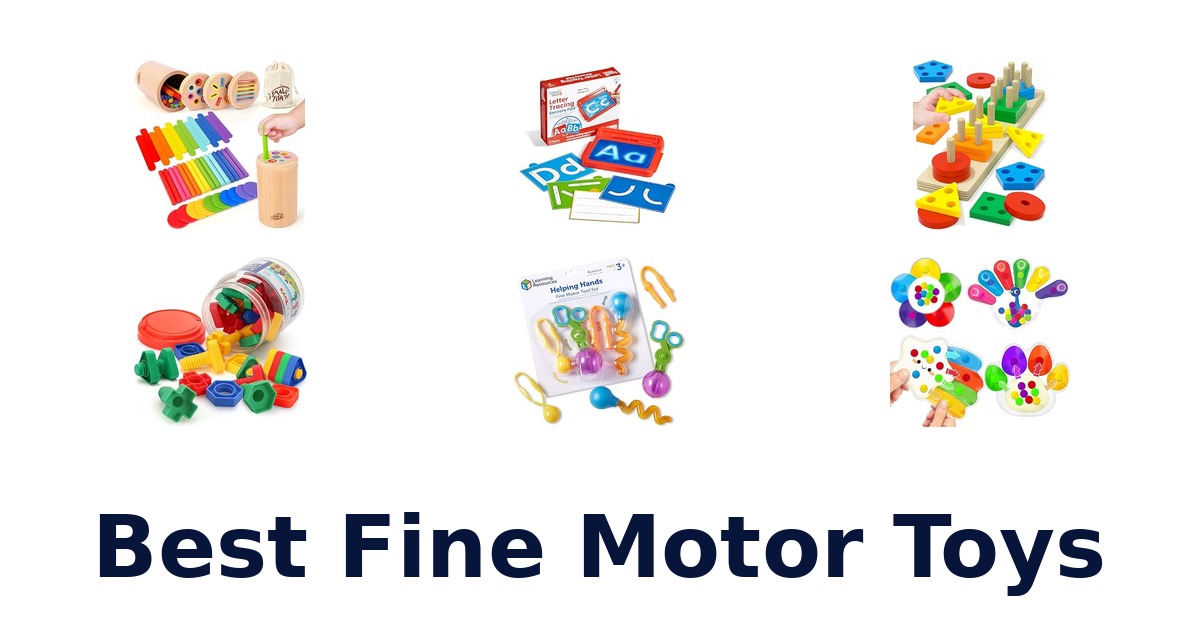
A strong fine motor toy gives children a clear, repeatable hand task—such as grasping pegs, threading beads, or squeezing tools—and suits their age and interests. Learning Resources Spike The Fine Motor Hedgehog leads this roundup with colorful removable quills, numbered holes, and an age recommendation of 18 months to 4 years. The other options cover different play styles: sorting games, wooden construction pieces, sensory tools, lacing, and letter tracing.
Check the listed age guidance and the kind of hand movement each toy asks for before choosing. Some sets are aimed at preschoolers, while others start at 12 or 18 months.
The best fit is the one whose pieces and activity match the child’s current abilities and the practice you want to encourage.
Learning Resources Spike The Fine Motor Hedgehog is the best overall choice for a broadly useful fine motor activity. Its chunky, removable quills give toddlers a direct grasp-and-place task, while numbered holes add sorting, matching, and sequencing practice. The manufacturer recommends it for ages 18 months to 4 years, making its listed range useful for younger toddlers as well as preschoolers.
Choose another option if your priority is specifically letter tracing, lacing, or tool-based sensory play.
Our Top Picks
 Best Overall
Learning Resources Spike Hedgehog
Removable chunky quills provide a simple grasp-and-place activity, and numbered holes add color matching and sequencing; the listed age range is 18 months to 4 years.
View on Amazon Best Tool Set
Learning Resources Helping Hands
Four distinct tools—tweezers, scoops, droppers, and tongs—support varied grasping and sensory-bin activities; the recommended age range is 3 to 10 years.
View on Amazon Best Construction Play
The 24-piece set gives children repeated nut-and-bolt manipulation and matching practice, with an 18-month-and-up recommendation and a storage box.
View on Amazon- Best Threading Activity Melissa & Doug Lacing Beads
- Best Tweezer Sorting YUNCHY Bee to Hive
Compare fine motor toys by activity
| # | Product | Dimensions | Material Type | Operation Mode | Buy |
|---|---|---|---|---|---|
| 1 | 1. Learning Resources Spike HedgehogBest Overall | 10 x 10 x 4 in | Plastic | Manual | View on Amazon |
| 2 | 2. Learning Resources Helping HandsBest Tool Set | 9.6 x 9.5 x 2.2 in | Plastic | Manual | View on Amazon |
| 3 | 3. LotFancy Nuts and BoltsBest Construction Play | 6.5 x 5.31 x 5.31 in | Plastic | Manual | View on Amazon |
| 4 |  4. Melissa & Doug Lacing BeadsBest Threading Activity | 8.85 x 7.3 x 1.3 in | Wood | Manual | View on Amazon |
| 5 |  5. YUNCHY Bee to HiveBest Tweezer Sorting | 7.87 x 5.71 x 1.77 in | Wood | Manual | View on Amazon |
| 6 |  6. SMALL FISH 3-in-1 ToyThree-action wooden play | 5.63 x 3.94 x 5.95 in | Wood | Manual | View on Amazon |
| 7 |  7. Skrtuan Counting DinosaursDinosaur counting and sorting | 3.74 x 3.74 x 6.3 in | Plastic | Manual | View on Amazon |
| 8 |  8. hand2mind Letter Tracing PadLetter-tracing practice | — | — | — | View on Amazon |
| 9 |  9. UIIOPJIOM Color Sorting ToysPortable color-pushing activity | 8.6 x 5.5 x 0.7 in | Plastic | Manual | View on Amazon |
| 10 |  10. Tonberless Wooden Shape ToysWooden shape play | 11.5 x 2.7 x 2.4 in | Wood | manual | View on Amazon |
Detailed Reviews: Best Fine Motor Toys
#1 · Best Overall
1. Learning Resources Spike Hedgehog
- Dimensions: 10 x 10 x 4 in
- Material Type: Plastic
- Operation Mode: Manual
Best for: Early pincer-grasp practice.
Why it ranks #1: Removable chunky quills provide a simple grasp-and-place activity, and numbered holes add color matching and sequencing; the listed age range is 18 months to 4 years.
Chunky, peg-shaped quills give toddlers a clear grasp-and-place task: pull each piece from Spike’s back, then return it to a numbered hole. The 14-piece set combines hands-on manipulation with opportunities to practice color recognition, matching, counting, and sequencing during play.
The easy-to-grasp quills let young children work on hand strength, coordination, and pincer grasp as they repeatedly remove and replace pieces. Numbered holes add a simple sequence to follow, while the colorful quills support sorting and matching activities. At 10 by 10 by 4 inches, the hedgehog offers a defined tabletop activity, though the play centers on placing pieces into its back rather than using separate tools or materials.
- Chunky quills support grasp-and-place practice
- Numbered holes invite counting and sequencing
- Colors offer sorting and matching activities
- Manual play requires no batteries
- Play centers on inserting and removing the included quills.
Skip it if you want threading, tracing, or multiple tool-based activities rather than placing quills into numbered holes.
A good fit for toddlers 18 months to 4 years who benefit from simple, repeatable grasping and color activities. Choose another format if your child is ready for tracing letters or lacing beads.
Full product details
| Brand | Learning Resources |
|---|---|
| Color | Multi-color |
| Included Components | 14 chunky, peg-shaped “quills”, and hedgehog’s |
| Item Dimensions | 10 x 10 x 4 inches |
| Item Weight | 22.68 g |
| Manufacturer | Learning Resources |
| Part Number | LER8904 |
| Manufacturer Warranty Description | No Warranty |
| Manufacturer recommended age | 18 months – 4 years |
| Material | Plastic |
| Model Number | LER8904 |
| Operation Mode | Manual |
| Size | 1 Count (Pack of 1) |
| Sub Brand | Spike The Fine Motor Hedgehog |
| Additional Information | Important information Safety Information No Warning Applicable Directions Remove the colorful quills from the hedgehog's back. Practice fine motor skills by grasping the quills and placing them back into the numbered holes on the hedgehog's back, following the color or number sequence to enhance color and number recognition. |
Listed on Amazon as: Learning Resources Spike The Fine Motor Hedgehog, Toddler Learning Toys, Fine Motor and Sensory Toys, Educational Toys for Toddlers, Montessori Toys, Ages 18+ Months,14 Pieces
View on Amazon#2 · Best Tool Set
2. Learning Resources Helping Hands
- Dimensions: 9.6 x 9.5 x 2.2 in
- Material Type: Plastic
- Operation Mode: Manual
Best for: Sensory-bin tool variety.
Why it ranks #2: Four distinct tools—tweezers, scoops, droppers, and tongs—support varied grasping and sensory-bin activities; the recommended age range is 3 to 10 years.
Four specialized tools—a tweezer, scooper, tong, and dropper—give children different ways to grasp and move sensory materials. Learning Resources’ set supports pincer-grasp and dexterity practice across activities with rice, beans, water beads, pom-poms, or other listed sensory-bin materials.
The varied tools make it possible to switch between grabbing, scooping, tonging, and using a dropper, so children can practice distinct hand actions within one activity set. The tools are listed for use with sensory-bin materials and also suit settings such as a sandbox or water table. This gives caregivers options for changing the material without changing the core tools. Recommended for ages 3 to 10, the manual set contains four pieces.
- Four tools support varied grasping actions
- Works with rice, beans, water beads, and pom-poms
- Suitable for sandbox, water-table, and sensory-bin play
- Targets dexterity and pincer grasp
- The set is recommended for ages three and up.
Skip it if you need a fine motor toy for a child under three; Learning Resources Spike is recommended from 18 months.
Choose it for children three and up who enjoy sensory materials and benefit from practicing different tool grips. It requires a separate material or play surface, so it is not a self-contained sorting game.
Full product details
| Brand | Learning Resources |
|---|---|
| Color | Multi-color |
| Included Components | states counters (should be fine motor tools) |
| Item Dimensions | 9.6 x 9.5 x 2.2 inches |
| Item Weight | 0.11 kg |
| Manufacturer | Learning Resources |
| Part Number | LER5558 |
| Manufacturer Warranty Description | No Warranty |
| Manufacturer recommended age | 36 months – 10 years |
| Material | Plastic |
| Model Number | LER5558 |
| Operation Mode | Manual |
| Size | 4 Items |
| Sub Brand | Helping Hands Fine Motor Tool |
Listed on Amazon as: Learning Resources Helping Hands Fine Motor Tool Set Toy, Fine Motor and Sensory Play Toys, Toddler Tweezers, Sensory Bin Toys, Ages 3+,4 Pieces
View on Amazon#3 · Best Construction Play
3. LotFancy Nuts and Bolts
- Dimensions: 6.5 x 5.31 x 5.31 in
- Material Type: Plastic
- Operation Mode: Manual
Best for: Hands-on nut-and-bolt play.
Why it ranks #3: The 24-piece set gives children repeated nut-and-bolt manipulation and matching practice, with an 18-month-and-up recommendation and a storage box.
Twenty-four jumbo nuts and bolts turn fine motor practice into a simple construction task: children match shapes and colors, then twist pieces together by hand. LotFancy’s manual plastic set also comes with a storage box, making it a portable option for repeated matching and building play.
The jumbo pieces give children a direct way to practice grasping and turning, while the matching focus engages visual perception and hand-eye coordination. With 24 nuts and bolts, the set offers multiple pieces for sorting or construction rather than a single fixed puzzle. The included storage box supports collecting the pieces after play and taking them on the go. It is recommended from 18 months and uses manual operation, with no powered components listed.
- Twenty-four pieces support matching and building
- Jumbo nuts and bolts invite grasping and twisting
- Color and shape matching exercises visual perception
- Storage box supports collection and travel
- The set is made of plastic rather than wood.
Skip it if you prefer a wooden fine motor activity; SMALL FISH offers a wooden three-in-one stick, coin, and slot toy.
Consider this set for toddlers and older users who enjoy sorting, twisting, and assembling chunky pieces. The manual construction format suits hands-on matching, but not children seeking tracing or bead-lacing activities.
Full product details
| Brand | LotFancy |
|---|---|
| Color | Assorted Color |
| Item Dimensions | 6.5 x 5.31 x 5.31 inches |
| Item Weight | 12 ounces |
| Manufacturer | LotFancy |
| Part Number | 13X-4027-W |
| Manufacturer recommended age | 18 months and up |
| Material | Plastic |
| Model | 13X-4027-W |
| Model Number | 13X-4027-W |
| Model Year | 2021 |
| Operation Mode | Manual |
| Size | 24 pcs nuts and bolts |
| Sub Brand | LotFancy |
| Additional Information | Important Information Toy Safety Our recommended age: Manufacturer's minimum age: 18 months |
#4 · Best Threading Activity
4. Melissa & Doug Lacing Beads
- Dimensions: 8.85 x 7.3 x 1.3 in
- Material Type: Wood
- Operation Mode: Manual
Best for: Bead threading starter set.
Why it ranks #4: Thirty wooden beads in five shapes, two laces, and a storage case make this a focused threading choice for ages 3 to 5.
Thirty wooden beads in five shapes give children a hands-on threading challenge, with two laces and a wooden case included. Melissa & Doug’s set lets preschoolers practice grasping, sequencing, and making patterns as they guide each bead onto a lace and create their own designs.
The beads are described as easy for little hands to grasp, and the thin laces fit through them, helping children coordinate both hands as they thread. Five shapes and assorted colors give the activity options for sorting or creating patterns, while the two laces allow more than one design to be underway. The wooden storage case keeps the beads and cords together after play. The recommended age range is 36 months to 5 years.
- Thirty wooden beads provide repeated threading practice
- Five shapes support pattern-making and sorting
- Two laces allow multiple designs
- Wooden case stores beads and laces
- Threading small beads is recommended for ages 36 months and up.
Skip it if you want a large-grip activity for children under three; Learning Resources Spike is recommended from 18 months.
A strong match for preschoolers ready to thread beads, make patterns, and practice two-handed coordination. Keep the 36-month minimum age in mind if choosing an activity for a younger toddler.
Full product details
| Brand | Melissa & Doug |
|---|---|
| Color | Multi-color |
| Included Components | 30 wooden beads, 2 lacing cords, storage case |
| Item Dimensions | 8.85 x 7.3 x 1.3 inches |
| Item Weight | 0.59 kg |
| Manufacturer | Melissa & Doug |
| Part Number | 544 |
| Manufacturer Warranty Description | No Warranty |
| Manufacturer recommended age | 36 months – 5 years |
| Material | Wood |
| Model Number | 544 |
| Operation Mode | Manual |
| Size | 7.7 x 7.7 x 1.45 |
| Sub Brand | Doug |
| Additional Information | Important information Directions 1. Remove the laces from the storage case. 2. Thread the beads onto the laces, following any desired pattern or design. 3. Once all beads are threaded, tie a knot at the end of the lace to secure the beads in place. |
Listed on Amazon as: Melissa & Doug Primary Lacing Beads 33-Piece Montessori Toy Set
View on Amazon#5 · Best Tweezer Sorting
5. YUNCHY Bee to Hive
- Dimensions: 7.87 x 5.71 x 1.77 in
- Material Type: Wood
- Operation Mode: Manual
Best for: Tweezers-and-color matching.
Why it ranks #5: Children use the included tweezer to match seven colorful bees to their hives, combining grasp practice with color sorting for ages 3 and up.
A child-sized tweezer task makes this bee-to-hive game distinctive: children grasp each bee by its wings and return it to the matching hive. The wooden set pairs color matching with hands-on placement, giving preschoolers a focused way to practice coordination and fine motor control.
The seven colorful bees and corresponding hives create a clear matching routine, while the included tweezer asks children to grip and guide each piece rather than simply pick it up by hand. A storage box keeps the game components together between sessions. The manufacturer recommends ages 36 months to 12 years; the listed directions focus on color matching with tweezers, not on broader counting or letter activities.
- Tweezer use exercises controlled grasping
- Matching bees to hives reinforces color sorting
- Wooden components provide a tactile play format
- Storage box keeps game pieces together
- The listed activity centers on matching seven bees to their hives.
Skip it if you want several kinds of fine motor tools; Learning Resources Helping Hands offers tweezers, scoops, tongs, and droppers.
Consider it for preschoolers who enjoy color matching and are ready to manipulate a tweezer. Its focused bee-and-hive routine suits a short tabletop activity, rather than a set of varied sensory tools.
Full product details
| Brand | YUNCHY |
|---|---|
| Color | Multi-colored |
| Included Components | Bee to Hive Game, Tweezer |
| Item Dimensions | 7.87 x 5.71 x 1.77 inches |
| Manufacturer | jiaxingxuyikejiyouxiangongsi |
| Part Number | YUNCHY |
| Manufacturer recommended age | 36 months – 12 years |
| Material | Wood |
| Operation Mode | Manual |
| Size | Medium |
| Additional Information | Important information Directions Instructions on how to assemble the toy (if any) and how to play the color matching game using the tweezers. |
Listed on Amazon as: Toddler Fine Motor Skill Toy, Bee to Hive Matching Game, Montessori Wooden Color Sorting Matching Toy, Preschool Educational Learning Toys Gift for Toddler 3 Years Old
View on Amazon#6
6. SMALL FISH 3-in-1 Toy
- Dimensions: 5.63 x 3.94 x 5.95 in
- Material Type: Wood
- Operation Mode: Manual
Best for: Three-action wooden play.
Why it ranks #6: The wooden toy offers stick insertion, coin delivery, and stacking, with activities involving wrist rotation and angle finding and a recommended age range of 12 months to 6 years.
Three lid styles let this compact wooden toy shift among stick insertion, coin placement, and stacking, giving toddlers distinct hand movements to practice. SMALL FISH also uses colored sticks to bring color recognition into play, while the stick slot asks children to rotate their wrists and find an entry angle.
Inserting colored sticks pairs grasping with color recognition, while rotating the wrist to line them up with the slit adds a direction-finding challenge. The other listed activities involve delivering coins and stacking them, broadening the motions beyond one repeated task. At 5.63 by 3.94 by 5.95 inches, it has a small tabletop footprint. Directions call for direct adult supervision, and the recommended age begins at 12 months.
- Three lid styles offer different play actions
- Stick insertion encourages wrist rotation and angle finding
- Colored sticks support color recognition
- Compact dimensions suit tabletop play
- Directions specify direct adult supervision.
Skip it if you want an activity that does not call for direct adult supervision; check the stated supervision requirement before choosing this toy.
A fit for toddlers who can explore stick insertion, coin placement, and stacking with an adult supervising. Its compact wooden format favors focused tabletop play, rather than a larger collection of independent tools.
Full product details
| Brand | SMALL FISH |
|---|---|
| Color | Brown |
| Included Components | wooden sticks |
| Item Dimensions | 5.63 x 3.94 x 5.95 inches |
| Manufacturer | SMALL FISH |
| Part Number | 2408JX01 |
| Manufacturer recommended age | 12 months – 6 years |
| Material | Wood |
| Model Number | 2408JX01 |
| Operation Mode | Manual |
| Size | Small (suitable for toddlers 1-3) |
Listed on Amazon as: Wooden Montessori 3 in 1 Learning Fine Motor Preschool Toys for 1-3
View on Amazon#7
7. Skrtuan Counting Dinosaurs
- Dimensions: 3.74 x 3.74 x 6.3 in
- Material Type: Plastic
- Operation Mode: Manual
Best for: Dinosaur counting and sorting.
Why it ranks #7: Forty-eight dinosaurs, six sorting bowls, and two large tweezers provide many pieces for color sorting and counting; the listed age range is 3 to 6 years.
Forty-eight small dinosaurs, six sorting bowls, and two large tweezers combine color sorting with counting in one preschool activity. Skrtuan’s set gives children pieces to pick up and organize, while the dinosaur theme supports visual math play involving counting, addition, and subtraction.
Children can use the two tweezers to transfer dinosaurs into the six color bowls, linking controlled grasping with sorting and hand-eye coordination. The 48 pieces provide repeated opportunities to count groups or compare quantities, supporting the listed basic math activities. A portable storage bucket helps collect and organize the set after play. Recommended for ages 36 months to 6 years, this manual activity is a better fit for supervised tabletop sorting than for letter-tracing practice.
- Forty-eight dinosaurs support repeated counting
- Six bowls provide color-sorting destinations
- Two tweezers add grasping practice
- Portable bucket helps collect and organize pieces
- The recommended age range starts at 36 months.
Skip it if you need a fine motor activity for a child under three; Learning Resources Spike is recommended from 18 months.
A good option for preschoolers ready to sort small pieces, count groups, and use tweezers. The 36-month minimum and many individual dinosaurs make it better suited to an age-appropriate, supervised activity.
Full product details
| Brand | Skrtuan |
|---|---|
| Color | Dinosaurs |
| Included Components | Counting Toys, Sorting Cups, Tweezers |
| Item Dimensions | 3.74 x 3.74 x 6.3 inches |
| Item Weight | 10.88 ounces |
| Manufacturer | Skrtuan |
| Part Number | 2188-90 |
| Manufacturer recommended age | 36 months – 6 years |
| Material | Plastic |
| Operation Mode | Manual |
| Size | Medium |
Listed on Amazon as: Counting Dinosaur Montessori Toys for Kids 3-5, Color Sorting Sensory Toys
View on Amazon#8
8. hand2mind Letter Tracing Pad
Best for: Letter-tracing practice.
Why it ranks #8: The sealed gel pad, attached stylus, and 16 double-sided activity cards focus practice on letter formation; the safety information excludes children under 36 months.
A sealed, movable gel surface turns letter practice into a tactile tracing task, letting children follow letter forms with an attached child-friendly stylus. The hand2mind pad includes 16 double-sided activity cards and a guide, connecting fine motor practice with early handwriting and literacy activities.
The thick, squishy gel stays inside the pad, so children can move the surface while tracing without loose sensory material to clean up. Because the stylus is securely attached, it stays with the pad during use and is less to become separated from the activity. The 16 double-sided cards provide prompts for practice, making this more structured than open-ended sensory play. The stated minimum age is 36 months.
- Movable gel provides tactile letter tracing
- Sealed pad supports mess-free use
- Attached stylus stays with the activity
- Includes 16 double-sided cards and a guide
- The listed minimum age is 36 months.
Skip it if you need a toddler activity for under age three; Learning Resources Spike is recommended from 18 months.
A fit for learners at least three years old who are beginning letter formation and benefit from tactile practice. The focused tracing format is less suitable if you want varied tools or free-form sensory-bin play.
Full product details
| Brand | hand2mind |
|---|---|
| Color | Multicolor |
| Included Components | 1 Letter Tracing Sensory Pad, 16 double-sided Activity Cards, Guide |
| Item Weight | 11.68 ounces |
| Manufacturer | hand2mind |
| Part Number | 96240 |
| Model Number | 96240 |
| Recommended Uses | School |
| Additional Information | Important Information Toy Safety Our recommended age: Manufacturer's minimum age: not_suitable_under_36_months |
Listed on Amazon as: hand2mind Letter Tracing Sensory Pad, Fine Motor Activities, Ages 3+
View on Amazon#9
9. UIIOPJIOM Color Sorting Toys
- Dimensions: 8.6 x 5.5 x 0.7 in
- Material Type: Plastic
- Operation Mode: Manual
Best for: Portable color-pushing activity.
Why it ranks #9: Four bead-pushing designs offer color-position matching and early-math play for ages 3 and up, though the listing provides fewer details about the activity set.
Four flat sensory toys shaped like dinosaurs, flowers, stars, and bear paws let children push colored beads toward matching positions. This manual activity combines color recognition, early math, and hand-eye coordination in a thin format measuring 8.6 by 5.5 by 0.7 inches.
The bead-pushing action gives children a repeated, hands-on way to practice controlled finger movements while matching colors. Four different shapes provide visual variety, and the listed activity connects sorting with early math learning. Its 0.7-inch thickness makes the set relatively flat to pack alongside travel activities, though the listing does not specify a storage case. The manufacturer recommends ages three and up and states that it is not for children under three.
- Four shapes provide visual variety
- Pushing beads practices controlled finger movements
- Color positions support sorting and early math
- Flat 0.7-inch profile is easy to pack
- The manufacturer states it is not for children under three.
Skip it if you need a fine motor toy for a child under three; Learning Resources Spike is recommended from 18 months.
Consider this set for children three and up who want a flat, manual color-sorting activity for home or travel. Its bead-pushing format is focused, rather than offering tweezers, laces, or multiple tools.
Full product details
| Brand | UIIOPJIOM |
|---|---|
| Color | 4pc |
| Included Components | color sorting water bag |
| Item Dimensions | 8.6 x 5.5 x 0.7 inches |
| Manufacturer | UIIOPJIOM |
| Part Number | 4PC |
| Manufacturer recommended age | 3 years and up |
| Material | Plastic |
| Operation Mode | Manual |
| Size | Small |
| Additional Information | Important information Safety Information not for children under 3 year old Directions Push colorful beads into the right color positions to learn colors and early math. |
#10
10. Tonberless Wooden Shape Toys
- Dimensions: 11.5 x 2.7 x 2.4 in
- Material Type: Wood
- Operation Mode: manual
Best for: Wooden shape play.
Why it ranks #10: The listing describes wooden shape toys and a 12-month minimum age, but gives limited detail about the specific fine motor tasks or included pieces.
Smooth-edged wooden shapes with vivid water-based paint give this Tonberless set a tactile format for young children to grasp and explore. Its Montessori-inspired approach centers on hands-on shape play, making it a straightforward choice for families seeking wooden learning toys for ages 12 months and up.
The wooden construction and stated moderate geometric size make the pieces approachable for small hands to grasp, while smooth edges are specified to protect delicate skin during handling. Water-based paint is described as non-toxic, odorless, and fade-resistant, so the colors support visual exploration over repeated play. The listing identifies wooden shape toys but supplies few activity details, so buyers seeking a defined multi-step fine motor task may prefer a more explicit activity set.
- Wooden shapes offer a tactile grasping activity
- Smooth edges are specified for handling
- Water-based paint is described as non-toxic and odorless
- Recommended from 12 months
- The listing gives few specifics about the shapes or a structured activity.
Skip it if you want a clearly described threading or tweezer task; Melissa & Doug Primary Lacing Beads includes beads, laces, and a case.
This is a reasonable match for families seeking wooden shape pieces for open-ended handling from 12 months. It is less suited to buyers who want a specified sequence, tool, or clearly itemized activity.
Full product details
| Brand | Tonberless |
|---|---|
| Color | Multicolored |
| Included Components | Wooden shape toys |
| Item Dimensions | 11.5 x 2.7 x 2.4 inches |
| Manufacturer | Tonberless |
| Part Number | js-5tz-yuancai |
| Manufacturer recommended age | 12 months – 8 years |
| Material | Wood |
| Model | js-5tz-yuancai |
| Model Number | js-5tz-yuancai |
| Model Year | 2024 |
| Operation Mode | manual |
| Size | Medium |
| Additional Information | Important Information Toy Safety Our recommended age: Manufacturer's minimum age: 12 months |
Listed on Amazon as: Montessori Toys for 1 2 3 Year Old Boy Girl, Toddler Learning Toys Gifts
View on AmazonWhere Fine Motor Play Can Become Frustrating
Fine motor play can become frustrating when the task demands more control than a child is ready to use. Threading the Melissa & Doug Lacing Beads requires guiding a lace through bead openings, while the Learning Resources Helping Hands set asks children to operate tools such as tweezers and droppers. By contrast, placing the Spike Hedgehog’s chunky quills into holes is a more direct grasp-and-place task.
These differences matter: a child who loses interest in a precise action may do better with a larger, simpler movement before trying more involved manipulation. Adult guidance can help make a task easier by demonstrating one action at a time or offering fewer pieces for a turn.
The listings do not provide piece dimensions or difficulty ratings, so age recommendations are a starting point rather than a guarantee that every activity will suit every child.
How to Choose a Fine Motor Toy
Age Guidance and Task Demands
Look for a listed age range that fits the child, then consider how much control the activity asks them to use. Spike Hedgehog is recommended for 18 months to 4 years, and LotFancy Nuts and Bolts for 18 months and up. The SMALL FISH 3-in-1 Toy lists 12 months to 6 years.
Several more focused activities begin at 3 years: Melissa & Doug Lacing Beads is listed for ages 3 to 5, and Helping Hands for 3 to The hand2mind pad is not suitable under 36 months.
A younger toddler may suit a simple insertion activity, while an older preschooler may enjoy threading or tracing; follow the product’s safety guidance.
Choose the Hand Movement
Choose the toy by the hand action you want the child to repeat, rather than by the educational label alone. Spike Hedgehog involves pulling out and replacing quills; lacing beads asks for threading; LotFancy Nuts and Bolts uses turning and matching. For tool practice, Helping Hands includes tweezers, scoops, tongs, and droppers, while YUNCHY Bee to Hive supplies a tweezer for placing bees into matching hives.
The best match depends on the play experience sought: choose insertion and removal for a straightforward repeated action, threading for a more precise task, or tools when you want to vary how materials are picked up and moved.
Pieces, Materials, and Cleanup
Check the number and type of pieces, as well as whether the set includes a way to contain them. Skrtuan Counting Dinosaurs has 48 dinosaurs, six bowls, and two tweezers; Melissa & Doug includes 30 beads, two laces, and a wooden storage case. LotFancy provides 24 nuts and bolts with a storage box.
Materials also vary: several sets are wooden, including the lacing beads and bee game, while Spike Hedgehog and Helping Hands are plastic. For a child who likes many pieces and color sorting, a larger collection may offer variety; for a more contained activity, consider sets with fewer components or a storage case.
The listings do not give dimensions for every individual piece, so check suitability for the child’s age and supervise play as appropriate.
Which Fine Motor Toy Should You Choose?
For a versatile starting point, choose Learning Resources Spike Hedgehog: its removable quills and numbered holes combine grasping, matching, and sequencing. For a child ready to use tools across different activities, Learning Resources Helping Hands includes four options, from tweezers to droppers. Choose Melissa & Doug Lacing Beads when threading is the goal, or hand2mind Letter Tracing Pad for guided letter-formation practice with activity cards.
LotFancy Nuts and Bolts suits children drawn to turning and matching pieces; YUNCHY Bee to Hive or Skrtuan Counting Dinosaurs fits color sorting and counting. For younger children, compare listed age guidance carefully: SMALL FISH 3-in-1 Toy starts at 12 months, while several focused preschool activities begin at age 3.
Frequently Asked Questions
How should I choose a fine motor toy for a child who is just starting to grasp small objects?
Start with a simple grasp-and-place activity using pieces that are easy for the child to handle, and check the toy’s listed age guidance. Spike’s chunky removable quills offer a direct placement task, while its numbered holes add matching and sequencing for children ready for those steps. Supervise play, especially with small pieces.
Which fine motor activities can help prepare a preschooler for handwriting?
Choose activities that give practice controlling fingers and hands, such as placing pieces, sorting, threading, and tracing. For guided letter-formation practice, the hand2mind Letter Tracing Pad includes activity cards and is listed for ages 3 and up. Match the activity to the child’s interest and readiness rather than expecting one toy to cover every skill.
How can I use sorting and threading toys without making play frustrating?
Keep the task manageable: begin with a small number of pieces, demonstrate one step, and let the child try at their own pace. For sorting, focus on one simple match at a time; for threading, offer a clear start and pause when interest fades. Build in more pieces or steps only when the child is ready.
How important is the listed age range when choosing a fine motor toy?
Use the listed age guidance as a starting point, then consider the activity and the child’s readiness. The article identifies the SMALL FISH 3-in-1 Toy as starting at 12 months, Spike as recommended from 18 months to 4 years, and several focused preschool activities as beginning at age Check each listing before choosing.
Which toy should I choose if my child is interested in a specific activity?
Choose by the skill you want to focus on: Melissa & Doug Lacing Beads for threading, the hand2mind Letter Tracing Pad for guided letter formation, or Learning Resources Helping Hands for tool-based activities. For a broader grasp-and-place starting point, Spike combines removable quills with matching and sequencing practice.
Final Words
For a versatile starting point, choose Spike: its removable quills and numbered holes combine grasping, matching, and sequencing. If your child is drawn to a particular task, choose lacing beads for threading, the tracing pad for letter practice, or Helping Hands for tool use. Compare listed age guidance before deciding, especially for younger toddlers, and favor the activity your child is ready to try.