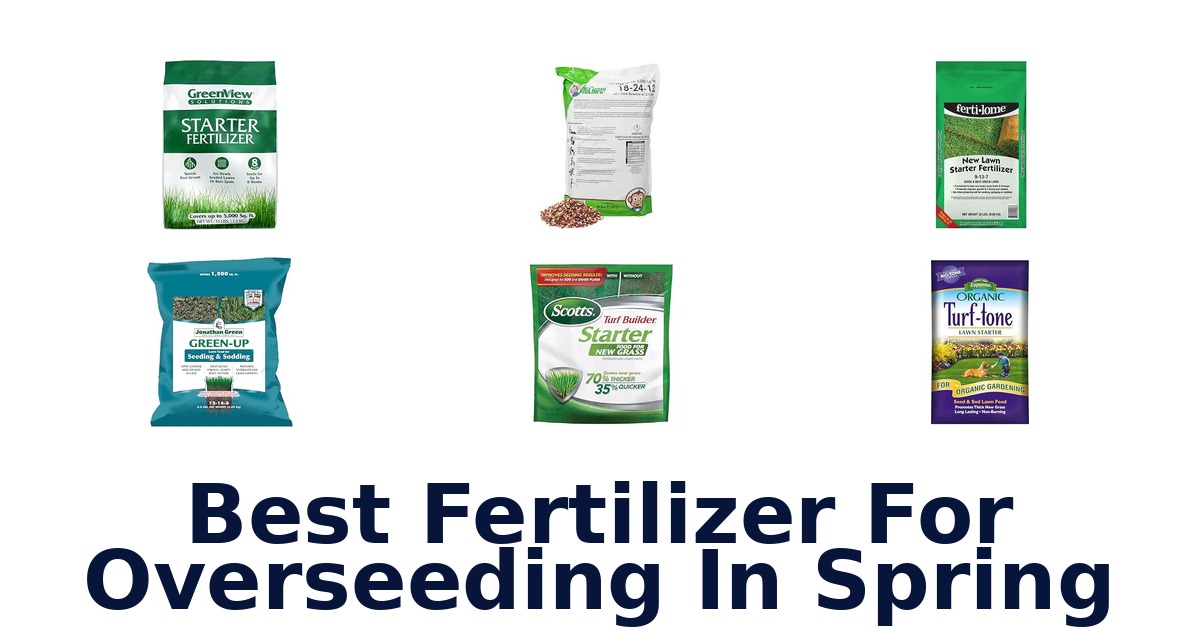
A strong spring overseeding fertilizer supports seedling roots while supplying nutrients for early growth, making a starter formula suited to new grass or bare spots the right place to look. These six granular products range from phosphorus-forward formulas such as AgChimp 18-24-12 and Jonathan Green 12-18-8 to Espoma Turf-Tone’s natural 4-6-3 blend. Several specifically mention overseeding or reseeding, while others are intended for new lawns, sod, or repairing bare areas.
Compare the stated NPK ratio, application guidance, and package coverage where supplied, then follow the product label for timing and rate. Spring conditions and seed type affect establishment, so fertilizer alone cannot guarantee germination.
The rankings favor clear overseeding suitability and useful details for establishing grass.
Greenview Starter Fertilizer is the best overall choice for spring overseeding because it is designed for new lawns and bare-spot repair, and its product description says it can be used anytime during the growing season. Its 10-18-10 analysis supplies phosphorus for root development, and the formula feeds for up to eight weeks. For a product that explicitly names overseeding, AgChimp 18-24-12 and Jonathan Green Green-Up are strong alternatives, with 18-24-12 and 12-18-8 analyses, respectively.
Our Top Picks
 Best Overall
Its 10-18-10 formula is designed for seeding and bare-spot repair, is listed for use anytime during the growing season, and feeds for up to eight weeks.
View on Amazon Highest Phosphorus
It explicitly targets overseeding and bare-spot repair, with an 18-24-12 analysis and slow-release polymer-coated nitrogen for gradual feeding.
View on Amazon Overseeding Specific
The product is expressly formulated for seeding and overseeding, and its 12-18-8 analysis is described as phosphorus-rich for seedling root formation.
View on Amazon- Highest Nitrogen Scotts Turf Builder Starter
- Natural Formula Espoma Turf-Tone Lawn Starter
Compare spring overseeding fertilizer options
| # | Product | Weight | Form | Buy |
|---|---|---|---|---|
| 1 | 1. Greenview Starter FertilizerBest Overall | 16 lb | Granules | View on Amazon |
| 2 | 2. AgChimp 18-24-12 StarterHighest Phosphorus | 16 lb | Granules | View on Amazon |
| 3 | 3. Jonathan Green Green-UpOverseeding Specific | 4.5 lb | Granules | View on Amazon |
| 4 |  4. Scotts Turf Builder StarterHighest Nitrogen | 3.3 lb | Granules | View on Amazon |
| 5 |  5. Espoma Turf-Tone Lawn StarterNatural Formula | 30 lb | Granules | View on Amazon |
| 6 |  6. Fertilome New Lawn StarterLarge-Area Seed And Sod Starter | 20 lb | Granules | View on Amazon |
Detailed Reviews: Best Fertilizer For Overseeding In Spring
#1 · Best Overall
1. Greenview Starter Fertilizer
- Weight: 16 lb
- Form: Granules
Best for: Bare-Spot Root Establishment.
Why it ranks #1: Its 10-18-10 formula is designed for seeding and bare-spot repair, is listed for use anytime during the growing season, and feeds for up to eight weeks.
An 18% phosphorus formula gives GreenView Solutions Starter Fertilizer a root-focused role in spring overseeding, helping new grass establish quickly and develop deep, strong roots. Its stated use for seeding or repairing bare spots anytime during the growing season makes it relevant beyond a one-time new-lawn project.
The 10-18-10 analysis pairs phosphorus for root development with nitrogen and potassium, while the product description says it feeds for up to eight weeks. That combination supports an establishment period without requiring an immediate second feeding. Granules can be applied after seed is spread, then watered, so the listed directions fit a straightforward overseeding sequence. The 16-pound bag is aimed at seeding and repair work, though no coverage area is specified.
- 10-18-10 analysis includes 18% phosphorus for root development
- Listed for new seeding and bare-spot repair
- Feeds for up to eight weeks
- Slow-release formula leaves no micro-plastic coating residue
- No lawn coverage area is specified in the supplied product information.
Skip it if you need a stated coverage area to plan an exact application; this listing does not provide one.
For overseeders repairing bare areas who want a phosphorus-focused starter and up to eight weeks of feeding, GreenView is a practical fit. Its listing does not state coverage, so it is less suitable when precise area planning is essential.
Full product details
| Brand | Greenview |
|---|---|
| Included Components | Fertilizer |
| Item Form | Granules |
| Item Weight | 16 pounds |
| Manufacturer | Lebanon Seaboard Corporation |
| Model Number | 2230144 |
| Additional Information | Important information Ingredients Nitrogen, Phosphorus, Potassium Directions Clear seeding area of debris, apply the grass seed of your choice, apply this product and water |
Listed on Amazon as: GreenView Solutions Starter Fertilizer, Lawn Fertilizer, 16 lb Bag
View on Amazon#2 · Highest Phosphorus
2. AgChimp 18-24-12 Starter
- Weight: 16 lb
- Form: Granules
Best for: Slow-Release Turf Establishment.
Why it ranks #2: It explicitly targets overseeding and bare-spot repair, with an 18-24-12 analysis and slow-release polymer-coated nitrogen for gradual feeding.
Polymer-coated nitrogen particles deliver nutrients gradually, giving AgChimp’s 18-24-12 starter a slow-release feeding approach for spring overseeding. Its listed uses include new seeding, overseeding, bare-spot repair, and stressed-grass recovery, making it relevant to both establishment and targeted lawn repair.
The 24% phosphorus supports root development as new grass establishes, while the coated nitrogen particles release nutrients gradually. Together, these features connect root-focused feeding with a steadier nutrient supply rather than a single quick application. The directions call for even application with a broadcast spreader, which suits buyers who already use that equipment for lawn work. At 16 pounds, it is a substantial granular product, but the supplied information gives no coverage figure.
- 18-24-12 analysis provides 24% phosphorus
- Polymer-coated nitrogen particles deliver nutrients gradually
- Listed for overseeding, bare spots, and stressed grass
- Directions specify even application with a broadcast spreader
- No coverage area or application rate is supplied in the listing.
Skip it if you need a listed coverage area or rate for calibration; AgChimp's supplied information gives neither.
For spreader-equipped lawn owners overseeding or repairing bare spots, AgChimp combines root-focused phosphorus with gradual nitrogen release. Consider the missing coverage and application-rate details if you need to calculate a precise amount before spreading.
Full product details
| Brand | AgChimp |
|---|---|
| Included Components | Nitrogen, Potassium and Weed Control |
| Item Form | Granules |
| Item Weight | 16 pounds |
| Manufacturer | AgChimp LLC |
| Model Number | AGC-SR-STARTFERT-16 |
| Additional Information | Important information Ingredients Urea, Polymer Coated Sulfur, Coated Urea, Diammonium Phosphate, Potassium Sulfate, Iron EDTA Directions Apply evenly using a broadcast spreader |
Listed on Amazon as: 18-24-12 Professional Turf Starter Fertilizer, 16lb
View on Amazon#3 · Overseeding Specific
3. Jonathan Green Green-Up
- Weight: 4.5 lb
- Form: Granules
Best for: Phosphorus-Focused Seedling Growth.
Why it ranks #3: The product is expressly formulated for seeding and overseeding, and its 12-18-8 analysis is described as phosphorus-rich for seedling root formation.
Jonathan Green’s 12-18-8 analysis puts phosphorus at the center of its spring seeding and overseeding formula, supporting deep, dense root development in new seedlings. The product is also listed for sod, giving buyers one granular lawn food for several establishment tasks.
The 18% phosphorus is identified as a key component in root formation, connecting the formula to the early needs of new grass. The product information says it helps seedlings grow faster and thicker, and verified facts also describe support for germination and weather resilience. Its listed compatibility includes cool-season grasses such as Kentucky bluegrass, tall fescue, and ryegrass, plus warm-season turfgrass. At 4.5 pounds, it is a smaller package, and the supplied listing does not state coverage.
- 12-18-8 analysis contains 18% phosphorus
- Listed for seeding, overseeding, and laying sod
- Supports deep and dense root development
- Compatibility information names cool-season grasses including bluegrass, fescue, and ryegrass
- The supplied listing does not state a coverage area.
Skip it if you need a stated coverage area to calculate application quantity; Jonathan Green's supplied listing does not include one.
For overseeders establishing new seedlings, particularly on lawns with the named cool-season grasses, Jonathan Green provides a phosphorus-focused starter. Check whether the stated grass compatibility and missing coverage information suit your lawn-planning needs.
Full product details
| Brand | Jonathan Green |
|---|---|
| Included Components | Fertilizer |
| Item Form | Granules |
| Item Weight | 4.5 pounds |
| Manufacturer | Jonathan Green & Sons, |
| Model Number | 11540 |
Listed on Amazon as: Jonathan Green (11540) Green-Up Lawn Food for Seeding & Sodding – 12-18-8 Grass Fertilizer (1,500 Sq. Ft.)
View on Amazon#4 · Highest Nitrogen
4. Scotts Turf Builder Starter
- Weight: 3.3 lb
- Form: Granules
Best for: Small-Scale Spring Overseeding.
Why it ranks #4: Its 24-25-4 formula is suitable for reseeding existing lawns and supplies substantial nitrogen and phosphate; the listed guidance calls for a second application at 2–4 weeks.
Scotts pairs a 24-25-4 analysis with a 3-pound package, giving spring overseeders a compact starter option centered on root development. It is labeled for reseeding existing lawns as well as new grass, sod, and plugs, and is listed as suitable for any grass type.
The 25% phosphate is identified as fuel for root development, so the formula targets establishment while new blades emerge. Scotts recommends applying it at planting and again two to four weeks later, a schedule that gives buyers a clear follow-up step during early growth. Its granules work across seed, sod, and plugs, and the stated suitability for any grass type broadens use. The listing excludes sales in Florida.
- 24-25-4 formula has 25% phosphate for root development
- Listed for reseeding, new grass, sod, and grass plugs
- Stated to be safe for any grass type
- Application guidance includes a second feeding at two to four weeks
- The listing says it is not sold in Florida.
Skip it if you live in Florida; the listing says this product is not sold there.
For overseeders wanting a small-package starter with a stated early follow-up schedule, Scotts offers clear application timing and broad grass-type compatibility. It is not a fit for Florida buyers, according to the listing.
Full product details
| Brand | Scotts |
|---|---|
| Included Components | Plant Food |
| Item Form | Granules |
| Item Weight | 3.3 pounds |
| Manufacturer | The Scotts Company |
| Model Number | 21701 |
Listed on Amazon as: Scotts Turf Builder Starter Food for New Grass, 3 lbs.
View on Amazon#5 · Natural Formula
5. Espoma Turf-Tone Lawn Starter
- Weight: 30 lb
- Form: Granules
Best for: Natural-Organic Overseeding.
Why it ranks #5: This natural and organic 4-6-3 starter specifically lists overseeding, covers up to 3,000 square feet per 30-pound bag, and uses Bio-tone formula.
Espoma’s Bio-tone formula and 4-6-3 analysis distinguish Turf-Tone as a natural and organic starter for spring overseeding. It is specifically listed for newly seeded areas, overseeding, and new sod, with a 30-pound bag covering up to 3,000 square feet.
The product combines nitrogen, phosphorus, and Bio-tone, giving buyers a starter formula specifically intended for new turf establishment. Its listed coverage of up to 3,000 square feet helps with planning a spring overseeding area, while drop or broadcast spreader application fits common lawn-spreading workflows. Feather meal and poultry manure are named ingredients. The listing says it can be used anytime to help establish new turf, rather than limiting use to a narrow seasonal window.
- Natural and organic starter with Espoma Bio-tone formula
- 4-6-3 fertilizer analysis
- Listed for overseeding, new seed, and new sod
- 30-pound bag covers up to 3,000 square feet
- The 4-6-3 analysis has less phosphorus than the higher-phosphorus starter formulas in this roundup.
Skip it if you want a higher-phosphorus analysis for root-focused feeding; Jonathan Green Green-Up is listed at 12-18-8.
For overseeders seeking a natural and organic starter with stated coverage, Turf-Tone suits spreading over areas up to 3,000 square feet. Its 4-6-3 analysis is a consideration for buyers prioritizing a higher phosphorus percentage.
Full product details
| Brand | Espoma |
|---|---|
| Included Components | Espoma TTLS30 30 lbs Turf-Tone Lawn Starter |
| Item Form | Granules |
| Item Weight | 30 pounds |
| Manufacturer | Espoma |
| Model Number | TTLS30 |
| Additional Information | Important information Ingredients Featehr Meal, Poultry Manure |
Listed on Amazon as: Turf-Tone Lawn Starter Natural & Organic Starter Fertilizer. with Long Lasting, Nitrogen, Phosphorus and Our Bio-Tone Formula. 30 lb. Bag Covers up to 3,000 Sq. Ft.
View on Amazon#6
6. Fertilome New Lawn Starter
- Weight: 20 lb
- Form: Granules
Best for: Large-Area Seed And Sod Starter.
Why it ranks #6: It is intended to help grass seed develop roots and can be applied with seed, but the listed product details do not specifically mention overseeding.
A 20-pound bag covering up to 5,000 square feet makes ferti-lome New Lawn Starter a practical option for larger spring overseeding areas. Its 9-13-7 analysis is intended to help seed and sod develop roots and mature stems before rapid growth begins.
The 13% phosphate supports the stated root-development role, while nitrogen and soluble potash complete the 9-13-7 analysis. The supplied directions allow application with grass seed or immediately after seeding, which lets buyers coordinate feeding with the overseeding workflow. A drop or broadcast spreader provides two application options, and the recommended rate is 4 pounds per 1,000 square feet. Even, uniform spreading is specified to avoid streaks, skips, or overlaps.
- 20-pound bag covers up to 5,000 square feet
- 9-13-7 analysis includes 13% phosphate
- Can be applied with grass seed or immediately after seeding
- Drop or broadcast spreader application at 4 pounds per 1,000 square feet
- Application requires a fertilizer spreader.
Skip it if you do not have a drop or broadcast fertilizer spreader; application instructions specify using one.
For overseeders handling larger areas who can apply granules with a spreader, ferti-lome offers stated coverage and a specified application rate. Its spreader requirement is an important boundary for buyers without that equipment.
Full product details
| Brand | ferti-lome |
|---|---|
| Included Components | 1 |
| Item Form | Granules |
| Item Weight | 20 pounds |
| Manufacturer | VPG FERTILOME' |
| Model Number | 10906 |
Listed on Amazon as: Fertilome (10906) New Lawn Starter Fertilizer 9-13-7, 20 lbs
View on AmazonAvoid uneven feeding across a spring seedbed
Uneven application is a practical risk when spreading granular starter fertilizer over newly seeded ground. Fertilome’s instructions specifically warn against streaks, skips, or overlaps and give a rate of 4 pounds per 1,000 square feet; use that rate only for that product, not as a general rule for the others. AgChimp directs users to spread its granules evenly with a broadcast spreader, while Espoma says to use a drop or broadcast spreader.
These details matter because a package size alone does not tell you how much to apply to your lawn. Coverage is stated for some products, including Espoma’s 3,000 square feet and Fertilome’s 5,000 square feet, but not all.
Measure the overseeded area and follow the specific label directions to avoid guessing a rate or assuming every bag covers the same area.
Match fertilizer timing to the seed and product label
Do not assume every starter fertilizer uses the same application schedule just because it is intended for new grass. Greenview says to clear the area, apply grass seed, apply the product, and water; Scotts’ supplied guidance says to apply at planting and again at 2–4 weeks. Fertilome can be applied with grass seed or immediately after seeding, while Espoma says it can be used anytime to help establish new turf.
Those differences are a meaningful trade-off: a product with a stated follow-up schedule requires planning another feeding, while other listings do not provide a comparable repeat interval. The supplied facts do not establish a universal spring calendar or watering frequency.
Check the current label for the selected product and use it alongside the seed instructions, rather than transferring timing directions from one formula to another.
How to Choose Spring Overseeding Fertilizer
Fit for overseeding and lawn repair
Look for product wording that explicitly covers overseeding or reseeding if you are treating an established lawn. AgChimp and Jonathan Green name overseeding directly, Espoma lists overseeding, and Scotts says its formula is suitable for reseeding an existing lawn. Greenview instead highlights seeding new lawns and repairing bare spots, while Fertilome describes use with grass seed or sod.
Buyers filling isolated bare patches may favor Greenview’s stated repair use; those spreading seed across an existing lawn may prefer a product whose listing directly names overseeding or reseeding. The wording signals intended use, not a guarantee of results, so confirm that the label matches your grass and application.
NPK ratio and feeding profile
Compare the NPK analysis with your goal, but do not treat the largest number as automatically best for every lawn. The listed formulas range from Espoma’s 4-6-3 to Scotts’ 24-25-4; Greenview is 10-18-10, Jonathan Green 12-18-8, AgChimp 18-24-12, and Fertilome 9-13-The listings describe phosphorus as supporting root development, while AgChimp also specifies polymer-coated slow-release nitrogen and Greenview says it feeds for up to eight weeks.
Someone prioritizing a phosphorus-forward starter can consider AgChimp or Jonathan Green; a buyer seeking the explicitly described natural and organic option can consider Espoma. Soil conditions and label directions still matter when choosing a nutrient formula.
Bag size, stated coverage, and spreading
Choose a package and application method that suit the area you need to treat, using stated coverage rather than weight alone. The products range from Scotts at 3 pounds to Espoma at 30 pounds; Greenview and AgChimp are 16-pound bags, and Fertilome is 20 pounds. Espoma states coverage up to 3,000 square feet, while Fertilome states up to 5,000 square feet and gives a rate of 4 pounds per 1,000 square feet.
Several products call for a drop or broadcast spreader, and AgChimp specifically directs even broadcast-spreader application. Larger lawns may benefit from the larger listed packages, while a small reseeding area may suit Scotts’ smaller bag.
Verify label coverage before calculating how many bags you need.
Which Fertilizer Should You Choose for Spring Overseeding?
For most spring overseeding and bare-spot repair, choose Greenview Starter Fertilizer: its 10-18-10 formula is suited to seeding, it can be used during the growing season, and it feeds for up to eight weeks. If explicit overseeding language and slow-release nitrogen matter most, choose AgChimp 18-24-12 Starter. Jonathan Green Green-Up is another direct overseeding option, with a 12-18-8 analysis.
For reseeding and a clearly stated follow-up schedule, Scotts Turf Builder Starter lists a second application at 2–4 weeks. Choose Espoma Turf-Tone Lawn Starter if you specifically want a natural and organic formula that names overseeding and gives coverage up to 3,000 square feet.
Fertilome New Lawn Starter is a seed-and-sod option, but its listing is less specific to overseeding.
Frequently Asked Questions
When should I apply starter fertilizer relative to grass seed in spring?
Apply starter fertilizer at seeding time, following the product label for whether it goes down before or alongside the seed. Greenview is described for new lawns and bare-spot repair and can be used during the growing season; follow its label directions to avoid applying more than specified.
How often should I water newly overseeded grass after applying fertilizer?
Keep the seeded area consistently moist, watering gently enough to avoid washing seed away. Follow the grass seed and fertilizer label directions for timing and amounts, since the listed products do not establish one universal watering schedule for every lawn or weather condition.
Can I use a high-phosphorus starter fertilizer on any lawn soil?
No. A high-phosphorus formula is not automatically right for every soil; a soil test can help determine whether phosphorus is needed. The listed starter formulas provide different nutrient analyses, and phosphorus supports root development, but choose a formula based on your lawn’s needs and follow its label.
Which options specifically name overseeding?
AgChimp 18-24-12 and Jonathan Green Green-Up are strong alternatives when explicit overseeding language matters. Espoma Turf-Tone also names overseeding and is described as natural and organic. Greenview remains the overall choice for general spring overseeding and bare-spot repair, even though its title does not explicitly say overseeding.
When should I apply a second round of starter fertilizer?
Scotts Turf Builder Starter lists a second application at 2–4 weeks, making its follow-up schedule clear. Do not assume that interval applies to other products: Greenview is described as feeding for up to eight weeks, and each product’s label should guide any repeat application.
Final Words
For most spring overseeding and bare-spot repair, choose Greenview Starter Fertilizer: it is intended for new lawns, has a 10-18-10 analysis, can be used during the growing season, and feeds for up to eight weeks. Choose AgChimp or Jonathan Green if explicit overseeding language is the priority. Scotts offers a stated follow-up interval, while Espoma suits those seeking a natural and organic formula.