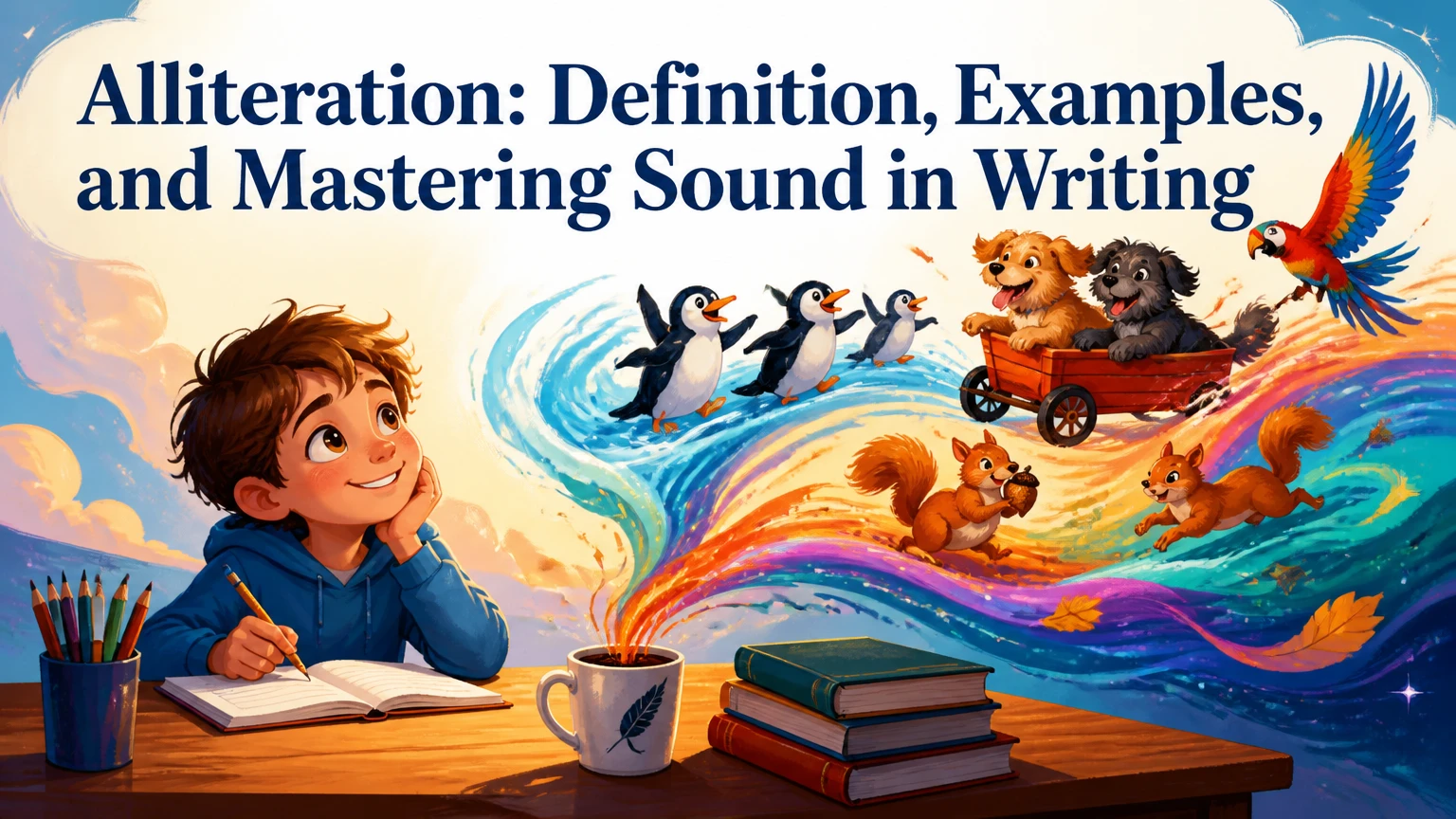
Alliteration is a stylistic literary device characterized by the repetition of identical initial consonant sounds in successive or closely associated syllables within a group of words. You can find this musical quality in common phrases such as busy as a bee, picture perfect, cool as a cucumber, rocky road, and tough talk. By repeating these specific sounds, writers and speakers create a rhythmic pulse that makes language more memorable, engaging, and aesthetically pleasing to the ear. This technique is not merely a poetic flourish; it serves as a powerful tool for branding, mnemonic devices, and emotional emphasis across various forms of communication.
Understanding the nuances of alliteration allows students, writers, and public speakers to manipulate the “texture” of their prose or poetry. Whether you are crafting a persuasive speech or writing a lyrical novel, the strategic use of consonant repetition helps highlight key concepts and link ideas together through auditory patterns. This comprehensive guide will explore the structural rules of alliteration, differentiate it from similar phonetic devices, and provide extensive examples to help you master this essential element of English rhetoric and creative writing.
Table of Contents
- Comprehensive Definition of Alliteration
- Structural Breakdown and Phonetic Rules
- Types and Categories of Alliteration
- Alliteration vs. Consonance and Assonance
- Extensive Examples: Literature and Poetry
- Extensive Examples: Pop Culture and Branding
- Usage Rules and Best Practices
- Common Mistakes and Misconceptions
- Advanced Topics: Sibilance and Plosives
- Practice Exercises and Worksheets
- Frequently Asked Questions (FAQ)
- Conclusion and Key Takeaways
Comprehensive Definition of Alliteration
At its core, alliteration is the repetition of the same letter or sound at the beginning of adjacent or closely connected words. It is often referred to as “head rhyme” or “initial rhyme” because the echoing effect happens at the start of the word rather than the end. While many people believe alliteration is strictly about repeating letters, it is actually a phonetic phenomenon, meaning it is defined by the sound rather than the spelling.
The primary function of alliteration is to provide a melodic or rhythmic quality to language. In ancient Germanic and Old English poetry, such as Beowulf, alliteration was the primary structural principle of verse, serving the role that end-rhyme plays in modern poetry. In contemporary contexts, it is used to draw attention to specific phrases, making them stand out from the surrounding text. This is why it is so prevalent in advertising, where “Coca-Cola” or “PayPal” use the device to stick in the consumer’s memory.
Furthermore, alliteration can set the mood of a piece. A series of soft “s” sounds might evoke a sense of calm or secrecy, while harsh “k” or “b” sounds might suggest violence, energy, or chaos. By choosing specific consonants to repeat, a writer can subconsciously influence the reader’s emotional response to the text without changing the literal meaning of the words themselves.
Structural Breakdown and Phonetic Rules
To identify alliteration correctly, one must look beyond the alphabet and focus on linguistics. There are several key rules that determine whether a phrase is truly alliterative. The most important distinction is that alliteration depends on stressed syllables and sounds. If a letter is silent, it does not contribute to alliteration. For example, “knotty” and “nice” are alliterative because they both start with the /n/ sound, even though one starts with ‘k’.
The physical proximity of the words also matters. The words do not necessarily have to be side-by-side, but they must be close enough that the ear retains the memory of the first sound when the second sound occurs. This is often referred to as the “proximity rule.” If there are too many non-alliterative words between the target sounds, the effect is lost. Usually, a gap of one or two small words (like “and,” “of,” or “the”) is acceptable.
The following table outlines the phonetic rules that govern how we identify alliterative pairs in English, focusing on the difference between visual spelling and auditory reality.
Table 1: Phonetic Rules of Alliteration
| Rule Category | Description | Example Pair | Status |
|---|---|---|---|
| Consonant Sound | The sound must be identical, regardless of spelling. | Phone and Friend | Alliterative (/f/ sound) |
| Silent Letters | Silent initial letters do not count toward the sound. | Knight and Night | Alliterative (/n/ sound) |
| Visual Match | Same letters with different sounds are not alliterative. | Chef and Chair | Not Alliterative (sh vs. ch) |
| Vowel Alliteration | Some define this as any vowel start; others require the same vowel. | Apple and Avenue | Alliterative |
| Stressed Syllables | The sound usually needs to be on the stressed syllable. | Around and Render | Weak Alliteration |
Types and Categories of Alliteration
While the general definition covers the basics, scholars often break alliteration down into more specific categories based on the types of sounds being repeated. The most common distinction is between General Alliteration and Sibilance. Sibilance is a specific form of alliteration involving “hissing” sounds like ‘s’, ‘sh’, and ‘z’. This creates a distinct auditory texture that is often used to imply whispering, snakes, or softness.
Another category is Consonantal Alliteration, which is the standard form we think of, and Vocalic Alliteration, which involves the repetition of vowel sounds at the beginning of words. While less common, vocalic alliteration (sometimes overlapping with assonance) provides a more open, airy feel to a sentence. We can also categorize alliteration by its placement, such as Internal Alliteration, where the sound repeats on stressed syllables inside the words rather than just the very first letter.
Finally, there is Symmetrical Alliteration, where the sounds repeat in a specific pattern, such as A-B-A-B. This is frequently found in formal poetry and adds a layer of mathematical precision to the writing. Understanding these sub-types helps writers choose the right “flavor” of repetition for their specific needs, whether they want the sharp crack of a plosive ‘p’ or the smooth flow of a liquid ‘l’.
Alliteration vs. Consonance and Assonance
It is very easy to confuse alliteration with other “sound devices” like consonance and assonance. The main difference lies in where the sound occurs within the word. Alliteration is strictly about the beginning. Consonance involves the repetition of consonant sounds anywhere in the words (middle or end), such as “the lucky duck.” Assonance involves the repetition of vowel sounds within words, like “the rain in Spain.”
Writers often use these three devices in tandem to create a “sonic landscape.” For example, a line might use alliteration to start a rhythm and consonance to finish it. This creates a cohesive feeling that makes the text feel “written” rather than just spoken. In the table below, we compare these three devices to clarify their distinct roles in English grammar and literature.
Table 2: Comparison of Sound Devices
| Device | Focus Area | Primary Requirement | Example |
|---|---|---|---|
| Alliteration | Beginning of words | Initial consonant sounds | Seven slippery snakes |
| Consonance | Anywhere in words | Consonant sounds only | Toss the glass, Boss |
| Assonance | Usually middle | Vowel sounds only | Fleet feet sweep |
| Onomatopoeia | Whole word | Word mimics a sound | The buzzing bee |
Extensive Examples: Literature and Poetry
Literature is the richest source of alliteration. From the epic poems of the Middle Ages to modern novels, authors use this device to create mood. In William Shakespeare’s A Midsummer Night’s Dream, he uses heavy alliteration to parody bad acting: “Whereat, with blade, with bloody blameful blade, / He bravely broach’d his boiling bloody breast.” Here, the repetition of the ‘b’ sound is intentional and over-the-top, showing how too much alliteration can become comical.
In contrast, Edgar Allan Poe used alliteration to create a haunting, somber atmosphere. In “The Raven,” the line “Once upon a midnight dreary, while I pondered, weak and weary” uses the ‘w’ sound to evoke a sense of exhaustion and drifting thought. The ‘w’ is a soft, breathy sound that mirrors the narrator’s fading energy. This demonstrates that the choice of consonant is just as important as the act of repetition itself.
The following table provides a wide array of literary and common alliterative examples, categorized by the specific consonant sound they emphasize. This illustrates how different letters provide different “feelings” to a sentence.
Table 3: 30 Examples of Alliteration by Sound
| Sound | Example Sentence / Phrase | Context |
|---|---|---|
| /b/ | Barbaric beasts basked in the bright blaze. | Descriptive Prose |
| /c/ or /k/ | The cold, callous captain commanded the crew. | Narrative |
| /d/ | Deep, dark dungeons discouraged the daring. | Fantasy Fiction |
| /f/ | Fine feathers fly in the fickle frost. | Poetry |
| /g/ | Green gardens grow great grapes. | Simple Description |
| /h/ | Humble heroes hope for honest hearts. | Proverbial |
| /j/ | Joyful journalists joined the jolly journey. | Journalism |
| /l/ | Lovely lilies lined the lonely lake. | Romanticism |
| /m/ | Many men make much money. | Idiom |
| /n/ | Noisy neighbors noticed the narrow net. | Everyday Speech |
| /p/ | Peter Piper picked a peck of pickled peppers. | Tongue Twister |
| /r/ | Rough rivers run round rugged rocks. | Nature Writing |
| /s/ | Soft silken sails slipped silently seaward. | Sibilance |
| /t/ | Two tiny tigers took the taxi to town. | Children’s Literature |
| /v/ | Vivid violets vanished in the valley. | Imagery |
| /w/ | Wild winds whistled west of the woods. | Atmospheric |
| /z/ | Zealous zebras zigzagged through the zoo. | Playful |
| /sh/ | She showed shiny shells to the shepherd. | Phonetic Practice |
| /th/ | Thin threads through the thick thorn. | Alliterative Verse |
| /ch/ | Charming children chose chunky cherries. | Casual |
| /b/ | Big bad bears bite blue berries. | Basic Alliteration |
| /k/ | Keep the keen kitchen knife clean. | Instructional |
| /m/ | Mild-mannered men make modest moves. | Characterization |
| /p/ | Please put the pink plants in the pot. | Direct Address |
| /r/ | Rapid rabbits ran right round the ruts. | Action |
| /s/ | Seven sisters slept soundly on the sofa. | Rhythm |
| /t/ | Tell the truth to the tired teacher. | Moralistic |
| /w/ | Wonderful wizards watch the waking world. | Fantasy |
| /f/ | Four furious friends fought for fame. | Conflict |
| /g/ | Giggling girls gathered golden grains. | Pastoral |
Extensive Examples: Pop Culture and Branding
Beyond literature, alliteration is a cornerstone of the business world. Marketing experts use “sticky” names to ensure consumers remember their products. Think of how many famous brands use this technique: Best Buy, Dunkin’ Donuts, Lulu Lemon, and Weight Watchers. The repetition of the initial sound creates a “brand harmony” that feels complete and professional. It also aids in word-of-mouth marketing, as alliterative names are easier and more fun to say aloud.
In the world of entertainment, fictional characters often have alliterative names to make them more iconic. Stan Lee, the creator of many Marvel characters, famously used this to help him remember the names of his vast roster of heroes. This gave us Peter Parker, Bruce Banner, Reed Richards, Lois Lane, and Stephen Strange. In these cases, the alliteration acts as a mnemonic device for both the creator and the audience.
The following table lists 25 recognizable examples from business, media, and entertainment to show how pervasive this device is in our daily lives.
Table 4: 25 Alliterative Names in Branding and Media
| Brand / Character | Sound | Industry / Category |
|---|---|---|
| Bed Bath & Beyond | /b/ | Retail |
| Burt’s Bees | /b/ | Skincare |
| Captain Cook | /k/ | History |
| Donald Duck | /d/ | Animation |
| DoorDash | /d/ | Service |
| Gold’s Gym | /g/ | Fitness |
| Gone Girl | /g/ | Literature/Film |
| Gorilla Glue | /g/ | Hardware |
| Hip Hop | /h/ | Music Genre |
| Howard Hughes | /h/ | History |
| Janice Joplin | /j/ | Music |
| Kit Kat | /k/ | Confectionery |
| Krispy Kreme | /k/ | Food |
| Life Lock | /l/ | Security |
| Marilyn Monroe | /m/ | Film |
| Mickey Mouse | /m/ | Animation |
| PayPal | /p/ | Finance |
| Peppa Pig | /p/ | Children’s TV |
| Range Rover | /r/ | Automotive |
| SpongeBob SquarePants | /s/ | Animation |
| Teen Titans | /t/ | Comics |
| Tic Tac | /t/ | Confectionery |
| Vince Vaughn | /v/ | Entertainment |
| Wonder Woman | /w/ | Comics |
| World Wide Web | /w/ | Technology |
Usage Rules and Best Practices
While alliteration is a fun and effective tool, it requires a “light touch” to be successful in serious writing. The most important rule for using alliteration is purposefulness. If you use it accidentally, it can distract the reader. If you use it too much, it can make your writing sound like a nursery rhyme or a tongue twister. In academic or professional writing, alliteration should be used sparingly to emphasize a title or a concluding thought.
In creative writing, consider the connotative weight of the sounds you choose. This is often called “sound symbolism.” For example, “plosive” sounds like b, p, t, d, k, g involve stopping the airflow and then releasing it. These sounds feel energetic, abrupt, or powerful. “Fricative” sounds like f, v, s, z, th involve partial obstruction and feel smoother, more continuous, or sometimes more sinister. Matching the sound to the meaning of the sentence is the mark of a skilled writer.
Another rule is the Rule of Three. Alliteration often feels most balanced when it spans three words. Phrases like “Veni, Vidi, Vici” (though Latin) or “Stop, Slack, and Stutter” have a natural cadence that feels complete. Two words can feel like a coincidence; four or more can feel like an intentional gimmick. Three is often the “sweet spot” for rhetorical impact.
Table 5: Sound Symbolism in Alliteration
| Sound Group | Letters | Common Connotations |
|---|---|---|
| Plosives | b, p, t, d, k, g | Power, violence, suddenness, percussion |
| Fricatives | f, v, s, z, th, sh | Softness, wind, whispering, friction, speed | l, r | Flow, water, movement, elegance |
| Nasals | m, n | Humming, continuity, resonance, sleep |
Common Mistakes and Misconceptions
The most frequent mistake learners make is equating alliteration with spelling. As mentioned earlier, English is not a phonetic language; letters often represent different sounds. “City” and “Cake” both start with ‘C’, but they are not alliterative because “City” starts with an /s/ sound and “Cake” starts with a /k/ sound. Conversely, “Keep” and “Cat” are alliterative because they share the same initial sound despite having different starting letters.
Another mistake is ignoring word stress. In English, we naturally emphasize certain syllables. Alliteration is most powerful when it occurs on the stressed syllable of the word. If the repeated sound falls on an unstressed syllable, the human ear might not even register it. For example, in the phrase “potential police,” the ‘p’ is stressed in both, making it strong. In “appear and pretend,” the ‘p’ in “appear” is part of an unstressed syllable, making the alliteration much weaker.
Finally, avoid “forced alliteration.” This happens when a writer chooses a word that doesn’t quite fit the meaning just because it starts with the right letter. This results in awkward phrasing that confuses the reader. Always prioritize clarity and meaning over the sound device. If the perfect word doesn’t alliterate, use it anyway.
Table 6: Correct vs. Incorrect Alliteration
| Example Phrase | Status | Reasoning |
|---|---|---|
| Physical Fitness | Correct | Both start with the /f/ sound. |
| Giant Gnat | Incorrect | /j/ vs. /n/ sounds. |
| Knotty Night | Correct | Both start with the /n/ sound. |
| Simple Sugar | Incorrect | /s/ vs. /sh/ sounds. |
| The blue bird | Correct | Simple /b/ repetition. |
Advanced Topics: Sibilance and Plosives
For advanced students of English, alliteration can be analyzed through the lens of articulatory phonetics. This involves looking at how the mouth actually produces the sounds. Sibilance is the most-studied sub-type of alliteration. It involves the “hissing” sounds produced by directing a stream of air with the tongue towards the sharp edge of the teeth. In literature, sibilance is frequently used to create an atmosphere of tension, secrecy, or the supernatural. Think of the “Serpent” in Paradise Lost; its speech is often heavy with ‘s’ sounds to remind the reader of its reptilian nature.
Another advanced concept is Internal Alliteration. This occurs when the sound repeats within the words, specifically on the stressed syllables. For example, in the line “The lullaby rendered him sleepy,” the repetition of the ‘l’ sound (lullaby, rendered, sleepy) isn’t just at the start of words but echoes through the sentence. This is more subtle than head rhyme and is often used by poets to create a “hidden” music that the reader feels rather than notices immediately.
Finally, consider Apt Alliteration. This is a term used when the sound of the words actually mimics the action being described. If you are writing about a bubbling brook, using “b” and “p” sounds can mimic the sound of water popping and splashing. If you are writing about a fast car, “f” and “s” sounds can mimic the sound of wind rushing past. This level of intentionality elevates writing from simple communication to true art.
Practice Exercises and Worksheets
To master alliteration, you must practice both identifying it in existing texts and creating your own. The following exercises are designed to test your understanding of the phonetic rules and your ability to use the device creatively.
Exercise 1: Identification
In the following sentences, identify the alliterative words and the sound they share. Remember to focus on the sound, not the letter.
- The king’s court was filled with cold-hearted knights.
- She sells sea shells by the sea shore.
- The phone rang frequently on Friday.
- Psychology students study the soul.
- The gentle giant jumped over the gate.
- Wild wolves wandered through the winter woods.
- Tiny tadpoles turned into tough toads.
- He hit the heavy hammer against the hard house.
- Please prepare the purple plums for the party.
- The chef chose the cheapest cheese.
Exercise 2: Creation
Complete the following sentences by adding an alliterative word that fits the context.
| Sentence Starter | Target Sound | Your Completion |
|---|---|---|
| The brave boy… | /b/ | (e.g., broke the box) |
| Lazy lizards… | /l/ | ____________________ |
| Funny farmers… | /f/ | ____________________ |
| Great green… | /g/ | ____________________ |
| Mighty mountains… | /m/ | ____________________ |
| Silent shadows… | /s/ | ____________________ |
| Tired travelers… | /t/ | ____________________ |
| Quick queens… | /k/ | ____________________ |
| Deep dancers… | /d/ | ____________________ |
| Happy hikers… | /h/ | ____________________ |
Answer Key for Exercise 1
| Sentence # | Alliterative Words | Shared Sound |
|---|---|---|
| 1 | King’s, court, cold | /k/ |
| 2 | She, shells, shore (and) sea, sea | /sh/ and /s/ |
| 3 | Phone, frequently, Friday | /f/ |
| 4 | Students, study, soul | /s/ (Psychology starts with /s/ too!) |
| 5 | Gentle, giant, jumped | /j/ |
| 6 | Wild, wolves, wandered, winter, woods | /w/ |
| 7 | Tiny, tadpoles, turned, tough, toads | /t/ |
| 8 | Hit, heavy, hammer, hard, house | /h/ |
| 9 | Please, prepare, purple, plums, party | /p/ |
| 10 | Chef, chose, cheapest, cheese | None (Chef is /sh/, others are /ch/) |
Frequently Asked Questions (FAQ)
Q: Does alliteration have to be at the very start of the word?
A: Generally, yes. Traditional alliteration focuses on the first letter or sound. However, “Internal Alliteration” allows for the sound to repeat on the first stressed syllable, even if it’s not the first letter of the word (e.g., “aloft” and “below”).
Q: How many words do I need for it to count as alliteration?
A: At minimum, you need two words. However, to create a noticeable stylistic effect, three or more words are usually preferred. In branding, two words (like “Best Buy”) are very common.
Q: Is alliteration the same as rhyming?
A: No. Rhyming usually refers to “end rhyme,” where the final sounds of words match (e.g., “cat” and “hat”). Alliteration is “head rhyme,” where the beginning sounds match.
Q: Can vowels be alliterative?
A: Yes! This is called “vocalic alliteration.” Some linguists argue that any vowel starting a word counts as alliteration with any other vowel, while others believe it must be the exact same vowel sound (e.g., “Angry Apples”).
Q: Why is alliteration used in advertisements?
A: It makes the brand name more “musical” and easier for the brain to encode into long-term memory. It also creates a sense of symmetry and “rightness” that consumers find appealing.
Q: Can alliteration span across different sentences?
A: Usually, no. The effect of alliteration relies on the sounds being close enough together for the ear to “link” them. If the sounds are in different sentences, the connection is typically too weak to be considered a formal literary device.
Q: Is “the” or “and” allowed between alliterative words?
A: Yes. Small “filler” words or articles do not break the alliterative chain. “The boy and the bear” is perfectly alliterative.
Q: What is the difference between alliteration and onomatopoeia?
A: Alliteration is about repeating sounds across words. Onomatopoeia is a single word that sounds like what it describes (e.g., “bang,” “hiss,” “pop”). You can use them together, like “The bee buzzed busily.”
Conclusion and Key Takeaways
Alliteration is one of the most versatile and enduring tools in the English language. By repeating initial consonant sounds, writers can create rhythm, establish mood, and ensure their words linger in the reader’s mind. From the ancient verses of Beowulf to the modern marketing of Coca-Cola, this device bridges the gap between sound and meaning. Remember that true alliteration is an auditory experience, not just a visual one; always listen to the sounds of the words rather than just looking at their first letters. Use it with intention, avoid over-saturation, and let the natural music of the English language enhance your creative and professional writing. With practice, you will find that alliteration is the secret ingredient to making your prose truly “picture perfect.”