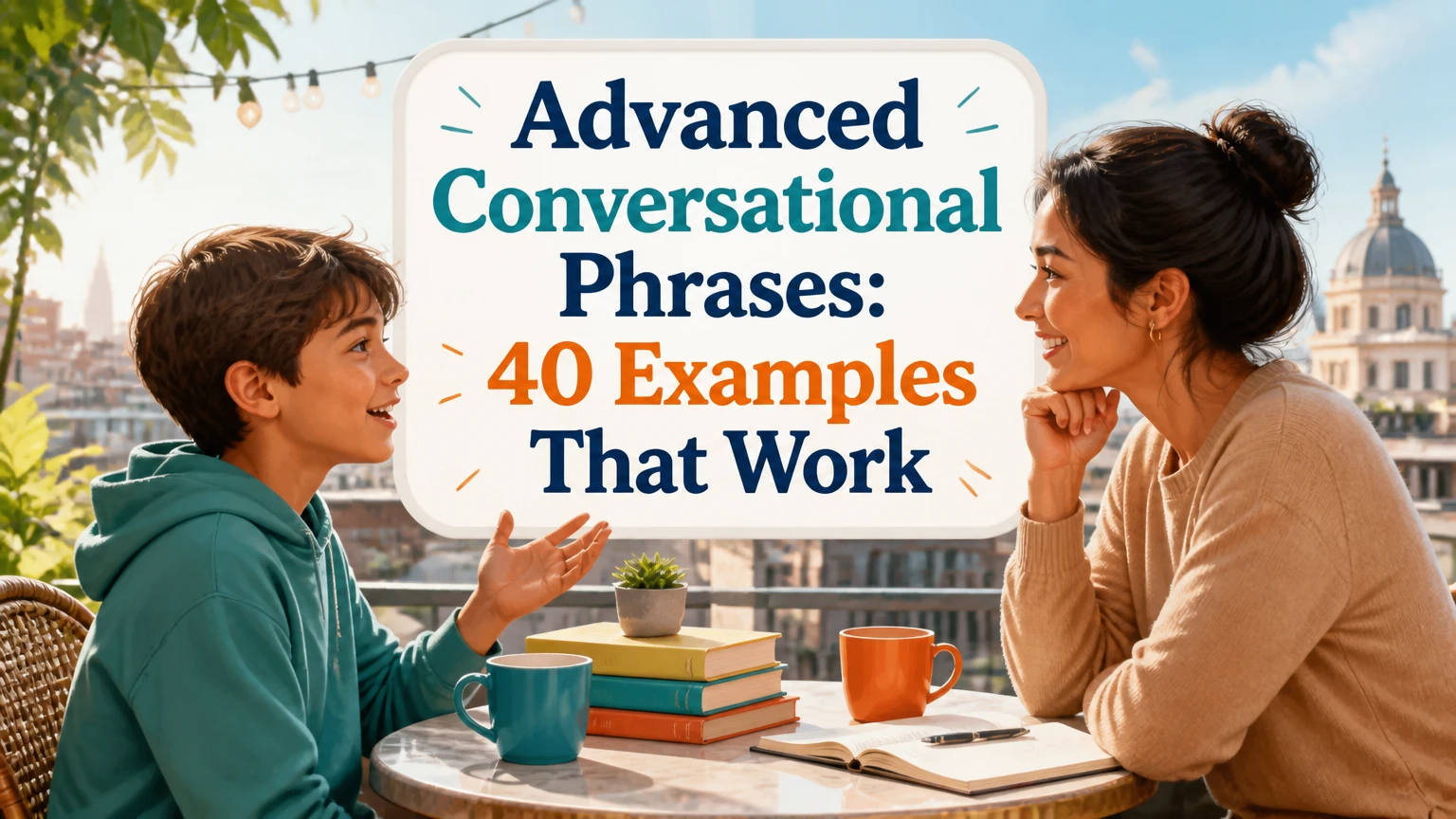
Advanced conversational phrases are reusable language frames that help speakers manage meaning, tone, disagreement, pacing, and group alignment. Unlike basic expressions such as “I understand,” they shape how an idea is received by adding context, qualification, redirection, or a clear next step.
Key Facts at a Glance
- Advanced conversational phrases manage interaction, not merely vocabulary.
- The four core functions are redirection, diplomatic pushback, nuance, and synthesis.
- A useful phrase must match the speaker’s goal, relationship, power dynamic, and emotional temperature.
- Plain English usually sounds more authoritative than dense corporate jargon.
- A short pause before a difficult point can improve clarity, but no universal 1.5-second rule applies to every conversation.
- Fluency comes from adapting phrase structures, not reciting memorized scripts.
What Are Advanced Conversational Phrases?
Advanced conversational phrases are language frames that perform a social or structural function while conveying information. Examples include “I see the reasoning behind that; my concern is…” for respectful disagreement and “Let me separate the immediate issue from the longer-term question” for analytical clarification.
Basic language communicates a literal message. Advanced conversational language also manages turn-taking, certainty, emotional risk, and shared understanding. The phrase “That is wrong” challenges a person directly, while “I interpret the evidence differently because…” moves the disagreement toward reasoning.
These expressions are not automatically sophisticated because they contain formal words. “Let’s synergistically optimize the operational paradigm” is jargon, not effective advanced communication. “The proposal may reduce costs, but it also increases implementation risk” is advanced because it identifies a trade-off precisely.
Phrase, Idiom, and Discourse Marker
| Language form | Primary function | Example | Best setting |
|---|---|---|---|
| Conversational frame | Shapes a response | “My concern is…” | Meetings and negotiation |
| Discourse marker | Organizes speech | “That said…” | Presentations and discussion |
| Idiom | Expresses figurative meaning | “Let’s not put the cart before the horse” | Familiar informal groups |
| Qualification | Adjusts certainty | “Based on the available data…” | Analysis and reporting |
| Repair phrase | Corrects or clarifies | “Let me rephrase that” | Any high-stakes exchange |
How Do These Phrases Work?
Advanced conversational phrases work through four mechanisms: framing, pacing, cushioning, and alignment. A phrase changes the listener’s interpretation of a proposition by showing whether the speaker is exploring, challenging, summarizing, or requesting action.
Linguistic Framing
Framing places an issue inside a chosen interpretation. “The launch failed” assigns a final judgment; “The launch exposed a weakness in our testing process” identifies a more useful operational frame. Ethical framing clarifies consequences without hiding relevant facts.
Cognitive Pacing
Pacing phrases give speakers time to select accurate language. “Let me think through the implication” sounds more purposeful than a long stream of fillers such as “um,” “like,” and “you know.” The phrase should precede a real thought, not disguise the absence of one.
Social Cushioning
Social cushioning reduces unnecessary threat around disagreement. “I agree with the objective; I am less certain about the proposed route” preserves the shared goal while isolating the disputed method.
Context and Power Calibration
The same phrase changes meaning according to status and relationship. “Could we revisit that assumption?” is appropriate with a colleague or manager, whereas “I need clarification on the decision and its owner” is stronger when accountability matters.
What Are the Main Types of Advanced Conversational Phrases?
The four most useful categories are strategic redirection, diplomatic pushback, nuance framing, and synthesis. Each category solves a different conversational problem and requires a different level of directness.
| Category | Main goal | Example phrase | Primary risk |
|---|---|---|---|
| Strategic redirection | Move discussion to a useful issue | “Let’s return to the decision we need today” | Sounding dismissive |
| Diplomatic pushback | Challenge an idea respectfully | “My reservation is the delivery capacity” | Hiding the actual objection |
| Nuance framing | Express a qualified judgment | “The early evidence suggests…” | Sounding indecisive |
| Synthesis and alignment | Summarize and coordinate | “The trade-off is speed versus control” | Misrepresenting someone’s view |
| Boundary setting | Define a limit or condition | “I can commit to X, not Y” | Appearing inflexible |
How Can You Redirect a Conversation?
Use a redirection phrase that acknowledges the current point, names the more relevant issue, and explains why the shift matters. A bare “Let’s move on” often feels dismissive because it offers neither recognition nor reasoning.
Strategic Redirection Examples
- “That raises a useful question; the decision we need today is the rollout date.”
- “Let’s zoom out and examine the effect on the full customer journey.”
- “I want to park that detail temporarily and return to the underlying assumption.”
- “That is relevant to implementation; first, can we agree on the desired outcome?”
- “We may be solving a secondary problem before confirming the primary one.”
- “Let’s separate the urgent issue from the longer-term design question.”
- “The metric is informative, but the operational consequence deserves attention.”
- “Could we bring this back to the constraint that determines the timeline?”
- “I suggest we record that as a follow-up rather than letting it derail the decision.”
- “Before we compare solutions, can we define the problem consistently?”
A strong redirect does not erase the speaker’s contribution. It places that contribution in a sequence. In a meeting, “Let’s capture that for the implementation discussion” preserves ownership while protecting the current agenda.
Written Redirection
Written communication needs more explicit transitions because it lacks facial expression and vocal tone. Use “For clarity, there are two separate questions here” before dividing a long email into issues, decisions, and actions.
How Can You Disagree Without Sounding Aggressive?
State agreement with the shared objective, identify the specific reservation, and provide evidence or a condition. Diplomatic pushback should make the disagreement easier to evaluate, not make the disagreement vague.
Diplomatic Pushback Examples
- “I see the logic; my reservation is the available engineering capacity.”
- “I agree with the goal, although I question whether this sequence gets us there.”
- “Could we test that assumption against the retention data?”
- “I interpret the risk differently because the dependency is outside our control.”
- “I would support the proposal if we added a clear rollback condition.”
- “That may work for the pilot, but the scale-up introduces another constraint.”
- “I am not convinced the short-term saving outweighs the maintenance cost.”
- “How does this approach fit with our commitment to reducing overhead?”
- “The recommendation is reasonable; I need more evidence on the failure rate.”
- “I would separate the commercial case from the technical feasibility question.”
A Directness Ladder
| Level | Phrase | Suitable situation |
|---|---|---|
| Low | “I wonder whether another interpretation is possible” | Early exploration |
| Moderate | “My concern is the effect on delivery capacity” | Peer discussion |
| Firm | “I cannot support this without a testing requirement” | Decision meeting |
| Very firm | “I object to proceeding without documented risk ownership” | Governance or safety |
The common mistake is cushioning the message until the listener cannot locate the objection. A diplomatic sentence still needs a clear noun, verb, and consequence.
How Do You Express Nuance and Humility?
Use a confidence marker that identifies the evidence behind your view, then state the conclusion plainly. Intellectual humility is not constant self-doubt; it is accurate calibration between evidence and certainty.
Nuance and Humility Examples
- “Based on the information available, my initial reading is that demand is shifting.”
- “I may be missing context, but the timeline appears dependent on one supplier.”
- “The evidence points in that direction, although the sample is still small.”
- “I would treat that as a working hypothesis rather than a confirmed cause.”
- “Correct me if I have misunderstood the sequence of events.”
- “There are two plausible explanations, and the current data does not distinguish them.”
- “My confidence is moderate because we have only one reporting period.”
- “That conclusion follows if the assumption about pricing remains valid.”
- “I would be cautious about generalizing from this example.”
- “The result is encouraging, but it does not yet establish a durable trend.”
Avoid “I could be wrong” when you have strong evidence and no specific uncertainty. Replace it with the exact limitation: “The conclusion is based on self-reported data, so recall bias remains possible.”
How Do You Create Alignment?
Summarize the agreed facts, name the unresolved trade-off, and assign the next decision or action. Synthesis phrases create leadership through accurate compression, not through formal vocabulary.
Synthesis and Alignment Examples
- “Let me check that I have captured the main points.”
- “It sounds like we agree on the destination but not the route.”
- “The central trade-off is speed versus control.”
- “I hear consensus on the outcome and an open question about ownership.”
- “The decision appears to depend on whether we prioritize cost or resilience.”
- “So far, we have agreed on scope, timing, and the remaining risk.”
- “There are three open issues: budget authority, technical readiness, and support coverage.”
- “If I have understood correctly, the proposed next step is a limited pilot.”
- “Before we close, can we confirm the owner and deadline for each action?”
- “We are aligned on the problem statement; the recommendation still needs evidence.”
A synthesis is useful only when participants can correct it. End with “What have I missed?” when the discussion involved competing interests or absent stakeholders.
Which Phrases Fit Different Situations?
The best phrase depends on the outcome required, the relationship involved, and the cost of misunderstanding. A board meeting rewards concise synthesis, while a personal conflict requires emotional acknowledgment before analysis.
| Situation | Recommended phrase | Avoid | Reason |
|---|---|---|---|
| Job interview | “The result was…, and my contribution was…” | “We synergized” | Shows ownership |
| Salary negotiation | “I would like to connect the scope with the compensation” | “I deserve more” | Links request to criteria |
| Customer complaint | “I understand the impact; here is what I can resolve today” | “That is our policy” | Combines empathy and action |
| Team conflict | “Can we distinguish intent from effect?” | “You overreacted” | Reduces personal blame |
| Executive meeting | “The decision hinges on two constraints” | Long background narrative | Improves decision speed |
| Technical presentation | “The business implication of this metric is…” | Unexplained acronyms | Connects detail to value |
| Performance feedback | “The outcome was below target; the next behavior is…” | “You need to improve” | Makes correction actionable |
| Email disagreement | “I read the proposal differently for two reasons” | “As I already said” | Prevents escalation |
For Non-Native English Speakers
Non-native professionals do not need obscure vocabulary to sound advanced. A reliable set of five frames, practiced with accurate pronunciation and clear evidence, is more useful than memorizing fifty expressions without understanding their conditions.
Start with:
- “My understanding is…”
- “My concern is…”
- “Could we clarify…?”
- “The evidence currently suggests…”
- “The next decision is…”
These frames reduce grammatical pressure because the sentence structure remains stable while the content changes.
For Technical Leaders
Technical leaders should connect metrics to decisions. “Latency fell from 420 to 180 milliseconds” is valuable, but “That reduction removes the response-time constraint for the mobile workflow” explains why the metric matters.
For Executives and Negotiators
Executives need concise qualification rather than excessive certainty. “The proposal is viable if regulatory approval arrives by June” is stronger than “The proposal will definitely work,” because it exposes the condition that controls the outcome.
Are Advanced Phrases Better Than Plain English?
Plain English is usually better when it expresses the same relationship with fewer words. Advanced conversational language adds value when it clarifies structure, uncertainty, or social risk; it becomes harmful when it replaces a concrete claim with impressive-sounding abstraction.
| Plain expression | Advanced but clear alternative | When the alternative helps |
|---|---|---|
| “I disagree” | “I reach a different conclusion because…” | Evidence-based discussion |
| “Change the subject” | “Let’s return to the decision at hand” | Formal meetings |
| “I do not know” | “The current data does not allow a firm conclusion” | Analytical reporting |
| “What do you mean?” | “Could you clarify the assumption behind that?” | Technical discussion |
| “We agree” | “We are aligned on the outcome and need to resolve the method” | Complex planning |
Corporate jargon is not a higher form of communication. Terms such as “bandwidth,” “leverage,” and “alignment” can be useful when a group shares their meanings, but “ideational paradigm optimization” obscures rather than organizes thought.
How Should You Deliver These Phrases?
Deliver advanced conversational phrases with a natural pause, moderate speed, and emphasis on the substantive noun or verb. A phrase sounds scripted when the speaker uses identical rhythm, exaggerated formality, or a soft introduction followed by an aggressive conclusion.
Typical professional speech falls around 120-150 words per minute, but comprehension, accent, topic complexity, and audience familiarity affect the useful rate. Treat that range as a practice reference, not a performance standard.
Use these delivery controls:
- Pause briefly before a disagreement or summary.
- Put vocal emphasis on the reason, condition, or consequence.
- Use falling intonation for a completed recommendation.
- Keep eye contact natural rather than continuous.
- Stop after the key sentence and allow a response.
- Match facial expression to the intended level of concern.
A counterintuitive rule matters here: softer wording does not compensate for hostile timing. “I understand your point” delivered while interrupting can sound more antagonistic than a direct sentence delivered after the speaker finishes.
How Can You Practice Without Sounding Scripted?
Practice one conversational function at a time for 10-15 minutes, three times weekly, and transform each frame into several original sentences. Fluency develops when the speaker retrieves a structure under pressure, not when the speaker repeats a perfect sentence in isolation.
A 14-Day Practice Plan
| Days | Practice target | Quantity | Checkpoint |
|---|---|---|---|
| 1-2 | Redirection frames | 5 recordings | Each redirect names a reason |
| 3-4 | Diplomatic pushback | 5 scenarios | Objection remains explicit |
| 5-6 | Nuance markers | 5 evidence statements | Confidence matches evidence |
| 7 | Synthesis | 3 one-minute summaries | Summary includes next action |
| 8-10 | Mixed responses | 10 prompts | No filler before the answer |
| 11-12 | Workplace simulation | 3 role-plays | Tone remains consistent |
| 13 | Written adaptation | 5 email sentences | Meaning survives without voice |
| 14 | Review and selection | 5 preferred frames | Each frame works in two contexts |
Record yourself answering realistic prompts, then assess clarity, directness, filler words, and whether the phrase changed the conversation. Speech-feedback applications commonly cost about $20-$60 per month, while executive communication coaching often ranges from $150-$500 per hour; neither is necessary for basic practice.
The Three-Variation Rule
For every phrase, create:
- A peer version: “My concern is the delivery capacity.”
- An upward version: “Could we examine the delivery-capacity assumption?”
- A written version: “The main delivery constraint appears to be team capacity.”
This variation prevents memorized language from sounding artificial and teaches the underlying structure.
What Goes Wrong With Advanced Conversational Phrases?
Most failures come from mismatched directness, vague jargon, inaccurate summaries, or delivery that contradicts the words. The repair is usually simpler language plus a more specific claim.
| Failure mode | Observable symptom | Repair phrase | Recovery action |
|---|---|---|---|
| Buzzword overload | Listener asks for translation | “In practical terms…” | State the action plainly |
| Excessive hedging | No one knows your position | “My recommendation is…” | Give a clear conclusion |
| Passive aggression | “With all due respect” sounds hostile | “My specific concern is…” | Remove sarcasm and name evidence |
| Premature redirection | Speaker feels dismissed | “I want to acknowledge that point” | Reflect before steering |
| Poor synthesis | Participant says “That is not what I said” | “Let me test my understanding” | Invite correction |
| Overlong framing | Main point arrives too late | “The short version is…” | Lead with the conclusion |
Advanced conversational phrases are not good tools for manipulation, evasion, or false certainty. A polished frame cannot repair missing evidence, an unreasonable request, or a refusal to accept responsibility.
Frequently Asked Questions
How Many Advanced Phrases Should I Memorize?
Memorize five to eight flexible frames first, with at least two for disagreement, one for clarification, one for redirection, and two for synthesis. Add new phrases only after you can adapt existing frames naturally across work, social, and written situations.
Can I Use Advanced Conversational Phrases in Emails?
Yes. Written use works particularly well for clarifying scope, documenting disagreement, and confirming decisions. Replace spoken fillers such as “Let me think” with an explicit structure: “There are two issues to separate,” followed by the evidence and requested action.
What Is the Best Phrase for Buying Thinking Time?
Use “Let me consider the implication before I answer” when you need a few seconds for analysis. Use “I do not have enough information to answer accurately” when the missing information is material. A pause is more credible when the eventual answer is specific.
How Do I Sound Confident Without Sounding Arrogant?
State your conclusion, identify its basis, and name the relevant limitation. For example: “I recommend delaying the launch because the support process is not ready; the recommendation should be revisited after the load test.”
Are Idioms Necessary for Advanced English Conversation?
No. Idioms can demonstrate cultural fluency, but they are not required for authority or precision. Prefer literal language when speaking with international teams, discussing legal or technical risk, or communicating instructions that cannot tolerate ambiguity.
How Can I Stop Overusing the Same Phrase?
Keep the function and vary the wording. Instead of repeating “My concern is,” alternate with “The risk I see is,” “The constraint is,” and “I would examine.” Review recordings weekly and remove phrases that add no information.
The Bottom Line
Advanced conversational phrases help speakers redirect discussion, disagree diplomatically, express calibrated uncertainty, and create alignment. The strongest phrases remain concrete: they identify the issue, explain the reasoning, and state the next action.
Use advanced conversational phrases with examples as flexible sentence patterns, not as a script. Choose one category, adapt five frames to your real situations, practice for 10-15 minutes three times per week, and simplify any wording that sounds more impressive than clear.