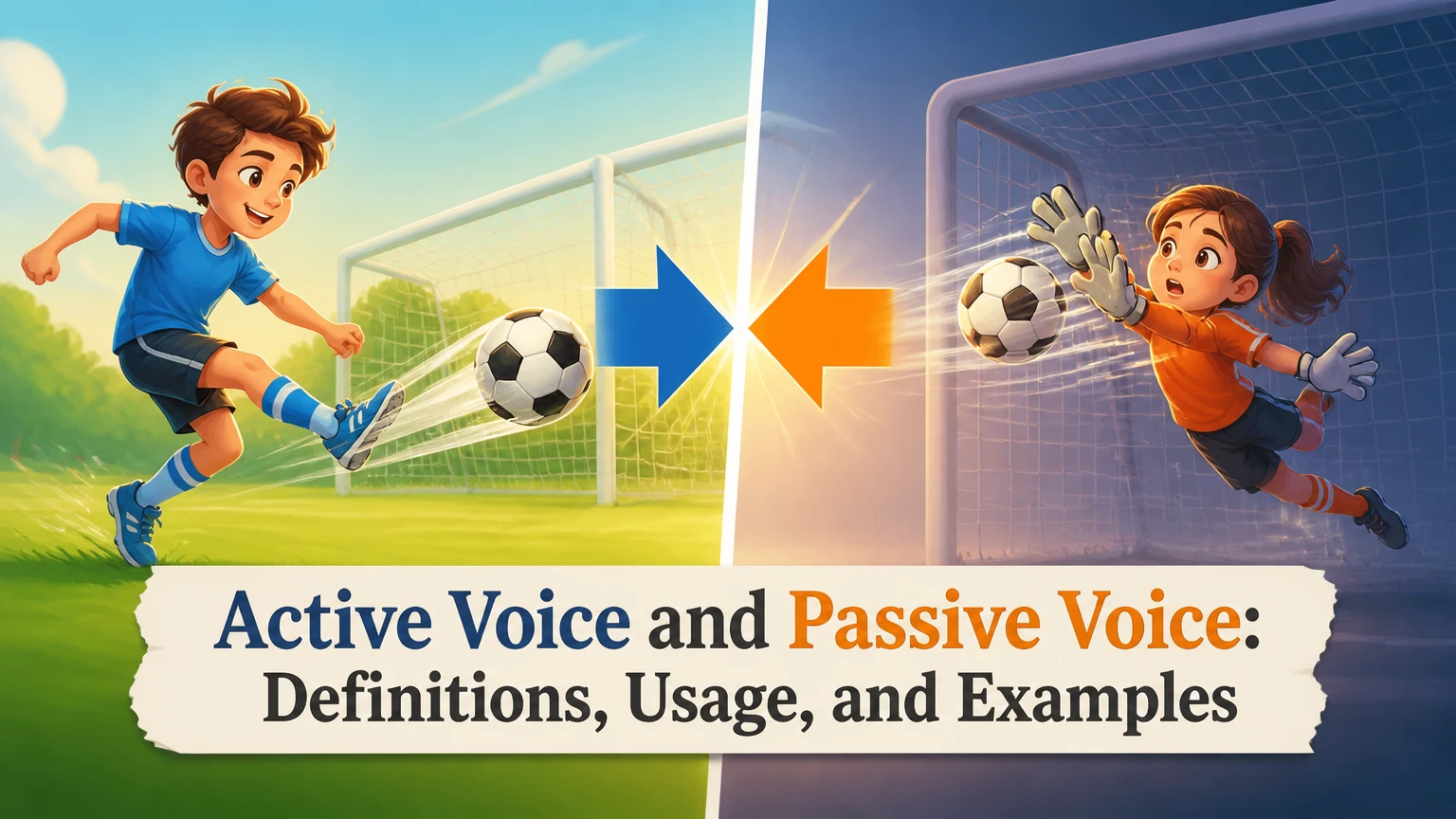
Active voice and passive voice describe whether a sentence’s grammatical subject performs an action or receives it. Active voice places the doer before the verb, as in “The analyst reviewed the report”; passive voice places the receiver first, as in “The report was reviewed by the analyst.” Voice affects emphasis, clarity, tone, and accountability.
Key Facts at a Glance
- Active voice follows the usual pattern: subject, verb, object.
- Passive voice follows the usual pattern: receiver, form of be, past participle, optional by phrase.
- Only transitive verbs, such as “build,” “approve,” and “measure,” normally form standard passives.
- Passive voice can occur in present, past, future, continuous, perfect, and modal constructions.
- Passive voice is useful when the receiver, result, process, or unknown actor matters more than the doer.
- A sentence containing “was” or “were” is not automatically passive.
What Do Active and Passive Voice Mean?
Active voice makes the grammatical subject the agent of the action. In “The technician repaired the printer,” the technician performs “repaired,” and the printer receives the action. The basic formula is subject + verb + object.
Passive voice makes the receiver of the action the grammatical subject. In “The printer was repaired by the technician,” the printer occupies the subject position, while “by the technician” identifies the original agent. The basic formula is receiver + form of be + past participle + optional by phrase.
Voice is a grammatical relationship, not a measure of sentence quality. Active voice often reduces word count and identifies responsibility quickly, while passive voice can foreground a result or protect an actor’s identity.
Active Voice Examples
| Active sentence | Subject or agent | Verb | Object or receiver |
|---|---|---|---|
| The nurse recorded the temperature. | The nurse | recorded | the temperature |
| The committee approved the proposal. | The committee | approved | the proposal |
| Maya will deliver the package. | Maya | will deliver | the package |
| Engineers tested the bridge. | Engineers | tested | the bridge |
Active voice does not require a human subject. “A sensor detected smoke” and “The storm damaged the roof” are active because the grammatical subjects perform or cause the action.
Passive Voice Examples
| Passive sentence | Receiver as subject | Passive verb phrase | Optional agent |
|---|---|---|---|
| The temperature was recorded by the nurse. | The temperature | was recorded | by the nurse |
| The proposal was approved by the committee. | The proposal | was approved | by the committee |
| The package will be delivered by Maya. | The package | will be delivered | by Maya |
| The roof was damaged by the storm. | The roof | was damaged | by the storm |
A passive sentence may omit the agent: “The proposal was approved.” Omission is appropriate when the committee is obvious, irrelevant, confidential, or genuinely unknown. It becomes misleading when the writer knows who acted but suppresses that information to avoid accountability.
How Can You Identify Each Voice?
Identify the grammatical subject and ask whether that subject performs the verb’s action. If the subject acts, the sentence is active; if the subject receives an action expressed through a form of be or get plus a past participle, the sentence is usually passive.
Use the following tests:
- Find the main verb. In “The files were deleted,” the verb phrase is “were deleted.”
- Find the subject. “The files” occupy the subject position.
- Ask who performed the action. The sentence does not identify the person.
- Try a by phrase. “The files were deleted by zombies” remains grammatical, so the construction is passive.
- Check the meaning. Some “be + participle” phrases describe a state, not an action.
The zombie test is a useful diagnostic, but it is not a complete grammar rule. “The door was closed by zombies” is passive, whereas “The door was closed” may describe either a completed action or the door’s current state, depending on context.
How Do You Convert Active Voice to Passive Voice?
Convert active voice to passive voice by moving the direct object into subject position, matching the original tense with an auxiliary verb, changing the main verb to its past participle, and adding the original subject in a by phrase only when useful.
Example:
- Active: The laboratory measured the sample.
- Object moved forward: The sample
- Tense preserved: simple past, so use was
- Past participle: measured
- Optional agent: by the laboratory
- Passive: The sample was measured by the laboratory.
Four Conversion Steps
1. Find a Direct Object
Standard passives require an active verb that takes an object. “The editor revised the headline” can become “The headline was revised.” By contrast, “The child slept” has no direct object, so “The sleep was slept” is not a standard passive construction.
2. Move the Object to Subject Position
The active object becomes the passive subject. “The mechanic replaced the battery” becomes “The battery replaced…” before the auxiliary and participle are added.
3. Preserve Tense and Agreement
Use the correct form of be and make it agree with the new subject. “The batteries were replaced” requires plural were, while “The battery was replaced” requires singular was.
4. Add the Agent Selectively
Add by + original subject when the agent changes interpretation or supplies valuable evidence. Omit it when the actor is unknown, predictable, unimportant, or intentionally confidential.
How Does Voice Work Across Tenses?
Passive voice preserves tense through the auxiliary verb, while the main lexical verb appears as a past participle. The construction becomes longer in continuous and perfect forms because each additional grammatical meaning requires another auxiliary.
| Tense or construction | Active voice | Passive voice |
|---|---|---|
| Simple present | The chef cooks the meal. | The meal is cooked by the chef. |
| Simple past | The chef cooked the meal. | The meal was cooked by the chef. |
| Simple future | The chef will cook the meal. | The meal will be cooked by the chef. |
| Present continuous | The chef is cooking the meal. | The meal is being cooked by the chef. |
| Past continuous | The chef was cooking the meal. | The meal was being cooked by the chef. |
| Present perfect | The chef has cooked the meal. | The meal has been cooked by the chef. |
| Past perfect | The chef had cooked the meal. | The meal had been cooked by the chef. |
| Modal | The chef must cook the meal. | The meal must be cooked by the chef. |
Less common forms remain grammatical but may sound heavy. “The meal will have been cooked by noon” is a future perfect passive. “The meal is being cooked” is a present continuous passive.
Questions and Negatives
Passive questions place the auxiliary before the subject:
- Active: Did the inspector approve the plan?
- Passive: Was the plan approved by the inspector?
Passive negatives place not after the first auxiliary:
- Active: The supplier did not ship the parts.
- Passive: The parts were not shipped by the supplier.
Which Verbs Cannot Become Passive?
Intransitive verbs cannot form a standard passive because they do not take a direct object. Verbs such as “arrive,” “sleep,” “occur,” “laugh,” and “remain” do not transfer an action to an object.
| Verb type | Active example | Passive result |
|---|---|---|
| Intransitive | The guests arrived. | No standard passive |
| Intransitive | The accident occurred. | No standard passive |
| Transitive | The team solved the puzzle. | The puzzle was solved |
| Transitive | The company hired Lena. | Lena was hired |
| Linking verb | The soup became cold. | No standard passive meaning |
Some verbs take both an object and a preposition. “The manager spoke to the applicant” does not normally become “The applicant was spoken by the manager,” but informal English may allow “The applicant was spoken to.”
What Are Special Passive Constructions?
English has several passive patterns that do not fit the simplest “be + participle” example.
Get-Passive
The get-passive uses get instead of be: “The cyclist got injured during the race.” It commonly emphasizes a change of condition, an unexpected event, or an affected person, and it is more conversational than “The cyclist was injured.”
The form is unsuitable for many formal reports. “The database got corrupted” sounds natural in technical conversation, while “The database was corrupted” is generally more appropriate in documentation.
Double-Object Passives
Verbs such as “give,” “send,” and “offer” can produce two passive structures:
- Active: The publisher sent the author a contract.
- Passive: The author was sent a contract.
- Passive: A contract was sent to the author.
The first passive version foregrounds the recipient. The second foregrounds the item sent. Choose the version that matches the information the paragraph is developing.
Reporting Passives
Reporting verbs create formal structures such as “The device is believed to be safe” and “The policy is expected to reduce costs.” These constructions compress a longer clause:
- Active: Researchers believe that the device is safe.
- Passive: The device is believed to be safe.
Reporting passives can sound authoritative, but they should identify a source when attribution matters. “The treatment is believed to work” is weaker than “The National Institute for Health and Care Excellence reported that the treatment works.”
When Should You Use Active or Passive Voice?
Use active voice when the actor, responsibility, sequence, or instruction matters. Use passive voice when the receiver, result, process, or unknown actor deserves primary emphasis. The correct choice depends on information structure rather than a fixed percentage of sentences.
| Situation | Preferred voice | Example | Reason |
|---|---|---|---|
| Direct instruction | Active | Save the file before closing. | Names the implied actor |
| Business accountability | Active | Our team missed the deadline. | Assigns responsibility |
| Scientific procedure | Passive or active | Samples were heated to 80°C. | Focuses on procedure |
| Unknown actor | Passive | The window was broken overnight. | Actor is unavailable |
| Legal protection | Passive, carefully | The records were disclosed under warrant. | Focuses on authorized action |
| Bad-news communication | Active with ownership | We cannot approve the refund. | Avoids evasive wording |
| Narrative action | Active | The horse jumped the fence. | Maintains movement |
| Result-focused report | Passive | The bridge was completed in June. | Foregrounds the completed structure |
The claim that professional writing should contain exactly 80%-90% active voice is not a universal grammar rule. Treat that range as a practical editing target for direct business prose, not as a requirement for laboratory methods, legal analysis, or literary narration.
Why Do Scientific Writers Use Passive Voice?
Scientific writers use passive voice when the method or material matters more than the researcher. “The solution was heated to 100°C” foregrounds the procedure and temperature, which may improve continuity in a methods section.
Modern scientific style does not require total impersonality. The American Psychological Association’s Publication Manual, 7th edition, permits active voice and recommends it when it improves clarity, as in “We analyzed the samples.” A useful rule is to choose passive voice for process continuity and active voice for decisions, interpretations, and conclusions.
Which Voice Is Better for Clarity?
Active voice is usually clearer when the reader needs to know who did what. Passive voice is clearer when the receiver or result connects directly to the surrounding paragraph.
Compare:
- Passive: A decision was made to delay the launch.
- Active: The directors decided to delay the launch.
The active version names the decision-makers and uses fewer words. However:
- Active: The technicians calibrated the instruments before each trial.
- Passive: The instruments were calibrated before each trial.
The second sentence may be better in a methods paragraph where instruments, not technicians, remain the topic. Clarity comes from matching grammatical subject to discourse focus.
Expert Rule: Track Topic Continuity
Keep the same topic in subject position when a paragraph describes a sequence. “The sample was filtered, dried, and weighed” creates a smooth process chain. Rewriting every clause actively as “The researchers filtered, dried, and weighed the sample” may be equally clear, but it shifts focus to the researchers.
Expert Rule: Prefer Active Voice for Responsibility
Passive voice can hide responsibility without violating grammar. “The customer’s data was exposed” identifies the harm but not the organization that failed to protect it. If the actor is known and relevant, “Our vendor exposed the customer’s data” provides more useful information.
Why Is Passive Voice Not the Same as Past Tense?
Passive voice describes who receives an action, while past tense describes when an event occurs. “The employee was running” is active past continuous because the employee performs the action; “The employee was dismissed” is passive simple past because the employee receives the action.
| Sentence | Tense | Voice | Explanation |
|---|---|---|---|
| She was running. | Past continuous | Active | She performs “running” |
| She was praised. | Simple past | Passive | She receives praise |
| They have finished. | Present perfect | Active | They perform “finished” |
| The work has finished. | Present perfect | Usually active or stative | No external agent is expressed |
| They were exhausted. | Simple past | Linking description | “Exhausted” describes a state |
| They were examined. | Simple past | Passive | An examiner acted on them |
The word was only signals a form of be. It does not prove that a sentence is passive. Check whether the following participle expresses an action received or an adjective describing a condition.
What Are the Main Advantages and Disadvantages?
Active voice generally produces shorter, more accountable sentences, while passive voice provides control over emphasis and anonymity. Neither voice is inherently more formal, truthful, or intelligent.
| Feature | Active voice | Passive voice |
|---|---|---|
| Typical word count | 4-8 words for a basic clause | 6-12 words for a basic clause |
| Main emphasis | Agent or doer | Receiver, result, or process |
| Accountability | Usually explicit | May be explicit or omitted |
| Reading speed | Usually faster | Often slower |
| Actor unknown | Awkward if forced | Natural |
| Formal procedure | Suitable | Often suitable |
| Risk | Blunt or repetitive subjects | Vagueness or inflated wording |
Passive voice is not good for every sentence in a report. Excessive passive constructions can obscure agency, create long verb phrases, and make instructions harder to follow. Active voice is not good for every sentence either: repeating “the researchers” in every methods sentence can make the prose monotonous and shift attention away from the experiment.
What Are Common Errors?
Mistaking Every “Be” Verb for a Passive
Incorrect diagnosis: The manager is tired is passive.
Correct diagnosis: Tired functions as an adjective describing the manager’s condition.
Passive example: The manager was criticized by the board. The manager receives the action, and “by the board” identifies the agent.
Using an Unnecessary By Phrase
“ The final report was completed by the reporting team” is grammatical but often inefficient if the team is already obvious. “The final report was completed” may be sufficient, or “The reporting team completed the final report” may be better when accountability matters.
Creating a Misleading Agentless Passive
“Errors were made in the invoice” avoids naming the responsible party. If the finance department made the errors, write “The finance department entered incorrect amounts in the invoice.” Use omission only when the actor lacks relevance or certainty.
Losing the Original Tense
Active: The committee will review the appeal.
Incorrect passive: The appeal is reviewed by the committee.
Correct passive: The appeal will be reviewed by the committee.
The incorrect version changes future time into present time.
Choosing the Wrong Pronoun
Active: The supervisor notified him.
Passive: He was notified by the supervisor.
The object pronoun him becomes the subject-form pronoun he after promotion to subject position. Similar changes include me → I, her → she, and them → they.
How Do You Revise Accidental Passive Voice?
Revise an accidental passive by locating the agent, making that agent the subject, replacing the passive verb phrase with an active verb, and checking whether the new sentence preserves the intended emphasis.
Use this editing workflow:
- Circle forms of be, such as “is,” “was,” “were,” and “been.”
- Check whether the following word is a past participle.
- Ask whether the sentence contains a receiver rather than a doer as subject.
- Identify the hidden or stated agent.
- Rewrite actively if the agent matters.
- Keep the passive if the receiver controls paragraph focus.
- Read the sentence aloud for rhythm and ambiguity.
Example:
- Draft: The access request was rejected by the security team because the form was incomplete.
- Active revision: The security team rejected the access request because the form was incomplete.
- Focus-preserving passive: The access request was rejected because the form was incomplete.
The best revision depends on whether the paragraph concerns the security team, the request, or the rejection reason.
Active Voice and Passive Voice Definition, Usage, and Examples: The Bottom Line
Active voice puts the doer before the verb and usually offers the fastest route to clarity and accountability. Passive voice puts the receiver first and remains valuable when the result, process, unknown actor, privacy concern, or established topic deserves emphasis. Use active voice as the default, but retain passive voice when changing it would weaken focus, accuracy, or tone.
Frequently Asked Questions
Is passive voice always bad writing?
No. Passive voice is appropriate when the actor is unknown, irrelevant, confidential, or less important than the receiver. “The artifacts were discovered in 1924” works when the discovery location and date matter more than the discoverer. Passive voice becomes a problem when it hides responsibility, creates ambiguity, or makes a simple instruction unnecessarily long.
How can I find passive voice in Microsoft Word or Google Docs?
Grammar checkers can flag many passive constructions, but they cannot determine whether passive voice fits the paragraph’s purpose. Microsoft Word’s Editor includes a passive-voice suggestion in its grammar settings, while Google Docs may identify some passive phrasing through grammar suggestions. Confirm every recommendation manually because a passive method sentence may be deliberate.
What is the difference between passive voice and an active sentence with a past participle?
A past participle does not determine voice by itself. In “The frozen lake reflected the moon,” frozen functions adjectivally; in “The lake was frozen by the cold,” the construction can express a passive event. Examine whether an external agent performs an action on the subject or whether the participle describes a resulting state.
Should resumes use active or passive voice?
Resumes should usually use active voice because hiring managers need to see the applicant’s contribution quickly. Write “Reduced processing time by 18%” rather than “Processing time was reduced by 18%.” Passive voice may be useful when the achievement’s result matters more than the applicant’s identity, but explicit ownership is generally stronger.
Can passive voice improve privacy?
Yes. Passive voice can omit an actor when naming that person would disclose confidential information or create an unfair implication. “The patient was transferred to another ward” avoids unnecessary identity details. Privacy does not justify hiding organizational responsibility when the reader needs to know which institution made a decision.
Does passive voice use more words than active voice?
Often, but not always. The auxiliary verb and optional by phrase commonly make passive clauses longer: “The technician inspected the valve” has five words, while “The valve was inspected by the technician” has seven. Passive voice can still reduce repetition when the receiver remains the paragraph’s subject.