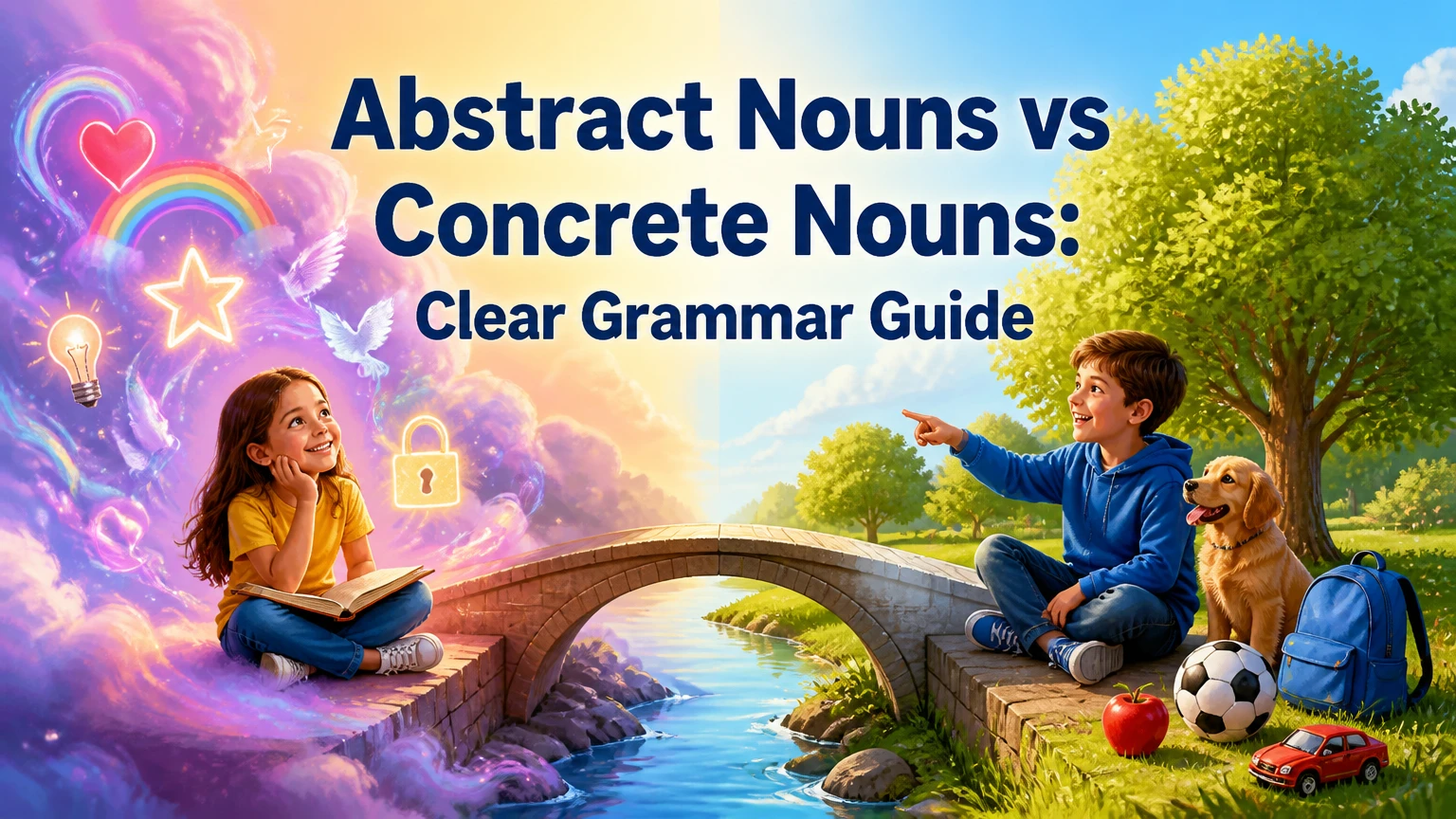
Abstract nouns name ideas, qualities, feelings, states, or processes that cannot be detected directly through the five senses. Concrete nouns name physical people, places, objects, substances, organisms, or phenomena that can be sensed or measured. The distinction concerns what a noun refers to, not whether the noun functions as a subject, object, singular, plural, common, or proper noun.
Key Facts at a Glance
- A concrete noun refers to a physically perceptible or measurable entity, such as river, doctor, music, oxygen, or rain.
- An abstract noun refers to an intangible idea, quality, emotion, condition, relationship, or process, such as justice, patience, fear, poverty, or education.
- Concrete nouns and abstract nouns can both serve as subjects, direct objects, indirect objects, and objects of prepositions.
- Countability is separate from concreteness: apple is concrete and countable, while water is concrete but usually uncountable.
- Many abstract nouns form from adjectives or verbs with suffixes such as -ness, -ity, -ment, and -tion, but suffixes provide clues rather than absolute rules.
- Context can change classification: light may mean physical illumination or a conceptual quality, while experience may mean an event, knowledge, or a particular occurrence.
What Is the Difference Between Abstract and Concrete Nouns?
Concrete nouns refer to entities with a physical presence, while abstract nouns refer to entities understood through thought, interpretation, emotion, or social agreement. A stone can be touched, and thunder can be heard; honesty, democracy, and anxiety cannot be sensed directly as objects.
The sensory test is useful, but it requires precision. A person does not need to see an entity at every moment for its noun to be concrete. Air, bacteria, gravity, and radio waves may be invisible, yet they refer to physical phenomena that can be detected, measured, or scientifically investigated. By contrast, a person can see evidence of anger without seeing anger itself.
| Criterion | Concrete noun | Abstract noun | Example |
|---|---|---|---|
| Referent | Physical entity or phenomenon | Idea, quality, emotion, state, or process | chair versus comfort |
| Direct sensory access | Seen, heard, smelled, tasted, or touched | Not directly sensed as the named concept | perfume versus beauty |
| Scientific measurement | Often measurable as matter, energy, or location | Usually measured through effects, opinions, or social indicators | temperature versus well-being |
| Typical writing effect | Adds observable detail | Expresses interpretation or general meaning | wet pavement versus sadness |
| Countability | May be countable or mass | May be countable or uncountable | three books, much advice |
What Are Concrete Nouns?
Concrete nouns name physical people, animals, places, objects, substances, and perceptible events. Examples include teacher, sparrow, kitchen, laptop, coffee, smoke, music, and earthquake.
Concrete does not mean “solid.” Water, steam, wind, noise, and heat are concrete when they refer to physical substances or phenomena. A concrete noun can also name something too small, distant, or dangerous to touch. Virus, oxygen, sunlight, and electricity remain concrete because they have physical referents.
Concrete nouns commonly provide the observable evidence in a sentence:
- The child placed a blue cup on the wooden table.
- Rain struck the window for two hours.
- The violin produced a low note.
- A bacterium grew in the laboratory dish.
Categories of Concrete Nouns
| Category | Concrete examples | Typical physical basis | Sentence example |
|---|---|---|---|
| People and animals | nurse, horse, infant, crow | Living bodies | The nurse opened the door. |
| Places and structures | school, bridge, Paris, garden | Geographic or built locations | The bridge crossed the river. |
| Objects | key, phone, hammer, book | Manufactured or natural things | The key fell beneath the sofa. |
| Substances | salt, air, oil, oxygen | Matter with physical properties | The tank contained oxygen. |
| Sensory phenomena | sound, smell, light, heat | Energy or detectable stimulus | The smell filled the room. |
| Events | concert, collision, storm, earthquake | Physical occurrences in time | The storm damaged the roof. |
What Are Abstract Nouns?
Abstract nouns name nonphysical concepts, qualities, emotions, relationships, states, systems, and processes. Examples include kindness, freedom, jealousy, knowledge, childhood, ownership, and democracy.
Abstract nouns can have real consequences without being physical objects. Poverty can affect housing, law can determine conduct, and fear can change behavior. The consequences may be observable, but the abstract noun names the underlying condition, interpretation, or idea rather than one visible object.
Abstract nouns allow writers to discuss general meaning:
- Justice requires consistent rules.
- Her confidence improved after practice.
- The committee debated ownership.
- Education changes access to employment.
- Their friendship lasted for decades.
Categories of Abstract Nouns
| Category | Abstract examples | What the noun represents | Sentence example |
|---|---|---|---|
| Emotions | love, anger, grief, anxiety | Internal feeling or emotional condition | Anxiety delayed his decision. |
| Qualities | honesty, beauty, patience, courage | Attribute or degree of a characteristic | Patience improved her teaching. |
| States | freedom, poverty, childhood, silence | Condition or period of existence | Childhood shaped his interests. |
| Ideas and theories | mathematics, capitalism, truth, equality | Mental, philosophical, or explanatory framework | Equality was the central demand. |
| Relationships | friendship, leadership, ownership, citizenship | Social connection or status | Citizenship carries legal rights. |
| Processes | education, communication, growth, selection | Activity or change viewed as a concept | Communication prevented confusion. |
How Can You Identify an Abstract or Concrete Noun?
Use a five-step test: identify the noun, determine its referent, apply the sensory test, separate evidence from concept, and check the sentence context. The method usually takes under one minute per noun once practiced.
- Locate the noun. In “The dog showed remarkable loyalty,” identify dog and loyalty.
- Ask what the noun names. Dog names an animal; loyalty names a quality.
- Apply the direct-sensation test. A person can see and touch the dog, but cannot touch loyalty itself.
- Separate the concept from its evidence. Wagging, waiting, or protecting may demonstrate loyalty, but those actions do not make loyalty concrete.
- Check meaning in context. In “The light entered the room,” light is physical. In “She gave him a light of hope,” the meaning is figurative and abstract.
A noun can be grammatically important without being concrete. In “Justice changed the law,” justice is the subject, and law is the object, but both remain abstract.
Which Words Commonly Form Abstract Nouns?
Common abstract-noun suffixes include -ness, -ity, -ment, -tion, -ship, -hood, and -ism. Suffixes help learners predict meaning and spelling, but English has irregular forms, and some words with these endings refer to concrete entities.
| Base word | Abstract noun | Suffix or pattern | Example |
|---|---|---|---|
| kind | kindness | -ness | Her kindness helped the visitor. |
| equal | equality | -ity | The law protects equality. |
| excite | excitement | -ment | The crowd expressed excitement. |
| educate | education | -tion | Education requires sustained effort. |
| friend | friendship | -ship | Their friendship survived distance. |
| child | childhood | -hood | His childhood included frequent travel. |
| realist | realism | -ism | The novel uses social realism. |
The suffix rule has limits. Government can name an abstract system or a concrete group of officials, while neighborhood can refer to a physical area or the social community within it. Classification depends on the noun’s meaning in the sentence.
Are Abstract Nouns Countable or Uncountable?
Abstract nouns can be countable or uncountable, so concreteness does not determine pluralization. Idea, fear, and argument are often countable, while advice, information, and knowledge are normally uncountable in standard English.
| Abstract noun | Usual grammar | Correct example | Common error |
|---|---|---|---|
| advice | Uncountable | two pieces of advice | two advices |
| information | Uncountable | useful information | useful informations |
| idea | Countable | several ideas | much idea |
| fear | Both, depending on meaning | fear of failure, specific fears | automatic singular |
| experience | Both, depending on meaning | work experience, two experiences | treating meanings as identical |
| beauty | Usually uncountable for quality | natural beauty | three beauties, unless people or works are meant |
Use a counterphrase with uncountable abstract nouns: a piece of advice, two items of information, or a great deal of knowledge. A plural form can become possible when the meaning changes, as in fears meaning separate anxieties or experiences meaning separate events.
How Do Abstract and Concrete Nouns Work in Sentences?
Abstract and concrete nouns occupy the same grammatical positions, but they contribute different kinds of meaning. A concrete noun gives the reader an observable anchor, whereas an abstract noun states an interpretation, value, condition, or generalization.
| Grammatical role | Concrete example | Abstract example | Function |
|---|---|---|---|
| Subject | The engine stalled. | Patience matters. | Names what performs or controls the action |
| Direct object | She opened the gate. | They discussed justice. | Receives the action |
| Object of preposition | He stood beside the river. | She acted with courage. | Completes a prepositional phrase |
| Possessive noun | The teacher’s desk was full. | The company’s policy changed. | Shows ownership or association |
| Complement | Maria is a doctor. | Maria is a leader. | Identifies or describes the subject |
The distinction does not determine grammatical role. Writers should choose the noun type according to the information they need to express.
Why Do Concrete Nouns Usually Improve Clarity?
Concrete nouns improve clarity by giving readers observable people, objects, places, measurements, or actions. The U.S. National Archives’ Plain Language guidance recommends using “specific, concrete words” because readers process precise referents more easily than broad administrative abstractions.
Compare these sentences:
- Abstract: The implementation of improvements produced an enhancement in performance.
- Concrete: The engineering team reduced page-loading time from 4.2 seconds to 1.8 seconds.
The second sentence identifies an actor, action, measurement, and result. Concrete nouns do not automatically make prose better, however. A legal contract needs terms such as liability, jurisdiction, and ownership because replacing them with physical descriptions could remove necessary precision.
A practical rule is to pair an abstract noun with concrete evidence:
- The company improved safety by installing guardrails, adding night lighting, and recording zero injuries over six months.
- The student gained confidence after delivering four presentations and answering twelve questions.
When Should Writers Use Abstract Nouns?
Writers should use abstract nouns when the subject involves a general principle, legal status, emotion, theory, quality, or process that cannot be reduced to one physical object. Academic, legal, scientific, and policy writing often requires abstract vocabulary to name complex relationships accurately.
Abstract nouns become difficult when they hide the actor or action. This problem often appears through nominalization, which turns a verb or adjective into a noun:
- The committee conducted an evaluation of the proposal.
- The committee evaluated the proposal.
The second version names the actor and uses the stronger verb evaluated. Nominalization is not always wrong. The evaluation took three days is useful when the process itself is the topic, but conducted an evaluation adds unnecessary distance in many contexts.
How Can You Revise Abstract Writing?
Use a four-part revision sequence:
- Circle abstract nouns that end in -tion, -ment, -ness, or -ity.
- Ask who performed the action.
- Replace unnecessary nominalizations with active verbs.
- Add a concrete example, quantity, place, or observable result.
| Abstract sentence | More concrete revision | Improvement |
|---|---|---|
| The implementation of the policy began in June. | The department implemented the policy in June. | Names the actor |
| There was a reduction in errors. | The update reduced errors by 18%. | Adds measurable result |
| We need clarification of the requirement. | Please clarify the requirement. | Uses a direct verb |
| Her sadness was visible. | She lowered her head and stopped speaking. | Shows physical evidence |
| The organization values sustainability. | The organization cut electricity use by 12%. | Defines the claimed value |
“Show, don’t tell” does not mean eliminating every abstract noun. It means supporting an abstract interpretation with concrete evidence when the reader needs proof.
What Are the Most Difficult Edge Cases?
The most difficult cases involve invisible physical entities, figurative meanings, events, collective nouns, and words whose classification changes by context. A sensory test should be applied to the meaning in the sentence, not to the spelling or dictionary entry alone.
| Word | Concrete use | Abstract use | Classification clue |
|---|---|---|---|
| light | Light entered through the window. | Her advice gave him light. | Physical illumination versus hope or guidance |
| space | The spacecraft entered space. | Give me space to think. | Physical region versus personal freedom |
| communication | The communication arrived by satellite. | Communication prevents conflict. | Message or signal versus general process |
| experience | We recorded two experiences. | She has experience in nursing. | Separate events versus acquired knowledge |
| school | The school has twelve classrooms. | School shaped his worldview. | Building versus educational institution |
| time | The timer measures time. | Time heals the wound. | Measured duration versus conceptual force |
| government | The government issued a statement. | Government requires public consent. | Institution or system, usually abstract in the second use |
Are Events Concrete or Abstract?
Events can be concrete when they refer to physical occurrences, such as collision, storm, concert, or earthquake. Events can be abstract when a word names a process or period conceptually, such as education, development, childhood, or employment.
The boundary is semantic rather than chronological. Every event happens in the physical world, but English nouns may name either the observable occurrence or the broader process, institution, or experience associated with it.
Are Collective Nouns Concrete?
Collective nouns are not automatically abstract. Team, crowd, flock, and committee can refer to groups of real people or animals, making them concrete in many contexts. The grammatical category “collective noun” describes grouping, while “concrete” or “abstract” describes the type of referent.
- The flock crossed the field. Concrete group of birds.
- The committee approved the budget. Concrete group of people as an institution.
- The committee demonstrated accountability. Accountability is abstract.
What Mistakes Do Learners Make?
Learners most often confuse physical evidence with an intangible concept, treat all suffix forms as abstract, and pluralize uncountable nouns. Correcting the underlying meaning is more reliable than memorizing isolated word lists.
| Mistake | Incorrect reasoning | Correct analysis | Repair |
|---|---|---|---|
| Anger is concrete because shouting is visible | Evidence equals emotion | Shouting is observable; anger is abstract | Name the evidence separately |
| Equal is used as a noun | Adjective and noun forms are interchangeable | Equal is usually an adjective; equality is the noun | “They demanded equality” |
| Advice receives a plural -s | All nouns pluralize regularly | Advice is normally uncountable | “Two pieces of advice” |
| Government is always abstract | The word has one fixed category | Meaning changes with context | Analyze the sentence |
| Invisible means abstract | The eyes cannot detect it | Physical measurability can establish concreteness | Oxygen is concrete |
| Concrete means countable | Physical things must take numbers | Mass nouns can be concrete | Water is concrete and usually uncountable |
How Long Does It Take to Learn the Distinction?
Most learners can understand the basic sensory contrast in 15-30 minutes, while reliable performance with context, countability, and nominalization usually requires several practice sessions over 1-2 weeks. Those are typical learning ranges, not guarantees, because first-language background and vocabulary size affect accuracy.
A free practice plan can use 20 sentences per day:
- Days 1-2: Label obvious examples such as chair, river, love, and honesty.
- Days 3-4: Practice invisible physical nouns such as air, sound, electricity, and bacteria.
- Days 5-6: Analyze context-dependent words such as light, school, time, and experience.
- Days 7-10: Revise abstract nominalizations into active sentences and add concrete evidence.
Grammar references from Purdue Online Writing Lab and the British Council can support terminology and exercises. Automated tools such as Grammarly or Hemingway Editor may flag vague wording, but neither tool can determine every noun classification correctly from context.
How Should Different Writers Balance Abstract and Concrete Nouns?
Creative writers generally need concrete sensory detail, while academic, legal, policy, and business writers need abstract terms supported by definitions, examples, or measurements. No universal 70/30 ratio governs good prose; the appropriate balance depends on audience, genre, and the writer’s purpose.
| Writing situation | Abstract nouns needed | Concrete support | Recommended practice |
|---|---|---|---|
| Fiction scene | Emotion, memory, conflict | Objects, gestures, setting, dialogue | Show the emotion through selected details |
| Academic essay | Theory, evidence, causation, validity | Data, quotations, cases, methods | Define key abstractions before using them |
| Legal document | Liability, jurisdiction, consent, ownership | Parties, dates, assets, procedures | Pair broad terms with operative definitions |
| Business report | Revenue, efficiency, risk, strategy | Costs, rates, deadlines, outputs | Attach metrics and responsible teams |
| ESL writing | Basic concepts and relationships | Familiar objects and actions | Build word families and sentence pairs |
The strongest prose moves between levels. Freedom expresses the principle, while a locked gate, a permit requirement, or a person leaving prison supplies evidence that readers can imagine and evaluate.
How Do Alternatives to Abstract Nouns Improve a Sentence?
The best alternative is often a specific verb, an observable noun, or a short clause rather than a forced concrete synonym. Writers should not replace a precise abstract term merely to make a sentence sound simpler.
- Replace make an improvement with improve.
- Replace provide assistance with assist or help.
- Replace conduct an investigation with investigate.
- Replace a lack of compliance with the contractor ignored the rule, when that is the intended meaning.
- Keep compliance when the legal or regulatory status itself matters.
A useful test asks whether the abstract noun carries information that a concrete description would lose. Jurisdiction cannot always be replaced by the court’s area because the legal term includes authority, territory, and governing law. Precision comes before sensory vividness.
Frequently Asked Questions
Is “love” an abstract noun or a concrete noun?
Love is an abstract noun because it names an emotion, relationship, or valued condition rather than a physical object. A hug, letter, photograph, or act of care can provide concrete evidence of love, but none of those physical items is identical to the feeling or relationship named by love.
Is “dream” abstract or concrete?
Dream can be abstract or concrete by meaning. A dream experienced during sleep is an intangible mental event, while dream meaning an aspiration is also abstract. In “I had three dreams,” the noun is countable, but countability does not make it concrete.
Is “music” a concrete noun?
Music is generally concrete when it means audible sound because listeners can hear it and recording equipment can capture it. Music can also refer to an abstract art form or system of organization in theoretical discussion. The sentence’s meaning determines the classification.
Is “friendship” an abstract noun?
Friendship is an abstract noun because it names a social relationship rather than a physical object. Friends, messages, shared activities, and photographs are concrete manifestations of friendship, but the relationship itself cannot be touched or placed in a container.
Is “history” abstract or concrete?
History is usually abstract when it means the study, record, or interpretation of past events. A physical history book is concrete, and a particular historical event may be concrete as an occurrence, but the broad concept history is abstract.
Can one noun be both abstract and concrete?
Yes. A noun can have concrete and abstract senses in different contexts. School may name a physical building in “The school has a new roof” or an educational institution in “School shaped her ambitions.” Classification follows the intended referent, not the word alone.
The Bottom Line
Abstract nouns vs concrete nouns differ by meaning: abstract nouns name intangible ideas, emotions, qualities, states, relationships, and processes, while concrete nouns name physically perceptible or measurable entities. Use the sensory test as a starting point, check context for edge cases, separate countability from noun type, and support necessary abstractions with specific actions, examples, and measurable evidence.