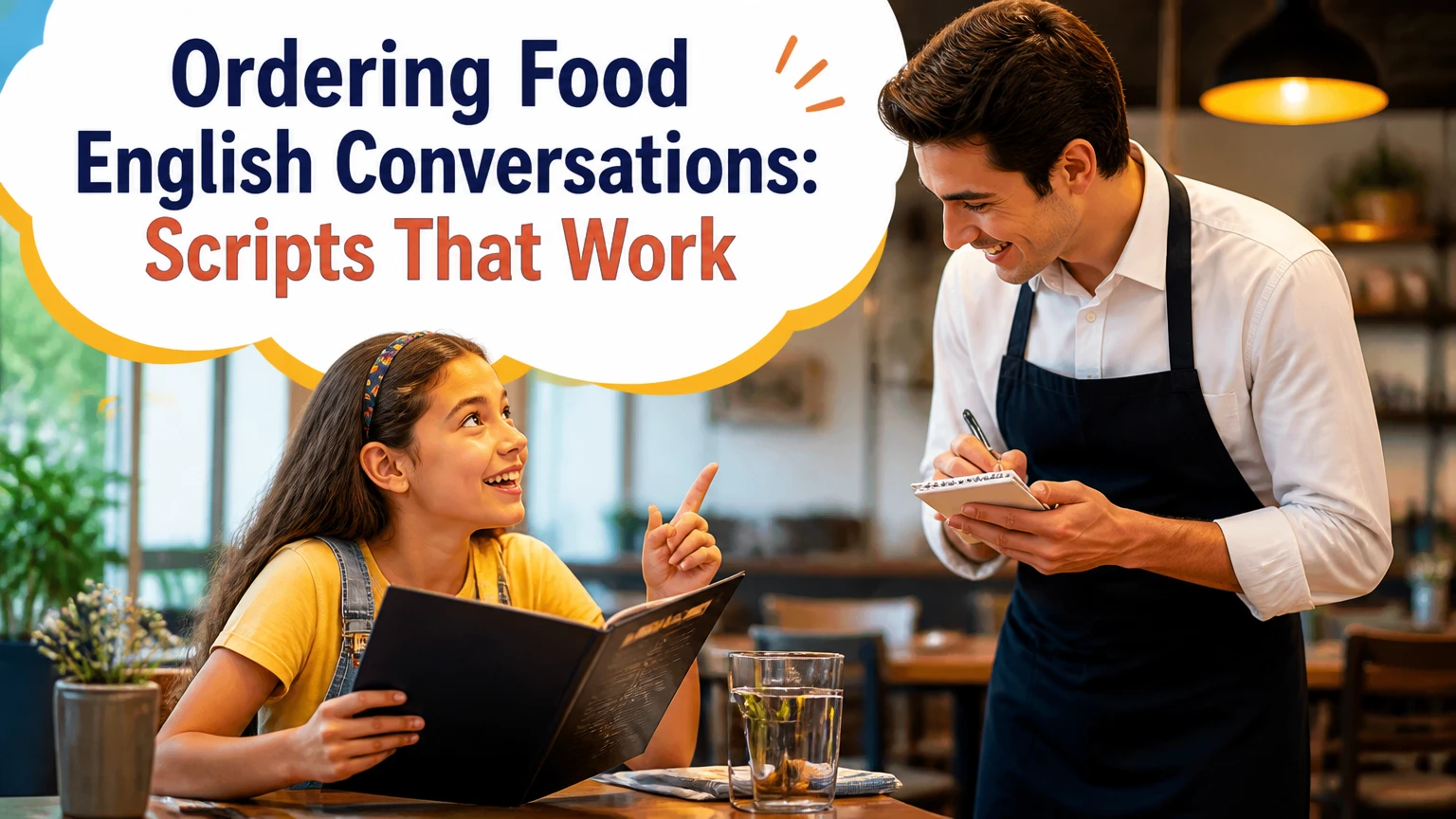
Ordering food in English is a structured conversation in which a customer chooses food, answers follow-up questions, requests changes, confirms the order, and pays. The most reliable sequence is greeting, selection, customization, confirmation, and payment. Polite requests such as “I’ll have,” “Could I get,” and “Can we have” work in most English-speaking restaurants.
Key Facts at a Glance
- “I’ll have the chicken sandwich, please” is a natural standard restaurant order.
- “For here” means eating at the establishment; “to go” and “takeaway” mean taking food away.
- A serious allergy should be stated directly: “I have a peanut allergy. Is this dish safe for me?”
- “How would you like your steak cooked?” normally requires a doneness answer such as “medium rare.”
- “The bill” is common in the UK, while “the check” is common in the United States.
- Typical preparation takes 2-5 minutes at fast-food restaurants, 5-15 minutes at cafés, and 15-30 minutes for many sit-down meals.
What Does Ordering Food in English Involve?
Ordering food in English involves more than naming a dish. Customers also communicate quantity, size, location, dietary requirements, substitutions, cooking preferences, payment arrangements, and whether food is for immediate consumption or takeaway.
The interaction usually follows five stages:
- Initiation: Say hello, state your party size, or identify your order type.
- Selection: Choose food and drinks from a menu or display.
- Modification: Request a size, side, topping, temperature, or ingredient change.
- Confirmation: Listen while the employee repeats the order and correct errors.
- Payment: Pay, request a receipt, divide the bill, and handle any tip.
A useful ordering sentence contains four parts: quantity + item + modification + politeness marker. For example: “Could I get two chicken tacos without cheese, please?” The quantity prevents ambiguity, the item identifies the product, the modification changes the order, and “please” maintains a polite tone.
Which phrases make a food order polite and clear?
The safest phrases are short, direct, and courteous. “I want a burger” is grammatically correct, but “I’ll have a burger, please” sounds more natural in a restaurant. “Give me the menu” sounds abrupt; “Could we see the menu, please?” is more appropriate.
| Purpose | Natural phrase | Less suitable phrase |
|---|---|---|
| Order a meal | “I’ll have the grilled salmon, please.” | “Give me the salmon.” |
| Request an item | “Could I get a glass of water?” | “I want water.” |
| Ask for advice | “What do you recommend?” | “What is best?” |
| Request time | “Could we have a few more minutes?” | “Wait.” |
| Ask about cost | “How much is the lunch special?” | “Price?” |
| Finish ordering | “That’s all, thank you.” | “Nothing else.” |
“I’ll have” describes your choice. “Could I get” makes a request. “I’d like” is polite and useful in formal or unfamiliar settings. “Can I have” is common and acceptable, especially in cafés and counter-service restaurants.
How Does a Food Order Move From Greeting to Payment?
A complete restaurant order normally takes 2-5 minutes to communicate, although waiting time depends on the queue, menu complexity, and service style. The customer succeeds when the employee can repeat every item, quantity, modification, and dining location without guessing.
Step 1: State your party size or order type
At a sit-down restaurant, say:
- “Hi, a table for two, please.”
- “There are four of us.”
- “We have a reservation under Patel.”
- “Could we sit outside, if possible?”
At a counter, identify the eating arrangement:
- “One coffee for here, please.”
- “This order is to go.”
- “Can I place a pickup order for Jordan?”
- “I’m here to collect an online order.”
“Dine-in” and “for here” are widely understood in North America. “Takeaway” is especially common in the UK, Ireland, Australia, and New Zealand. “To go” is standard in the United States and Canada.
Step 2: Order drinks or ask for time
A server may ask, “Can I start you off with something to drink?” Suitable replies include:
- “Still water, please.”
- “Could we have two glasses of tap water?”
- “I’ll have an iced tea with lemon.”
- “We’re still deciding. Could we have five more minutes?”
- “Could you tell us about the non-alcoholic drinks?”
If you want tap water, ask for “tap water.” If you want bottled water, say “a bottle of still water” or “a bottle of sparkling water.” In some countries, bottled water costs extra, while tap water may be free or unavailable without a request.
Step 3: Name the main items
Read the menu name accurately, then add the quantity:
- “I’ll have the seafood pasta.”
- “Could I get two classic cheeseburgers?”
- “We’d like one vegetable curry and one rice bowl.”
- “I’ll take the soup of the day.”
If the employee asks, “What can I get for you?” begin with the item rather than a long explanation. Add modifications afterward so the order remains easy to follow.
Step 4: Answer size, side, and menu questions
Common follow-up questions include “What size?”, “Would you like fries or a salad?”, “Is that a meal?”, and “Do you want to make it a combo?” Answer with the exact option:
- “Medium, please.”
- “The large meal, but no drink.”
- “Fries, please.”
- “Could I substitute the fries for a side salad?”
- “No combo, thanks.”
- “Can I get the sauce on the side?”
A substitution may cost extra. Ask, “Is there an additional charge?” before confirming when the menu does not state the price.
Step 5: Confirm the complete order
Listen for the employee’s repetition. Correct the record immediately:
- “Yes, that’s correct.”
- “Actually, the pasta is for me, and the burger is for my friend.”
- “Sorry, I ordered sparkling water, not still water.”
- “Could you repeat the last item, please?”
A practical rule is to check quantity, item, modification, and destination. Destination matters when several people order together: “The salad is for the person at the window seat.”
How Do Café and Counter Orders Differ?
Café and counter orders are shorter because the menu, price, and payment point are usually visible before the conversation begins. The customer normally orders first, pays immediately, receives a number or name reference, and waits for collection.
| Setting | Typical order time | Useful opening | Collection language |
|---|---|---|---|
| Coffee shop | 30-90 seconds | “Could I get a medium latte?” | “Is this for here or to go?” |
| Fast-casual counter | 1-3 minutes | “I’ll have the chicken bowl.” | “Your number is 48.” |
| Food truck | 1-4 minutes | “Can I get two tacos?” | “We’ll call your name.” |
| Bakery | 30-120 seconds | “Could I have four croissants?” | “Could you box those, please?” |
| Buffet | 1-2 minutes at checkout | “Is the price per person?” | “Can I pay by card?” |
At a café, specify temperature and milk when relevant: “A small decaf cappuccino with oat milk, please.” For an iced drink, say “iced latte,” not merely “cold latte,” because the menu may distinguish iced, chilled, and blended drinks.
How Do Takeaway, Phone, and App Orders Work?
Takeaway and delivery orders require more identifying information than a table order. A telephone customer usually gives a name, phone number, address, order details, payment method, and delivery instructions, while an app records much of this information through form fields.
| Order method | Information usually required | Main communication risk | Best solution |
|---|---|---|---|
| Telephone delivery | Name, address, phone, items, payment | Misheard numbers | Repeat every digit and street name |
| Telephone pickup | Name, items, pickup time | Wrong collection time | Ask, “When will it be ready?” |
| Restaurant website | Address, items, modifiers, payment | Hidden substitutions | Review the final basket |
| Delivery app | Account, location, items, instructions | Missing notes or fees | Check total and estimated arrival |
| Counter takeaway | Items, sizes, destination | Dine-in confusion | Say “to go” at the start |
For spelling, use a clear phrase: “That’s Nguyen, N-G-U-Y-E-N.” For an address, give the number first, then the street: “42 King Street, apartment 6B.” Confirm the expected arrival time by asking, “What is the estimated delivery time?”
A useful phone script is:
“Hello, I’d like to place a pickup order. Could I get one large margherita pizza, one garlic bread, and two bottles of water? The name is Elena, E-L-E-N-A. When will it be ready?”
Written app notes should be specific but cannot guarantee that a kitchen will meet a request. “Please leave at the side door. Do not ring the bell” is clearer than “special delivery.”
How Should You Explain Allergies and Dietary Needs?
State a serious allergy before ordering and ask whether the kitchen can prevent cross-contact. “I don’t like nuts” communicates preference, while “I have a nut allergy” communicates a safety condition that requires staff attention.
Use these distinctions:
- Allergy: “I have a severe shellfish allergy.”
- Intolerance: “I’m lactose intolerant.”
- Preference: “I don’t eat mushrooms.”
- Diet: “I’m vegetarian.”
- Religious requirement: “Does this contain pork?” or “Is the chicken halal?”
- Ingredient avoidance: “Does this contain gluten?”
Ask targeted questions:
- “Does the sauce contain peanuts?”
- “Is the broth made with meat?”
- “Is this cooked in the same oil as shellfish?”
- “Can the kitchen prepare this without dairy?”
- “Could you check with the chef?”
Do not assume “vegetarian,” “vegan,” “gluten-free,” “halal,” or “kosher” guarantees the absence of every unwanted ingredient. The U.S. Food and Drug Administration identifies nine major food allergens in the United States, including sesame, but restaurant procedures and legal labeling requirements differ from packaged-food rules. A severe allergy requires the customer to assess whether the establishment can safely accommodate it.
How Do You State Cooking Preferences?
Cooking preferences describe the final state of certain foods, especially beef, eggs, and sometimes fish. When a server asks how a steak should be cooked, answer with a recognized doneness term rather than “grilled” or “fried.”
| Food | Common options | Example response |
|---|---|---|
| Steak | Rare, medium rare, medium, medium well, well done | “Medium rare, please.” |
| Burger | Medium, well done, restaurant policy dependent | “Well done, please.” |
| Eggs | Scrambled, fried, poached, over easy | “Two eggs over easy.” |
| Toast | Light, medium, dark | “Lightly toasted, please.” |
| Coffee | Regular, decaf, half-caf | “A decaf Americano, please.” |
Descriptions vary by kitchen, so the terms are not laboratory measurements. “Medium rare” generally means a warm red center, while “well done” means cooked through with no red center. Some jurisdictions or restaurants cook ground beef only to a fixed internal standard, regardless of a requested preference.
“Rare” is not the same as raw. “Over easy” means a fried egg flipped briefly, with a runny yolk; “over hard” means the yolk is fully cooked.
What Should You Say About the Bill and Tip?
Ask for the bill or check when you are ready to pay, then verify the subtotal, tax, service charge, and final amount. “Could we have the bill, please?” is common in the UK, while “Could we get the check, please?” is common in the United States.
| Payment situation | Natural phrase | Practical note |
|---|---|---|
| Request bill | “Could we get the check, please?” | US usage |
| Request bill | “Could we have the bill, please?” | UK usage |
| Pay together | “We’ll pay together.” | One transaction |
| Split evenly | “Could we split it evenly?” | Equal shares |
| Separate items | “Can we pay separately?” | Confirm restaurant policy |
| Need receipt | “Could I have a receipt?” | Paper or digital |
| Cash tip | “Keep the change.” | Only when change is intended as gratuity |
Taxes and service charges vary by country, state, and restaurant. In the United States, a service charge is not always the same as a voluntary tip, so check the bill before adding money. Tipping norms also vary: sit-down service commonly receives a percentage in the US and Canada, while many countries use service charges or do not expect a percentage tip.
If the payment terminal presents several percentages, you can ask, “Is a service charge already included?” At counter service, a tip prompt is a request, not proof that a particular percentage is mandatory.
Which Ordering Method Fits Your Situation?
The best ordering method depends on the amount of support you need, the speed of the environment, and whether customization matters. Sit-down service allows the most questions, while a drive-thru rewards concise speech and a delivery app reduces spoken interaction.
| Method | Typical interaction | Typical wait | Best use | Main limitation |
|---|---|---|---|---|
| Sit-down restaurant | 5-15 exchanges | 15-30 minutes | Questions and customization | More vocabulary and billing steps |
| Counter service | 3-8 exchanges | 5-15 minutes | Visual menu support | Faster decision pressure |
| Drive-thru | 4-10 exchanges | 2-8 minutes | Fast, familiar orders | Noise and unclear audio |
| Telephone | 8-15 exchanges | 20-60 minutes | Delivery or pickup | Spelling and number errors |
| Delivery app | 0-3 spoken exchanges | 25-75 minutes | Written customization | Fees and unavailable items |
Choose counter service if you are a beginner who benefits from pictures and menu boards. Choose sit-down service if you need to ask about allergens or preparation. Choose an app when spelling and listening are difficult, but review every modifier because a digital interface can hide substitutions or added charges.
Drive-thrus are not automatically easier. The speaker may distort numbers, employee speech, and item names, so repeat the order at the payment window: “Could you confirm that this is the medium meal with no pickles?”
Which Food-Ordering Words Cause Confusion?
Restaurant vocabulary changes by region and context. Knowing the common alternatives prevents a learner from treating one word as universally correct.
| Meaning | United States and Canada | United Kingdom and Ireland | Example |
|---|---|---|---|
| Main course | Entrée | Main course | “The entrée comes with rice.” |
| Side dish | Side | Side dish | “Can I add a side salad?” |
| Takeaway food | To go | Takeaway | “Two coffees to go.” |
| Bill | Check | Bill | “Could we have the bill?” |
| Reservation | Reservation | Booking or reservation | “I have a booking at seven.” |
| Fries | French fries | Chips | “Fish and chips” uses chips for fries |
| Chips | Potato chips | Crisps | “A bag of crisps” in the UK |
“Entrée” is a particularly important regional difference. In the United States, it usually means the main dish; in French and some other contexts, entrée means a starter. Follow the restaurant’s menu labels rather than translating word for word.
What Can You Say When Communication Breaks Down?
A communication problem should be repaired with a specific request, not a general apology. Ask for repetition, slower speech, written information, or a visual reference, depending on the problem.
Use these recovery phrases:
- “I’m sorry, could you say that more slowly?”
- “Could you repeat the price, please?”
- “Did you say fifteen or fifty?”
- “Could you point to it on the menu?”
- “Could you write the address down?”
- “I didn’t catch the last item.”
- “Could you confirm whether this contains dairy?”
If the wrong dish arrives, do not silently accept it and hope the kitchen notices. Say, “Excuse me, I ordered the grilled chicken, but this appears to be the fish.” If an order is unavailable, ask for an alternative: “What would be a similar substitute at the same price?”
If you need to change an order, act quickly: “I’m sorry, is it too late to change the soup to the salad?” Once cooking has begun, a restaurant may refuse or charge for the original item.
A practical safety rule comes from the U.S. Department of Agriculture’s food-safety guidance: “When in doubt, throw it out.” The same conservative logic applies to severe allergy uncertainty: if staff cannot answer clearly, select a safer alternative or do not order the item.
How Can You Practice at A1, B1, and C1 Levels?
Beginners should memorize one complete sentence and use the menu as visual support. Intermediate learners should practice modifications, clarification, and payment. Advanced learners should practice recommendations, substitutions, complaints, and nuanced questions about preparation.
| Level | Skill target | Practice sentence | Suitable setting |
|---|---|---|---|
| A1-A2 | Name an item and quantity | “I’ll have this one, please.” | Bakery or café |
| B1-B2 | Add modifications | “Could I get the sauce on the side?” | Counter restaurant |
| B1-B2 | Repair misunderstanding | “Did you mean still or sparkling?” | Sit-down restaurant |
| C1-C2 | Ask detailed questions | “What would pair well with the catch of the day?” | Full-service restaurant |
| C1-C2 | Handle billing | “Could you explain the service charge?” | Restaurant or hotel |
Practice aloud with a five-line role-play:
- Employee: “What can I get for you?”
- Customer: “I’ll have the chicken wrap, please.”
- Employee: “Would you like fries or salad?”
- Customer: “A salad, please, with the dressing on the side.”
- Employee: “Anything to drink?” Customer: “Sparkling water, please.”
Record yourself saying quantities and prices. Numbers create more practical errors than food nouns, especially during phone orders and drive-thru conversations. Practice pairs such as 15 and 50, 16 and 60, and 18 and 80.
Common Expert Rules for Natural Conversations
Put the important restriction early. Say “I have a severe peanut allergy” before discussing the dish, not after ordering it. Staff can then decide whether the item is appropriate.
Do not over-apologize for normal questions. “Could you explain what comes with the meal?” is sufficient. Repeating “Sorry” before every sentence can make the interaction harder to follow.
Confirm modifications, not obvious menu words. The highest-risk errors usually involve “no onion,” “extra sauce,” size, side choice, and allergy information. Repeat those details before payment.
Use one request per sentence in noisy settings. “A medium coffee, please. Oat milk. To go.” Short units are easier to hear than one long sentence.
Treat menu language as evidence, not a guarantee. A label such as “vegetarian” may describe ingredients but not shared cooking equipment. Ask the kitchen when cross-contact matters.
Ordering Food English Conversations: FAQ
Is “I want” rude when ordering food?
“I want” is grammatically correct but can sound direct, particularly with “I want a menu” or “I want water.” Use “I’ll have,” “I’d like,” or “Could I get” for a more natural restaurant tone. Context, facial expression, and “please” also affect politeness, so “I want the same thing, please” may be perfectly acceptable among familiar speakers.
How do I order food if I do not know the menu item’s name?
Point to the item and say, “Could I have this one, please?” You can also describe its position: “The sandwich in the second picture.” Ask, “What is this made with?” before ordering if ingredients matter. A photo, written menu, or translation app can reduce pronunciation problems, but confirm the final item verbally.
How do I ask whether a restaurant accepts cards?
Ask before ordering or before the bill arrives: “Do you accept credit cards?” You can ask about contactless payment with “Can I pay by contactless?” For a group bill, ask, “Can we split the payment between two cards?” Some small businesses require a minimum card purchase or accept cash only.
What does “86’d” mean in a restaurant?
“86’d” is restaurant slang meaning an item is unavailable or has been removed from service. Customers usually hear the simpler phrase “We’re out of the salmon” or “The soup is no longer available.” Reply with “What would you recommend instead?” or “Could I substitute the chicken?”
How do I complain politely about food?
Describe the problem and request a solution without insulting the staff. Say, “Excuse me, this dish is cold. Could you please heat it up?” or “I ordered this without cheese, but cheese was added.” If the issue concerns safety, stop eating and state the ingredient clearly before asking for a manager.
What is the fastest way to order in English?
Prepare the item, size, modifications, dining location, and payment before speaking. A concise order sounds like: “Medium chicken meal, no onions, fries instead of salad, to go, please.” In a drive-thru, pause after each major detail and repeat the final order when the employee confirms it.
The Bottom Line
Successful ordering food English conversations follow a predictable pattern: greet the employee, choose items, answer size or side questions, state modifications, confirm the order, and pay. Use “I’ll have,” “Could I get,” and “I’d like” for polite requests; state allergies directly; distinguish “for here” from “to go”; and ask for repetition when necessary. With these scripts, ordering food in English becomes a sequence of manageable decisions rather than an improvised conversation.