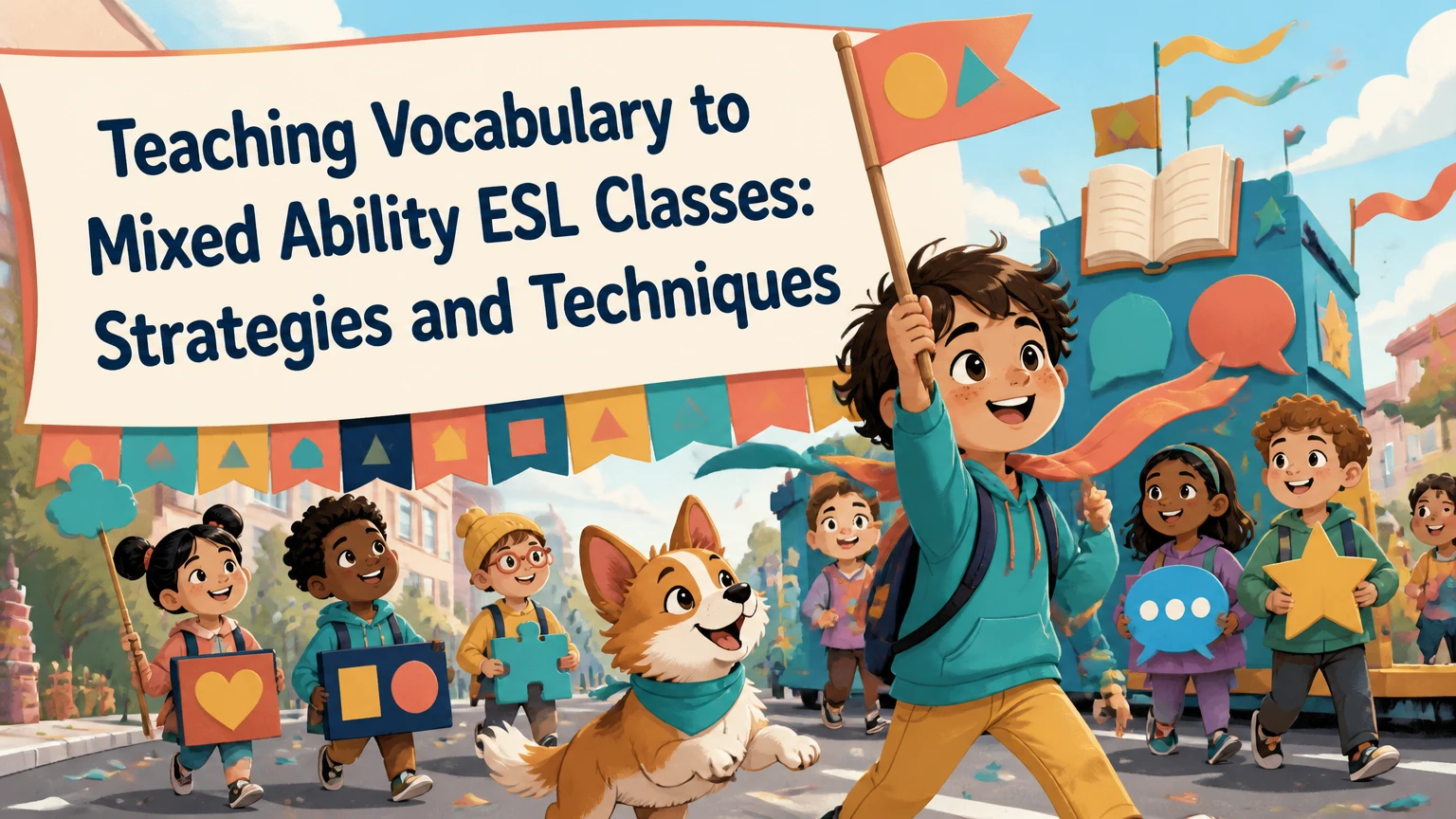
Teaching vocabulary in a mixed-ability ESL classroom involves the strategic presentation of new language to students who possess varying levels of linguistic proficiency, cognitive speed, and prior educational backgrounds. In these diverse environments, educators must introduce lexical items such as ephemeral, ubiquitous, mitigate, resilient, and paradigm while ensuring that both beginners and advanced learners remain engaged and challenged. This pedagogical approach requires a delicate balance of differentiation, scaffolding, and tiered instruction to ensure that every student can internalize and apply new words effectively in their daily communication. By mastering these techniques, teachers can transform a potentially chaotic classroom into a vibrant learning community where students support one another’s growth regardless of their starting point.
The practical application of differentiated vocabulary instruction is essential for modern educators who often face groups containing students at A1 through C1 levels simultaneously. Understanding how to adapt a single lesson to meet these varying needs allows for a more inclusive environment and prevents the common issues of boredom among high-achievers or frustration among struggling learners. This comprehensive guide is designed for TESOL professionals, student teachers, and curriculum developers who seek to refine their ability to manage complexity through organized, evidence-based instructional strategies.
Table of Contents
- Definition and Scope of Mixed-Ability Vocabulary Instruction
- Structural Breakdown of Differentiated Lessons
- Types of Vocabulary for Mixed Ability Groups
- Tiered Instruction Models
- Extensive Vocabulary Examples and Categories
- Usage Rules and Pedagogical Principles
- Common Mistakes and Solutions
- Comprehensive Practice Exercises
- Advanced Topics in Lexical Acquisition
- Frequently Asked Questions (FAQ)
- Conclusion and Final Tips
Definition and Scope of Mixed-Ability Vocabulary Instruction
Mixed-ability vocabulary instruction refers to the methodology used by English as a Second Language (ESL) teachers to facilitate the acquisition of new words within a classroom where students display a wide range of English language competencies. This concept is rooted in the “Zone of Proximal Development” (VPD), which suggests that learning happens most effectively when tasks are neither too easy nor too difficult. In a mixed-ability context, the teacher must identify the “sweet spot” for each learner, often using the same core content but varying the depth of exploration.
The classification of mixed-ability groups often falls into two categories: horizontal and vertical. Horizontal diversity refers to students at the same proficiency level who have different learning styles or interests. Vertical diversity, which is more challenging, refers to students at significantly different levels of proficiency, such as having a student who can barely form a sentence sitting next to one who can write a persuasive essay. Vocabulary instruction in this context focuses on form, meaning, and use (FMU), but the complexity of these three pillars is adjusted according to the learner’s tier.
Functionally, this approach aims to maximize “input” while providing appropriate “output” opportunities. For example, while a beginner might focus on the literal meaning of a word like “run,” an advanced student in the same class might explore its metaphorical uses, such as “running for office” or “running a business.” This allows the class to remain cohesive while meeting individual educational requirements.
Contextually, these strategies are applied in public schools, private language institutes, and university preparation programs. The goal is to move beyond the “one-size-fits-all” textbook approach, which often fails to address the nuances of individual progress. By implementing differentiated vocabulary instruction, teachers ensure that the word-rich environment of the classroom serves as a catalyst for growth for every participant, regardless of their initial baseline.
Structural Breakdown of Differentiated Lessons
To successfully teach vocabulary to mixed-ability classes, a specific lesson structure is required to maintain order and ensure learning outcomes. The structure usually follows a “Global-to-Specific” pattern. This begins with a whole-class introduction to a theme, followed by split-group activities that target specific proficiency levels, and ends with a collaborative review.
The first structural element is the Anchor Topic. This is a central theme or text that provides the context for all vocabulary. For example, if the theme is “The Environment,” all students will learn words related to this topic, but the specific lexemes will vary. The anchor topic ensures that the class feels like a single unit rather than several disconnected groups.
The second element is Tiered Tasking. This involves creating three levels of tasks for the same set of words. Level 1 tasks focus on recognition and basic definitions. Level 2 tasks focus on sentence construction and basic collocations. Level 3 tasks focus on nuance, register, and complex application. This structural flexibility allows the teacher to circulate and support different groups based on their immediate needs.
The third element is the Feedback Loop. In a mixed-ability setting, feedback cannot be uniform. The teacher must provide corrective feedback that is appropriate for the student’s level. For a beginner, correcting a basic spelling error in a new vocabulary word is vital. For an advanced learner, feedback might focus on whether the word chosen was too informal for the given context.
Finally, the Scaffolding Framework provides the necessary support for lower-level students to reach higher goals. This includes tools like sentence frames, bilingual glossaries, and visual aids. For higher-level students, the scaffolding is “faded” or removed to encourage independence and critical thinking. This structural balance is what prevents the classroom from becoming overwhelming for the teacher or the students.
Types of Vocabulary for Mixed Ability Groups
In a mixed-ability classroom, it is helpful to categorize vocabulary into different “Tiers” of utility. This classification system, popularized by Beck, McKeown, and Kucan, helps teachers decide which words to emphasize for which students. Understanding these types allows for more effective lesson planning and resource allocation.
Tier 1: Basic Vocabulary
Tier 1 consists of the most basic words that appear frequently in spoken language. These words rarely require explicit instruction for native speakers but are the foundation for ESL beginners. Examples include book, girl, run, blue, and eat. In a mixed-ability class, these words are the focus for the lowest-level learners, while advanced learners use them as building blocks for more complex structures.
Tier 2: High-Frequency Academic Vocabulary
Tier 2 words are high-utility words that appear across various academic domains. These are the “power words” of the English language. Examples include analyze, contrast, evaluate, and significant. These words are the primary focus for intermediate and advanced learners. They are essential for reading comprehension and formal writing, making them the most valuable category for instruction in mixed-ability settings.
Tier 3: Domain-Specific Vocabulary
Tier 3 words are low-frequency words that are limited to specific fields of study, such as photosynthesis, isotope, or sonnet. These are usually taught within the context of a specific subject like science or literature. In a mixed ESL class, these words are often used as “challenge words” for the most advanced students or taught to everyone if the entire class is studying a specific content area.
Tiered Instruction Models
Tiered instruction is the most effective way to handle mixed abilities. This doesn’t mean writing three different lesson plans; it means writing one plan with three ways to interact with it. The teacher presents the core concept to everyone and then differentiates the “process” and “product.”
The “Must, Should, Could” Model: This is a simple but effective way to organize vocabulary goals. All students must learn the core 5-10 words. Most students should learn the additional 5 related collocations. The advanced students could also learn 3-5 idiomatic expressions or nuances related to those words. This gives everyone a sense of achievement without capping the potential of the high-flyers.
Flexible Grouping: This model involves moving students into different groups depending on the specific vocabulary task. Sometimes groups are “homogeneous” (all the same level) so the teacher can provide targeted support. Other times, groups are “heterogeneous” (mixed levels) to allow for peer-teaching, where advanced students solidify their knowledge by explaining concepts to beginners.
Learning Centers: The teacher sets up different stations around the room. One station might focus on visual matching (for beginners), another on sentence building (intermediate), and a third on debating or writing a critique using the new vocabulary (advanced). Students rotate or stay at the station that matches their current needs.
Extensive Vocabulary Examples and Categories
The following tables provide a comprehensive look at how vocabulary can be categorized and differentiated for mixed-ability instruction. Each table provides at least 20-30 examples to ensure a wide range of options for lesson planning.
Table 1: Adjectives for Describing Personality (Tiered Levels)
This table demonstrates how to take a common theme (personality) and provide vocabulary that ranges from basic to advanced. This allows the teacher to give students words that match their current expressive capabilities.
| Basic (Beginner) | Intermediate | Advanced (C1/C2) |
|---|---|---|
| Happy | Cheerful | Effervescent |
| Sad | Miserable | Melancholic |
| Angry | Irritated | Exasperated |
| Nice | Friendly | Affable |
| Mean | Unkind | Malevolent |
| Smart | Intelligent | Astute |
| Lazy | Unmotivated | Indolent |
| Brave | Courageous | Intrepid |
| Shy | Timid | Diffident |
| Funny | Humorous | Witty |
| Hard-working | Diligent | Assiduous |
| Quiet | Reserved | Reticent |
| Talkative | Chatty | Loquacious |
| Stubborn | Inflexible | Obdurate |
| Careful | Cautious | Prudent |
| Honest | Sincere | Candid |
| Proud | Confident | Arrogant |
| Calm | Relaxed | Placid |
| Active | Energetic | Vivacious |
| Strange | Unusual | Eccentric |
| Rich | Wealthy | Affluent |
| Poor | Needy | Impecunious |
| Boring | Dull | Tedious |
| Fast | Quick | Expeditious |
| Old | Elderly | Venerable |
Table 2: Verbs of Movement and Their Nuances
Understanding the nuance of verbs is a key step in moving from intermediate to advanced proficiency. This table provides 25 verbs that describe movement, categorized by intensity or style.
| Standard Verb | Nuanced Alternative | Context/Meaning |
|---|---|---|
| Walk | Stroll | Relaxed, for pleasure |
| Walk | Stride | Purposeful, long steps |
| Walk | Shuffle | Dragging feet, tired |
| Walk | Tiptoe | Quietly, on toes |
| Run | Sprint | Very fast, short distance |
| Run | Jog | Steady, for exercise |
| Run | Dash | Suddent, hurried movement |
| Look | Gaze | Long, steady look |
| Look | Glance | Very quick look |
| Look | Stare | Fixed look, often rude |
| Look | Peer | Looking with difficulty |
| Speak | Whisper | Very quiet speaking |
| Speak | Shout | Very loud speaking |
| Speak | Mumble | Unclear, quiet speaking |
| Speak | Chatter | Quick, constant talking |
| Eat | Devour | Eat quickly and hungrily |
| Eat | Nibble | Small, cautious bites |
| Eat | Munch | Eating with a crunching sound |
| Eat | Gorge | Eating excessively |
| Hold | Grasp | Firm, sudden hold |
| Hold | Clutch | Holding tightly, often in fear |
| Hold | Cradle | Holding gently and protectively |
| Throw | Hurl | Throwing with great force |
| Throw | Toss | Throwing lightly |
| Throw | Chuck | Informal, casual throwing |
Table 3: Academic Transition Words and Connectors
For mixed-ability classes, teaching how to connect ideas is crucial for writing development. This table provides 25 connectors categorized by their logical function.
| Function | Basic Transition | Advanced Transition |
|---|---|---|
| Addition | And / Also | Furthermore / Moreover |
| Contrast | But / However | Nevertheless / Conversely |
| Cause | Because | Due to the fact that |
| Effect | So | Consequently / Subsequently |
| Example | For example | To illustrate / For instance |
| Comparison | Like | In a similar vein / Likewise |
| Emphasis | Really | Undoubtedly / Manifestly |
| Sequence | First / Second | Initially / Subsequently |
| Summary | In short | To encapsulate / In essence |
| Opinion | I think | From my perspective |
| Condition | If | Provided that / Assuming |
| Concession | Even though | Albeit / Notwithstanding |
| Clarification | I mean | In other words |
| Certainty | Maybe | Presumably / Arguably |
| Generalization | Mostly | By and large / Predominantly |
| Time | Now | Presently / Currently |
| Time | Later | Ultimately / Eventually |
| Conclusion | Finally | In conclusion / To conclude |
| Importance | Important | Paramount / Crucial |
| Choice | Or | Alternatively |
| Evidence | The facts show | Empirical evidence suggests |
| Similarity | Same | Equivalent |
| Difference | Different | Disparate / Divergent |
| Purpose | To | In order to / With the aim of |
| Reference | About | Regarding / Concerning |
Table 4: Synonyms for Common Adjectives (Expanding Vocabulary)
One of the best ways to help intermediate students reach the advanced level is to replace “overused” words with more specific synonyms. This table lists 30 common words and their more sophisticated counterparts.
| Common Word | Alternative 1 | Alternative 2 | Alternative 3 |
|---|---|---|---|
| Good | Excellent | Superb | Exemplary |
| Bad | Terrible | Atrocious | Substandard |
| Big | Huge | Enormous | Colossal |
| Small | Tiny | Minute | Microscopic |
| Happy | Joyful | Elated | Ecstatic |
| Sad | Depressed | Despondent | Heartbroken |
| Hot | Boiling | Scorching | Sweltering |
| Cold | Freezing | Frigid | Chilly |
| Fast | Rapid | Swift | Hasty |
| Slow | Sluggish | Leisurely | Gradual |
| Beautiful | Stunning | Gorgeous | Exquisite |
| Ugly | Hideous | Grotesque | Unsightly |
| Easy | Simple | Effortless | Straightforward |
| Difficult | Challenging | Arduous | Formidable |
| New | Modern | Recent | Contemporary |
| Old | Ancient | Antique | Outdated |
| Rich | Wealthy | Prosperous | Opulent |
| Poor | Broke | Destitute | Impoverished |
| Funny | Hilarious | Amusing | Comical |
| Serious | Solemn | Grave | Earnest |
| Important | Vital | Essential | Critical |
| Necessary | Required | Mandatory | Obligatory |
| Strong | Powerful | Robust | Mighty |
| Weak | Feeble | Fragile | Frail |
| Smart | Wise | Clever | Brilliant |
| Stupid | Foolish | Idiotic | Mindless |
| Many | Numerous | Abundant | Countless |
| Few | Scant | Sparse | Limited |
| Clear | Obvious | Apparent | Evident |
| Dark | Gloomy | Somber | Murky |
Usage Rules and Pedagogical Principles
When teaching vocabulary to a mixed-ability group, certain “rules of thumb” or pedagogical principles should guide your practice. These rules ensure that the instruction remains effective and that students don’t develop bad habits or misconceptions about how English works.
Rule 1: Depth over Breadth. It is better for a student to truly understand the usage, collocations, and connotations of 10 words than to have a vague idea of 50 words. In a mixed-ability class, this means that while the advanced students might see more words, the teacher should ensure that the “core” vocabulary is mastered by everyone at a deep level.
Rule 2: The Contextualization Requirement. Never teach a word in isolation. Words should always be presented within a sentence or a thematic cluster. For example, instead of just teaching the word “mitigate,” teach it as “mitigate the risks” or “mitigate the damage.” This helps all levels understand how the word functions in the real world.
Rule 3: Use the “I+1” Principle. Formulated by Stephen Krashen, this principle suggests that learners acquire language best when the input is just one step above their current level. In a mixed class, the teacher must provide “i+1” for the beginners AND “i+1” for the advanced learners simultaneously. This is achieved through tiered reading texts where the vocabulary is slightly different but the content is the same.
Rule 4: Multi-Sensory Engagement. Vocabulary is retained better when it is linked to different senses. Use images for beginners, audio clips for intermediates, and abstract conceptual discussions for advanced learners. This variety ensures that different learning styles within the mixed-ability group are addressed.
Rule 5: Cyclical Review. Vocabulary is easily forgotten if not used. Teachers should implement a “Spaced Repetition” system where words from week 1 are brought back in week 3 and week 6. This is especially important in mixed classes where some students may need more time to move a word from their “passive” vocabulary to their “active” vocabulary.
Common Mistakes and Solutions
Teaching in a mixed-ability setting is difficult, and even experienced teachers make mistakes. Recognizing these errors is the first step toward improving classroom outcomes.
Mistake 1: Ignoring the “Middle”
Teachers often focus so much on helping the struggling students and challenging the advanced ones that they ignore the “average” students in the middle.
Solution: Use a three-tier system for every activity to ensure the middle group has a clear, dedicated path for progression.
Mistake 2: Over-reliance on Translation
In a mixed-ability class, beginners often rely on translation apps. While helpful initially, it can prevent them from thinking in English.
Solution: Use “Concept Checking Questions” (CCQs) to verify understanding without using the native language. For example, for the word “expensive,” ask: “Is a Ferrari expensive? Is a pencil expensive?”
Mistake 3: Giving the Same Homework
Giving a C1 student the same vocabulary worksheet as an A2 student is a waste of time for both.
Solution: Create “Menu-Based Homework.” Give students a list of 5 tasks and ask them to choose two. Beginners might choose a word-search and a drawing task, while advanced students might choose to write a short story using the words.
Mistake 4: Correcting Every Error
In a mixed-ability group, correcting every small mistake of a beginner can destroy their confidence.
Solution: Practice “Selective Correction.” Only correct errors that interfere with meaning for beginners, but hold advanced students to a higher standard of grammatical precision.
| Incorrect Approach | Correct Approach | Why it works |
|---|---|---|
| Explaining a word using a dictionary definition. | Explaining a word using a story or image. | Provides context and aids memory. |
| Asking “Do you understand?” | Using Concept Checking Questions (CCQs). | Forces the student to prove their understanding. |
| Giving the advanced students “more work.” | Giving the advanced students “deeper work.” | Avoids punishing fast learners with busy-work. |
| Only teaching the meaning of a word. | Teaching meaning, form, and use. | Ensures the student can actually use the word. |
| Teaching words in alphabetical order. | Teaching words in thematic clusters. | Matches how the brain organizes information. |
Comprehensive Practice Exercises
These exercises are designed to be used in a mixed-ability classroom. They can be adapted for different levels by changing the complexity of the vocabulary provided.
Exercise 1: Tiered Vocabulary Matching
Match the word to its definition. This exercise includes words of varying difficulty levels.
| Word | Definition | Level |
|---|---|---|
| 1. Giant | A. To make something less severe or painful. | Beginner |
| 2. Evaluate | B. Very large; much larger than normal. | Intermediate |
| 3. Mitigate | C. To judge or determine the value of something. | Advanced |
| 4. Fast | D. Existing everywhere at the same time. | Beginner |
| 5. Ubiquitous | E. Moving or capable of moving at high speed. | Advanced |
Answers: 1-B, 2-C, 3-A, 4-E, 5-D
Exercise 2: Sentence Completion (Cloze Test)
Fill in the blanks with the appropriate word from the list: (happy, significant, ephemeral, quickly, meticulously).
- The child was very ______ when he received a new toy.
- The scientist ______ recorded every detail of the experiment.
- There was a ______ increase in temperatures last year.
- The beauty of a sunset is ______; it only lasts a few minutes.
- He ran ______ to catch the bus before it left.
Answers: 1. happy, 2. meticulously, 3. significant, 4. ephemeral, 5. quickly
Exercise 3: Synonyms and Antonyms
Provide a synonym and an antonym for the following words. (Beginners can use the table above for help).
| Word | Synonym | Antonym |
|---|---|---|
| 1. Brave | _____________ | _____________ |
| 2. Wealthy | _____________ | _____________ |
| 3. Ancient | _____________ | _____________ |
| 4. Simple | _____________ | _____________ |
| 5. Fragile | _____________ | _____________ |
Sample Answers: 1. Courageous/Cowardly, 2. Rich/Poor, 3. Old/Modern, 4. Easy/Complex, 5. Weak/Strong
Exercise 4: The “Word Web” Challenge
This is a collaborative task. In groups of three (one beginner, one intermediate, one advanced), choose a core word (e.g., “Water”). The beginner must find 5 basic related words (drink, rain, sea). The intermediate student must find 5 collocations (salt water, water pollution, tap water). The advanced student must find 5 idiomatic or technical terms (hydroelectric, water under the bridge, stagnant).
Advanced Topics in Lexical Acquisition
For high-level learners and teachers looking to deepen their expertise, understanding Lexical Priming and Corpus Linguistics is essential. Lexical Priming is the theory that we learn words in the company of other words. When we hear “strong,” our brain is “primed” to expect “coffee” or “tea,” but not “strong computer.” Teaching these collocations is vital for achieving a “native-like” fluency.
Corpus Linguistics involves using massive databases of language (like the British National Corpus) to see how words are actually used by native speakers. In mixed-ability classes, advanced students can be taught to use “concordancers” to discover for themselves which prepositions follow certain verbs. This encourages autonomous learning, which is a key goal for high-level students.
Another advanced topic is Morphological Analysis. This involves breaking words down into their roots, prefixes, and suffixes. For example, if a student knows that “bene” means “good” (as in benefit), they can guess the meaning of “benevolent” or “benefactor.” Teaching these patterns allows students to “unlock” thousands of words they have never seen before, which is an incredibly efficient way to build vocabulary.
Finally, the concept of Register and Pragmatics is paramount. Advanced learners must understand that a word like “commence” and “start” mean the same thing, but they cannot be used interchangeably in all situations. “The meeting will commence” sounds professional, while “The party will commence” might sound strangely formal or even sarcastic. Mastering these social nuances is the final frontier of vocabulary acquisition.
Frequently Asked Questions (FAQ)
1. How do I prevent advanced students from getting bored while I help beginners?
The key is to provide “Extension Tasks.” While you are explaining a basic concept to beginners, advanced students should be working on a higher-order thinking task, such as analyzing the connotation of a word or writing a paragraph using the new vocabulary in a specific formal register.
2. Is it okay to use the students’ first language (L1) in a mixed-ability class?
Yes, but use it strategically. For beginners, a quick L1 translation can save ten minutes of confusion. However, for intermediate and advanced learners, you should push for English-only definitions to build their “circumlocution” skills (the ability to describe a word they don’t know).
3. How many new vocabulary words should I teach per lesson?
For a mixed-ability class, aim for 5-8 “core” words that everyone must learn. You can then provide an additional 5-10 “challenge” words for the faster learners. Quality is always better than quantity when it comes to long-term retention.
4. How do I assess vocabulary in a mixed-ability class?
Use “Differentiated Assessment.” You can give the same test but with different instructions. For example, a beginner might just need to circle the correct word, while an advanced student has to use the word in an original sentence that demonstrates its meaning.
5. What if a student is advanced in speaking but has a very poor vocabulary in writing?
This is common and is known as an “asymmetrical profile.” Focus their vocabulary work on formal, academic written English (Tier 2 words) while allowing them to use their natural speaking ability to help others during group discussions.
6. Can games be used in mixed-ability vocabulary classes?
Absolutely. Games like “Pictionary” or “Charades” are great because they rely on non-verbal communication, allowing beginners to participate fully. For advanced students, games like “Taboo” (where they have to describe a word without using specific related words) are excellent for building fluency.
7. How do I handle a student who is much lower than the rest of the class?
Provide them with a “Vocabulary Survival Kit”—a list of common classroom phrases and basic nouns with pictures. Use them as a “teaching assistant” for very basic tasks to keep their confidence high while providing them with modified, simpler versions of the main class activities.
8. How can I use technology to help with mixed-ability vocabulary?
Apps like Quizlet or Memrise allow you to create different “folders” for different levels. Students can practice the words at their own pace on their phones or tablets, and the software automatically tracks which words they are struggling with.
Conclusion and Final Tips
Teaching vocabulary to mixed-ability ESL classes is a complex but rewarding endeavor that requires a shift from “teaching the book” to “teaching the students.” By utilizing tiered instruction, focusing on high-frequency Tier 2 words, and creating a supportive environment where peer-teaching is encouraged, you can ensure that no student is left behind and no student is held back. Remember to keep your lessons contextualized, use visual aids generously, and always provide opportunities for students to use new words in meaningful ways. Consistency and cyclical review are the keys to moving vocabulary from short-term memory to long-term mastery. As you continue to refine your differentiated teaching strategies, you will find that the diversity of your classroom becomes its greatest strength, fostering a rich, multi-layered learning experience for everyone involved.