Article generation failed: Error code: 402 – {‘error’: {‘message’: ‘Insufficient credits. Add more using https://openrouter.ai/settings/credits’, ‘code’: 402}}
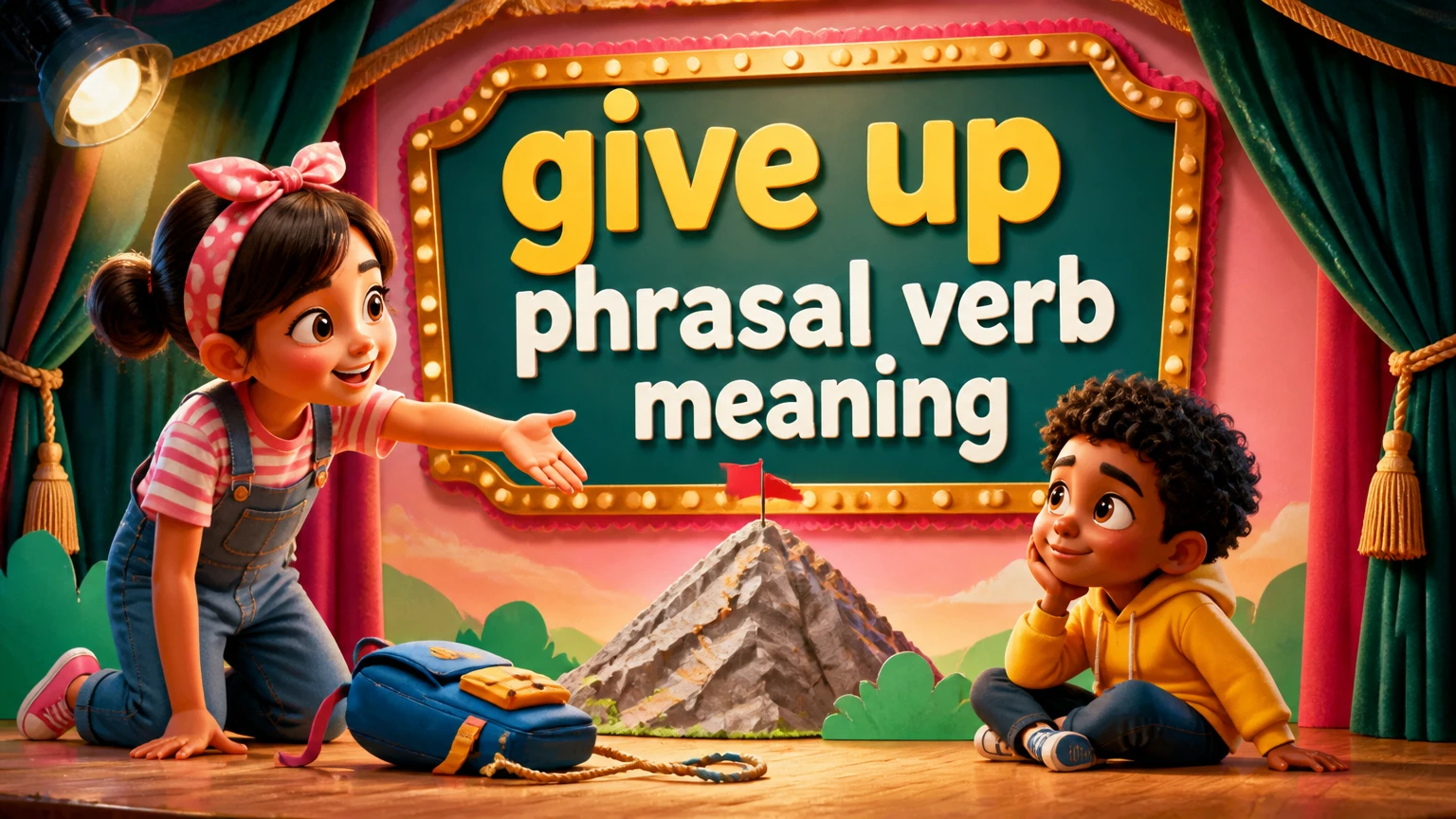
The phrasal verb “give up” is one of the most versatile and frequently used expressions in the English language. While many learners first encounter it as a synonym for “quitting,” its meaning can shift significantly depending on the context. Understanding these nuances is essential for achieving natural fluency.
Table of Contents
1. Primary Meanings and Definitions
There are four main ways we use “give up” in daily communication:
A. To Stop Doing Something (Habits)
This is often used when discussing lifestyle changes, particularly stopping a bad habit or a regular activity.
Meaning: He stopped the habit of smoking.
B. To Stop Trying (Surrender/Despair)
When a task becomes too difficult or you realize you cannot win, you might give up.
Meaning: I stopped attempting to solve the puzzle.
C. To Part With Something (Relinquish)
This involves surrendering a possession, a seat, or an opportunity to someone else.
Meaning: She allowed someone else to have her seat.
D. To Sacrifice Time
Using your personal time for a specific cause or person.
Meaning: I will use my free time for your benefit.
2. Grammatical Structure: Separable or Inseparable?
The phrasal verb “give up” is transitive and separable. This means it can take an object, and that object can sometimes go between “give” and “up.”
- Correct: I gave it up.
- Incorrect: I gave up it.
| Scenario | Sentence Structure | Example |
|---|---|---|
| With a Noun | Give up + [Noun] OR Give [Noun] + up | Give up candy / Give candy up |
| With a Pronoun | Give [Pronoun] + up | Give it up |
| With a Gerund (-ing) | Give up + [Verb-ing] | Give up running |
3. Synonyms and Antonyms
To expand your vocabulary, consider these alternatives to “give up” depending on the situation:
Synonyms
- Quit: Used for jobs or habits (e.g., “I quit my job”).
- Surrender: Used in contests or wars (e.g., “The army surrendered”).
- Abandon: To leave something behind (e.g., “They abandoned the project”).
- Renounce: Formal use for beliefs or claims (e.g., “He renounced his title”).
Antonyms
- Persist: To continue despite difficulties.
- Keep up: To maintain a pace or habit.
- Start/Adopt: To begin a new habit (the opposite of giving one up).
4. Common Idioms and Variations
There are specific expressions where “give up” takes on a unique cultural meaning:
- “Don’t give up the day job!” – A humorous (and slightly mean) way to tell someone they are not very good at a new hobby, like singing or acting.
- “Give up the ghost” – An old-fashioned way to say something has died or a machine has finally stopped working.
- “Give yourself up” – To surrender to the police or authorities.
5. Practice Exercises
Fill in the blanks with the correct form of “give up”:
- I’ve been trying to solve this math problem for an hour, but I’m ready to ________.
- She ________ chocolate for Lent last year. (Past Tense)
- If you have a dream, you should never ________ on it.
- The criminal finally ________ himself ________ to the police.
Answers: 1. give up, 2. gave up, 3. give up, 4. gave… up
6. Frequently Asked Questions
Is “give up” formal or informal?
It is neutral to informal. In very formal writing (like a legal document), you might use “relinquish,” “cease,” or “surrender” instead.
Can I say “give up from”?
No. We usually say “give up on [someone/something]” or “give up [doing something].” For example: “Don’t give up on me.”
What is the difference between “give up” and “stop”?
“Stop” is a general term. “Give up” often implies that the thing you are stopping was a habit, a challenge, or something you once possessed.