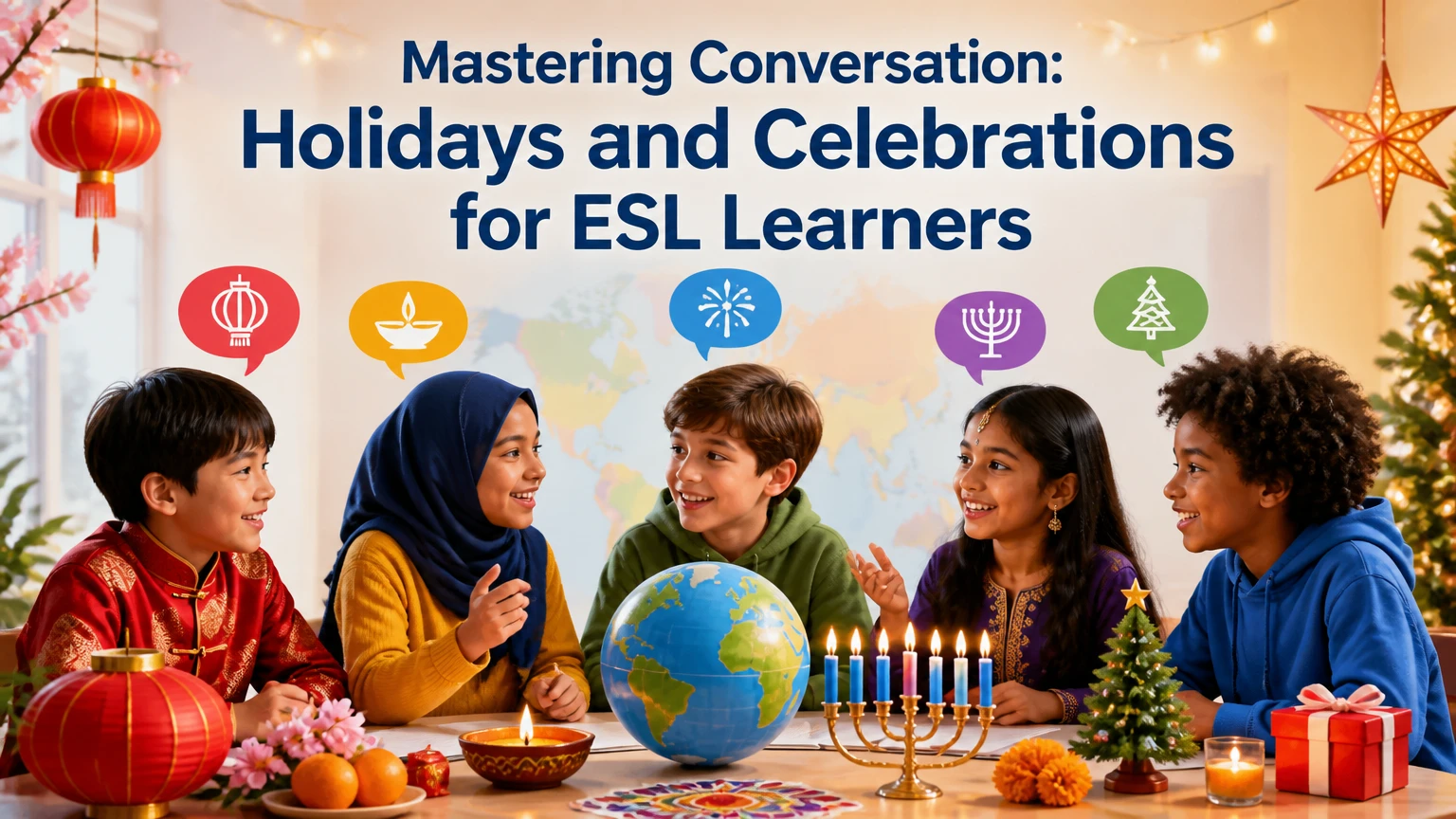
Holidays and celebrations are universal human experiences that provide a rich tapestry for language learning and cultural exchange. When we discuss special occasions, we use specific vocabulary and grammatical structures to describe traditions, express well-wishes, and recount memorable experiences. Effective communication about these events involves using specialized terms such as festivities, commemorative, gathering, tradition, and anniversary. Mastering these conversations allows English learners to connect deeply with others, share their own cultural heritage, and participate fully in the social life of English-speaking communities. By understanding the nuances of how to invite, congratulate, and describe rituals, students can move from basic functional English to expressive, fluent communication that captures the joy and significance of life’s milestones.
Table of Contents
- Defining Holidays and Celebrations in Linguistics
- Grammatical Structures for Festive Contexts
- Vocabulary Categories: From Religious to Secular
- Phrasal Verbs for Social Gatherings
- Prepositions of Time in Celebratory Contexts
- Conversational Formulas and Social Etiquette
- Extensive Example Tables for Practice
- Usage Rules and Cultural Nuances
- Common Mistakes and How to Avoid Them
- Comprehensive Practice Exercises
- Advanced Topics: Idioms and Formal Addresses
- Frequently Asked Questions (FAQ)
- Conclusion and Final Tips
Defining Holidays and Celebrations in Linguistics
In the context of English as a Second Language (ESL), “holidays and celebrations” refers to a specific functional domain of language. This domain encompasses the lexical sets and syntactic patterns used to describe communal or individual events of significance. Linguistically, this involves a high density of stative verbs (to feel, to believe), action verbs (to dance, to decorate), and temporal markers. A “holiday” typically refers to a day of exemption from work or school, often established by law or custom, while a “celebration” is the act of performing a ritual or engaging in enjoyable social activity.
Functionally, these conversations serve two primary purposes: informative and social-bonding. Informative language is used when an ESL learner explains a holiday from their home country to a native speaker. Social-bonding language involves the use of “small talk” and “phatic communication”—language used to maintain social relationships rather than just to convey information. For example, saying “Happy New Year!” is less about the literal meaning of the words and more about establishing a positive social connection during a specific time of year.
Furthermore, the language of celebrations is heavily influenced by collocations—words that naturally go together. We “throw” a party, “make” a toast, and “exchange” gifts. Understanding these pairings is essential for sounding natural. This article explores the intersection of grammar and culture, providing the tools necessary to navigate these social waters with confidence and accuracy.
Grammatical Structures for Festive Contexts
When discussing holidays, certain grammatical structures appear more frequently than others. To talk about the future—such as upcoming plans—we often rely on the Present Continuous for fixed arrangements or “be going to” for intentions. For instance, “We are having dinner at eight” implies a firm plan, whereas “I am going to visit my family” expresses a general intention. Both are vital for planning holiday logistics with friends and colleagues.
The Past Simple and Used To are indispensable for sharing memories and describing how traditions have evolved over time. “When I was a child, we used to light candles every night” provides a nostalgic look at past habits. Conversely, the Present Simple is the standard for describing recurring traditions or general truths about a holiday: “Thanksgiving always falls on the fourth Thursday of November.” Mastery of these tense shifts allows a speaker to move fluidly between history, current practice, and future expectations.
Relative clauses also play a significant role in defining specific customs. Using “where” and “when” helps clarify the context of a celebration. “Diwali is a festival when people light lamps” or “The town square is the place where the parade starts.” These structures allow for more complex and descriptive sentences, moving beyond simple Subject-Verb-Object patterns into more sophisticated narrative forms.
Vocabulary Categories: From Religious to Secular
Holiday vocabulary can be broadly categorized to help learners organize their mental lexicon. The first category involves Religious Observances. These terms often carry historical weight and include words like pilgrimage, fasting, prayer, and sacred. Understanding these words is crucial for respectful dialogue regarding faiths like Islam (Ramadan), Christianity (Easter), Judaism (Hanukkah), or Hinduism (Holi).
The second category is Secular and National Holidays. These are often tied to the history of a specific country, such as Independence Day or Labor Day. Vocabulary here includes patriotism, fireworks, parade, anthem, and commemoration. These events often involve public displays and community-wide involvement, requiring language that describes crowds, spectacles, and national pride.
Finally, we have Personal Milestones. These are celebrations unique to individuals or families, such as birthdays, weddings, anniversaries, and graduations. The vocabulary focuses on personal achievement and life transitions: vows, diploma, reception, milestone, and toast. Each of these categories requires a different register of formality, from the solemn tones of a religious ceremony to the exuberant cheers of a birthday party.
Phrasal Verbs for Social Gatherings
English speakers frequently use phrasal verbs in casual conversation about parties and holidays. Phrasal verbs like show up (to arrive) or dress up (to wear formal or costume clothing) are ubiquitous. For an ESL learner, these can be challenging because their meanings are often idiomatic and cannot be guessed from the individual words. For example, to bring up a topic during dinner means to mention it, not to carry something upstairs.
Consider the phrasal verb go off. In the context of New Year’s Eve, “The fireworks went off at midnight” means they exploded or started. However, if a party goes off without a hitch, it means it proceeded successfully. Learning these nuances is what separates a beginner from an intermediate or advanced speaker. Other common festive phrasal verbs include look forward to (anticipating the event), get together (meeting socially), and wrap up (finishing an event or literally covering a gift in paper).
To use these effectively, learners must also understand their transitivity. Some phrasal verbs require an object, like “I need to set up the decorations,” while others do not, like “Everyone stayed up until dawn.” Practicing these in the context of holiday stories helps cement their meaning and usage in the learner’s mind.
Prepositions of Time in Celebratory Contexts
Prepositions are notoriously difficult in English, but they follow specific rules when applied to holidays. We use “at” for specific times and for the names of some holiday periods without the word “day”: at Christmas, at Easter, at night, at the weekend. However, we use “on” for specific dates and holidays that include the word “day”: on Christmas Day, on my birthday, on the 4th of July.
The preposition “in” is reserved for longer periods like months, years, and seasons: in December, in 2024, in the spring. Misusing these prepositions is one of the most common errors for ESL students. Saying “I will see you in Christmas Day” sounds jarring to a native speaker, whereas “I will see you on Christmas Day” is perfectly correct. Precision with these small words significantly improves the clarity of plans and invitations.
Additionally, we use “during” to describe something that happens within the duration of a holiday period: “During the holidays, we usually go skiing.” “Throughout” suggests an action that happens from the beginning to the end: “It rained throughout the festival.” These temporal markers provide the necessary framework for any narrative regarding a celebration.
Conversational Formulas and Social Etiquette
Conversations about holidays often follow predictable patterns, or “formulas.” When someone mentions an upcoming holiday, the standard response is to ask about their plans: “Do you have any plans for the long weekend?” This is a “conversation starter” that invites the other person to share. If the person has no plans, a common follow-up is, “Oh, it’s nice to just relax sometimes.”
When responding to an invitation, etiquette dictates a clear “Yes” or “No” accompanied by a reason if the answer is “No.” Using softeners is essential for politeness. Instead of saying “I can’t come,” one might say, “I’d love to, but I’ve already made plans.” This demonstrates a mastery of the social nuances of English. Furthermore, expressing gratitude after an event is a key social skill. Phrases like “Thank you for having me” or “The food was delicious” are standard and expected.
Cultural etiquette also involves knowing what topics are appropriate. In many English-speaking cultures, asking about the cost of a gift is considered rude, while complimenting the effort put into a celebration is highly encouraged. Learning these “unspoken rules” alongside the grammar ensures that the ESL learner is not just grammatically correct, but also socially competent.
Extensive Example Tables for Practice
The following tables provide a comprehensive reference for vocabulary, verbs, and phrases commonly used in holiday contexts. These are designed to help you build your “word bank” for various types of celebrations.
Table 1: Common Holiday Vocabulary and Collocations
| Category | Key Vocabulary | Common Verb Collocation | Example Sentence |
|---|---|---|---|
| Decorations | Ornaments, lights, tinsel, banners | To put up / To hang | We put up the lights early this year. |
| Food & Drink | Feast, leftovers, toast, beverage | To prepare / To serve | They prepared a massive feast for the guests. |
| Gifts | Present, souvenir, wrapping paper | To exchange / To unwrap | The children couldn’t wait to unwrap their gifts. |
| Ceremony | Ritual, tradition, procession | To observe / To perform | The community observes this ritual every spring. |
| Socializing | Guest, host, invitation, party | To host / To attend | Are you going to attend the party on Friday? |
| Music | Carols, anthem, playlist, live band | To sing / To play | We sang carols around the neighborhood. |
| Attire | Costume, formal wear, tuxedo, gown | To wear / To dress up | Everyone dressed up for the masquerade ball. |
| Emotions | Excitement, nostalgia, joy, gratitude | To feel / To express | She expressed her gratitude for the invitation. |
The table above highlights how nouns and verbs work together. Using the correct verb with a noun (collocation) is vital for natural-sounding English. For example, we usually “put up” decorations rather than “make” them, unless we are referring to the actual construction of the items.
Table 2: Prepositions of Time for Holidays
| Preposition | Usage Rule | Examples | Common Mistakes |
|---|---|---|---|
| At | Specific times or holiday periods (no “day”) | At Christmas, at Easter, at noon | Don’t say: At Monday |
| On | Specific days and dates | On my birthday, on New Year’s Eve, on May 1st | Don’t say: On Christmas (unless you mean the day) |
| In | Months, seasons, years | In January, in the winter, in 2025 | Don’t say: In Tuesday |
| During | Within a period of time | During the summer break, during the ceremony | Don’t say: During two hours |
| By | Not later than a specific time | By the end of the party, by midnight | Don’t say: By the morning (if you mean ‘in’) |
This preposition table serves as a quick reference guide. Remember that “At Christmas” refers to the entire holiday season, while “On Christmas Day” refers specifically to December 25th. This subtle distinction is a common point of confusion for many learners.
Table 3: Phrasal Verbs for Celebrations
| Phrasal Verb | Meaning | Example Sentence |
|---|---|---|
| Get together | To meet socially | Let’s get together for a drink next week. |
| Show up | To arrive (often late or unexpectedly) | He showed up at the party without an invitation. |
| Run out of | To have no more of something | We ran out of snacks halfway through the movie. |
| Look forward to | To feel excited about a future event | I’m looking forward to the long weekend. |
| Stay up | To not go to bed | We stayed up until 3 AM talking. |
| Call off | To cancel | They had to call off the parade because of the rain. |
| Dress up | To wear formal or special clothes | You don’t need to dress up; it’s a casual BBQ. |
| Eat out | To eat at a restaurant | We usually eat out for my mother’s birthday. |
Phrasal verbs add a layer of informality and “native-like” quality to your speech. In the table above, note how “call off” is used for cancellations—this is very common when outdoor events are affected by bad weather.
Usage Rules and Cultural Nuances
When using holiday language, it is important to follow certain grammatical and social rules. One major rule involves the use of Articles. Generally, we do not use “the” with names of holidays: “I love Christmas,” not “I love the Christmas.” However, if the holiday name is used as an adjective, the article might return: “The Christmas tree is beautiful.” Similarly, if we refer to a specific day using “of,” we use the article: “The fourth of July.”
Another rule concerns Capitalization. In English, all specific names of holidays, days of the week, and months must be capitalized. This includes “Easter Sunday,” “New Year’s Eve,” and “Thanksgiving.” Failing to capitalize these in writing is a common orthographic error that can make professional or academic writing look sloppy.
Cultural nuances also dictate the Register of your language. For religious holidays, it is often more appropriate to use formal and respectful language. For secular holidays like Halloween or April Fools’ Day, the language is much more playful and informal. Understanding the “vibe” of the holiday helps you choose the right words. For example, you wouldn’t tell someone to “Have a blast!” at a solemn memorial service, but it would be perfectly appropriate for a New Year’s Eve party.
Common Mistakes and How to Avoid Them
Even advanced learners make mistakes when discussing holidays. One frequent error is the confusion between “Congratulate” and “Celebrate.” You “congratulate” a person on an achievement (like a graduation), but you “celebrate” an event (like a birthday). You cannot “congratulate a birthday.” Instead, you say “Happy Birthday!” or “Congratulations on your graduation!”
Another error involves the word “Anniversary.” In some languages, the word for birthday and anniversary is the same. In English, a “birthday” is only for the day a person was born. An “anniversary” is for the date a past event occurred, most commonly a wedding or the founding of a company. Saying “Happy Anniversary” to someone on their birthday is a common but confusing mistake.
Table 4: Correcting Common Errors
| Incorrect Sentence | Correct Sentence | Explanation |
|---|---|---|
| I congratulate you for your birthday! | Happy Birthday! | Use “congratulate” for achievements, not birthdays. |
| We are going to the Paris in Christmas. | We are going to Paris at Christmas. | No “the” before city names or holiday periods. |
| I am looking forward to see you. | I am looking forward to seeing you. | “Look forward to” is followed by a gerund (-ing). |
| The party was very fun. | The party was a lot of fun. | “Fun” is a noun here; “funny” means it made you laugh. |
| Happy anniversary of 21 years! | Happy 21st birthday! | Use “birthday” for people, “anniversary” for events. |
As shown in the table, the phrase “looking forward to” is a major trap for learners. Because “to” looks like part of an infinitive, people often follow it with a base verb. However, in this phrase, “to” is a preposition, so it must be followed by a noun or a gerund (an -ing verb acting as a noun).
Comprehensive Practice Exercises
To master these concepts, practice is essential. The following exercises are designed to test your knowledge of prepositions, vocabulary, and conversational flow. Try to complete them without looking back at the tables first.
Exercise 1: Fill in the Prepositions
Complete the sentences using at, on, in, during, or by.
- We always have a big family dinner ______ Christmas Eve.
- The fireworks are scheduled to start ______ 10:00 PM.
- Most people in this country go on vacation ______ August.
- I hope to finish all my gift shopping ______ next Tuesday.
- The children were very well-behaved ______ the ceremony.
- My birthday is ______ the 15th of March.
- We usually light the candles ______ sunset.
- The festival takes place ______ the spring every year.
- I’ll see you ______ the weekend!
- They stayed in a small cabin ______ their winter break.
Exercise 2: Multiple Choice – Holiday Etiquette
Choose the most appropriate response for each social situation.
- Your friend invites you to a party, but you are busy. You say:
a) I don’t want to come.
b) I’d love to, but I have other plans.
c) No, I am busy. - It is your friend’s wedding day. You say:
a) Happy Anniversary!
b) Congratulations!
c) Good luck! - You are at a dinner party and the food is great. You say:
a) This food is okay.
b) You are a good cooker.
c) This is delicious, thank you for the wonderful meal! - You want to ask about someone’s plans for New Year’s. You say:
a) What do you do for New Year?
b) Are you doing anything special for New Year’s Eve?
c) Where is the party? - Someone says “Happy Holidays!” to you. You respond:
a) You too!
b) Yes, it is.
c) Thank you, I am happy.
Exercise 3: Answer Key
| Ex 1 Answers | Ex 2 Answers |
|---|---|
| 1. on, 2. at, 3. in, 4. by, 5. during, 6. on, 7. at, 8. in, 9. at/on, 10. during | 1. b, 2. b, 3. c, 4. b, 5. a |
Advanced Topics: Idioms and Formal Addresses
Advanced learners should aim to incorporate idioms related to celebration into their speech. For example, “to paint the town red” means to go out and enjoy oneself flamboyantly. “To blow off steam” means to relax and get rid of stress, often by partying after a long period of work. These expressions add color and personality to your English, making you sound more like a native speaker.
Another advanced area is the Formal Address. When writing an invitation or a formal thank-you note, the language changes. Instead of “Come to my party,” you might write, “You are cordially invited to attend a celebration in honor of…” This use of the passive voice and specific formal vocabulary (cordially, in honor of, RSVP) is common in professional and high-society contexts. Mastery of these forms is essential for business English and formal social settings.
Finally, understanding Regional Variations is a mark of an advanced student. In the UK, people might say “Happy Christmas,” while in the US, “Merry Christmas” is more common. In some regions, “Happy Holidays” is preferred as a more inclusive greeting. Being aware of these local preferences shows a high level of cultural intelligence and linguistic adaptability.
Frequently Asked Questions (FAQ)
1. Is it “Happy New Year” or “Happy New Years”?
The correct singular form is “Happy New Year.” People often add an “s” because they are thinking of “New Year’s Eve” or “New Year’s Day,” where the ‘s is possessive. However, when wishing someone well for the upcoming year, use the singular: “Happy New Year!”
2. When should I use “Congratulations” versus “Happy [Holiday]”?
Use “Congratulations” for personal achievements like weddings, graduations, or promotions. Use “Happy [Holiday]” for general calendar events like birthdays, Christmas, or Easter. You can use both if a personal milestone falls on a holiday!
3. What does “RSVP” mean on an invitation?
RSVP stands for the French phrase “Répondez s’il vous plaît,” which means “Please respond.” If you see this on an invitation, the host needs to know if you are coming so they can plan for food and seating. You should always reply by the date requested.
4. How do I politely decline a holiday invitation?
The best way is to use the “Sandwich Method”: start with a thank you, give a brief reason why you can’t attend, and end with a positive wish. For example: “Thank you so much for the invite! Unfortunately, I’ll be out of town that weekend. I hope you all have a wonderful time!”
5. Is “Xmas” disrespectful?
In most casual contexts, “Xmas” is just a common abbreviation for Christmas, where the ‘X’ represents the Greek letter ‘Chi,’ the first letter of Christ’s name. However, in formal writing or religious contexts, it is better to write out the full word “Christmas.”
6. What is the difference between a “holiday” and a “vacation”?
In British English, “holiday” is used for both a day off (like Christmas) and a trip away from home. In American English, “holiday” usually refers to a specific day of celebration (like Thanksgiving), while a trip away from home is called a “vacation.”
7. How do I toast someone in English?
To make a toast, stand up (if appropriate), raise your glass, and say a few kind words about the person or occasion. End by saying “To [Name/Occasion]!” or simply “Cheers!” Everyone then takes a sip of their drink.
8. Should I bring a gift to a party?
This depends on the occasion. For birthdays and weddings, a gift is usually expected. For a casual dinner party or a “housewarming,” a small token like a bottle of wine, flowers, or chocolates is a polite gesture but not always mandatory. When in doubt, it’s always better to bring something small.
Conclusion and Final Tips
Navigating conversations about holidays and celebrations is a rewarding part of the ESL journey. By mastering the grammar of time, the vocabulary of tradition, and the nuances of social etiquette, you can participate more fully in the joyful moments of life. Remember that language is a tool for connection; even if your grammar isn’t perfect, the warmth of a “Happy Birthday” or a sincere “Thank you” goes a long way. Continue to practice your phrasal verbs, keep an eye on your prepositions, and don’t be afraid to ask others about their own traditions. The more you engage with the cultural aspects of the English language, the more natural and confident your speech will become. Happy learning and happy celebrating!