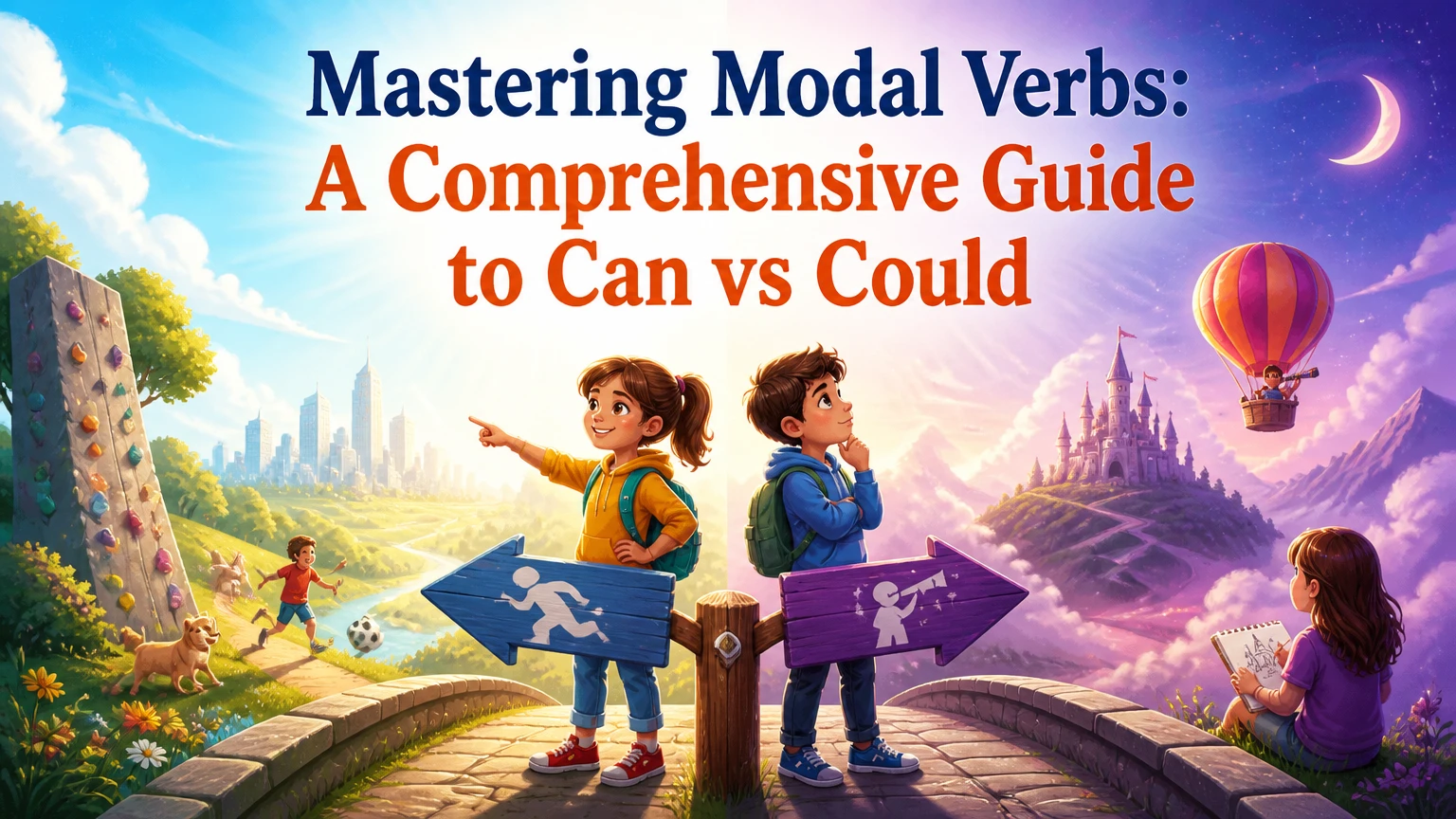
Modal verbs represent one of the most dynamic and essential components of the English language, serving as the primary tools for expressing nuances of possibility, permission, and ability. The distinction between “can” and “could” is particularly vital for learners to master, as these words appear in nearly every conversational and formal context imaginable. These auxiliary verbs help speakers articulate various shades of meaning, such as can, could, can’t, couldn’t, and could have. Understanding the subtle shifts in tense and tone between these two forms allows a speaker to move from a direct statement of fact to a polite request or a hypothetical suggestion. For students, professionals, and casual learners alike, gaining a firm grasp of these modal verbs is the key to achieving natural-sounding English and avoiding common misunderstandings in social and professional settings.
Table of Contents
- Definition and Classification
- Structural Breakdown and Sentence Patterns
- Categories of Usage: Ability, Permission, and More
- Extensive Examples and Comparison Tables
- Comprehensive Usage Rules and Nuances
- Common Mistakes and How to Avoid Them
- Advanced Topics: Conditionals and Past Modals
- Practice Exercises and Solutions
- Frequently Asked Questions (FAQ)
- Conclusion and Final Learning Tips
Definition and Classification
In the realm of linguistics, both “can” and “could” are classified as modal auxiliary verbs. Unlike main verbs, modal verbs do not change their form based on the subject; they do not take an “-s” in the third person singular, nor do they have infinitive or participle forms. Their primary function is to provide additional meaning to the main verb that follows them, indicating the “mood” or “mode” of the action.
Can is generally considered the present tense form of the modal. It is used to describe current abilities, general truths, and immediate possibilities. When you say “I can swim,” you are stating an objective fact about your current skillset. It is direct, assertive, and frequently used in informal environments to ask for permission or make offers.
Could serves two primary roles: it is the past tense of “can” and a conditional marker for hypothetical or polite scenarios. Because it is perceived as more distant from reality or the present moment, it naturally sounds more polite and less demanding than “can.” For instance, “Could you help me?” is softer than “Can you help me?” because it introduces a layer of theoretical possibility rather than a direct inquiry into capability.
Syntactically, these verbs are followed by the bare infinitive (the base form of a verb without “to”). This is a crucial rule that distinguishes them from other types of auxiliary verbs. Whether you are discussing a physical skill, a legal right, or a future probability, the structure remains consistent, providing a stable foundation for building complex sentences.
Structural Breakdown and Sentence Patterns
Understanding the structure of sentences involving “can” and “could” is the first step toward fluency. These verbs follow a very strict pattern that does not vary, regardless of whether the subject is “I,” “you,” “he,” “she,” “it,” “we,” or “they.” This lack of conjugation makes them easier to learn than many other verb types in English.
The Positive Form
The positive structure is: Subject + Can/Could + Base Verb. Note that there is never a “to” between the modal and the main verb. We say “I can dance,” never “I can to dance.” This applies to both present and past contexts. When using “could” to describe a past ability, the structure remains identical, but the context of the sentence shifts the timeline.
The Negative Form
Negative sentences are formed by adding “not” after the modal. For “can,” the most common written form is the single word “cannot,” though “can not” is occasionally used for emphasis. In speech, the contraction “can’t” is nearly universal. For “could,” the negative is “could not,” often contracted to “couldn’t.” The negative form is used to express inability, prohibition, or the impossibility of a situation.
The Interrogative (Question) Form
To form a question, we use inversion. The modal verb moves to the beginning of the sentence: Can/Could + Subject + Base Verb? This structure is used for asking about abilities, requesting permission, or making polite inquiries. When we use “could” in a question, we are often employing it as a “distancing” mechanism to make the request feel less intrusive to the listener.
Categories of Usage
The choice between “can” and “could” depends heavily on the functional category of the sentence. While they share some territory, their applications in ability, permission, possibility, and requests vary significantly.
1. Ability and Capability
This is perhaps the most common use of these modals. “Can” expresses a current, general ability. For example, “Birds can fly.” “Could” expresses a general ability that existed in the past but may not exist now. For example, “My grandfather could speak five languages.” It is important to note that for specific successful actions in the past, we often use “was able to” instead of “could,” a nuance we will explore later.
2. Permission and Prohibition
In modern English, “can” is the standard way to ask for and give permission, especially among friends and family. “Could” is used for the same purpose but is considered more formal and polite. If you are in a job interview or speaking to a stranger, “Could I ask a question?” is preferable to “Can I ask a question?” Prohibition is almost always expressed with “cannot” or “can’t,” as in “You can’t park here.”
3. Possibility and Impossibility
“Can” is used to express things that are generally or theoretically possible. “It can get very cold in Canada” means it is a known fact that this happens. “Could,” on the other hand, is used for specific possibilities in the present or future that are less certain. “It could rain later” suggests a chance of rain, whereas “It can rain” sounds like a general statement about the climate.
4. Requests and Suggestions
When asking someone to do something, “could” is the gold standard for politeness. “Could you pass the salt?” is much more common in social settings than “Can you pass the salt?”, though both are grammatically correct. For suggestions, “could” is used to present an idea gently. “We could go to the cinema tonight” sounds like an open-ended proposal, while “We can go” sounds more like a statement of available options.
Extensive Examples and Comparison Tables
To truly understand the differences, it is helpful to see these verbs in a variety of contexts. The following tables provide a comprehensive look at how “can” and “could” function across different personas and situations. These examples illustrate the versatility of the words and how they adapt to different linguistic needs.
Table 1: Expressing Ability (Present vs. Past)
This table demonstrates how “can” refers to current skills and “could” refers to skills held in the past. Notice how the base verb remains unchanged regardless of the timeframe.
| Subject | Present Ability (Can) | Past Ability (Could) | Context Note |
|---|---|---|---|
| I | I can play the piano. | I could play the piano as a child. | Musical skill |
| You | You can run very fast. | You could run faster last year. | Physical ability |
| He | He can speak Japanese. | He could speak Japanese fluently. | Language skill |
| She | She can code in Python. | She could code before college. | Technical skill |
| It | It can jump high. | It could jump higher when younger. | Animal/Object ability |
| We | We can solve this puzzle. | We could solve it easily then. | Problem-solving |
| They | They can sing beautifully. | They could sing in the choir. | Artistic skill |
| The chef | The chef can cook Italian. | The chef could cook French food. | Professional skill |
| My dog | My dog can sit on command. | My dog could do many tricks. | Trained behavior |
| The car | The car can reach 200 mph. | The car could reach 200 mph. | Mechanical capacity |
| Students | Students can access the lab. | Students could access the lab. | Access/Capability |
| Artists | Artists can see colors well. | Artists could see colors well. | Perception |
| Athletes | Athletes can endure pain. | Athletes could endure more. | Physical endurance |
| Birds | Birds can migrate far. | Birds could migrate further then. | Natural instinct |
| Computers | Computers can process data. | Computers could process less then. | Processing power |
| Children | Children can learn quickly. | Children could learn faster then. | Cognitive ability |
| Trees | Trees can grow tall. | Trees could grow taller here. | Biological growth |
| Cameras | Cameras can zoom in. | Cameras could zoom less before. | Functional capacity |
| Engineers | Engineers can design bridges. | Engineers could design simple ones. | Professional ability |
| Writers | Writers can create worlds. | Writers could create stories. | Creative ability |
Table 2: Requests and Politeness Levels
This table highlights the shift in tone when moving from “can” to “could” in interrogative sentences. “Could” is almost always the better choice for formal or polite interactions.
| Scenario | Informal Request (Can) | Polite/Formal Request (Could) | Social Nuance |
|---|---|---|---|
| Borrowing a pen | Can I borrow your pen? | Could I borrow your pen? | Polite is safer |
| Asking for time | Can you tell me the time? | Could you tell me the time? | Strangers prefer ‘could’ |
| Opening a window | Can you open the window? | Could you open the window? | ‘Could’ sounds like a favor |
| Ordering food | Can I have a coffee? | Could I have a coffee? | Both are common in cafes |
| Asking for help | Can you help me with this? | Could you help me with this? | ‘Could’ is more humble |
| Seeking directions | Can you show me the way? | Could you show me the way? | ‘Could’ is more respectful |
| Phoning someone | Can I speak to John? | Could I speak to John? | ‘Could’ is professional |
| Leaving early | Can I leave now? | Could I leave now? | ‘Could’ asks for permission |
| Using a phone | Can I use your phone? | Could I use your phone? | ‘Could’ is less intrusive |
| Checking a price | Can you tell me the price? | Could you tell me the price? | ‘Could’ is standard retail |
| Requesting a seat | Can I sit here? | Could I sit here? | ‘Could’ is very polite |
| Asking for a favor | Can you do me a favor? | Could you do me a favor? | ‘Could’ softens the ask |
| Changing a date | Can we meet on Tuesday? | Could we meet on Tuesday? | ‘Could’ is a suggestion |
| Asking for feedback | Can you check my work? | Could you check my work? | ‘Could’ respects their time |
| Requesting a refund | Can I get a refund? | Could I get a refund? | ‘Could’ is better for disputes |
| Asking for water | Can I have some water? | Could I have some water? | ‘Could’ is polite at dinner |
| Taking a photo | Can you take a photo? | Could you take a photo? | ‘Could’ is common for tourists |
| Asking for a discount | Can you give a discount? | Could you give a discount? | ‘Could’ is better negotiation |
| Entering a room | Can I come in? | Could I come in? | ‘Could’ is formal entry |
| Borrowing money | Can you lend me $5? | Could you lend me $5? | ‘Could’ is less demanding |
Table 3: Possibility and Probability
The following table explores how “can” describes general possibilities (facts), while “could” describes specific, uncertain possibilities (guesses) about the present or future.
| Context | General Fact (Can) | Specific Possibility (Could) | Meaning Difference |
|---|---|---|---|
| Weather | It can be hot in July. | It could be hot tomorrow. | Fact vs. Prediction |
| Traffic | Traffic can be heavy here. | Traffic could be heavy now. | General vs. Specific |
| Health | Smoking can cause cancer. | This could cause a problem. | Certainty vs. Risk |
| Travel | Travel can be expensive. | The flight could be expensive. | General vs. Specific cost |
| Education | Learning can be fun. | The exam could be hard. | General vs. Specific event |
| Work | Work can be stressful. | This week could be stressful. | General vs. Specific time |
| Technology | Software can have bugs. | The update could have bugs. | General vs. Specific version |
| Nature | Forest fires can spread. | The fire could spread fast. | General vs. Specific fire |
| Sports | Anyone can win the race. | He could win the race. | General vs. Specific person |
| Cooking | Salt can ruin a dish. | The soup could be too salty. | General vs. Specific dish |
| Business | Prices can fluctuate. | The price could drop soon. | General vs. Specific trend |
| Science | Mars can be seen at night. | Life could exist on Mars. | Fact vs. Theory |
| Social | Parties can be loud. | The party could be loud. | General vs. Specific party |
| Safety | Ice can be slippery. | The path could be slippery. | General vs. Specific path |
| Dogs | Dogs can be aggressive. | That dog could bite. | General vs. Specific animal |
| Movies | Horror can be scary. | The movie could be scary. | General vs. Specific film |
| Books | Reading can improve vocabulary. | This book could be useful. | General vs. Specific item |
| Money | Investing can be risky. | The stock could crash. | General vs. Specific risk |
| Cities | London can be rainy. | It could rain in London today. | General vs. Specific day |
| People | People can be kind. | She could be the winner. | General vs. Specific person |
Comprehensive Usage Rules and Nuances
While the basic definitions provide a starting point, English grammar is full of nuances that dictate when one modal is superior to the other. Mastering these rules will elevate your writing and speaking from a basic level to an advanced, nuanced level. Below, we explore the specific rules governing these two words.
The Rule of “General” vs. “Specific” Ability
One of the most complex aspects of using “could” is understanding that it is primarily used for general past ability. If you want to say you were able to do something one time in a specific situation, “could” is often replaced by “was/were able to” or “managed to.” For example, “I could swim when I was five” (general ability) vs. “I was able to escape the building” (specific incident). Using “could” for a specific past achievement can sometimes sound incorrect to native speakers.
The Rule of Theoretical Possibility
We use “can” for theoretical possibilities—things that we know happen from time to time because they are part of the nature of the thing. “The sea can be dangerous” is a theoretical possibility. We use “could” for factual possibilities in specific circumstances. “The sea could be dangerous today because of the storm” refers to a specific possibility based on current evidence.
The Rule of Negative Certainty
In the negative, “can’t” and “couldn’t” have very strong meanings. “It can’t be true” means you are 100% sure it is impossible. “It couldn’t be true” is slightly softer but still expresses strong disbelief. Interestingly, “couldn’t” is also used to express that something was impossible in the past, regardless of whether it was a general or specific situation. “I couldn’t find my keys yesterday” is perfectly correct.
The Rule of Future Suggestions
When making suggestions about the future, “could” is the preferred choice because it sounds less forceful. “We could go to the park” leaves room for the other person to disagree or offer a different idea. “We can go to the park” sounds more like a statement of a plan that has already been decided or a simple statement of availability.
Common Mistakes and How to Avoid Them
Even advanced learners make mistakes with “can” and “could.” These errors often stem from direct translation from the learner’s native language or a misunderstanding of the “politeness” vs. “tense” distinction. Let’s look at some of the most frequent pitfalls.
1. Using “to” after the modal
Incorrect: I can to speak English.
Correct: I can speak English.
Rule: Modals are always followed by the base form of the verb without “to.” This is a fundamental rule of English syntax that applies to all modal verbs.
2. Adding “-s” for the third person
Incorrect: He cans play guitar.
Correct: He can play guitar.
Rule: Modal verbs do not change their form. “Can” and “could” are the same for “I,” “he,” “she,” and “they.” This simplicity is actually what makes them unique.
3. Confusing “Could” with “Was Able To” in the Past
Incorrect: Yesterday, I could find a great parking spot.
Correct: Yesterday, I was able to find a great parking spot.
Rule: Use “could” for general skills in the past. Use “was able to” for specific achievements or successes in a single moment.
4. Using “Can” for polite requests to strangers
Incorrect (Too direct): Can you move your bag?
Correct (Polite): Could you move your bag?
Rule: While “can” is not grammatically wrong, it can sound rude or demanding in formal situations or when speaking to people you do not know well.
Advanced Topics: Conditionals and Past Modals
For those looking to master English, understanding how “can” and “could” function in complex sentence structures is essential. This includes their role in conditional sentences and their “perfect” forms.
The Second Conditional
In second conditional sentences (hypothetical situations in the present or future), we use “could” in the result clause. For example: “If I had more money, I could buy a boat.” Here, “could” represents a hypothetical ability or possibility that depends on a condition that is currently untrue.
The Third Conditional
In the third conditional (hypothetical situations in the past), we use “could have” followed by a past participle. For example: “If I had studied harder, I could have passed the exam.” This expresses a past possibility that did not actually happen.
Could Have vs. Can Have
We almost never use “can have” to talk about the past. Instead, we use “could have” to speculate about things that were possible. “Where is John? He could have missed the bus.” This indicates a guess about a past event. If we are certain something didn’t happen, we use “couldn’t have.” For example: “He couldn’t have stolen the money; he was with me all night.”
Practice Exercises and Solutions
Testing your knowledge is the best way to ensure the rules have “stuck.” Complete the following exercises to practice the distinctions between “can” and “could.”
Exercise 1: Present vs. Past Ability
Fill in the blanks with either can or could.
- When I was a child, I ________ climb any tree in the garden.
- I ________ speak three languages fluently now.
- My grandmother ________ knit beautiful sweaters before her eyesight failed.
- Look! I ________ touch my toes without bending my knees.
- They ________ finish the project on time last week.
- Most birds ________ fly, but penguins cannot.
- In the 1920s, people ________ not travel across the world so easily.
- ________ you hear that strange noise coming from the basement right now?
- He ________ play the violin when he was only four years old.
- We ________ see the mountains from our hotel window yesterday.
Exercise 2: Politeness and Requests
Choose the most appropriate word (can or could) based on the context provided.
- (To a waiter) ________ I have the bill, please?
- (To a close friend) ________ you pass me that magazine?
- (In a job interview) ________ you tell me more about the company culture?
- (To a stranger on the street) ________ you tell me where the nearest station is?
- (To your sibling) ________ I borrow your sweater for an hour?
- (To a professor) ________ I come to your office hours tomorrow?
- (To a child) ________ you please be quiet for a moment?
- (To a shop assistant) ________ you show me where the fitting rooms are?
- (At a formal dinner) ________ you please pass the water?
- (To a teammate) ________ you help me finish this report?
Exercise 3: Possibility and Logic
Choose can’t or couldn’t to complete the sentences.
| Question | Answer Choice |
|---|---|
| 1. That ________ be the right house; it’s the wrong color. | can’t |
| 2. I ________ find my phone anywhere this morning. | couldn’t | can’t |
| 4. We ________ go to the party because we were sick. | couldn’t |
| 5. It ________ be 5 PM already; I just arrived! | can’t |
| 6. She ________ swim when she was five. | couldn’t |
| 7. You ________ be serious! That’s impossible. | can’t |
| 8. They ________ understand why the flight was cancelled. | couldn’t |
| 9. I ________ believe my eyes when I saw the prize. | couldn’t |
| 10. This ________ be the end of the movie; it’s only been an hour. | can’t |
Answer Key
| Exercise 1 | Exercise 2 |
|---|---|
| 1. could | 1. Could (Polite) |
| 2. can | 2. Can (Informal) |
| 3. could | 3. Could (Formal) |
| 4. can | 4. Could (Stranger) |
| 5. could (or ‘were able to’) | 5. Can (Informal) |
| 6. can | 6. Could (Formal) |
| 7. could | 7. Can (Direct) |
| 8. Can | 8. Could (Polite) |
| 9. could | 9. Could (Formal) |
| 10. could | 10. Can/Could (Either) |
Frequently Asked Questions (FAQ)
1. Is “could” always the past tense of “can”?
Not always. While “could” is the past tense of “can” when talking about ability (e.g., “I could run fast”), it is also used as a present-tense modal to express politeness (e.g., “Could you help me?”) or hypothetical possibility (e.g., “It could rain”). Context is the only way to determine if “could” refers to the past or is simply being used for politeness.
2. When should I use “be able to” instead of “can” or “could”?
You should use “be able to” in tenses where “can” and “could” do not exist, such as the future (“I will be able to”) or the present perfect (“I have been able to”). Additionally, use “was able to” for specific past achievements where you succeeded in doing something difficult at a particular moment.
3. Is “can” ever polite enough for formal writing?
In formal writing, “can” is perfectly acceptable for stating facts or general possibilities. However, when making requests or suggestions in a professional email or academic paper, “could” or “may” is generally preferred to maintain a respectful and professional tone.
4. Can I use “could” to talk about future possibility?
Yes. “Could” is frequently used for future possibilities that are uncertain. For example, “We could win the game tomorrow” means there is a chance of winning, but it is not a certainty. It is more tentative than saying “We can win.”
5. What is the difference between “couldn’t” and “could not”?
There is no difference in meaning. “Couldn’t” is the contracted form used in speech and informal writing. “Could not” is the full form used in formal documents, academic essays, and for emphasis. In speech, using “could NOT” with stress on the second word emphasizes the impossibility.
6. Can “can” be used for the future?
“Can” is often used for the future when we have already made a decision or when something is scheduled. “I can meet you tomorrow at ten” is common because the ability to meet is already decided. However, for future possibilities that aren’t decided, “could” or “might” is better.
7. Is it “Can I” or “May I”?
Grammatically, “May I” is the traditional way to ask for permission, while “Can I” asks about ability. However, in modern English, “Can I” is used for permission in almost all informal and semi-formal contexts. “Could I” is the perfect middle ground—more polite than “can” but less stiff than “may.”
8. Why do we say “could have” instead of “can have”?
In English, we use “could have + past participle” to talk about past possibilities. “Can have” is simply not a standard structure for expressing past potential. Even if you are talking about something that might be true now about the past, “could have” is the required form.
Conclusion and Final Learning Tips
Mastering the distinction between can and could is a journey that moves from basic grammar rules to an understanding of social etiquette and logical nuances. Remember that can is your tool for the present, for facts, and for informal interactions, while could is your versatile companion for the past, for polite requests, and for hypothetical “what-if” scenarios. To improve, try to notice these words in movies and books; pay attention to who is speaking and what their relationship is to the listener. Practice using “could” more often in your professional emails to soften your tone. With consistent practice and attention to the contexts of ability, permission, and possibility, you will soon use these modal verbs with the confidence and precision of a native speaker. Keep exploring the nuances of English, and don’t be afraid to make mistakes—they are the stepping stones to fluency.