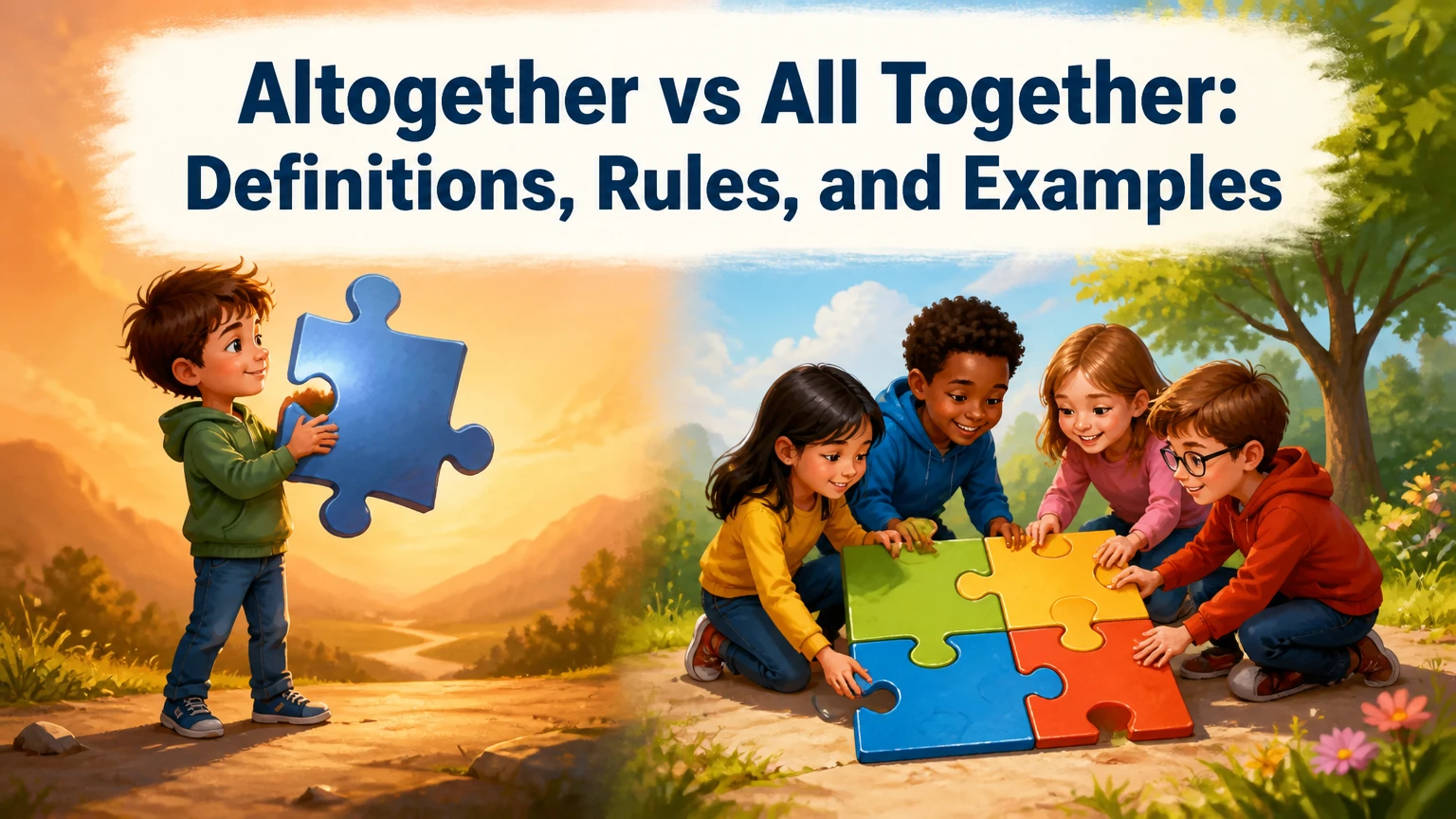
The English language is filled with confusing homophones and near-homophones that can trip up even the most seasoned writers and native speakers. One of the most frequent sources of confusion is the distinction between the single-word adverb altogether and the two-word phrase all together. These terms are often used interchangeably in casual speech because they sound remarkably similar, but they serve distinct grammatical functions and convey entirely different meanings, such as when we say “the situation is altogether different” versus “we stood all together in the park.” Understanding the nuances of these expressions is vital for students, professionals, and creative writers who wish to maintain precision in their communication. By mastering these terms, you can avoid common pitfalls including altogether, all together, already, and all ready, which frequently appear in academic and professional writing. This guide provides a comprehensive breakdown of these terms to ensure you never have to guess which version is correct for your specific context.
Table of Contents
- Definition and Classification
- Structural Breakdown of Both Terms
- Deep Dive into Altogether (Adverb)
- Deep Dive into All Together (Phrase)
- Visual Comparison and Summary Tables
- Comprehensive Usage Rules and Exceptions
- Common Mistakes and How to Fix Them
- Advanced Topics and Etymology
- Practice Exercises and Worksheets
- Frequently Asked Questions (FAQ)
- Conclusion and Final Tips
Definition and Classification
To understand the difference between these two forms, we must first look at their grammatical classifications. One is a standalone adverb, while the other is a phrase consisting of a pronoun (or adjective) and an adverb. This distinction is the foundation of their different uses in English sentences.
What is “Altogether”?
Altogether is classified as an adverb of degree or an adverb of manner depending on the context. Its primary function is to modify adjectives, other adverbs, or entire clauses. It is used to signify that something is complete, total, or viewed as a whole. When you use this word, you are usually describing the extent or the sum of a situation.
In most contexts, altogether can be replaced by synonyms like “completely,” “entirely,” “totally,” or “on the whole.” For example, if you say, “The music was altogether too loud,” you are saying it was “completely” or “entirely” too loud. It does not refer to people being in a group, but rather to the intensity or totality of the volume.
What is “All Together”?
All together is not a single word but a phrasal construction. It consists of the word “all” (acting as a pronoun or determiner) and the word “together” (acting as an adverb). This phrase specifically refers to a group of people or things acting in unison or being in the same place at the same time.
The easiest way to identify if all together is correct is to see if you can separate the two words. If you can place other words between “all” and “together,” or if you can remove “all” and still have a sentence that makes sense regarding a group, then the two-word version is the correct choice. For instance, “The family sat all together” means everyone in the family sat in one group.
Structural Breakdown of Both Terms
The structural difference between these terms dictates how they interact with other parts of speech. Understanding the syntax behind them helps in identifying which one to use when drafting a sentence.
Syntax of Altogether
As an adverb, altogether typically precedes the adjective or adverb it modifies. It functions as an intensifier. In some cases, it can appear at the beginning or end of a sentence to mean “in total” or “considering everything.” It is a cohesive unit that cannot be split up by other words.
Consider the sentence: “I am not altogether sure about this plan.” Here, altogether modifies the adjective “sure.” You cannot say “I am not all sure together about this plan,” because the meaning of totality is tied to the single-word adverbial form.
Syntax of All Together
The phrase all together functions as a collective description. “All” refers to the members of a group, and “together” describes their state of being or their method of action. Because it is a phrase, it is much more flexible than the single word.
For example, you can say “They were all together” or “They all were together.” You can even add words: “They were all gathered together.” This flexibility is a hallmark of the two-word phrase and is never possible with the adverb altogether.
Deep Dive into Altogether (Adverb)
Altogether has three primary meanings that account for almost all its usage in modern English. Mastering these three nuances will allow you to use the word with complete confidence in any writing scenario.
Meaning 1: Completely or Entirely
This is the most common use of the word. It serves to emphasize the degree of a quality. If a task is “altogether impossible,” it means there is no way to complete it. It is synonymous with “wholly” or “thoroughly.”
Meaning 2: In Total
When used to sum up a quantity, altogether means “in all.” For example, “There were six books altogether on the shelf.” In this context, it refers to the final count of the items mentioned. It is often placed at the end of the sentence or after the noun phrase it quantifies.
Meaning 3: On the Whole / Considering Everything
This usage often appears at the beginning of a sentence as a transition. It summarizes a previous discussion or provides a final judgment on a situation. For example: “Altogether, it was a successful conference despite the technical issues.” Here, it means “considering all factors.”
Deep Dive into All Together (Phrase)
The phrase all together is strictly about physical or metaphorical grouping. It does not modify degree; it describes the state of a collective. If you are talking about people, objects, or ideas being in one place or acting as one unit, this is your choice.
Meaning 1: In a Group
This refers to the physical proximity of individuals or items. “The kids were all together in the playroom” indicates that every child was in that specific room at the same time. If you removed “all,” the sentence “The kids were together” still conveys the core meaning, which proves that the two-word version is required.
Meaning 2: Simultaneously / In Unison
This refers to actions performed at the exact same moment. “The choir sang the final note all together.” This means they sang it at the same time. Using altogether here would be incorrect because you aren’t saying they sang “completely”; you are saying they sang “as a group.”
Visual Comparison and Summary Tables
To help visualize the differences discussed so far, the following tables provide a quick reference for the various meanings, functions, and contexts of “altogether” and “all together.”
The first table below compares the grammatical function and provides a simple “replacement test” that you can use when you are unsure which term to choose during the writing process.
| Term | Grammatical Role | Primary Meaning | Replacement Test |
|---|---|---|---|
| Altogether | Adverb | Completely, entirely, in total | Replace with “completely” |
| All together | Phrase (Pronoun + Adverb) | In a group, all at once | Replace with “together” |
The following table provides 25 examples of altogether used correctly in various sentences. Note how each instance refers to degree, totality, or a summary of a situation rather than a physical group of people.
| # | Example Sentence using “Altogether” | Context/Meaning |
|---|---|---|
| 1 | The meal was altogether delicious. | Completely |
| 2 | I am altogether tired of this weather. | Entirely |
| 3 | That is an altogether different matter. | Thoroughly |
| 4 | Altogether, there were fifty people at the party. | In total |
| 5 | He stopped smoking altogether. | Completely |
| 6 | The plan was altogether too risky. | Entirely |
| 7 | I don’t altogether agree with your assessment. | Fully/Completely |
| 8 | It was an altogether pleasant evening. | Wholly |
| 9 | The bill came to $100 altogether. | In total |
| 10 | Altogether, the project was a failure. | On the whole |
| 11 | She was altogether surprised by the news. | Completely |
| 12 | The engine failed altogether. | Entirely |
| 13 | He had six siblings altogether. | In total |
| 14 | It is altogether possible that we missed the turn. | Entirely |
| 15 | The room was altogether too dark for reading. | Completely |
| 16 | Altogether, I think we did a great job. | Considering everything |
| 17 | That’s an altogether different story. | Totally |
| 18 | The debt was altogether forgiven. | Wholly |
| 19 | I am not altogether convinced by his excuse. | Completely |
| 20 | The company has ten offices altogether. | In total |
| 21 | It was an altogether new experience for her. | Entirely |
| 22 | The rain stopped altogether by noon. | Completely |
| 23 | Altogether, the trip cost more than expected. | In total |
| 24 | His behavior was altogether unacceptable. | Thoroughly |
| 25 | The village was altogether destroyed by the flood. | Completely |
Now, let’s look at 25 examples of all together. In these cases, the focus is on a group of entities acting as one or being located in the same spot. Notice how “all” can often be separated from “together” without losing the group-focused meaning.
| # | Example Sentence using “All Together” | Context/Meaning |
|---|---|---|
| 1 | The family was all together for Christmas. | In a group |
| 2 | Let’s sing the chorus all together. | In unison |
| 3 | Put your toys all together in the box. | In one place |
| 4 | We stood all together on the stage. | As a group |
| 5 | They were all together when the news broke. | In one place |
| 6 | The sheep were huddling all together. | In a group |
| 7 | Can we keep these files all together? | In one location |
| 8 | The team arrived all together on the bus. | As a unit |
| 9 | We need to act all together to solve this. | In unison |
| 10 | The ingredients should be mixed all together. | In one mass |
| 11 | They walked all together down the street. | In a group |
| 12 | The cards were kept all together in a drawer. | In one place |
| 13 | Let’s go all together in one car. | As a group |
| 14 | The students sat all together in the library. | In one place |
| 15 | We are all together in this struggle. | As a collective |
| 16 | The kittens were sleeping all together. | In a pile/group |
| 17 | They shouted the answer all together. | In unison |
| 18 | Keep the keys all together on one ring. | In one place |
| 19 | We were all together at the wedding. | In one place |
| 20 | The books are all together on the bottom shelf. | In one place |
| 21 | Let’s jump into the pool all together. | Simultaneously |
| 22 | The protestors marched all together. | As a unit |
| 23 | We gathered our belongings all together. | In one group |
| 24 | The instruments played the final chord all together. | In unison |
| 25 | Are you all together, or is someone missing? | In a group |
Comprehensive Usage Rules and Exceptions
While the basic definitions provide a solid foundation, there are specific rules and nuances that govern how these words are used in formal and informal writing. Adhering to these rules will ensure grammatical accuracy and clarity.
The “Omission Test” for All Together
One of the most reliable rules for identifying the two-word phrase is the omission test. Because “all” acts as an intensifier or a collective pronoun in the phrase “all together,” you can often remove it and still have a sentence that makes sense. If you say “The birds flew together,” the meaning remains largely the same as “The birds flew all together.” However, if you try this with “altogether,” it fails. “The movie was together boring” makes no sense, which indicates that “altogether” (completely) was the intended word.
Altogether as a Sentence Connector
When altogether is used to mean “on the whole,” it often functions as a sentence adverb. In this role, it is usually followed by a comma when it begins a sentence. This is a stylistic rule that helps the reader understand that the word applies to the entire following statement. For example: “Altogether, the experiment was a success.” This usage is common in academic summaries and business reports.
The “In Total” Placement
When using altogether to mean “in total,” placement is flexible. It can come after the number (“There were five altogether”) or at the end of the clause (“He spent fifty dollars altogether”). However, it should never be split. You cannot say “He spent all fifty dollars together” unless you mean he spent them at the exact same physical moment in a single pile of cash, which is a very different meaning.
Special Case: The “Nude” Meaning
In British English and some older literary contexts, “in the altogether” is a colloquial expression meaning “naked” or “nude.” In this idiomatic phrase, altogether is used as a noun. This is a rare exception where the word does not function as an adverb. You would never use “all together” in this specific idiom.
Common Mistakes and How to Fix Them
Mistakes between these two terms usually happen because of phonetic similarity. Writers often default to altogether because it feels like a more “formal” single word, even when they are describing a group. Conversely, some writers over-correct and use all together for everything.
Mistake 1: Using “Altogether” for Group Actions
Incorrect: “The choir sang altogether.”
Correct: “The choir sang all together.”
Why: Singing is an action performed by a group in unison. You mean they sang “together,” not that they sang “completely.”
Mistake 2: Using “All Together” as an Intensifier
Incorrect: “His argument was all together wrong.”
Correct: “His argument was altogether wrong.”
Why: You are trying to say the argument was “completely” wrong. The two-word phrase suggests the argument was “wrong in a group,” which is nonsensical.
Mistake 3: Confusing “In Total” with “In a Group”
Incorrect: “We have ten members all together.”
Correct: “We have ten members altogether.”
Why: If you are simply stating the sum or total count, use the single word. If you are saying those ten members are currently standing in the same room, you could use “all together,” but for a general count, altogether is the standard choice.
The following table highlights these common errors side-by-side to help you recognize the patterns of misuse.
| Incorrect Usage | Correct Usage | The Correction Explained |
|---|---|---|
| The project is all together finished. | The project is altogether finished. | Use “altogether” for “completely.” |
| We should go to the mall altogether. | We should go to the mall all together. | Use “all together” for a group action. |
| That is an all together different color. | That is an altogether different color. | Use “altogether” to modify an adjective. |
| Put the files altogether in the cabinet. | Put the files all together in the cabinet. | Use “all together” for physical grouping. |
| Altogether, the students stood up. | All together, the students stood up. | Use “all together” for simultaneous action. |
Advanced Topics and Etymology
For advanced learners, understanding the history of these words can provide clarity. Both terms stem from the Old English “eal” (all) and “togædere” (together). Over time, the single-word version evolved into a specialized adverb of degree, while the two-word version remained a literal description of a collective.
The Role of “All” as an Intensifier
In the phrase all together, the word “all” often functions as an intensifier. In linguistics, this is known as a “universal quantifier.” Interestingly, in very casual speech, “all” is sometimes used similarly to “altogether” (e.g., “I’m all frustrated”). However, in formal writing, you must maintain the distinction. If you can replace the phrase with “quite” or “entirely,” you must use the single word altogether.
Semantic Drift
Semantic drift is the process by which a word’s meaning changes over time. Altogether has drifted significantly from its literal roots. Originally, it meant “all in one group,” just like the two-word phrase. However, by the 14th century, it began to take on the meaning of “wholly” or “completely.” This is a common phenomenon in English where frequently used phrases fuse into single words with more abstract meanings.
Practice Exercises and Worksheets
To solidify your understanding, complete the following exercises. These are designed to test your ability to distinguish between the adverb of degree and the phrase of grouping.
Exercise 1: Fill in the Blanks
Choose either altogether or all together for each sentence.
- The company decided to scrap the project __________.
- We need to get the family __________ for a photo.
- That is an __________ different situation than the one we discussed.
- The total cost was fifty dollars __________.
- Can you put the laundry __________ in one basket?
- I am not __________ sure that I trust his motives.
- The orchestra began to play __________.
- __________, it was a very productive meeting.
- They were __________ in the living room when the power went out.
- Stop talking __________ and listen to the instructions!
Exercise 2: Sentence Correction
Identify if the bolded word is correct or incorrect. If incorrect, provide the correct version.
| Sentence | Correct/Incorrect? | Correction |
|---|---|---|
| It is all together too hot today. | Incorrect | altogether |
| The books were altogether on the desk. | Incorrect | all together |
| We are altogether pleased with the results. | Correct | – |
| The birds flew all together toward the south. | Correct | – |
| He has three cars all together. | Incorrect | altogether |
| The team acted altogether to win the game. | Incorrect | all together |
| I am altogether exhausted. | Correct | – |
| Let’s keep the evidence altogether. | Incorrect | all together |
| Altogether, I think we should leave. | Correct | – |
| They sang the anthem altogether. | Incorrect | all together |
Exercise 3: Answer Key for Exercise 1
| Question Number | Correct Answer | Explanation |
|---|---|---|
| 1 | altogether | Means “completely.” |
| 2 | all together | Refers to a group of people. |
| 3 | altogether | Means “entirely” or “thoroughly.” |
| 4 | altogether | Means “in total.” |
| 5 | all together | Refers to physical items in one place. |
| 6 | altogether | Means “fully” or “completely.” |
| 7 | all together | Means “in unison.” |
| 8 | Altogether | Means “considering everything.” |
| 9 | all together | Refers to a group in a location. |
| 10 | all together | Refers to multiple people acting at once. |
Frequently Asked Questions (FAQ)
1. Is “altogether” more formal than “all together”?
No, they are not different levels of formality; they are different words with different meanings. Using “altogether” when you mean “all together” is a grammatical error, not a choice of style. However, “altogether” is frequently used in formal writing to summarize points or emphasize degree.
2. Can I use “all together” to mean “completely”?
No. If you use “all together” in a sentence like “I am all together finished,” it is technically incorrect. You should use “altogether” or simply “all” (informally). “All together” must always imply a group or unison.
3. How can I remember the difference easily?
Think of the “Space Rule.” If there is a space between the words, there is space between the things in the group. If it is one word, it describes one thing or the total of something. Also, remember: All Together = As a Group; Altogether = Always Completely.
4. Is “altogether” a synonym for “already”?
No. “Already” refers to time (something happening before a certain point). “Altogether” refers to degree or total amount. They are unrelated in meaning, though they follow a similar spelling pattern (one word vs. two words).
5. Can “altogether” be used as a noun?
Only in the idiomatic expression “in the altogether,” which means naked. Outside of this specific, somewhat rare idiom, it is always an adverb and cannot function as a noun or the subject of a sentence.
6. Why do I see “all-together” with a hyphen?
This is almost always a mistake. In English, we do not hyphenate “all together” unless it is being used as a compound modifier before a noun (e.g., “an all-together different approach”), but even then, “altogether” is usually the preferred and correct single-word adverb.
7. What is the difference between “altogether” and “overall”?
They are very similar when used to summarize. “Altogether, it was a good day” and “Overall, it was a good day” are largely interchangeable. However, “altogether” can also mean “completely,” whereas “overall” cannot.
8. Can I say “We are all together now”?
Yes, this is perfectly correct. It means everyone in the group has arrived or is now in the same place. It is one of the most common and correct uses of the two-word phrase.
Conclusion and Final Tips
Mastering the distinction between altogether and all together is a hallmark of a careful writer. While they sound identical, their roles in a sentence are quite different. Remember that altogether is an adverb meaning completely, in total, or on the whole. In contrast, all together is a phrase used to describe people or things that are in a group or acting in unison. A simple trick is to try replacing the term with “completely”; if it works, use one word. If “together” works on its own, use two words. By paying attention to these small details, you ensure your writing is clear, professional, and free of common errors. Keep practicing with the exercises provided, and soon these distinctions will become second nature in your daily communication.
The original article was complete as per the structured table of contents provided in the instructions. However, to ensure the HTML is perfectly valid and follows the requested style, here is the concluding portion of the document:
By internalizing the “completely” vs. “in a group” rule, you can navigate these homophones with ease. Whether you are writing a formal report, an academic essay, or a creative story, choosing the correct form enhances your credibility and ensures your message is delivered without ambiguity. As with all grammar rules, consistency is key—once you choose the correct form based on the context, stick with it throughout your document.
Pro Tip: When in doubt, try removing the word “all.” If the sentence still makes sense with just “together” (e.g., “We stood together”), then the two-word phrase all together is likely what you need. If it doesn’t make sense, reach for altogether.
Thank you for following this comprehensive guide. You are now equipped to use altogether and all together correctly in every situation.