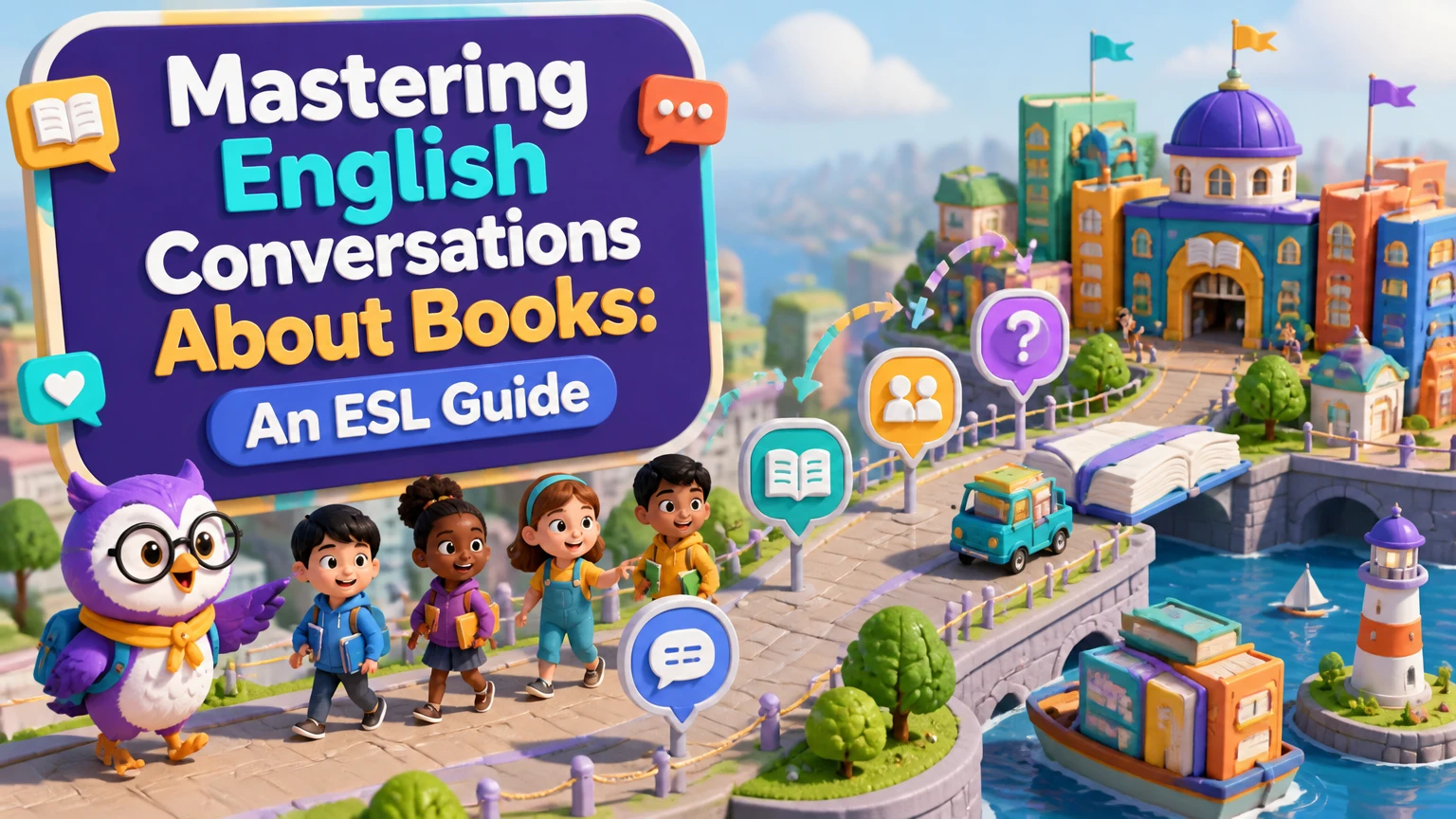
Engaging in discussions about literature is one of the most rewarding ways for English language learners to practice their speaking and comprehension skills. To participate effectively, one must master specific vocabulary and grammatical structures that allow for the expression of opinions, summaries, and critiques. For instance, learners often use descriptive adjectives such as thought-provoking, fast-paced, predictable, and well-written to characterize their reading experiences. Understanding how to use these terms within the framework of conversational English helps students move beyond simple “I like it” statements toward nuanced literary analysis. This guide is designed for intermediate to advanced ESL students who wish to expand their communicative competence through the medium of book discussions.
Table of Contents
- Defining Book-Related Discourse
- Structural Breakdown of Book Conversations
- Literary Genres and Classifications
- Describing Plots and Narratives
- Grammar for Character Analysis
- Extensive Example Tables
- Usage Rules and Tense Consistency
- Common Mistakes and How to Avoid Them
- Comprehensive Practice Exercises
- Advanced Literary Criticism for ESL
- Frequently Asked Questions
- Conclusion and Final Tips
Defining Book-Related Discourse
Book-related discourse refers to the specialized language and communicative strategies used to discuss written works. In an ESL context, this involves the intersection of functional language (giving opinions), descriptive vocabulary (adjectives and adverbs), and specific grammatical structures (the literary present tense). When we talk about books, we are not just reporting facts; we are interpreting themes, evaluating authorial intent, and sharing emotional responses. This requires a broad lexical range that spans from basic plot summaries to complex philosophical debates.
The function of this discourse is twofold: social and academic. Socially, discussing books allows learners to connect with native speakers over shared interests, fostering a sense of community and cultural exchange. Academically, it prepares students for university-level literature courses where they must defend their interpretations using evidence from the text. By mastering these conversations, learners improve their ability to summarize information, synthesize ideas, and express abstract thoughts—skills that are highly transferable to other areas of language use.
Contextually, these conversations can happen in a variety of settings, including formal book clubs, casual coffee shop chats, or structured classroom environments. Each context requires a slightly different register. A casual chat might involve phrases like “I couldn’t put it down,” while a formal critique might use “The protagonist serves as a catalyst for social change.” Understanding these shifts in register is crucial for advanced fluency and ensures that the learner’s tone matches the social situation.
Structural Breakdown of Book Conversations
A typical conversation about a book follows a predictable structural pattern. It usually begins with an opening gambit where the speakers establish which book is being discussed and why. This is followed by a summary phase, where the core plot or subject matter is outlined. Next comes the evaluation phase, where the speaker shares their personal opinion. Finally, the conversation often moves into a recommendation phase, where the speaker suggests the book to others or compares it to similar works.
To navigate these stages, learners need to understand the “Literary Present.” When summarizing a story, English speakers almost always use the present simple tense, even if the book was written or read in the past. For example, “In the first chapter, the hero discovers a secret map” is more natural than “The hero discovered a secret map.” This rule helps keep the narrative feeling immediate and alive for the listener.
Another structural element is the use of signaling phrases. These are short expressions that tell the listener what kind of information is coming next. For example, “As far as the plot is concerned…” signals a shift to narrative details, while “From my perspective…” signals a personal opinion. Mastering these transitions makes the speaker’s logic easier to follow and prevents the conversation from feeling disjointed or repetitive.
Literary Genres and Classifications
Before diving into a deep analysis, one must be able to categorize the book accurately. English has a vast array of genre-specific terms that carry certain expectations about the book’s content. Fiction and non-fiction are the two primary umbrellas, but within those, the sub-genres are numerous and specific. Knowing the difference between a “thriller” and a “mystery” or a “biography” and a “memoir” is essential for setting the right context.
Fiction Sub-genres
Fiction encompasses stories derived from the imagination. Common sub-genres include science fiction (exploring futuristic concepts), fantasy (involving magical elements), historical fiction (set in a specific past period), and romance (focusing on interpersonal relationships). Each of these genres utilizes a specific set of tropes and vocabulary that learners should be familiar with to participate in niche discussions.
Non-Fiction Sub-genres
Non-fiction deals with factual information and real-life events. This includes biographies (the life story of a person written by someone else), autobiographies (the life story of a person written by themselves), essays (short pieces on specific topics), and self-help (books designed to assist with personal growth). Discussing non-fiction often requires more objective language and the use of verbs like “argues,” “demonstrates,” or “illustrates.”
Describing Plots and Narratives
The plot is the sequence of events that make up a story. To describe a plot effectively, ESL learners should use a mix of sequencing words and action verbs. A plot description usually identifies the setting (where and when), the protagonist (the main character), the conflict (the main problem), and the resolution (how things end). Using words like “initially,” “subsequently,” and “ultimately” helps organize these elements into a coherent narrative arc.
When discussing the “pacing” of a plot, we use adjectives that describe speed and tension. A book might be gripping or compelling if it holds your attention, or it might be slow-burning if the action takes a long time to develop. If a book is difficult to stop reading, we call it a page-turner. Conversely, if the plot is too simple or easy to guess, it is often described as clichéd or formulaic.
Grammar for Character Analysis
Characters are the heart of any story, and talking about them requires a strong grasp of descriptive adjectives and the use of relative clauses. We often use the structure “The character who [action] is [adjective].” For example, “The character who betrays his friends is incredibly manipulative.” This allows the speaker to link a character’s actions directly to their personality traits.
In addition to basic descriptions, we often discuss “character development” or “character arcs.” This refers to how a person changes throughout the story. We might say a character is dynamic if they undergo significant change, or static if they remain the same. Using the present perfect can be helpful here to show change over time: “By the end of the novel, the protagonist has become much more courageous.”
Extensive Example Tables
The following tables provide a comprehensive reference for the vocabulary and phrases used in book-related conversations. These are organized by function to help you find the right words for any part of the discussion.
Table 1: Adjectives to Describe Books and Writing Styles
The table below lists 25 common adjectives used to describe the quality, tone, and impact of a book. These words are essential for moving beyond basic evaluations.
| Adjective | Definition | Example Sentence |
|---|---|---|
| Thought-provoking | Making you think seriously about a topic. | The essay was incredibly thought-provoking and changed my mind. |
| Fast-paced | Moving quickly from one event to the next. | It’s a fast-paced thriller that you can finish in one sitting. |
| Predictable | Easy to guess what will happen next. | I found the ending a bit predictable, to be honest. |
| Evocative | Bringing strong images or memories to mind. | The author’s evocative descriptions of the sea were beautiful. |
| Engrossing | Taking up all of one’s attention. | I was so engrossed in the book that I missed my bus stop. |
| Tedious | Too long, slow, or dull; tiresome. | The middle chapters were a bit tedious and hard to get through. |
| Poignant | Evoking a keen sense of sadness or regret. | The final scene where they say goodbye is very poignant. |
| Gritty | Showing the tough, realistic, and often unpleasant side. | It’s a gritty look at life in the city during the 1920s. |
| Whimsical | Playfully quaint or fanciful, especially in an appealing way. | The children’s book had a whimsical and charming tone. |
| Profound | Showing great knowledge or insight. | The philosopher’s ideas were too profound for a casual read. |
| Haunting | Difficult to ignore or forget; lingering in the mind. | The story of the lost child was truly haunting. |
| Convoluted | Extremely complex and difficult to follow. | The plot became so convoluted that I lost track of the characters. |
| Inspirational | Providing motivation or encouragement. | The biography of Malala is deeply inspirational. |
| Satirical | Using humor or irony to criticize people’s stupidity. | The book is a satirical take on modern politics. |
| Melancholic | Feeling or expressing pensive sadness. | The poem has a very melancholic and lonely atmosphere. |
| Redundant | Not or no longer needed or useful; repetitive. | The second half of the book felt redundant and unnecessary. |
| Vivid | Producing powerful feelings or strong, clear images. | She has a vivid imagination that shines through in her writing. |
| Pretentious | Attempting to impress by affecting greater importance. | I found the author’s writing style a bit pretentious. |
| Accessible | Easy to understand or enjoy. | Despite the complex topic, the book is very accessible. |
| Dated | Old-fashioned; belonging to a past time. | Some of the social commentary feels a bit dated now. |
| Compelling | Evoking interest or admiration in a powerful way. | The protagonist’s struggle is very compelling. |
| Heart-wrenching | Extremely sad and distressing. | The memoir’s climax was absolutely heart-wrenching. |
| Stilted | Stiff and unnatural (usually referring to dialogue). | The dialogue between the characters felt a bit stilted. |
| Lyrical | Expressing the writer’s emotions in an imaginative way. | The prose is lyrical and almost reads like poetry. |
| Overrated | Rated or valued too highly. | In my opinion, that bestseller is completely overrated. |
Table 2: Verbs for Summarizing and Analyzing
This table provides 20 verbs that are frequently used to describe what a book “does” or what an author “is doing” within the text.
| Verb | Function in Conversation | Example Sentence |
|---|---|---|
| Explores | Discussing themes or ideas. | The novel explores the theme of forbidden love. |
| Depicts | Showing or representing a scene or person. | The author depicts the Victorian era with great detail. |
| Chronicles | Recording a series of events in order. | The book chronicles the rise and fall of the Roman Empire. |
| Challenges | Questioning a common belief or idea. | This work challenges our assumptions about technology. |
| Illustrates | Providing an example to make a point clear. | The story illustrates the importance of family loyalty. |
| Critiques | Evaluating or criticizing a system or idea. | The author critiques the modern education system. |
| Symbolizes | Using an object to represent an abstract idea. | The green light symbolizes the character’s hope. |
| Foreshadows | Giving a hint of what is to come later. | The opening scene foreshadows the tragic ending. |
| Emphasizes | Giving special importance or prominence to. | The writer emphasizes the need for environmental reform. |
| Juxtaposes | Placing two things together for contrast. | The poet juxtaposes light and dark imagery. |
| Narrates | Telling a story or account. | The protagonist narrates the story in the first person. |
| Delves into | Examining something in great detail. | The second chapter delves into the character’s childhood. |
| Exposes | Revealing a hidden truth or scandal. | The journalist exposes corruption in the government. |
| Satirizes | Mocking something through humor. | The play satirizes the upper class of society. |
| Humanizes | Making a person or character seem relatable. | The writing humanizes the historical villain. |
| Intertwines | Connecting two or more plot lines. | The author intertwines three different stories beautifully. |
| Alludes to | Making an indirect reference to something. | The title alludes to a famous Shakespearean play. |
| Captures | Successfully representing a feeling or atmosphere. | The book captures the essence of summer in the 90s. |
| Traces | Following the development or history of something. | The author traces the origins of the English language. |
| Portrays | Describing or showing someone in a particular way. | He portrays the main character as a misunderstood hero. |
Table 3: Phrases for Giving Opinions and Recommendations
Use these 20 phrases to express your personal feelings about a book and to suggest it to others in a natural way.
| Phrase | Usage Context | Example Sentence |
|---|---|---|
| I couldn’t put it down. | Very positive; high engagement. | I started it last night and I couldn’t put it down. |
| It’s a real page-turner. | Describing an exciting plot. | If you like mysteries, this is a real page-turner. |
| It lived up to the hype. | When a popular book is actually good. | Everyone was talking about it, and it lived up to the hype. |
| It wasn’t really my cup of tea. | Polite way to say you didn’t like it. | I see why people like it, but it wasn’t my cup of tea. |
| I found it a bit of a struggle. | When a book is difficult to finish. | I found the first 100 pages a bit of a struggle. |
| It’s a must-read for… | Strong recommendation for a group. | It’s a must-read for anyone interested in history. |
| I’d highly recommend it. | General strong recommendation. | I’d highly recommend it to all my friends. |
| It left a lasting impression. | When a book is memorable. | The ending left a lasting impression on me. |
| It resonated with me. | When you relate to the themes. | The character’s struggle really resonated with me. |
| I was pleasantly surprised. | When expectations were low but met. | I didn’t think I’d like sci-fi, but I was pleasantly surprised. |
| It fell short of my expectations. | When a book was disappointing. | I loved her first book, but this one fell short of my expectations. |
| It’s not worth the read. | Strong negative recommendation. | Honestly, I think it’s not worth the read. |
| I’m on the fence about it. | When you have mixed feelings. | I’m on the fence about it; some parts were great, others dull. |
| It’s a bit of a slow-burner. | When the plot develops slowly. | Give it time; it’s a bit of a slow-burner. |
| I was hooked from the start. | Immediate engagement. | I was hooked from the very first sentence. |
| It’s a masterpiece. | Extremely high praise. | In my opinion, this novel is a modern masterpiece. |
| It’s light reading. | Easy, non-serious book. | It’s perfect for the beach; just some light reading. |
| It’s quite heavy. | Serious, difficult, or sad topics. | Be prepared; the subject matter is quite heavy. |
| It’s a classic for a reason. | Validating the status of a famous book. | I finally read Gatsby, and it’s a classic for a reason. |
| I’m halfway through it. | Reporting progress. | I’m halfway through it, and I still don’t know the killer! |
Usage Rules and Tense Consistency
When discussing books, maintaining consistency in your verb tenses is vital for clarity. The most important rule is the Literary Present. Even if the book was written centuries ago, the actions within the story are treated as if they are happening now. For example, “Romeo kills himself because he thinks Juliet is dead.” We use the present simple because the story exists eternally in the pages of the book. However, if you are talking about the author’s life or the process of writing, you should use the past tense: “Shakespeare wrote this play in the early 1600s.”
Another rule involves the use of Modals of Deduction. When we are interpreting a character’s motives or predicting a plot twist, we use words like “must,” “might,” or “could.” For example, “The butler must have known about the secret passage.” This shows that you are making an inference based on evidence rather than stating a known fact. Using these modals correctly adds a layer of sophistication to your literary analysis.
Finally, pay attention to the Passive Voice. While active voice is generally preferred, the passive voice is useful when the focus is on the recipient of an action or when the “doer” is unknown. For instance, “The protagonist is haunted by his past” or “The mystery is solved in the final chapter.” This shifts the emphasis onto the thematic elements of the story rather than just the plot actions.
Common Mistakes and How to Avoid Them
ESL learners often face specific hurdles when discussing literature. One common error is the overuse of the past tense when summarizing plots. While it feels natural to use the past tense for things that “happened” in the story, it can make the summary sound like a history report rather than a literary discussion. Always try to default to the present simple for plot summaries.
Another mistake is the misplacement of adjectives. Learners sometimes say “A book very interesting” instead of “A very interesting book.” In English, adjectives almost always precede the noun they modify. Additionally, be careful with the distinction between -ed and -ing adjectives. You are interested in a book because the book is interesting. You are bored by a book because the book is boring. Confusing these two can lead to significant misunderstandings.
| Incorrect Usage | Correct Usage | Explanation |
|---|---|---|
| In the book, the hero died. | In the book, the hero dies. | Use the literary present for plot summaries. |
| I am very interesting in this book. | I am very interested in this book. | Use -ed for your feelings, -ing for the cause. |
| The story is too much long. | The story is too long. | “Too much” is for uncountable nouns; “too” is for adjectives. |
| I readed a great book. | I read a great book. | “Read” is an irregular verb (pronounced ‘red’ in past). |
| The author wrote the book very good. | The author wrote the book very well. | Use the adverb “well” to modify the verb “wrote.” |
Comprehensive Practice Exercises
To master these concepts, practice is essential. The following exercises are designed to test your understanding of vocabulary, grammar, and conversational flow in the context of book discussions.
Exercise 1: Vocabulary Match
Match the literary term on the left with its correct definition on the right.
| Term | Definition |
|---|---|
| 1. Protagonist | A. A hint about future events in the story. |
| 2. Foreshadowing | B. The main character of a story. |
| 3. Genre | C. The primary problem or struggle in a plot. |
| 4. Conflict | D. A category or type of literature. |
| 5. Setting | E. The time and place where a story occurs. |
Exercise 2: Tense Correction
Rewrite the following sentences using the correct “Literary Present” tense.
- In the final scene, the detective found the missing jewels.
- The author was describing the landscape in great detail throughout the first chapter.
- When the monster appeared, the villagers ran away in fear.
- The story ended with a surprising twist that no one expected.
- As the protagonist grew older, he realized the truth about his family.
Exercise 3: Opinion Fill-in-the-Blanks
Complete the sentences with the most appropriate phrase from the list: page-turner, cup of tea, lived up to the hype, couldn’t put it down, slow-burner.
- I stayed up until 3 AM reading because I simply ___________.
- I didn’t really like the fantasy setting; it just wasn’t my ___________.
- The first half was a bit of a ___________, but the ending was spectacular.
- Everyone said this was the best book of the year, and it definitely ___________.
- This thriller is a real ___________; I finished it in just two days!
Advanced Literary Criticism for ESL
For advanced learners, moving beyond plot and character into the realm of literary criticism is the next step. This involves analyzing the “subtext”—the underlying meaning or message that isn’t explicitly stated. To do this, you need to use verbs like “subverts,” “deconstructs,” or “interrogates.” For example, “The novel subverts the traditional hero’s journey by making the protagonist fail in the end.”
Another advanced concept is intertextuality, which refers to the way books reference or influence one another. When discussing this, you might say, “This book is reminiscent of Orwell’s 1984,” or “The author draws parallels between her characters and Greek mythological figures.” This requires a broader knowledge of the “literary canon”—the collection of works considered most important in a culture.
Finally, advanced students should practice nuanced critique. Instead of just saying a book is “bad,” an advanced speaker might say, “While the prose is elegant, the character motivations feel underdeveloped.” Or, “The author’s use of unreliable narration creates a sense of ambiguity that might frustrate some readers.” These types of comments show a high level of critical thinking and linguistic precision.
Frequently Asked Questions
1. Should I always use the present tense when talking about a book?
Use the present tense for the actions happening inside the story (the plot). Use the past tense for the author’s life, the historical context of when the book was written, or your own personal history of reading the book (e.g., “I read it last summer”).
2. What is the difference between a “theme” and a “plot”?
The plot is what happens (the sequence of events), while the theme is what it’s about on a deeper level (e.g., love, betrayal, the struggle for power). Plot is concrete; theme is abstract.
3. How can I sound more natural when I didn’t like a book?
Instead of saying “It was bad,” use softer phrases like “It didn’t quite resonate with me,” “I found it a bit hard to get into,” or “It wasn’t really my cup of tea.” This sounds more like a personal opinion and less like an objective fact.
4. What does “pacing” mean in a book?
Pacing refers to the speed at which the story unfolds. High-action thrillers usually have “fast pacing,” while character-driven dramas might have “slow pacing.”
5. How do I describe a book that is very famous but I haven’t read?
You can use phrases like “It’s on my to-read list,” “I’ve heard mixed reviews about it,” or “It’s a classic that I’ve been meaning to get to.”
6. What is an “unreliable narrator”?
This is a character telling the story whose credibility is compromised. They might be lying, mentally ill, or simply biased, meaning the reader cannot fully trust their version of events.
7. Can I use “boring” to describe a book?
Yes, but “tedious,” “uninspiring,” or “monotonous” are more descriptive and sophisticated alternatives for an ESL learner looking to improve their vocabulary.
8. How do I talk about the ending without giving it away?
Use the term “spoilers.” You can say, “I won’t give any spoilers, but the ending was very unexpected,” or “Without spoiling it, let’s just say the ending is quite controversial.”
Conclusion and Final Tips
Mastering the art of talking about books in English is a journey that combines vocabulary building with a deep understanding of narrative structure. By utilizing the literary present, expanding your repertoire of descriptive adjectives, and practicing signaling phrases, you can engage in meaningful discussions with confidence. Remember that there is no “right” opinion in literature; the goal is to express your unique perspective clearly and support it with examples from the text. Keep a reading journal to jot down new words and practice summarizing chapters as you go. Over time, these conversations will become second nature, allowing you to connect with the global community of readers and thinkers. Happy reading and happy talking!