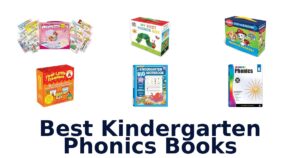
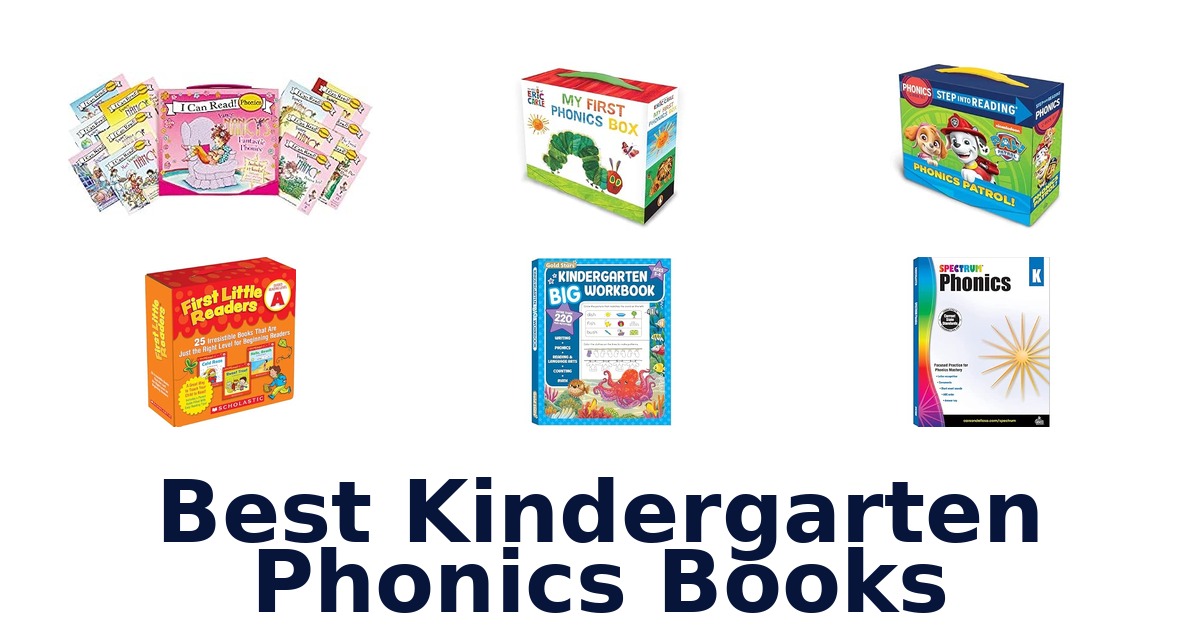
A strong kindergarten phonics book gives a child practice matched to their current reading step, whether they are learning letter sounds, blending simple words, or reading short stories. Bob Books – Set 1: Beginning Readers leads this selection for its small-step progression and words children can sound out. The list also includes focused workbooks, such as Spectrum Kindergarten Phonics Workbook and CVC Words for Kindergarten, plus mini-book collections that pair phonics with familiar characters.
These formats serve different needs: workbooks emphasize written practice, while readers invite children to apply sounds in stories. Check the age guidance and the skills named in each title, then choose the format your child is most likely to use.
The rankings prioritize kindergarten phonics relevance and specific practice details over character recognition alone.
Bob Books – Set 1: Beginning Readers is the strongest all-around match because it is identified for kindergarten and phonics, uses words children can sound out, and progresses in small steps. For children who need structured written practice, Spectrum Kindergarten Phonics Workbook focuses on letter recognition, alphabet order, and vowel and consonant sounds. Pete the Cat 12-Book Phonics Fun!
is a story-based alternative with 12 mini-books featuring short and long vowel sounds.
Our Top Picks
 Best Overall
Made for kindergarten and beginning readers, it teaches with sound-out words, simple illustrations, and small steps intended to build decoding confidence.
View on Amazon Best Skills Workbook
Spectrum Kindergarten Phonics Workbook
Its 144 pages focus on kindergarten phonics, including letter recognition, alphabet order, and vowel and consonant sound practice.
View on Amazon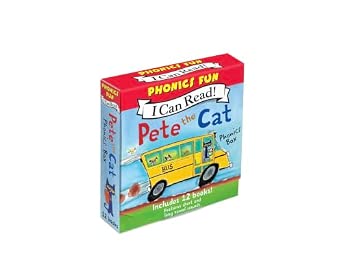 Best Vowel Readers
This 12-mini-book set explicitly features short and long vowel sounds and is intended for children ages 3 to 6.
View on Amazon- Best CVC Practice CVC Words for Kindergarten
Compare These Kindergarten Phonics Books
| # | Product | Buy |
|---|---|---|
| 1 | 1. Bob Books Set 1Best Overall | View on Amazon |
| 2 | 2. Spectrum Kindergarten Phonics WorkbookBest Skills Workbook | View on Amazon |
| 3 | 3. Pete the Cat Phonics FunBest Vowel Readers | View on Amazon |
| 4 |  4. CVC Words for KindergartenBest CVC Practice | View on Amazon |
| 5 |  5. Pinkalicious Phonics FunPinkalicious vowel-sound readers | View on Amazon |
| 6 |  6. Gold Stars Kindergarten Big WorkbookMulti-subject kindergarten practice | View on Amazon |
| 7 |  7. PAW Patrol Phonics Box SetPAW Patrol phonics readers | View on Amazon |
| 8 |  8. Eric Carle First Phonics BoxEric Carle beginning-reader collection | View on Amazon |
| 9 |  9. Fancy Nancy Phonics FunFancy Nancy phonics collection | View on Amazon |
| 10 |  10. First Little Readers Parent PackGuided-reading level A set | View on Amazon |
Detailed Reviews: Best Kindergarten Phonics Books
#1 · Best Overall
1. Bob Books Set 1
Best for: Step-by-step first readers.
Why it ranks #1: Made for kindergarten and beginning readers, it teaches with sound-out words, simple illustrations, and small steps intended to build decoding confidence.
Small-step progression pairs decodable words with simple illustrations, helping children practice sounding out words and recognize their own decoding success. Created by a teacher and based in the Science of Reading, Bob Books Set 1 is listed for ages four and up and Stage 1 starting readers.
The set's small steps support a gradual first-reading workflow, while words that can be sounded out give children a concrete chance to apply phonics rather than rely only on memorization. Simple illustrations accompany those words, providing visual context as children work through the stories. The teacher-created, Science of Reading basis is stated as part of its approach. Its stated level is Stage 1, making this a beginning-reader set rather than a later-stage reading collection.
- Progresses in small steps
- Uses words that can be sounded out
- Pairs text with simple illustrations
- Teacher-created and based in the Science of Reading
- It is a Stage 1 starting-reader set, not a later-stage reading collection.
Skip it if you need a workbook with tracing, spelling, and math activities rather than beginning-reader stories.
Choose this set for a child starting to decode words through short, incremental stories, especially when simple illustrations are useful support. Its Stage 1 positioning is the boundary: children ready for more advanced reading may need a later level.
Listed on Amazon as: Bob Books – Set 1: Beginning Readers Box Set | Phonics, Ages 4 and up, Kindergarten (Stage 1: Starting to Read)
View on Amazon#2 · Best Skills Workbook
2. Spectrum Kindergarten Phonics Workbook
Best for: Kindergarten phonics workbook practice.
Why it ranks #2: Its 144 pages focus on kindergarten phonics, including letter recognition, alphabet order, and vowel and consonant sound practice.
A 144-page workbook centers on letter recognition, alphabet order, and vowel and consonant sounds for kindergarten learners ages five to six. Its focused practice format gives families a paper-based option for working through several foundational phonics topics in a kindergarten routine.
Letter recognition and alphabet-order practice address early familiarity with letters, while vowel and consonant sound work brings sound identification into the same workbook. Across 144 pages, the listed activities provide a substantial paper-based practice resource for home or classroom use. Spectrum describes its workbooks as supporting individual learner needs from classroom to kitchen table. The supplied facts establish focused phonics practice; they do not identify a story collection or non-phonics subject mix.
- 144 pages
- Covers letter recognition and alphabet order
- Includes vowel and consonant sound practice
- Listed for kindergarten ages five to six
- The listed topics focus on phonics rather than a multi-subject workbook range.
Skip it if you want story-based readers or math and writing activities in the same book.
Consider this workbook for kindergarteners who need structured practice with letters, alphabet order, and speech sounds at home or in class. It is a focused phonics resource, so choose another format if your routine calls for stories or several school subjects.
Full product details
| Additional Information | Important information |
|---|
Listed on Amazon as: Spectrum Kindergarten Phonics Workbook, Ages 5 to 6, Kindergarten Phonics Workbooks, Letter Recognition, Alphabet Order, Vowel and Consonant Sound Practice – 144 Pages
View on Amazon#3 · Best Vowel Readers
3. Pete the Cat Phonics Fun
Best for: Pete the Cat mini-book readers.
Why it ranks #3: This 12-mini-book set explicitly features short and long vowel sounds and is intended for children ages 3 to 6.
Twelve mini-books focused on short and long vowel sounds give young readers a compact way to practice phonics through Pete the Cat stories. The ages 3–6 range makes this collection an option for early readers, while the varied adventures give the set a story-led identity.
The 12-book mini format lets families work through one small reader at a time, while the short- and long-vowel focus keeps practice centered on a defined early phonics skill. Supplied story details include Super Pete's rescue adventures, a family road trip, and a first camping trip, giving children different settings to explore across the collection. Paperback format suits a home reading routine; the listed scope is vowel sounds rather than a broad workbook curriculum.
- Twelve individual mini-books
- Short- and long-vowel sound focus
- Pete the Cat story settings include rescue, travel, and camping
- Listed for ages 3–6
- Phonics scope is centered on short and long vowel sounds.
Skip it if you want a broad workbook covering writing, math, and language arts alongside phonics.
A good fit for families seeking short, story-based phonics sessions with a familiar Pete the Cat character. Its clear vowel-sound focus suits early practice, but buyers wanting varied school subjects or extensive workbook activities should choose a broader resource.
Listed on Amazon as: Pete the Cat 12-Book Phonics Fun!: A Box of 12 Mini-Books Featuring Short and Long Vowel Sounds – Expert-Reviewed Beginning Readers for Kids (Ages 3-6) (I Can Read Phonics Fun)
View on Amazon#4 · Best CVC Practice
4. CVC Words for Kindergarten
Best for: CVC tracing and spelling practice.
Why it ranks #4: It targets easy CVC words for ages 4 to 8 and combines learning to read with tracing and spelling practice.
CVC words are the focus of this workbook, with learn-to-read, trace, and spell practice for children ages four to eight. That combination gives early learners a way to work with simple word patterns on the page, while the title makes its skill scope clearer than a general reading collection.
The learn-to-read, trace, and spell framing links word recognition with written practice, supporting a routine that moves from looking at CVC words to forming and spelling them. The listed ages four to eight cover a broad early-learning span, so the book can suit children at different points within that range. Additional supplied information mentions letter and number tracing with dinosaurs. This adds tracing content, though the stated central focus remains CVC words.
- Centers on CVC words
- Combines reading, tracing, and spelling
- Listed for ages four to eight
- Additional information mentions dinosaur-themed letter and number tracing
- The main stated reading focus is CVC words.
Skip it if you want a broad phonics curriculum covering a clearly listed range of vowel patterns and reading levels.
A fit for children ages four to eight who need hands-on practice reading, tracing, and spelling CVC words. Its specific word-pattern emphasis suits targeted practice; families seeking a wider sequence of phonics skills should look for a broader scope.
Listed on Amazon as: CVC Words for Kindergarten: Learn to Read, Trace & Spell Easy CVC Words – Phonics Workbook for Kids Ages 4-8
View on Amazon#5
5. Pinkalicious Phonics Fun
Best for: Pinkalicious vowel-sound readers.
Why it ranks #5: The 12 mini-books feature short and long vowel sounds for ages 3 to 6, with the listing also naming sight words and literacy development.
Twelve Pinkalicious mini-books cover short and long vowel sounds, giving children ages 3–6 a character-led format for early phonics practice. The collection also identifies sight words and literacy development in its title, making it a fit for families seeking a small-book reading routine.
The 12 mini-books create a simple way to divide reading into brief sessions, while the stated short- and long-vowel content keeps phonics practice focused. Pinkalicious provides the collection's character identity, and the title also points to sight words and literacy development as intended areas. Paperback format supports handling as individual readers. The supplied details do not specify a workbook or broader subject mix, so its clearest fit is an early-reader book set centered on phonics.
- Twelve mini-books in the collection
- Short- and long-vowel sound focus
- Pinkalicious character-led reading
- Title identifies sight words and literacy development
- Its stated phonics scope centers on short and long vowels.
Skip it if you want a workbook with clearly listed handwriting, math, or multi-subject activities.
This collection suits Pinkalicious fans and early readers ages 3–6 who benefit from several small books for vowel-focused practice. Consider its stated scope before choosing it if you need a detailed curriculum or extensive non-reading activities.
View on Amazon#6
6. Gold Stars Kindergarten Big Workbook
Best for: Multi-subject kindergarten practice.
Why it ranks #6: This ages 5 to 6 workbook includes 220-plus activities across writing, phonics, reading, language arts, counting, and math.
More than 220 activities combine writing, phonics, reading, language arts, counting, and math in one kindergarten workbook. That mix lets families move between literacy and number practice within a single activity book, with the listed age range of five to six aligning with kindergarten.
The broad subject mix gives a caregiver options to shift from phonics and reading to writing or counting without switching to a separate workbook. More than 220 activities provide the stated volume of practice, and the expert-teacher and educational-consultant development is described as supporting school learning. The additional guidance notes pencil use and practicing strokes, connecting workbook time to early writing skills. Preschool and first-grade workbooks are also named as adjacent levels in the series.
- More than 220 activities
- Combines phonics, reading, writing, and language arts
- Also includes counting and math
- Teacher and educational-consultant developed
- Its phonics practice shares space with several other subjects.
Skip it if you want a phonics-only book with reading stories rather than a multi-subject activity workbook.
A practical choice for kindergarten families wanting literacy and math activities together, especially when pencil practice is part of the routine. It is not a phonics-only resource, so readers seeking concentrated sound work may prefer a dedicated phonics book.
Listed on Amazon as: Kindergarten Big Workbook Ages 5 -6: 220+ Activities, Writing, Phonics, Reading & Language Arts, Counting and Math (Gold Stars Series)
View on Amazon#7
7. PAW Patrol Phonics Box Set
Best for: PAW Patrol phonics readers.
Why it ranks #7: It is explicitly identified as a phonics box set in the Step into Reading line, though the supplied details do not specify its sound skills or book count.
A PAW Patrol-branded Step into Reading box set puts familiar characters at the center of a phonics collection for young readers. The paperback format and storybook identity suit children drawn to the franchise, while the supplied listing identifies the set as phonics-focused rather than a general workbook.
The PAW Patrol theme gives the collection a recognizable character hook for children who enjoy the series, and the Step into Reading label identifies its reading-series format. As a box set of paperback books, it offers multiple reading pieces rather than a single workbook. The supplied product facts do not state the number of books, age range, or specific phonics patterns, so buyers should treat those as unspecified and base the choice on the stated theme and format.
- PAW Patrol character theme
- Step into Reading series identification
- Phonics-focused collection
- Paperback box-set format
- The supplied details do not specify particular phonics patterns.
Skip it if you need the book count, age range, or specific sound sequence stated before selecting a phonics set.
This set fits a young PAW Patrol fan who is drawn to character-based reading and a phonics collection in paperback format. Its supplied details are limited on level and skill sequence, so it is less clear for buyers following a specific phonics plan.
Listed on Amazon as: Paw Patrol Phonics Box Set (PAW Patrol) (Step into Reading)
View on Amazon#8
8. Eric Carle First Phonics Box
Best for: Eric Carle beginning-reader collection.
Why it ranks #8: The 12-book beginning-reader box includes eight decodable books and 32 flashcards, giving early readers more than one practice format.
Twelve books in a first-phonics box bring Eric Carle's familiar world to beginning readers. Supplied details also describe a set of eight decodable books and 32 flashcards, while another note refers to a twelve-book sight-words box; buyers should distinguish those descriptions when choosing the format.
The product title identifies a 12-book box for beginning readers, offering a book-based way to start phonics reading. Additional supplied facts describe eight decodable books with 32 flashcards, which would pair reading with a separate card-based component, and also mention a sight-words box of twelve books. Since the supplied descriptions refer to different configurations, confirm which contents apply to the offered edition rather than assuming every listed component is included together.
- Title identifies 12 books
- Aimed at beginning readers
- Eric Carle theme, including the Very Hungry Caterpillar
- Additional description mentions decodable books and flashcards
- Supplied descriptions give differing contents: 12 books, or eight decodable books with 32 flashcards.
Skip it if you need an unambiguous contents list before choosing between book-and-flashcard or twelve-book configurations.
This may suit young Eric Carle fans starting to read, particularly when a recognizable character helps draw them to books. Because supplied descriptions differ on book count and flashcards, select it only after identifying the contents of the offered edition.
Listed on Amazon as: World of Eric Carle: My First Phonics Box: 12 Books for Beginning Readers
View on Amazon#9
9. Fancy Nancy Phonics Fun
Best for: Fancy Nancy phonics collection.
Why it ranks #9: This 12-book phonics collection is intended for children ages 4 to 8, but the supplied details do not identify particular phonics skills.
Twelve books bring Fancy Nancy into a phonics collection for children ages four to eight, giving early readers multiple small-format reading pieces around a named character. The My First I Can Read designation identifies it as an early-reader series collection rather than a standalone workbook.
The 12-book collection lets families offer more than one reading selection while staying with the Fancy Nancy character theme. Its My First I Can Read label signals an early-reader format, and the listed ages four to eight give a broad age range for the intended audience. The supplied facts do not name specific phonics patterns or accompanying exercises, so the clearest use is character-based early reading rather than targeted worksheet practice.
- Twelve-book collection
- Fancy Nancy character theme
- My First I Can Read series designation
- Listed for ages four to eight
- The supplied details do not identify specific phonics patterns or exercises.
Skip it if you need explicit vowel, consonant, or CVC skill coverage listed for targeted phonics practice.
Choose this collection for a child ages four to eight who enjoys Fancy Nancy and is ready for early-reader books. It offers a character-centered reading format, but buyers needing named phonics skills or workbook exercises should consider a more explicit practice resource.
Listed on Amazon as: Fancy Nancy's 12-Book Fantastic Phonics Fun!: A Phonics Collection for Children (Ages 4-8) (My First I Can Read)
View on Amazon#10
10. First Little Readers Parent Pack
Best for: Guided-reading level A set.
Why it ranks #10: It offers 25 beginning-reader books at Guided Reading Level A, but the supplied details do not establish a specific phonics or decoding focus.
Twenty-five books at Guided Reading Level A give beginning readers a collection organized around a stated reading level. The Parent Pack framing makes it suitable for shared family reading, while the title's emphasis on just-right books signals a level-specific starting point rather than a broad workbook.
Having 25 separate books lets a family or educator rotate among multiple readers while keeping to the listed Level A designation. The beginning-reader focus provides a clear audience, and the Parent Pack title positions the set for guided use alongside an adult. The supplied details describe educational resources for teachers and families, but do not list particular phonics patterns or activity types. Buyers looking specifically for sound-by-sound instruction should weigh that distinction when selecting this reading set.
- Includes 25 books
- Guided Reading Level A designation
- Aimed at beginning readers
- Parent Pack format for family-supported reading
- The supplied description does not identify specific phonics patterns taught.
Skip it if you need named vowel patterns, decodable-word practice, or workbook exercises specified in the product details.
This is a fit for families seeking a sizeable group of Level A books for guided beginning reading. Choose it for level-based reading sessions; if your priority is explicit practice in particular phonics skills, its supplied details do not spell out those patterns.
Listed on Amazon as: First Little Readers Parent Pack: Guided Reading Level A: 25 Irresistible Books That Are Just the Right Level for Beginning Readers
View on AmazonAvoid mistaking familiar characters for phonics coverage
A familiar character can encourage a child to open a book, but the character alone does not show which phonics skills the set teaches. The listed details make the distinction clear: Pete the Cat 12-Book Phonics Fun! and Pinkalicious Phonics Fun each specify short and long vowel sounds, while Bob Books – Set 1: Beginning Readers specifies sound-out words and small-step progression.
By contrast, the PAW Patrol Phonics Box Set is identified as a phonics set, but the supplied product information does not name its sound sequence or contents. That missing detail is a real selection limitation, not proof that its coverage is inadequate.
If a child is working on a specific skill, favor a title that names that skill. If motivation is the priority, a character set may help, but check the books’ contents before treating it as a complete teaching sequence.
Match the practice format to the skill you want to reinforce
A book set and a workbook do not provide interchangeable practice, even when both mention phonics. Spectrum Kindergarten Phonics Workbook offers 144 pages with letter recognition, alphabet order, and vowel and consonant sound practice; CVC Words for Kindergarten explicitly combines reading, tracing, and spelling simple CVC words. Mini-book collections such as Pete the Cat Phonics Fun present short and long vowel sounds through 12 small readers instead.
This creates a practical trade-off: a workbook names written activities more clearly, while readers provide stories in which a child can try applying sounds while reading. Some listings also bundle skills beyond phonics: the Gold Stars workbook includes 220-plus activities across writing, reading, language arts, counting, and math.
Decide whether focused repetition or a broader activity mix better fits the next home-learning session.
How to Choose Kindergarten Phonics Books
Choose the phonics skill
Look for a title that names the sound or reading skill your child is practicing. Spectrum Kindergarten Phonics Workbook lists letter recognition, alphabet order, and vowel and consonant sound practice; Pete the Cat Phonics Fun and Pinkalicious Phonics Fun feature short and long vowel sounds. CVC Words for Kindergarten focuses on easy CVC words and includes reading, tracing, and spelling.
Bob Books – Set 1: Beginning Readers uses sound-out words and small steps but does not specify a particular vowel sequence in the supplied details. Choose broader alphabet and sound work for a child building early foundations, and choose CVC or vowel-focused material when you already know which skill to reinforce.
Decide between readers and written practice
Choose the format that matches how your child will practice most readily. Bob Books – Set 1: Beginning Readers uses simple illustrations and sound-out words in stories, while Pete the Cat Phonics Fun supplies 12 mini-books. For more explicit pencil-and-paper practice, Spectrum Kindergarten Phonics Workbook has 144 pages, and CVC Words for Kindergarten combines reading with tracing and spelling.
Gold Stars Kindergarten Big Workbook goes wider, with 220-plus activities spanning phonics, writing, reading, language arts, counting, and math. Readers suit families seeking sound practice within books; workbooks suit children who benefit from tracing or varied exercises.
A broad workbook may be a better fit when phonics is only one of several skills being practiced.
Check age guidance and set size
Use the stated ages and book counts to judge whether a set fits your learner and practice routine. Bob Books – Set 1: Beginning Readers is marked for ages 4 and up and kindergarten; Pete the Cat Phonics Fun and Pinkalicious Phonics Fun are for ages 3 to CVC Words for Kindergarten lists ages 4 to 8, while Fancy Nancy Phonics Fun lists ages 4 to 8.
The mini-book collections from Pete the Cat and Pinkalicious each contain 12 books, and First Little Readers Parent Pack contains 25 books at Guided Reading Level A. Younger beginners may prefer age-matched, short-step material; families wanting many short reading opportunities may favor a larger set, while checking that its phonics focus suits the child.
Which Kindergarten Phonics Book Should I Choose?
For a kindergarten beginner who is ready to sound out words, choose Bob Books Set 1: its simple illustrations and small-step progression make it the strongest overall fit. Choose Spectrum Kindergarten Phonics Workbook if your child needs direct practice with letter recognition, alphabet order, or vowel and consonant sounds. For short and long vowel reading practice in mini-books, choose Pete the Cat Phonics Fun; for CVC reading, tracing, and spelling, choose CVC Words for Kindergarten.
Pick Gold Stars Kindergarten Big Workbook when you want phonics among a wider mix of school activities. If familiar characters may encourage reading, consider Pinkalicious Phonics Fun, PAW Patrol Phonics Box Set, or Eric Carle First Phonics Box, but verify specific skill coverage where the listing details are limited.
First Little Readers Parent Pack is better treated as guided beginning reading than a clearly specified phonics program.
Related Buying Guides
Frequently Asked Questions
How can I tell whether my kindergartener is ready to move from letter sounds to decodable books?
Look for a child who can recognize some letters and connect them with their sounds, then try a simple decodable book together. If the child can sound out a few words with support, short, gradual reading practice may fit. If not, revisit letter recognition and sounds before expecting independent reading.
Should phonics practice at home focus on reading aloud, tracing, or spelling?
Choose the activity that matches the skill your child needs to practice. Reading aloud gives a chance to sound out words; tracing supports written letter practice; spelling asks a child to connect sounds with letters. A workbook such as Spectrum focuses on letter recognition, alphabet order, and vowel and consonant sounds.
How much adult help should a child get when sounding out an unfamiliar word?
Offer enough help to keep the child engaged, but leave room for them to try. Invite them to look at the letters and say the sounds, then give a prompt if they get stuck. If the word remains frustrating, model it and return to easier words or a smaller step.
Which type of book fits a child who needs more structured written practice?
A workbook is a sensible choice when the goal is direct practice on paper. Spectrum Kindergarten Phonics Workbook focuses on letter recognition, alphabet order, and vowel and consonant sounds. CVC Words for Kindergarten is another option for reading, tracing, and spelling simple CVC words.
What should I check when choosing a character-based phonics book?
Check the listing for the specific phonics skills and activities it covers rather than relying on a familiar character alone. The roundup identifies Pinkalicious, PAW Patrol, and Eric Carle options as character-based possibilities, but notes that skill coverage may be limited in the listing details.
Final Words
For a kindergarten beginner ready to sound out words, start with Bob Books Set 1, whose small-step progression makes it the strongest overall fit. Choose Spectrum for focused written practice with letters and sounds, or CVC Words for reading, tracing, and spelling. Pete the Cat offers short- and long-vowel mini-books; Gold Stars combines phonics with broader activities.
For character-led options, check the listed skill coverage before choosing.