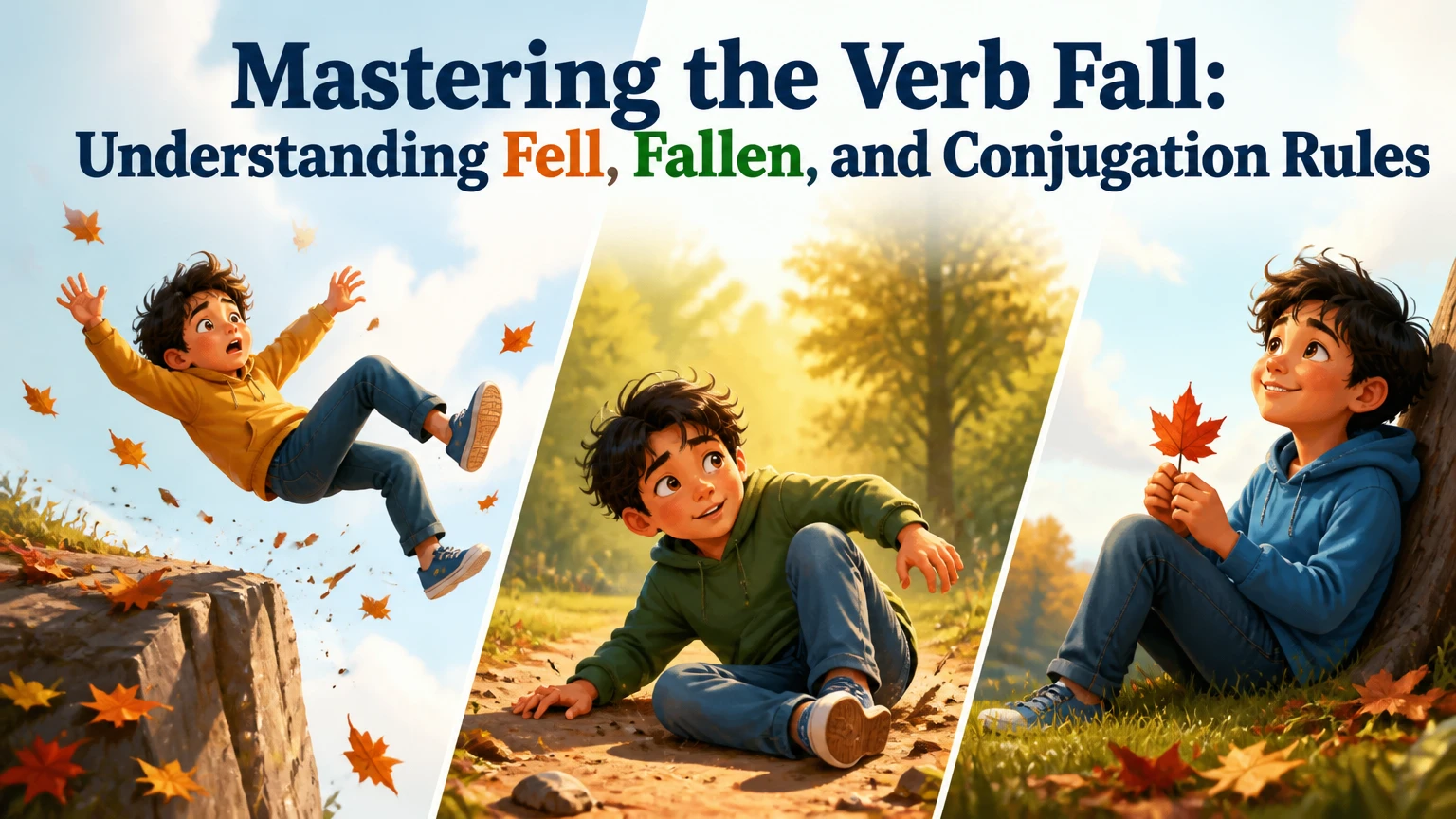
The English verb fall is a fundamental part of the language, used to describe downward movement, changes in states, or even metaphorical declines. When navigating its various forms, learners must distinguish between the simple past and the past participle, such as fell, fallen, falling, and falls. Understanding these distinctions is critical for maintaining subject-verb agreement and ensuring that tense usage aligns with the intended timeline of an action. This article serves as a comprehensive guide for students, writers, and educators who wish to master the nuances of this irregular verb in both formal and informal contexts.
Practical application of this verb appears in everyday phrases including to fall in love, to fall behind, and to fall apart. By mastering the conjugation of fall, you gain the ability to describe physical actions like a leaf dropping from a tree or abstract concepts such as a sudden drop in market prices. Whether you are writing a creative story or a technical report, knowing when to use the simple past fell versus the perfect tense fallen is essential for grammatical precision and clarity in communication.
Table of Contents
- Definition and Linguistic Classification
- Structural Breakdown of the Verb Fall
- Tense Variations and Conjugation Patterns
- Extensive Examples and Reference Tables
- Usage Rules and Syntactic Contexts
- Phrasal Verbs with Fall
- Common Mistakes and How to Avoid Them
- Practice Exercises and Worksheets
- Advanced Topics: Idioms and Nuance
- Frequently Asked Questions (FAQ)
- Conclusion and Final Tips
Definition and Linguistic Classification
The verb fall is classified as an irregular strong verb in English. Unlike regular verbs that follow a predictable pattern of adding “-ed” to form the past tense (like walk becoming walked), irregular verbs undergo internal vowel changes or stem transformations. In the case of fall, the vowel shifts from ‘a’ to ‘e’ in the past tense and adds an ‘-en’ suffix for the past participle.
Semantically, fall primarily denotes a movement from a higher position to a lower one under the influence of gravity. However, its function extends far beyond physical descent. It acts as a linking verb when describing a transition into a new state, such as falling ill or falling asleep. It also functions as an intransitive verb, meaning it does not require a direct object to complete its meaning; one can simply say, “The rain fell.”
In linguistic terms, fall belongs to a specific class of Germanic strong verbs. These verbs are characterized by “ablaut,” a process where the root vowel changes to indicate different grammatical functions. This history explains why we do not say “falled.” Understanding this classification helps learners recognize that fall belongs to a family of verbs with similar patterns, such as grow/grew/grown or throw/threw/thrown, though the specific vowel shifts may vary.
Structural Breakdown of the Verb Fall
Breaking down the structure of fall requires looking at its four primary principal parts. These parts are the foundation upon which all twelve English tenses are built. The base form is fall, the simple past is fell, the past participle is fallen, and the present participle is falling. Each of these serves a distinct purpose in sentence construction.
The base form, fall, is used for the simple present tense (except for the third-person singular) and with modal verbs like can, will, or should. The simple past, fell, is used exclusively for completed actions in the past that do not have a direct connection to the present. It stands alone without an auxiliary verb. For example, “The book fell yesterday” is a complete and correct thought.
The past participle, fallen, is perhaps the most complex part. It cannot stand alone as a verb; it requires an auxiliary verb like have, has, or had to form perfect tenses. Additionally, fallen can function as an adjective, as in “the fallen leaves.” The present participle, falling, is used for continuous tenses to show ongoing action, such as “Snow is falling right now.”
Tense Variations and Conjugation Patterns
To use fall correctly, one must understand how it adapts across different timelines. The English tense system is divided into simple, continuous, perfect, and perfect continuous forms. Each of these requires a specific version of the verb fall combined with various helping verbs to situate the action in time.
In the present tenses, we use fall (simple), is falling (continuous), has fallen (perfect), and has been falling (perfect continuous). Notice how the third-person singular adds an ‘s’ in the simple present: “He falls frequently.” This is a standard rule for almost all English verbs, even irregular ones.
In the past tenses, the shift to fell is the most prominent change. We use fell (simple), was falling (continuous), had fallen (perfect), and had been falling (perfect continuous). The transition from fell to fallen in the perfect tenses is where many learners stumble, often forgetting to include the auxiliary verb had or using fell when they should use fallen.
Extensive Examples and Reference Tables
The following tables provide a comprehensive look at how fall is conjugated across various subjects and tenses. These tables are designed to be a quick reference for students who need to verify the correct form of the verb for a specific grammatical person or timeline.
The first table focuses on the Simple Tenses. These are the most common forms used in daily conversation and basic storytelling. Note the change in the third-person singular in the present tense and the consistent use of fell in the past tense across all subjects.
| Subject | Simple Present | Simple Past | Simple Future |
|---|---|---|---|
| I | fall | fell | will fall |
| You | fall | fell | will fall |
| He/She/It | falls | fell | will fall |
| We | fall | fell | will fall |
| They | fall | fell | will fall |
| The leaves | fall | fell | will fall |
| The price | falls | fell | will fall |
| The rain | falls | fell | will fall |
| My keys | fall | fell | will fall |
| The snow | falls | fell | will fall |
| Water | falls | fell | will fall |
| A star | falls | fell | will fall |
| The curtain | falls | fell | will fall |
| Shadows | fall | fell | will fall |
| The empire | falls | fell | will fall |
| Night | falls | fell | will fall |
| The tree | falls | fell | will fall |
| Apples | fall | fell | will fall |
| The temperature | falls | fell | will fall |
| Tears | fall | fell | will fall |
The second table illustrates the Perfect Tenses. These tenses are used to describe actions that were completed at some point before another time or event. This is where the past participle fallen is used exclusively. It must always be accompanied by a form of the verb to have.
| Subject | Present Perfect | Past Perfect | Future Perfect |
|---|---|---|---|
| I | have fallen | had fallen | will have fallen |
| You | have fallen | had fallen | will have fallen |
| He/She/It | has fallen | had fallen | will have fallen |
| We | have fallen | had fallen | will have fallen |
| They | have fallen | had fallen | will have fallen |
| The glass | has fallen | had fallen | will have fallen |
| The stock | has fallen | had fallen | will have fallen |
| The champion | has fallen | had fallen | will have fallen |
| The wall | has fallen | had fallen | will have fallen |
| The city | has fallen | had fallen | will have fallen |
| The child | has fallen | had fallen | will have fallen |
| The vase | has fallen | had fallen | will have fallen |
| The bridge | has fallen | had fallen | will have fallen |
| The hero | has fallen | had fallen | will have fallen |
| The percentage | has fallen | had fallen | will have fallen |
| The level | has fallen | had fallen | will have fallen |
| The fruit | has fallen | had fallen | will have fallen |
| The ceiling | has fallen | had fallen | will have fallen |
| The snow | has fallen | had fallen | will have fallen |
| The silence | has fallen | had fallen | will have fallen |
The third table explores Continuous (Progressive) Tenses. These tenses describe actions that are, were, or will be in progress. They utilize the present participle falling combined with a form of the verb to be. This form emphasizes the duration or the ongoing nature of the falling motion.
| Subject | Present Continuous | Past Continuous | Future Continuous |
|---|---|---|---|
| I | am falling | was falling | will be falling |
| You | are falling | were falling | will be falling |
| He/She/It | is falling | was falling | will be falling |
| We | are falling | were falling | will be falling |
| They | are falling | were falling | will be falling |
| The rain | is falling | was falling | will be falling |
| The bricks | are falling | were falling | will be falling |
| The prices | are falling | were falling | will be falling |
| The leaves | are falling | were falling | will be falling |
| The temperature | is falling | was falling | will be falling |
| The climber | is falling | was falling | will be falling |
| The debris | is falling | was falling | will be falling |
| The snow | is falling | was falling | will be falling |
| The curtain | is falling | was falling | will be falling |
| The pressure | is falling | was falling | will be falling |
| The water | is falling | was falling | will be falling |
| The economy | is falling | was falling | will be falling |
| The sun | is falling | was falling | will be falling |
| The petals | are falling | were falling | will be falling |
| The tide | is falling | was falling | will be falling |
Usage Rules and Syntactic Contexts
Understanding the grammar of fall requires more than just knowing its forms; you must also understand the rules that govern its use in different contexts. One of the most important rules is that fall is an intransitive verb. This means it does not take a direct object. You cannot “fall something.” If you want to describe the action of making something go down, you must use a transitive verb like drop or lower.
Another key rule involves the use of fallen as an adjective. In English, the past participle of many verbs can function as a descriptive word. When fallen is used this way, it typically describes a state resulting from the action of falling. For example, in the phrase “the fallen soldier,” the word fallen describes the status of the soldier. This usage is very common in literature and formal writing.
The distinction between fell and fallen is the most frequent source of confusion. Fell is used for a definite time in the past: “Yesterday, I fell.” Fallen is used when the time is indefinite or when the action has a result in the present: “I have fallen many times in my life.” If there is a helping verb (have, has, had, was, been), you must use fallen (or falling for continuous). If there is no helping verb and the action is in the past, use fell.
Phrasal Verbs with Fall
The verb fall is incredibly versatile when combined with prepositions or adverbs to form phrasal verbs. These combinations often have meanings that are completely different from the literal act of falling. Mastering these is essential for reaching an advanced level of English proficiency, as they are used constantly in both spoken and written communication.
For example, fall out can mean to have an argument with someone (e.g., “They fell out over a misunderstanding”) or it can refer to hair or teeth becoming detached. Fall through is used when a plan or arrangement fails to happen (e.g., “Our travel plans fell through due to the storm”). Each of these phrasal verbs follows the same irregular conjugation rules as the base verb fall.
| Phrasal Verb | Meaning | Example Sentence |
|---|---|---|
| Fall apart | To break into pieces or fail emotionally | The old book fell apart in my hands. |
| Fall back on | To use something as a last resort | He had no savings to fall back on. |
| Fall behind | To fail to keep up with a pace | She fell behind in her schoolwork. |
| Fall for | To be deceived or fall in love | I can’t believe you fell for that trick! |
| Fall in | To collapse inward | The roof of the shed fell in. |
| Fall off | To decrease in quality or quantity | Attendance fell off after the first week. |
| Fall out | To have a disagreement | The two friends fell out years ago. |
| Fall through | To fail to happen (plans) | The deal fell through at the last minute. |
| Fall under | To be categorized as | This issue falls under the new policy. |
| Fall over | To lose balance and hit the ground | He tripped and fell over the cat. |
Common Mistakes and How to Avoid Them
One of the most frequent errors is the “double past” or the “over-regularization” of the verb. Because most English verbs end in “-ed,” many learners (and even some native speakers in certain dialects) might accidentally say “falled.” It is vital to memorize that fall is irregular and that “falled” is never correct in standard English. Always use fell for the simple past.
Another common mistake is confusing fell and felt. While they sound somewhat similar, felt is the past tense of feel (emotions or touch), whereas fell is the past tense of fall (movement). Confusing these can lead to very different meanings. For instance, “I felt for him” means you had sympathy, while “I fell for him” means you were attracted to him or were tricked by him.
The third major error involves the misuse of fallen without an auxiliary verb. You cannot say “He fallen down.” You must say “He has fallen down” or simply “He fell down.” The past participle fallen requires the support of a helping verb to function as a predicate. The only exception is when fallen acts as an adjective modifying a noun directly.
| Incorrect Sentence | Correct Sentence | Rule Explained |
|---|---|---|
| I have fell down the stairs. | I have fallen down the stairs. | Use past participle with “have”. |
| Yesterday, he fallen off his bike. | Yesterday, he fell off his bike. | Use simple past for specific past time. |
| The price has falled recently. | The price has fallen recently. | “Falled” is not a word. |
| She was felt down yesterday. | She fell down yesterday. | “Felt” is from “feel,” not “fall.” |
| They had fell behind the group. | They had fallen behind the group. | Use “fallen” with “had”. |
| The leaves are fell. | The leaves have fallen. | Use perfect tense for completed state. |
| He has been fell for an hour. | He has been falling for an hour. | Use “-ing” for continuous actions. |
| I will fallen tomorrow. | I will fall tomorrow. | Use base form with “will”. |
| Did you fell? | Did you fall? | Use base form after “did”. |
| He fall down every day. | He falls down every day. | Third-person singular needs “s”. |
Practice Exercises and Worksheets
To truly master the verb fall, you must practice using it in different contexts. Below are three sets of exercises designed to test your knowledge of simple past, past participle, and phrasal verb usage. Try to complete them without looking back at the tables, then check your answers in the provided key.
Exercise 1: Fill in the Blanks (Simple Past vs. Past Participle)
Choose the correct form (fall, fell, or fallen) for each sentence below.
- The temperature suddenly ________ last night.
- How many times have you ________ today?
- I saw the apple ________ from the tree.
- By the time we arrived, the snow had already ________.
- Be careful! You might ________ on the ice.
- The empire ________ in the fifth century.
- Has the price of gold ________ recently?
- She ________ asleep during the movie.
- The rain ________ steadily all morning.
- They have ________ in love with the new house.
Exercise 2: Identifying the Correct Tense
Identify which tense is being used in the following sentences (e.g., Present Perfect, Simple Past).
| Sentence | Tense Used |
|---|---|
| The leaves are falling. | Present Continuous |
| He had fallen before I could help. | Past Perfect |
Exercise 3: Phrasal Verb Matching
Match the phrasal verb to its correct meaning based on the context provided in previous sections.
- Fall through: ________
- Fall out: ________
- Fall apart: ________
- Fall behind: ________
- Fall for: ________
Advanced Topics: Idioms and Nuance
Beyond the basic grammar, fall appears in numerous English idioms that carry figurative meanings. These idioms are often used in literature, journalism, and high-level conversation. Understanding them requires a grasp of both the verb’s conjugation and the cultural context in which they are used.
One such idiom is “to fall on deaf ears.” This means that a suggestion or plea was ignored or not heard by the intended audience. Another is “to fall from grace,” which describes a person losing their high status or reputation due to a mistake or scandal. In both cases, the verb fall is conjugated normally: “His advice fell on deaf ears,” or “The politician has fallen from grace.”
There is also a distinction between fall and drop that advanced learners should note. While both indicate downward movement, fall is usually accidental or natural (gravity), whereas drop often implies an intentional action or a sudden, sharp change. For example, “I fell” (accidental), but “I dropped my keys” (intentional or unintentional action involving an object). This distinction is crucial for precise description.
| Idiom | Meaning | Example Sentence |
|---|---|---|
| Fall on your sword | To take the blame for something | The manager fell on his sword for the team’s error. |
| Fall short | To fail to reach a goal | The donations fell short of the target. |
| Fall into place | To become organized or clear | Everything finally fell into place. |
| Fall into the trap | To make a mistake others expected | Don’t fall into the trap of overspending. |
| Fall head over heels | To fall deeply in love | He fell head over heels for her. |
| Fall foul of | To get into trouble with a rule/law | They fell foul of the new regulations. |
| Fall prey to | To be victimized by something | Many people fall prey to online scams. |
| Fall flat | To fail to produce the intended effect | His joke fell flat, and no one laughed. |
Frequently Asked Questions (FAQ)
Is “falled” ever correct?
No, “falled” is not a correct word in standard English. Because fall is an irregular verb, the simple past is always fell and the past participle is always fallen. Using “falled” is a common mistake for young children or English language learners who are applying the regular “-ed” rule to an irregular verb.
What is the difference between “fell” and “fallen”?
Fell is the simple past tense. It is used for actions that happened and were completed at a specific time in the past (e.g., “I fell yesterday”). Fallen is the past participle. It is used in perfect tenses with a helping verb (e.g., “I have fallen“) or as an adjective (e.g., “the fallen leaves”).
Can “fall” be a noun?
Yes, fall is also a common noun. It can refer to the act of falling (e.g., “He had a bad fall“) or the season between summer and winter, primarily in American English (e.g., “I love the colors of fall“). In British English, the season is usually called autumn.
Is “fall” transitive or intransitive?
Fall is an intransitive verb. This means it does not take a direct object. You cannot “fall a tree.” Instead, you would say “The tree fell” (intransitive) or “I cut down the tree” (transitive). If you want to describe an action you do to an object, use drop.
How do I remember the difference between “fell” and “felt”?
Think of the source verbs. Fell comes from fall (moving down), while felt comes from feel (emotions or touch). A helpful trick is to remember that “fall” and “fell” both contain the letter ‘L’, which looks like a long line dropping down.
When do I use “has fallen” vs “had fallen”?
Use has fallen (Present Perfect) for actions that happened at an unspecified time or have relevance to the present. Use had fallen (Past Perfect) for an action that was completed before another action in the past occurred (e.g., “The rain had fallen before the game started”).
What does “fall out” mean?
The phrasal verb fall out has two primary meanings. Most commonly, it means to have a serious argument or disagreement with someone. It can also refer to something physically detaching and dropping, such as hair falling out or a tooth falling out.
Why is “falling” used in “I am falling”?
Falling is the present participle. It is used in continuous tenses to show that the action of falling is happening right now or was happening at a specific moment. It emphasizes the movement and duration of the fall rather than just the completion of the act.
Conclusion and Final Tips
Mastering the verb fall and its forms, fell and fallen, is a significant milestone in achieving English fluency. By understanding that this is an irregular strong verb, you can avoid common pitfalls like “falled” and ensure your tenses are always accurate. Remember that fell is your go-to for simple past actions, while fallen is reserved for perfect tenses and adjectival uses. Whenever you are in doubt, check for a helping verb; if “have,” “has,” or “had” is present, fallen is almost certainly the correct choice.
To keep these rules fresh in your mind, try to incorporate the phrasal verbs and idioms discussed in this article into your daily writing. Practice makes perfect, and the more you use these forms in context, the more natural they will become. Pay attention to how native speakers use fall in movies and books, and you will soon see that this versatile verb is a cornerstone of expressive English communication.
| Form | Grammatical Name | Example Use |
|---|---|---|
| Fall | Base Form / Present | I fall often. |
| Falls | 3rd Person Singular | She falls down. |
| Fell | Simple Past | He fell yesterday. |
| Fallen | Past Participle | They have fallen. |
| Falling | Present Participle | It is falling now. |