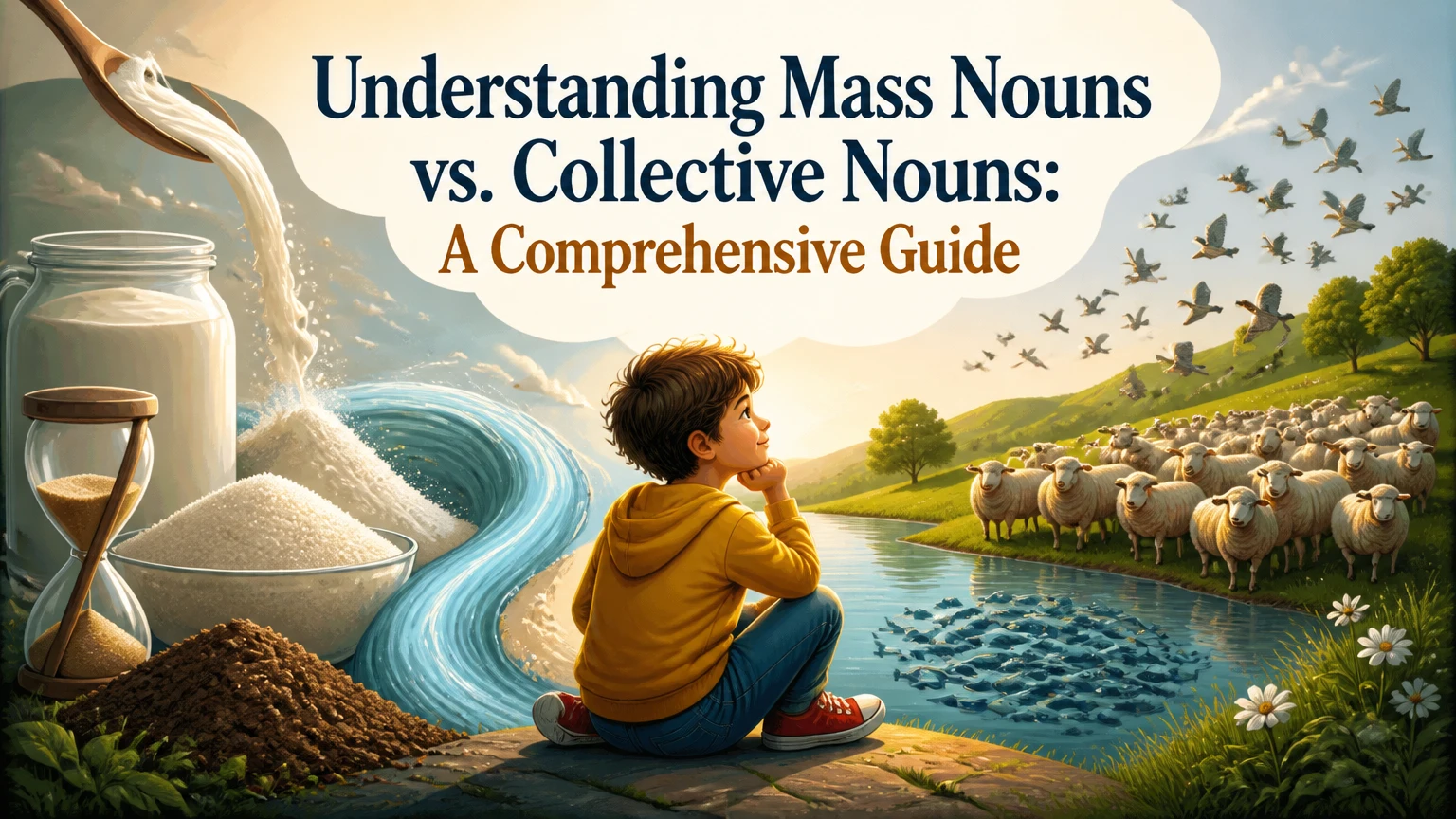
Noun classification is a fundamental pillar of English grammar that dictates how we use articles, verbs, and quantifiers in everyday communication. Mass nouns, often referred to as uncountable nouns, represent substances, concepts, or masses that cannot be counted as individual units, including examples such as water, rice, information, luggage, and furniture. Understanding these categories is essential for mastering subject-verb agreement and ensuring that your writing remains precise and grammatically sound. Whether you are a student, a professional writer, or an English language learner, distinguishing between things we can count and things we view as a whole is a vital skill for linguistic fluency.
While mass nouns focus on the indivisibility of a substance, collective nouns describe groups of individual people, animals, or things that act as a single unit, like team, jury, flock, family, and committee. By learning the nuances between these two categories, you can avoid common pitfalls such as “many informations” or “the team are winning.” This guide provides an exhaustive breakdown of these noun types, their structural rules, and practical examples to help you navigate the complexities of the English language with confidence.
Table of Contents
- Defining Mass Nouns and Collective Nouns
- Structural Breakdown and Grammatical Rules
- Categories of Mass Nouns
- Categories of Collective Nouns
- The Key Differences: Mass vs. Collective
- Extensive Example Tables
- Usage Rules and Quantifiers
- Common Mistakes and Corrections
- Advanced Topics: Countable Uses of Mass Nouns
- Practice Exercises and Solutions
- Frequently Asked Questions (FAQ)
- Conclusion
Defining Mass Nouns and Collective Nouns
To master English grammar, one must first understand that not all nouns behave the same way when it comes to quantity. Mass nouns are those that we perceive as a continuous whole rather than as distinct, separable parts. Because they lack individual boundaries, they do not have a plural form in their standard usage. You cannot say “three breads” or “five snows” because these substances are treated as a singular mass regardless of their actual volume.
Mass nouns often encompass abstract ideas, liquids, gases, and materials. For instance, “happiness” is a mass noun because you cannot have “two happinesses.” Similarly, “oxygen” is a mass noun because it is a gas that cannot be counted in units without the use of a container or a measurement system. These nouns are characterized by their inability to be used with the indefinite articles “a” or “an” and their reliance on singular verb forms.
Collective nouns, on the other hand, are quite different in their logical structure. A collective noun is a word that represents a group of individual entities. While the group itself is treated as a single unit, it is composed of distinct members that could be counted if they were separated. A “team” consists of players; a “flock” consists of birds; a “bouquet” consists of flowers. Unlike mass nouns, collective nouns can often be made plural (e.g., “one team” vs. “two teams”).
The primary function of a collective noun is to simplify language by allowing us to refer to a gathering of individuals as a single entity. This is particularly useful in organizational and biological contexts. However, collective nouns can be tricky because their verb agreement varies depending on whether the members are acting in unison or as individuals. This distinction is a major point of study for advanced English learners and varies between American and British English dialects.
Structural Breakdown and Grammatical Rules
The structural behavior of mass nouns is governed by several rigid rules. First and foremost, mass nouns almost always take a singular verb. Even if the amount of the substance is vast, the grammatical treatment remains singular. For example, “The water is cold” remains the same whether you are talking about a glass of water or the entire Pacific Ocean. This consistency makes mass nouns predictable once you identify them.
Another structural element of mass nouns is the lack of a plural suffix. You will rarely see “s” or “es” added to these words. Words like advice, knowledge, and homework never become advices, knowledges, or homeworks. To express quantity with mass nouns, we must use “partitive expressions” or “measure words.” These are phrases like “a piece of,” “a bottle of,” or “a grain of” which provide the countable unit that the mass noun itself lacks.
Collective nouns follow a different structural pattern. They are inherently countable because you can have multiple groups. Therefore, they have both singular and plural forms. You can discuss “one family” or “many families.” The complexity arises in subject-verb agreement. In American English, collective nouns are almost always followed by a singular verb: “The committee has reached a decision.” In British English, it is more common to use a plural verb if the speaker is thinking of the individual members: “The committee have reached a decision.”
Furthermore, collective nouns often use the preposition “of” to link the group name to the individuals within it. This creates a structure such as [Collective Noun] + of + [Plural Countable Noun]. Common examples include “a pack of wolves,” “a set of tools,” or “a crowd of people.” In these structures, the collective noun determines the verb agreement, not the plural noun that follows it. For instance, “A pack of wolves is hunting” is the standard form because “pack” is singular.
Categories of Mass Nouns
Mass nouns are not a monolithic group; they can be categorized into several distinct types based on what they represent. Understanding these categories helps learners predict which words will likely be uncountable. The first major category is Abstract Concepts. These are things that cannot be touched or seen physically, such as bravery, time, honesty, and freedom. Because these concepts are not physical objects, they cannot be divided into units.
The second category involves Liquids and Gases. Any substance that takes the shape of its container is typically a mass noun. This includes milk, oil, smoke, air, and blood. You cannot count “one milk”; you must count “one carton of milk” or “one liter of milk.” The substance itself remains a continuous mass in the eyes of English grammar.
A third category is Solids and Materials. This refers to substances that are used to make other things or that exist in bulk. Examples include wood, metal, gold, paper, and cloth. While you can count “three chairs” (objects), you cannot count “three woods” (the material the chairs are made of). Similarly, bread and meat are considered materials in English grammar, which is why they are mass nouns.
The fourth category consists of Masses of Small Particles. These are things that are made of such tiny parts that counting them individually is impractical or impossible. Examples include sand, sugar, salt, flour, and hair. Although a single grain of rice exists, we treat “rice” as a mass noun because we typically interact with it as a collective substance rather than as individual grains.
Finally, there is a category for General/Aggregate Groups. These are words that describe a collection of different items as a single concept. Furniture is a classic example; it includes chairs, tables, and beds, but “furniture” itself is uncountable. Other examples include luggage, equipment, jewelry, and garbage. These words are often the most confusing because their counterparts in other languages might be countable.
Categories of Collective Nouns
Collective nouns can be grouped based on the types of entities they describe. The most common category is People. These nouns describe groups of humans in various social, professional, or familial contexts. Examples include audience, choir, class, staff, and public. These words allow us to talk about the behavior of a group as a single unit, which is essential for sociology and organizational management.
Another fascinating category is Animals. English is famous for having unique and often poetic collective nouns for different species. While herd and flock are general terms, specific animals have their own terms like a pride of lions, a school of fish, or a murder of crows. These terms are often called “terms of venery” and have deep historical roots in hunting and naturalism.
The third category includes Objects and Things. These collective nouns describe groups of inanimate items that are often found together. Examples include a fleet of ships, a galaxy of stars, a forest of trees, or a deck of cards. Using these specific terms adds variety and precision to descriptive writing, helping the reader visualize the arrangement of the objects.
Finally, we have Organizational or Institutional Units. These are collective nouns used in legal, political, or corporate settings. Words like board, department, alliance, union, and senate fall into this category. These nouns are particularly important for understanding formal documents and news reports, where the actions of a group carry legal or social weight.
The Key Differences: Mass vs. Collective
The distinction between mass nouns and collective nouns often confuses learners because both involve groups or quantities. However, the fundamental difference lies in composition and countability. A mass noun is a substance that cannot be divided into distinct, identical units without changing its nature. If you cut a piece of “gold” in half, you still have “gold.” If you divide “information,” you still have “information.”
In contrast, a collective noun is made of distinct individuals. If you break up a “team,” you no longer have a team; you have individual “players.” The players are the building blocks of the team. This distinction is why collective nouns are countable and mass nouns are not. You can have multiple teams, but you cannot have multiple “informations” or “furnitures.”
Another key difference is verb agreement flexibility. Mass nouns are strictly singular in their verb agreement. You will never use a plural verb with a mass noun in standard English. Collective nouns, however, offer a “notional agreement” option. If the members of the collective are acting together, the verb is singular. If they are acting individually, the verb can be plural (especially in British English). For example: “The crew is preparing for takeoff” (acting as one) vs. “The crew are putting on their uniforms” (acting individually).
Finally, the use of articles differs significantly. Mass nouns cannot be used with “a” or “an.” You would never say “a water.” Collective nouns, being countable entities, frequently use indefinite articles. You can say “a group,” “a committee,” or “a herd.” This simple test—checking if the word can follow “a” or “an”—is one of the most effective ways to tell the two apart.
Extensive Example Tables
To provide a clear reference for learners, the following tables categorize various nouns. These tables are designed to help you recognize patterns and expand your vocabulary in both mass and collective noun categories.
Table 1: Common Mass Nouns by Category
The following table provides 30 examples of mass nouns, categorized to show the diversity of this noun type. Note that none of these words take a plural “s” in standard usage.
| Category | Example 1 | Example 2 | Example 3 | Example 4 | Example 5 | Example 6 |
|---|---|---|---|---|---|---|
| Abstract Ideas | Advice | Knowledge | Love | Freedom | Patience | Luck |
| Liquids/Gases | Water | Steam | Juice | Oxygen | Gasoline | Coffee |
| Food/Materials | Bread | Meat | Cheese | Wood | Cotton | Steel |
| Small Particles | Rice | Sand | Salt | Sugar | Dust | Flour |
| Aggregates | Furniture | Luggage | Jewelry | Traffic | Machinery | Money |
Table 2: Common Collective Nouns for People and Groups
This table lists 25 collective nouns used to describe various groups of people. These nouns can be singular or plural depending on how many groups are being discussed.
| Group Type | Collective Noun | Context Example |
|---|---|---|
| Social | Family | A family of four |
| Professional | Staff | The teaching staff |
| Performance | Orchestra | A symphony orchestra |
| Legal | Jury | A jury of peers |
| Political | Senate | The state senate |
| Military | Army | A massive army |
| Casual | Crowd | A crowd of tourists |
| Sports | Team | The winning team |
| Educational | Faculty | The university faculty |
| Religious | Congregation | A local congregation |
| Business | Board | The board of directors |
| Criminal | Gang | A gang of thieves |
| General | Committee | An ethics committee |
| Music | Band | A rock band |
| Work | Crew | A film crew |
| Social | Club | A chess club |
| Government | Council | The city council |
| Emergency | Squad | A rescue squad |
| Artistic | Troupe | A dance troupe |
| Academic | Class | A class of students |
| Public | Audience | A quiet audience |
| Labor | Union | A workers’ union |
| Diplomatic | Embassy | The foreign embassy |
| Research | Panel | A panel of experts |
| Youth | Troop | A scout troop |
Table 3: Unique Collective Nouns for Animals
Animal collective nouns are often specific and poetic. This table provides 20 interesting examples used in English literature and science.
| Animal | Collective Noun | Animal | Collective Noun |
|---|---|---|---|
| Lions | Pride | Wolves | Pack |
| Fish | School | Birds | Flock |
| Crows | Murder | Ants | Colony |
| Whales | Pod | Bees | Swarm |
| Elephants | Herd | Owls | Parliament |
| Kittens | Litter | Geese | Gaggle |
| Hyenas | Cackle | Sheep | Drove |
| Leopards | Leap | Flamingos | Flamboyance |
| Horses | Stud | Foxes | Skulk |
| Monkeys | Troop | Frogs | Army |
Usage Rules and Quantifiers
One of the most important aspects of using mass nouns is selecting the correct quantifier. Quantifiers are words that indicate the amount of something. Because mass nouns cannot be counted with numbers, they require specific quantifiers. You should use much, little, a lot of, some, and any. It is a common error to use “many” or “few” with mass nouns; these are reserved for countable nouns.
For example, you would say, “I don’t have much time,” rather than “I don’t have many time.” Similarly, “There is little water left” is correct, while “There are few water left” is incorrect. This distinction is crucial for maintaining grammatical accuracy in both spoken and written English. The quantifier “a lot of” is versatile and can be used with both mass and countable nouns, making it a safe choice for learners.
To express a specific quantity of a mass noun, you must use a “unit of measurement” or “container.” This process turns an uncountable concept into a countable phrase. Common units include a piece of, a slice of, a cup of, a gallon of, a bit of, and an item of. For example, while “advice” is uncountable, you can say “three pieces of advice.” While “furniture” is uncountable, you can say “two items of furniture.”
Collective nouns have their own set of rules, primarily concerning subject-verb agreement. In formal writing, the goal is consistency. If you treat a collective noun as singular, use singular pronouns as well. For example: “The team is doing its best” (singular verb/singular pronoun). If you use the plural form (more common in British English), use plural pronouns: “The team are doing their best.” Mixing singular verbs with plural pronouns is a frequent stylistic error that should be avoided.
Common Mistakes and Corrections
Even advanced learners often struggle with mass nouns because they can be counter-intuitive. One of the most frequent mistakes is pluralizing mass nouns that represent aggregates. Words like information, furniture, luggage, and homework never take an “s.” Saying “I have many homeworks” is a tell-tale sign of a non-native speaker. The correct form is “I have a lot of homework” or “I have many assignments.”
Another common error involves the word “people.” While “people” is the plural of “person,” it often functions similarly to a collective noun. However, “people” always takes a plural verb: “The people are waiting.” A specific mistake occurs when learners confuse “people” (plural individuals) with “a people” (meaning an ethnic group or nation). In the latter case, “peoples” is actually a valid plural form: “The various peoples of Asia.”
The table below highlights several common errors and provides the correct grammatical alternative.
| Incorrect Usage | Correct Usage | Explanation |
|---|---|---|
| I need some advices. | I need some advice. | Advice is a mass noun and cannot be plural. |
| The furnitures are new. | The furniture is new. | Furniture is an aggregate mass noun; use singular verbs. |
| Many breads were sold. | Many loaves of bread were sold. | Use a unit (loaves) to count mass nouns like bread. |
| The jury have decided. (US) | The jury has decided. (US) | In American English, collective nouns take singular verbs. |
| How many money do you have? | How much money do you have? | Money is uncountable; use ‘much’ instead of ‘many’. |
| A pack of dogs are barking. | A pack of dogs is barking. | The subject is ‘pack’ (singular), not ‘dogs’. |
| I lost my baggages. | I lost my luggage/baggage. | Baggage and luggage are always uncountable. |
| The sceneries are beautiful. | The scenery is beautiful. | Scenery is a mass noun; use singular form. |
Advanced Topics: Countable Uses of Mass Nouns
Language is fluid, and there are specific contexts where mass nouns can behave as countable nouns. This usually happens in the food and beverage industry or in scientific contexts. When a waiter asks, “Can I get you two coffees?”, they are using “coffees” as a shorthand for “cups of coffee.” In this context, the mass noun becomes countable because it implies a standard unit of serving.
Similarly, mass nouns can be pluralized when referring to “types” or “varieties” of a substance. A cheese shop might boast about its “fine cheeses from around the world.” Here, “cheeses” means “types of cheese.” This rule also applies to scientific discussions about “waters” (referring to different bodies of water) or “sands” (referring to different geological types of sand). Understanding this nuance is key for advanced proficiency.
For collective nouns, an advanced concept is the “notional agreement” versus “formal agreement.” Formal agreement follows the grammatical number of the noun (singular noun = singular verb). Notional agreement follows the idea of the noun. If you say, “The couple are honeymooning in Italy,” you are using notional agreement because a couple consists of two people doing things together. This is widely accepted in many English dialects but requires a keen ear for context.
Another advanced area is the use of “zero plurals” in collective contexts, particularly with animals. Some animal groups use the same word for singular and plural, which can mimic mass noun behavior. For example, “deer” and “fish” are count nouns, but we say “ten deer” and “ten fish.” However, if you are talking about different species of fish, you can say “fishes.” This overlap between mass, count, and collective behavior is one of the most complex parts of English morphology.
Practice Exercises and Solutions
To reinforce your understanding of mass and collective nouns, complete the following exercises. These are designed to test your ability to identify noun types and apply the correct grammatical rules.
Exercise 1: Identifying Noun Types
Classify each of the following words as a Mass Noun or a Collective Noun.
- Staff
- Oxygen
- Orchestra
- Knowledge
- Flock
- Equipment
- Committee
- Rain
- Audience
- Information
Exercise 2: Subject-Verb Agreement
Choose the correct verb form in the parentheses. (Use American English standards for collective nouns).
- The team (is / are) practicing for the big game.
- Much of the information (was / were) leaked to the press.
- A swarm of bees (is / are) heading toward the garden.
- Your hair (looks / look) great today.
- The faculty (has / have) voted on the new curriculum.
- All the furniture (needs / need) to be moved.
- The jury (is / are) still deliberating in the courtroom.
- Traffic (is / are) very heavy this afternoon.
- The collection of stamps (was / were) worth a fortune.
- Happiness (comes / come) to those who wait.
Exercise 3: Quantifier Selection
Fill in the blanks with much, many, little, or few.
- How _______ sugar do you want in your tea?
- There are so _______ people in this room!
- We have very _______ time before the train leaves.
- I have _______ items of clothing to donate.
- How _______ luggage did you bring?
- There is _______ hope for a quick resolution.
- _______ students passed the difficult exam.
- He gave me too _______ advice.
- There are _______ cars on the road today.
- I don’t have _______ money left.
Answer Key
| Exercise 1 | Exercise 2 | Exercise 3 |
|---|---|---|
| 1. Collective | 1. is | 1. much |
| 2. Mass | 2. was | 2. many |
| 3. Collective | 3. is | 3. little |
| 4. Mass | 4. looks | 4. many |
| 5. Collective | 5. has | 5. much |
| 6. Mass | 6. needs | 6. little |
| 7. Collective | 7. is | 7. few |
| 8. Mass | 8. is | 8. much |
| 9. Collective | 9. was | 9. few |
| 10. Mass | 10. comes | 10. much |
Frequently Asked Questions (FAQ)
1. Can a noun be both mass and collective?
Generally, no. A noun is usually categorized as one or the other. However, some words can be tricky. “Money” is a mass noun, but “currency” is a count noun. “People” acts as a plural count noun but represents a collective group. The key is to look at whether the word can be pluralized and how it interacts with “a/an.”
2. Why is ‘furniture’ a mass noun if I can count the chairs?
In English, some words represent a “category” or “concept” rather than the objects themselves. “Furniture” is the name of the category. You count the members of the category (chairs, tables), but you cannot count the category itself. This is a common feature of aggregate mass nouns.
3. Is ‘data’ a mass noun or a collective noun?
Technically, “data” is the plural of the Latin “datum.” In scientific writing, it is often treated as a plural count noun (“The data are…”). However, in common usage and in the tech industry, it is almost always treated as a mass noun (“The data is…”). Both are currently accepted, but mass noun usage is becoming more dominant.
4. How do I know whether to use ‘is’ or ‘are’ with ‘family’?
In American English, use “is” (The family is coming). In British English, you can use “is” or “are” depending on whether you mean the family as a unit or the individual members. If you want to be safe in any dialect, “is” is rarely considered wrong for a singular collective noun.
5. Can I say ‘a music’ or ‘a poetry’?
No. “Music” and “poetry” are mass nouns representing art forms. You must say “a song” or “a poem” if you want to use a count noun. Alternatively, you can say “a piece of music” or “a work of poetry.”
6. What are partitives?
Partitives are the phrases we use to “count” mass nouns. Examples include “a loaf of bread,” “a slice of cake,” “a liter of water,” and “a grain of truth.” They allow us to specify a quantity for a substance that is otherwise uncountable.
7. Is ‘news’ a mass noun?
Yes, “news” is a mass noun. Even though it ends in “s,” it is singular. You say, “The news is good,” not “The news are good.” To count it, you must say “a piece of news” or “an item of news.”
8. Why is ‘hair’ sometimes countable?
“Hair” is a mass noun when referring to the entire growth on someone’s head (“She has long hair”). It becomes a count noun when referring to individual strands (“I found two hairs in my soup”). This is a rare example of a word switching categories based on context.
Conclusion
Mastering the distinction between mass nouns and collective nouns is a significant milestone in achieving English proficiency. Mass nouns, such as water, advice, and furniture, remind us that some things are best viewed as an indivisible whole. Collective nouns, like team, jury, and flock, show us how to group individual entities into a single, cohesive unit. By understanding the rules of countability, quantifier usage, and subject-verb agreement, you can communicate more clearly and avoid the common errors that often trip up learners. Remember that grammar is a tool for precision; using the right noun type ensures your meaning is never lost. Continue practicing with different substances and groups, and soon these distinctions will become second nature in your writing and speech.