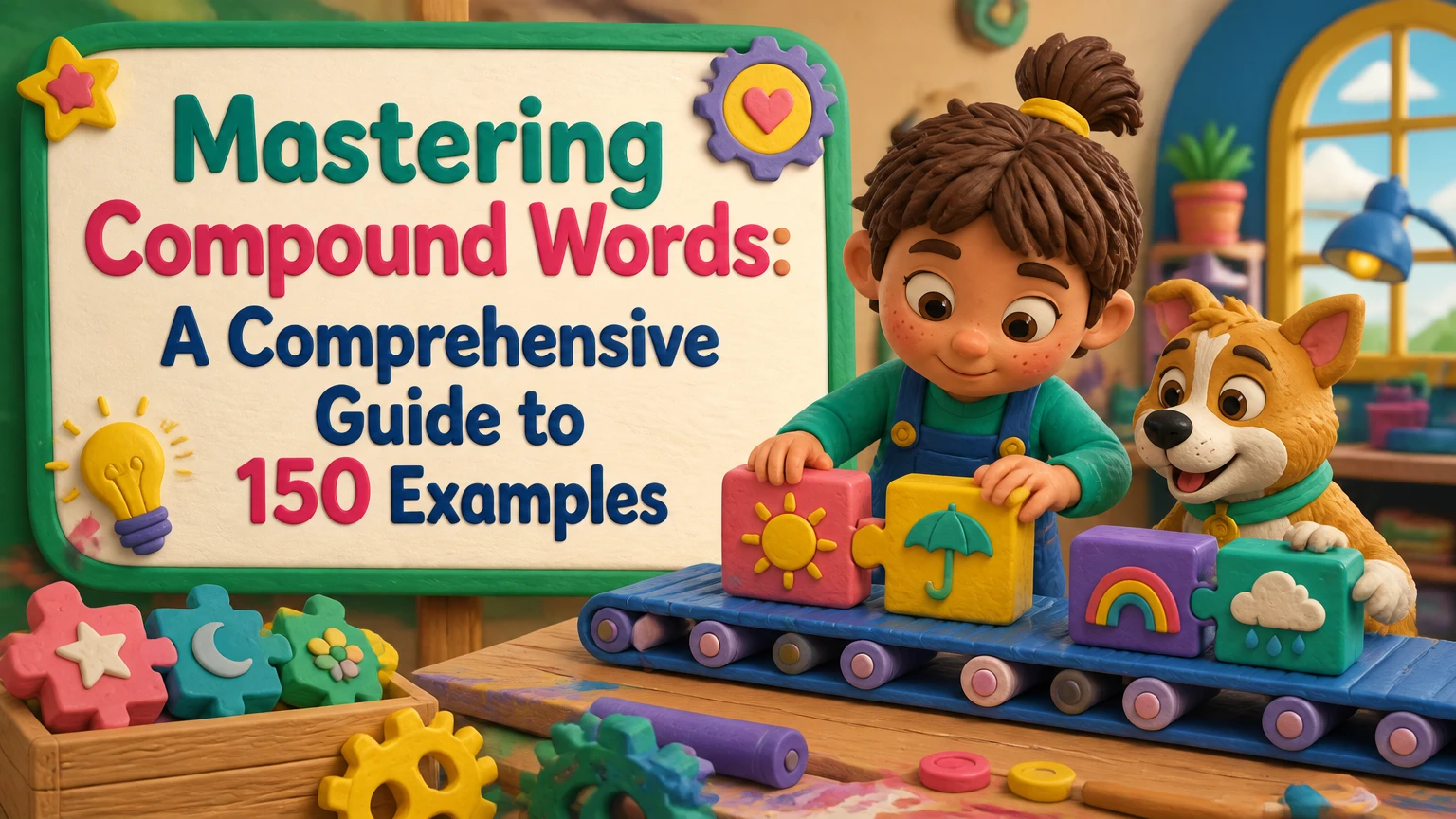
Compound words represent one of the most fascinating and versatile aspects of the English language, acting as the building blocks that allow us to create specific meanings by merging two or more independent words. These linguistic combinations result in unique terms such as sunflower, notebook, keyboard, raincoat, and skyscraper, which function as single units of meaning despite their multiple parts. Understanding how these words are formed is essential for expanding your vocabulary and improving your reading comprehension, as they appear in everything from technical manuals to creative poetry. By learning to identify the relationships between the base words, students of all levels can better navigate the nuances of English spelling and punctuation.
The practical application of compound words is vast, serving as a primary method for the language to evolve and adapt to new technologies and social concepts. Whether you are a non-native speaker looking to sound more natural or a student aiming for academic precision, mastering these forms helps you avoid common hyphenation errors and clarity issues. Words like backbone, firefly, and watermelon illustrate how simple concepts combine to describe complex objects or ideas vividly. This guide will explore the three main types of compound words, providing 150 specific examples and detailed rules to help you use them with confidence in any writing context.
Table of Contents
- Definition and Function of Compound Words
- Structural Breakdown and Formation Rules
- Closed Compound Words: The Seamless Blend
- Open Compound Words: Meaning Through Space
- Hyphenated Compound Words: The Connectors
- 150 Comprehensive Examples Organized by Category
- Advanced Usage Rules and Hyphenation Logic
- Common Mistakes and How to Avoid Them
- Practice Exercises and Assessments
- Advanced Topics: Etymology and Evolution
- Frequently Asked Questions (FAQ)
- Conclusion and Key Takeaways
Definition and Function of Compound Words
At its core, a compound word is a unit of meaning created when two or more individual words are joined together to form a new word with a specific, often different, meaning. This process, known in linguistics as compounding, is one of the most productive ways that the English language generates new vocabulary. For instance, the word moon refers to a celestial body, and light refers to illumination; when joined as moonlight, they describe a specific type of glow that occurs only at night.
The function of a compound word is to provide a more precise or efficient way to describe an object, action, or concept without using a long, descriptive phrase. Instead of saying “a person who works in a house to keep it clean,” we simply use the compound word housekeeper. This linguistic shorthand allows for faster communication and clearer mental imagery. Compound words can function as various parts of speech, including nouns, verbs, adjectives, and even adverbs.
It is important to distinguish between the physical appearance of the word and its grammatical function. A compound word might look like two words (open), one word (closed), or words connected by a dash (hyphenated). Regardless of the visual format, the group of words acts as a single semantic unit. This means that the words together represent one idea that cannot be easily understood by looking at the individual components in isolation, especially in the case of idiomatic compounds like brainstorm.
Context plays a massive role in how we perceive and categorize these words. Some compounds are “transparent,” meaning their meaning is obvious from their parts, such as bedroom. Others are “opaque,” where the meaning is metaphorical or historical, such as deadline. Understanding these nuances is the first step toward achieving fluency in English writing and speaking.
Structural Breakdown and Formation Rules
The structure of a compound word usually consists of two parts: the modifier and the head. In English, the head word usually comes second and determines the part of speech and the basic category of the compound. For example, in the word basketball, “ball” is the head (it is a type of ball), and “basket” is the modifier (specifying what kind of ball it is). This right-headed structure is a standard feature of Germanic languages like English.
The modifier provides essential detail that narrows down the scope of the head. In notebook, “book” is the general object, while “note” explains its purpose. If we changed the modifier to “sketch,” we would have sketchbook, a different specific object. This modular nature of English allows for endless creativity in word formation, which is why we see new compounds emerging constantly in fields like technology and social media.
Grammatically, compound words follow specific patterns based on the parts of speech being combined. The most common combination is Noun + Noun (e.g., toothpaste), but many other combinations exist. These include Adjective + Noun (e.g., software), Verb + Noun (e.g., breakfast), and even Preposition + Noun (e.g., underworld). Each combination carries its own set of expectations for how the word should be spelled or punctuated.
The transition of a word from two separate entities to a single compound often follows a historical trajectory. Usually, a term starts as an open compound (e.g., data base), moves to a hyphenated form as it becomes more common, and eventually settles into a closed compound (e.g., database). However, this is not a universal rule, and many words remain in their open or hyphenated forms indefinitely based on stylistic conventions and clarity needs.
Closed Compound Words: The Seamless Blend
Closed compound words are perhaps the most recognizable form of compounding. These occur when two words are fused together without any spaces or hyphens between them. They are treated as a single word in every sense, including spelling and pronunciation. The primary stress in a closed compound noun almost always falls on the first syllable, which helps distinguish it from a phrase (e.g., compare the stress in “a greenhouse” vs. “a green house“).
Closed compounds are typically well-established words that have been part of the language for a long time. Words like keyboard and football are so common that we rarely think of them as being made of two parts. They provide a sense of permanence and stability to the language. When a new concept becomes ubiquitous, it often closes the gap; for example, electronic mail became e-mail and is now frequently seen simply as email (though the hyphenated version is still very common).
These words are often used to describe everyday objects, household items, and natural phenomena. Because they are written as a single block, they are easy to identify in a sentence. However, they can sometimes pose a challenge for spelling, as learners must remember whether to keep or drop certain letters—though in English compounding, letters are almost always preserved exactly as they are in the original words (e.g., book + keeper = bookkeeper, with a double ‘k’).
Open Compound Words: Meaning Through Space
Open compound words consist of two or more words that are separated by a space but function together as a single concept. These are frequently nouns. Examples include ice cream, high school, and living room. Even though there is a physical space between the words, they represent one specific thing. You cannot remove one part without fundamentally changing the meaning or creating a nonsensical sentence in that context.
One of the biggest challenges for English learners is determining when a compound should remain open. Generally, if the first word is an adjective that modifies the second word in a literal way, it might stay open. However, many established open compounds are simply a matter of convention. For instance, hot dog is always open, even though it describes a very specific, singular object that isn’t necessarily a “hot” “dog” in the literal sense.
Open compounds are also very common in titles, roles, and technical terms. Words like Vice President or real estate are standard open compounds. When using these in a sentence, it is vital not to hyphenate them unless they are acting as a single adjective before another noun (e.g., “a real estate agent”). This distinction is a key part of advanced English grammar and style guides like APA or Chicago.
Hyphenated Compound Words: The Connectors
Hyphenated compound words use a small dash, known as a hyphen, to link two or more words together. This is most common when multiple words act as a single adjective before a noun. For example, in the phrase “a well-known actor,” the hyphen tells the reader that “well” and “known” are working together to describe the actor. Without the hyphen, the meaning could potentially become ambiguous.
Hyphens are also used for clarity to prevent “letter collisions” or to avoid confusion with other words. For example, re-sign (to sign again) is hyphenated to distinguish it from resign (to quit a job). Similarly, compounds involving numbers, such as twenty-one or two-thirds, always require a hyphen according to standard grammatical rules. This helps the reader process the numerical value as a single unit.
As language evolves, hyphenated compounds often serve as the “middle ground” between open and closed forms. Many words that we now write as closed compounds spent decades being hyphenated. However, some categories, like family relations (e.g., mother-in-law) and specific compound adjectives (e.g., state-of-the-art), almost always retain their hyphens to ensure the complex relationship between the words is clear to the reader.
150 Comprehensive Examples Organized by Category
To master compound words, it is helpful to see them grouped by their structural type. The following tables provide 150 examples, categorized into closed, open, and hyphenated forms. These lists cover a variety of contexts, from nature and technology to daily life and professional settings.
Table 1: 50 Common Closed Compound Words
Closed compounds are fused into a single word. These are often nouns that describe common objects or concepts. Notice how the two base words combine to create a specific new meaning.
| Compound Word | Word 1 | Word 2 | Usage Example |
|---|---|---|---|
| Afternoon | After | Noon | We went for a walk in the afternoon. |
| Backpack | Back | Pack | She carried her books in a backpack. |
| Basketball | Basket | Ball | The kids are playing basketball outside. |
| Bedtime | Bed | Time | It is past the children’s bedtime. |
| Birthday | Birth | Day | We celebrated his tenth birthday. |
| Bookstore | Book | Store | I bought a novel at the bookstore. |
| Butterfly | Butter | Fly | A colorful butterfly landed on the flower. |
| Cupcake | Cup | Cake | She baked a delicious chocolate cupcake. |
| Doorbell | Door | Bell | Someone rang the doorbell at midnight. |
| Earthquake | Earth | Quake | The earthquake shook the entire city. |
| Everything | Every | Thing | I have everything I need for the trip. |
| Firefly | Fire | Fly | We saw a firefly glowing in the dark. |
| Football | Foot | Ball | They watched a football game on Sunday. |
| Goldfish | Gold | Fish | The goldfish swam in its little bowl. |
| Haircut | Hair | Cut | He went to the barber for a haircut. |
| Handwriting | Hand | Writing | Her handwriting is very neat and clear. |
| Homework | Home | Work | I finished my homework before dinner. |
| Inside | In | Side | It is raining, so let’s stay inside. |
| Keyboard | Key | Board | I need a new keyboard for my computer. |
| Ladybug | Lady | Bug | A ladybug is considered good luck. |
| Lighthouse | Light | House | The lighthouse guided the ships to safety. |
| Moonlight | Moon | Light | The garden looked beautiful in the moonlight. |
| Notebook | Note | Book | I wrote the ideas in my notebook. |
| Outside | Out | Side | The dog wants to go outside. |
| Pancake | Pan | Cake | We had a pancake breakfast this morning. |
| Raincoat | Rain | Coat | Don’t forget your raincoat; it’s pouring. |
| Rainbow | Rain | Bow | A rainbow appeared after the storm. |
| Scarecrow | Scare | Crow | The scarecrow stood in the cornfield. |
| Skateboard | Skate | Board | He performed a trick on his skateboard. |
| Snowman | Snow | Man | The children built a snowman in the yard. |
| Spaceship | Space | Ship | The spaceship launched into orbit. |
| Starfish | Star | Fish | We found a starfish on the beach. |
| Sunlight | Sun | Light | The morning sunlight filled the room. |
| Tablecloth | Table | Cloth | She spread a white tablecloth on the table. |
| Teapot | Tea | Pot | The teapot started whistling on the stove. |
| Thunderstorm | Thunder | Storm | The thunderstorm caused a power outage. |
| Toothbrush | Tooth | Brush | You should replace your toothbrush regularly. |
| Underground | Under | Ground | The subway runs underground. |
| Wallpaper | Wall | Paper | They chose floral wallpaper for the hall. |
| Watermelon | Water | Melon | Nothing beats a cold watermelon in summer. |
| Wheelchair | Wheel | Chair | The building is accessible by wheelchair. |
| Windmill | Wind | Mill | The windmill generated clean energy. |
| Workout | Work | Out | I feel great after my morning workout. |
| Yoga | Yo | Ga | (Note: Not a compound, replacing with: Airport) |
| Airport | Air | Port | We arrived at the airport early. |
| Backbone | Back | Bone | The backbone protects the spinal cord. |
| Crosswalk | Cross | Walk | Always use the crosswalk to cross the street. |
| Daydream | Day | Dream | I often daydream about traveling the world. |
| Eggshell | Egg | Shell | Be careful not to get eggshell in the batter. |
| Firewall | Fire | Wall | The firewall protects the network from hackers. |
| Grapefruit | Grape | Fruit | I had half a grapefruit for breakfast. |
Table 2: 50 Common Open Compound Words
Open compounds are written as two separate words but function as a single unit. These are often used for specific nouns or titles. The space is mandatory for correct spelling.
| Compound Word | Word 1 | Word 2 | Usage Example |
|---|---|---|---|
| Ice cream | Ice | Cream | I want a scoop of vanilla ice cream. |
| High school | High | School | She is a teacher at the local high school. |
| Living room | Living | Room | We gathered in the living room to talk. |
| Hot dog | Hot | Dog | He ate a hot dog at the baseball game. |
| Post office | Post | Office | I need to mail this letter at the post office. |
| Real estate | Real | Estate | He works in real estate sales. |
| Remote control | Remote | Control | Where is the remote control for the TV? |
| Dining room | Dining | Room | The dining room table is set for six. |
| Bus stop | Bus | Stop | Wait for me at the bus stop. |
| Full moon | Full | Moon | The full moon was bright last night. |
| Video game | Video | Game | He played a video game all afternoon. |
| Coffee shop | Coffee | Shop | Let’s meet at the coffee shop. |
| First aid | First | Aid | Every car should have a first aid kit. |
| Grand jury | Grand | Jury | The grand jury will hear the evidence. |
| Cell phone | Cell | Phone | She checked her cell phone for messages. |
| Root beer | Root | Beer | I ordered a root beer float. |
| Swimming pool | Swimming | Pool | The swimming pool is open all summer. |
| Middle class | Middle | Class | The tax cuts benefit the middle class. |
| North America | North | America | Canada is located in North America. |
| Police station | Police | Station | The police station is downtown. |
| Roller coaster | Roller | Coaster | The roller coaster was terrifying. |
| Social studies | Social | Studies | We are learning history in social studies. |
| Table tennis | Table | Tennis | They played table tennis in the basement. |
| Vending machine | Vending | Machine | I got a snack from the vending machine. |
| Wait list | Wait | List | I am on the wait list for that class. |
| Washing machine | Washing | Machine | The washing machine is making a loud noise. |
| Web page | Web | Page | Please refresh the web page. |
| X-ray technician | X-ray | Technician | The X-ray technician was very professional. |
| Yellow fever | Yellow | Fever | He was vaccinated against yellow fever. |
| Zebra crossing | Zebra | Crossing | Pedestrians should use the zebra crossing. |
| Air conditioner | Air | Conditioner | Turn on the air conditioner; it’s hot. |
| Blood pressure | Blood | Pressure | The nurse checked his blood pressure. |
| Credit card | Credit | Card | I paid for the meal with a credit card. |
| Decision making | Decision | Making | He has excellent decision making skills. |
| Electric guitar | Electric | Guitar | She plays the electric guitar in a band. |
| Flash flood | Flash | Flood | The flash flood washed away the road. |
| Gas station | Gas | Station | We stopped at the gas station for fuel. |
| Heart attack | Heart | Attack | He is recovering from a heart attack. |
| Ink jet | Ink | Jet | I need a new ink jet cartridge. |
| Jet lag | Jet | Lag | I am suffering from jet lag after the flight. |
| Life jacket | Life | Jacket | Always wear a life jacket on the boat. |
| Mountain bike | Mountain | Bike | He rode his mountain bike up the trail. |
| Noble prize | Noble | Prize | (Note: Nobel Prize) He won the Nobel Prize. |
| Ocean floor | Ocean | Floor | Divers explored the ocean floor. |
| Paper clip | Paper | Clip | Use a paper clip to hold the sheets together. |
| Queue jump | Queue | Jump | It is rude to queue jump in the line. |
| Rain forest | Rain | Forest | The rain forest is home to many species. |
| Science fiction | Science | Fiction | I love reading science fiction novels. |
| Time zone | Time | Zone | We are in a different time zone now. |
| Uncle Sam | Uncle | Sam | Uncle Sam is a personification of the US. |
Table 3: 50 Common Hyphenated Compound Words
Hyphenated compounds use a dash to link words. These are often used for family roles, numbers, and adjectives that appear before a noun to modify it.
| Compound Word | Word 1 | Word 2/3 | Usage Example |
|---|---|---|---|
| Mother-in-law | Mother | in-law | My mother-in-law is visiting us. |
| Well-known | Well | known | He is a well-known author. |
| Up-to-date | Up | to-date | Keep your software up-to-date. |
| Twenty-one | Twenty | one | She just turned twenty-one years old. |
| State-of-the-art | State | of-the-art | The lab has state-of-the-art equipment. |
| Self-esteem | Self | esteem | Exercise can help boost your self-esteem. |
| Merry-go-round | Merry | go-round | The kids loved the merry-go-round. |
| Check-in | Check | in | The check-in time for the hotel is 3 PM. |
| One-way | One | way | This is a one-way street. |
| Long-term | Long | term | We need a long-term solution. |
| Part-time | Part | time | She has a part-time job at the library. |
| Father-in-law | Father | in-law | His father-in-law helped him fix the car. |
| Runner-up | Runner | up | He was the runner-up in the race. |
| Editor-in-chief | Editor | in-chief | The editor-in-chief approved the story. |
| Six-pack | Six | pack | He bought a six-pack of soda. |
| Full-time | Full | time | He finally found a full-time position. |
| Good-bye | Good | bye | We said our good-byes at the station. |
| High-tech | High | tech | The city is a high-tech hub. |
| Ice-skating | Ice | skating | We went ice-skating on the pond. |
| Jack-in-the-box | Jack | in-the-box | The baby laughed at the jack-in-the-box. |
| Know-it-all | Know | it-all | Nobody likes a know-it-all. |
| Left-handed | Left | handed | She is left-handed and plays guitar well. |
| Mind-blowing | Mind | blowing | The special effects were mind-blowing. |
| Non-stop | Non | stop | It was a non-stop flight to London. |
| Old-fashioned | Old | fashioned | She prefers old-fashioned clothes. |
| Over-the-counter | Over | the-counter | You can buy this over-the-counter. |
| Passer-by | Passer | by | A passer-by helped the elderly woman. |
| Quick-witted | Quick | witted | The comedian is very quick-witted. |
| Ready-made | Ready | made | I bought a ready-made meal for dinner. |
| Sister-in-law | Sister | in-law | My sister-in-law is a talented artist. |
| T-shirt | T | shirt | I am wearing a plain white T-shirt. |
| User-friendly | User | friendly | The new app is very user-friendly. |
| Vice-president | Vice | president | The vice-president gave a speech. |
| Warm-up | Warm | up | Do a warm-up before you start running. |
| X-ray | X | ray | The doctor ordered an X-ray of my arm. |
| Year-end | Year | end | We are preparing the year-end report. |
| Zero-tolerance | Zero | tolerance | The school has a zero-tolerance policy. |
| All-star | All | star | He was chosen for the all-star team. |
| Brother-in-law | Brother | in-law | My brother-in-law lives in Chicago. |
| Clear-cut | Clear | cut | There is no clear-cut answer to this. |
| Double-check | Double | check | Please double-check your work. |
| Empty-handed | Empty | handed | We didn’t want to arrive empty-handed. |
| Far-fetched | Far | fetched | The story sounds a bit far-fetched. |
| Get-together | Get | together | We are having a family get-together. |
| Hard-working | Hard | working | She is a very hard-working student. |
| In-depth | In | depth | We need an in-depth analysis. |
| Life-size | Life | size | The museum had a life-size model. |
| Middle-aged | Middle | aged | The middle-aged man enjoyed hiking. |
| Off-campus | Off | campus | He lives in an off-campus apartment. |
| Sugar-free | Sugar | free | I prefer sugar-free gum. |
Advanced Usage Rules and Hyphenation Logic
One of the most confusing parts of compound words is knowing when to use a hyphen. The general rule is that you should use a hyphen when two or more words act as a single adjective before a noun (a compound modifier). For example, in “a well-known singer,” the hyphen is necessary. However, if the same words appear after the noun, the hyphen is usually dropped: “The singer is well known.” This is a critical distinction for formal writing.
Another important rule involves adverbs ending in “-ly.” You should never use a hyphen between an adverb ending in “-ly” and the adjective it modifies. For instance, write “a happily married couple,” not “a happily-married couple.” The “-ly” ending already signals to the reader that the first word is modifying the second, so the hyphen is redundant and grammatically incorrect.
For compound nouns, the rules are less rigid and often depend on the specific dictionary or style guide you are following. However, a helpful tip is to check for clarity. If omitting a hyphen would cause the reader to stumble—such as in “re-form” (to form again) vs. “reform” (to improve)—always include the hyphen. Clarity and readability should always take precedence over rigid adherence to evolving spelling trends.
Prefixes and suffixes can also create compound-like structures. Generally, words with prefixes like un-, pre-, and post- do not require hyphens (e.g., unhappy, preheat). However, if the prefix is added to a proper noun (e.g., pro-American) or if it ends in the same vowel that the next word starts with (e.g., anti-inflammatory), a hyphen is often used to make the word easier to read.
Common Mistakes and How to Avoid Them
Mistakes with compound words often stem from a misunderstanding of how they function as parts of speech. A common error is confusing a compound verb with a compound noun. For example, setup (noun) is one word, but set up (verb) is two words. You might say, “I need to set up the computer,” but “The setup was very easy.” Mixing these up is a frequent mistake even among native speakers.
Another frequent error involves the “any” and “every” compounds. “Anyway” (adverb) means “regardless,” while “any way” (noun phrase) refers to “any method.” Similarly, “everyday” (adjective) means “commonplace,” while “every day” (adverbial phrase) means “each day.” Writing “I go to the gym everyday” is technically incorrect; it should be “I go to the gym every day.”
Table 4: Correct vs. Incorrect Compound Usage
The following table highlights common errors where people often confuse compound words with separate word phrases.
| Incorrect Usage | Correct Usage | Rule/Explanation |
|---|---|---|
| I work out every-day. | I work out every day. | Use two words for frequency; “everyday” is an adjective. |
| The set-up was hard. | The setup was hard. | “Setup” is the noun; “set up” is the verb. |
| A highly-trained dog. | A highly trained dog. | Do not hyphenate “-ly” adverbs. |
| She is my mother in law. | She is my mother-in-law. | Family titles with “in-law” always use hyphens. |
| The book is well-written. | The book is well written. | No hyphen when the modifier follows the noun. |
| I need to login now. | I need to log in now. | “Login” is the noun; “log in” is the verb. |
Practice Exercises and Assessments
To solidify your understanding of compound words, try these exercises. They range from identifying types to applying correct hyphenation rules in context. Check your answers in the key below.
Exercise 1: Identify the Compound Type
Determine whether each word is Closed, Open, or Hyphenated.
- Firefighter
- Post office
- Up-to-date
- Watermelon
- High school
- Self-service
- Basketball
- Ice cream
- Mother-in-law
- Notebook
Exercise 2: Fill in the Blank
Choose the correct form (closed, open, or hyphenated) to complete the sentence.
- I need to go to the _______ (post office / post-office) to buy stamps.
- She has a _______ (part time / part-time) job.
- The _______ (sun light / sunlight) is very bright today.
- We stayed in a _______ (five star / five-star) hotel.
- Please _______ (log in / login) to your account.
- He is a _______ (well known / well-known) actor.
- The children are playing _______ (hide and seek / hide-and-seek).
- I forgot my _______ (back pack / backpack) at school.
- The _______ (full moon / full-moon) looks beautiful.
- That is a _______ (mind blowing / mind-blowing) discovery.
Exercise 3: Answer Key
| Question # | Exercise 1 Answers | Exercise 2 Answers |
|---|---|---|
| 1 | Closed | post office |
| 2 | Open | part-time |
| 3 | Hyphenated | sunlight |
| 4 | Closed | five-star |
| 5 | Open | log in |
| 6 | Hyphenated | well-known |
| 7 | Closed | hide-and-seek |
| 8 | Open | backpack |
| 9 | Hyphenated | full moon |
| 10 | Closed | mind-blowing |
Advanced Topics: Etymology and Evolution
The study of how compound words evolve is known as historical linguistics. Many words that we consider a single unit today were once clearly separate. For example, the word daisy comes from the Old English “dæges ēage,” which literally means “day’s eye.” Over centuries, the two words fused and the spelling morphed so much that the original compound structure is no longer visible to the average speaker.
In modern times, the tech industry is the biggest driver of new compound words. We see words like vlog (video + log), podcast (iPod + broadcast), and webinar (web + seminar). While these are technically “portmanteaus” (where the words are blended and some letters are lost), they follow the same spirit as compounding—combining ideas to meet the needs of a changing world.
Linguists also study “phrasal verbs” and their relationship to compounding. When a phrasal verb like break down becomes a noun, it almost always becomes a compound: breakdown. This pattern is a reliable rule in English: verbs stay as two words (open), while the resulting nouns become one word (closed) or hyphenated. Understanding this pattern helps writers navigate the tricky waters of technical writing and reporting.
Frequently Asked Questions (FAQ)
1. Is “email” one word or two?
Modern usage has shifted significantly toward email as a single, closed compound word. However, some traditional style guides still prefer e-mail. It is almost never written as two separate words (e mail).
2. How do I know if a compound word should have a hyphen?
The most reliable way is to check if it is a compound adjective appearing before a noun. If it is, use a hyphen (e.g., a fast-moving car). If you are unsure about a noun, always consult a current dictionary, as these conventions change over time.
3. Can compound words have more than two parts?
Yes, they certainly can. Examples like mother-in-law or merry-go-round have three parts. Some technical or descriptive compounds can have even more, such as state-of-the-art or back-to-back.
4. Are “cannot” and “can not” both correct?
In most contexts, cannot is the standard closed compound and is preferred in formal writing. Can not is typically only used when the “not” is part of a different phrase, such as “I can not only sing, but also dance.”
5. Why do some words change from open to closed?
As a word becomes more common, the “linguistic distance” between the two parts shrinks. People begin to think of the two words as a single concept, and writers start omitting the space or hyphen for efficiency. This is a natural part of language evolution.
6. What is the difference between a compound word and a portmanteau?
A compound word joins two full words together (e.g., sun + flower = sunflower). A portmanteau blends parts of words together, often losing letters in the process (e.g., smoke + fog = smog).
7. Do all compound words have a primary stress on the first word?
Most compound nouns do (e.g., BEDroom, FOOTball). However, compound verbs and adjectives may have different stress patterns depending on their position in a sentence and the emphasis the speaker wants to convey.
8. Can a compound word be a verb?
Yes, though they are less common than compound nouns. Examples include to proofread, to troubleshoot, and to babysit. These are usually closed compounds.
Conclusion and Key Takeaways
Mastering compound words is a journey that significantly enhances your ability to communicate with precision and flair. By understanding the distinctions between closed, open, and hyphenated forms, you can avoid common grammatical pitfalls and improve your writing’s professional tone. Remember that the primary goal of any compound is to create a single, unified meaning from multiple parts, whether you are describing a rainbow, visiting a coffee shop, or using state-of-the-art technology. Always prioritize clarity, especially when it comes to hyphenation, and don’t be afraid to consult a dictionary when you encounter a new or evolving term. With the 150 examples provided in this guide, you now have a solid foundation to build an even more robust English vocabulary. Keep practicing, and soon these complex structures will become a natural part of your everyday language use.