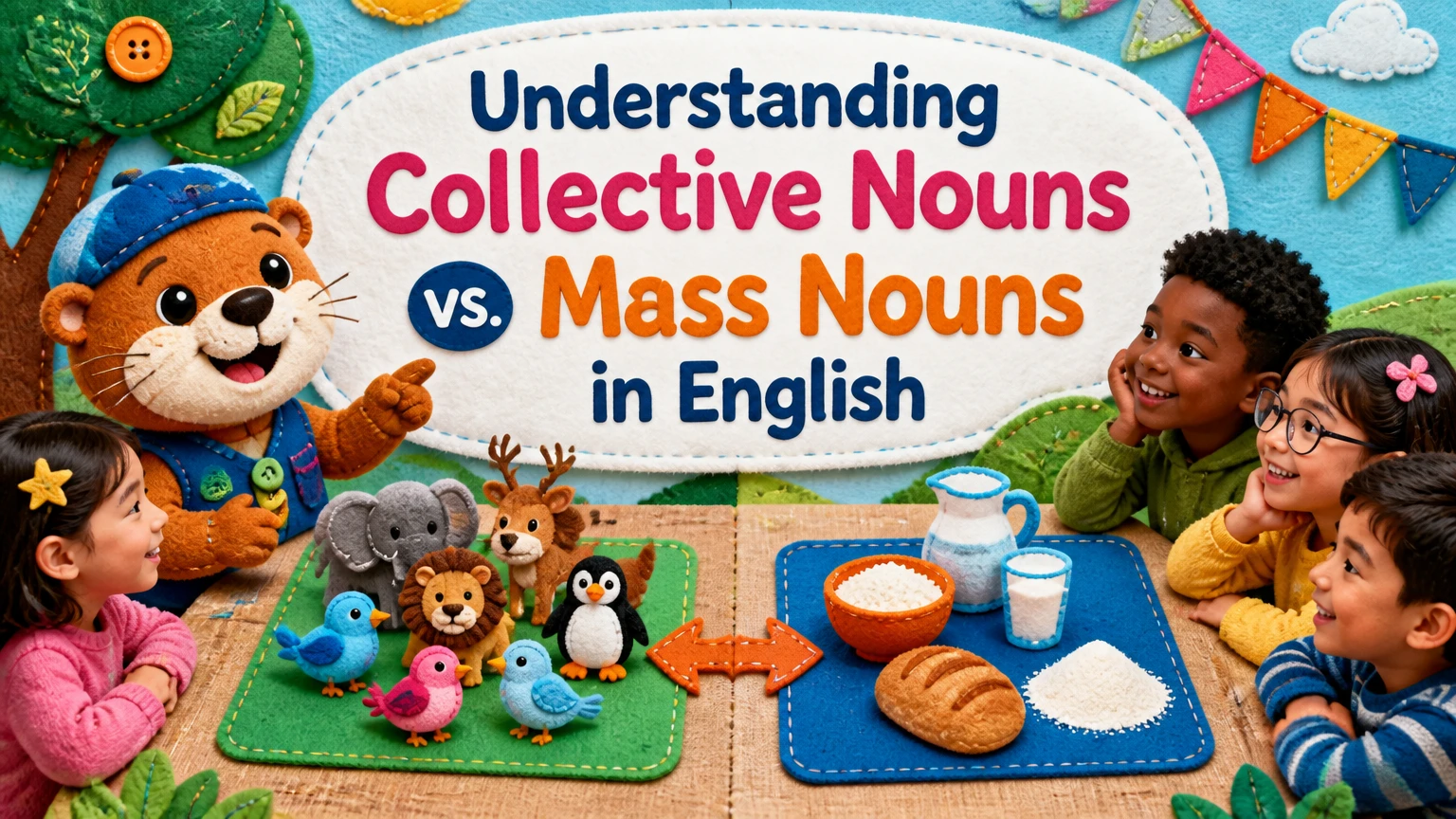
Noun classification is a fundamental pillar of English grammar that allows speakers to categorize the world around them with precision and clarity. Two of the most frequently confused categories are collective nouns and mass nouns, which represent groups and substances respectively. Collective nouns refer to a group of individuals or things that are treated as a single unit, such as team, choir, jury, flock, and orchestra. By contrast, mass nouns, also known as uncountable nouns, refer to substances or concepts that cannot be counted as individual units. Understanding the distinction between these two categories is essential for mastering subject-verb agreement and proper article usage, which benefits everyone from primary school students to advanced academic writers who wish to avoid common grammatical pitfalls.
Table of Contents
- Comprehensive Definition of Noun Categories
- Structural Breakdown and Rules
- Types and Categories of Collective Nouns
- Types and Categories of Mass Nouns
- Extensive Example Tables
- Key Usage Rules and Exceptions
- Common Mistakes and Corrections
- Advanced Topics: Countable vs. Uncountable Nuance
- Practice Exercises and Solutions
- Frequently Asked Questions (FAQ)
- Conclusion and Final Tips
Comprehensive Definition of Noun Categories
To understand the nuances of the English language, we must first define what nouns are and how they function. A noun is a word that names a person, place, thing, or idea. However, nouns are not all treated the same way in a sentence. The way we count them or group them determines the grammar of the entire sentence.
What are Collective Nouns?
A collective noun is a word that represents a group of people, animals, or things. Even though the group consists of multiple members, the word itself is usually singular in form. For example, when we say “the staff,” we are referring to many employees, but we treat the “staff” as one entity. The primary function of a collective noun is to simplify language by allowing us to refer to a complex group as a single concept.
What are Mass Nouns?
Mass nouns, or uncountable nouns, are different because they represent things that we cannot count with numbers. These are usually substances (like water), qualities (like bravery), or large collections of small items (like rice). You cannot say “one water” or “two braveries” in standard English. Mass nouns do not have a plural form; they are inherently singular in their grammatical structure, regardless of how much of the substance exists.
Structural Breakdown and Rules
The structural difference between collective nouns and mass nouns lies in how they interact with verbs and determiners. This section breaks down the DNA of these words to help you identify them in any context.
The Structure of Collective Nouns
Collective nouns are unique because they can be either singular or plural depending on the context of the sentence (especially in British English). If the group is acting as one unit, the verb is singular. If the members of the group are acting individually, the verb can be plural. For example, “The team is winning” versus “The team are arguing among themselves.”
The Structure of Mass Nouns
Mass nouns are structurally simpler but more rigid. They almost always take a singular verb and cannot be used with the indefinite articles “a” or “an.” You cannot have “a milk,” but you can have “some milk” or “a glass of milk.” To quantify a mass noun, you must use a “measure word” or “partitive,” such as “a piece of,” “a liter of,” or “a grain of.”
Types and Categories of Collective Nouns
Collective nouns are incredibly diverse and are often categorized by what they describe. English is famous for its specific “terms of venery” (collective nouns for animals), but the categories extend to people and objects as well.
Collective Nouns for People
These nouns describe professional, social, or familial groups. They are essential for describing human organization. Common examples include committee, audience, panel, and dynasty. These words help us discuss social structures without listing every individual involved.
Collective Nouns for Animals
Animals have some of the most creative collective nouns in the English language. While “group” or “herd” works for many, specific terms like pride (for lions), school (for fish), or murder (for crows) add color and precision to writing. Knowing these terms is a hallmark of an advanced English speaker.
Collective Nouns for Things
When we group inanimate objects, we use specific collective nouns to describe their arrangement. A fleet of ships, a set of tools, or a galaxy of stars are all ways to conceptualize multiple items as a single cluster.
Types and Categories of Mass Nouns
Mass nouns are generally grouped into categories based on their physical or abstract properties. Understanding these categories makes it easier to remember which words are uncountable.
Liquids, Gases, and Substances
Anything that flows or lacks a fixed shape is usually a mass noun. This includes air, blood, coffee, and smoke. We measure these by volume or weight rather than by individual count.
Abstract Concepts and Emotions
Ideas that you cannot touch or see are almost always mass nouns. Knowledge, information, happiness, and advice fall into this category. You cannot have “three advices”; you have “three pieces of advice.”
Granular or Tiny Items
Items that are too small or numerous to count individually are treated as a mass. Sand, salt, flour, and sugar are primary examples. While you could technically count grains of sand, the language treats the collection as a single mass.
Extensive Example Tables
To truly master these nouns, you need to see them in action. The following tables provide a comprehensive list of examples across various categories. These tables are designed to be a quick reference guide for your writing and study sessions.
Table 1: 30 Common Collective Nouns for People
The following table lists collective nouns used specifically for groups of human beings in various contexts, ranging from professional settings to casual gatherings.
| Collective Noun | Group Described | Example Sentence |
|---|---|---|
| Army | Soldiers | The army marches toward the border. |
| Audience | Listeners/Spectators | The audience cheered loudly. |
| Board | Directors | The board meets every Tuesday. |
| Choir | Singers | The choir sang a beautiful hymn. |
| Class | Students | The class is studying for the exam. |
| Committee | Appointed members | The committee has reached a decision. |
| Company | Actors/Workers | The theater company is on tour. |
| Crew | Sailors/Workers | The crew prepared the ship for departure. |
| Crowd | Large group of people | The crowd gathered in the square. |
| Dynasty | Family of rulers | The Ming dynasty lasted for centuries. |
| Faculty | Teachers | The faculty voted on the new policy. |
| Family | Related individuals | My family is coming for dinner. |
| Gang | Criminals/Friends | A gang of thieves was caught. |
| Government | Political leaders | The government is passing a new law. |
| Group | General individuals | A group of tourists blocked the path. |
| Horde | Nomads/Large crowd | A horde of fans waited outside. |
| Jury | Legal evaluators | The jury finds the defendant guilty. |
| Mob | Angry crowd | The mob demanded justice. |
| Orchestra | Musicians | The orchestra played a symphony. |
| Panel | Experts | A panel of judges will decide. |
| Party | Social group/Political | The party lasted until midnight. |
| Staff | Employees | The staff is very helpful. |
| Team | Players/Collaborators | The team celebrates its victory. |
| Tribal | Ethnic group | The tribe maintains its traditions. |
| Troop | Scouts/Soldiers | The troop set up their tents. |
| Troupe | Performers | A troupe of dancers arrived. |
| Union | Workers | The union went on strike. |
| Band | Musicians | The band is playing tonight. |
| Council | Advisors | The city council approved the plan. |
| Squad | Small specialized group | The police squad entered the building. |
Table 2: 30 Common Collective Nouns for Animals
Animal collective nouns are often poetic and specific. This table highlights some of the most interesting terms used in the natural world.
| Collective Noun | Animal Group | Example Sentence |
|---|---|---|
| Bed | Oysters | A bed of oysters lay on the sea floor. |
| Brood | Chicks/Hens | The hen watched over her brood. |
| Colony | Ants/Penguins | An ant colony is very organized. |
| Flock | Birds/Sheep | A flock of birds flew south. |
| Gaggle | Geese | A gaggle of geese blocked the road. |
| Herd | Cows/Elephants | The herd moved across the savanna. |
| Hive | Bees | The hive was full of honey. |
| Host | Sparrows | A host of sparrows filled the tree. |
| Kindle | Kittens | A kindle of kittens slept in the box. |
| Leap | Leopards | A leap of leopards was spotted. |
| Litter | Puppies/Cubs | The dog had a litter of six. |
| Murder | Crows | A murder of crows circled above. |
| Pack | Wolves/Dogs | The pack hunted together. |
| Parliament | Owls | A parliament of owls sat in the oak. |
| Pod | Dolphins/Whales | A pod of dolphins swam by. |
| Pride | Lions | The pride rested in the shade. |
| School | Fish | A school of fish darted away. |
| Shrewdness | Apes | A shrewdness of apes was observed. |
| Sloth | Bears | A sloth of bears walked through the woods. |
| Swarm | Insects/Bees | A swarm of bees surrounded the hive. |
| Troop | Monkeys | A troop of monkeys swung through trees. |
| Unkindness | Ravens | An unkindness of ravens gathered. |
| Ambush | Tigers | An ambush of tigers is rare to see. |
| Clowder | Cats | A clowder of cats lived in the alley. |
| Convocation | Eagles | A convocation of eagles soared high. |
| Drove | Cattle/Pigs | The drove moved slowly to market. |
| Exaltation | Larks | An exaltation of larks sang at dawn. |
| Labor | Moles | A labor of moles dug in the garden. |
| Mustering | Storks | A mustering of storks prepared for flight. |
| Watch | Nightingales | A watch of nightingales was heard. |
Table 3: 30 Common Mass Nouns (Uncountable)
Mass nouns are categorized by their inability to be counted as individual units. This table provides examples ranging from physical substances to abstract ideas.
| Mass Noun | Category | Example Sentence |
|---|---|---|
| Advice | Abstract | He gave me some good advice. |
| Air | Gas | The air is thin at high altitudes. |
| Baggage | Collection | They checked their baggage at the gate. |
| Blood | Liquid | Blood is thicker than water. |
| Butter | Food | Please pass the butter. |
| Chaos | Abstract | The meeting was pure chaos. |
| Cheese | Food | I love eating cheese with crackers. |
| Coffee | Liquid/Food | I need a cup of coffee. |
| Courage | Abstract | She showed great courage. |
| Dust | Granular | The shelf was covered in dust. |
| Education | Abstract | Education is the key to success. |
| Electricity | Energy | The electricity went out last night. |
| Equipment | Collection | The gym has new equipment. |
| Furniture | Collection | We bought new furniture today. |
| Gold | Material | The ring is made of solid gold. |
| Happiness | Abstract | Happiness is a state of mind. |
| Information | Abstract | I need more information. |
| Intelligence | Abstract | He is a man of high intelligence. |
| Knowledge | Abstract | Knowledge is power. |
| Luggage | Collection | Her luggage was lost at the airport. |
| Money | Concept | Money cannot buy happiness. |
| Music | Abstract | I listen to music every morning. |
| News | Abstract | The news is very depressing today. |
| Oil | Liquid | The engine needs more oil. |
| Patience | Abstract | Patience is a virtue. |
| Rain | Liquid | The rain fell steadily all day. |
| Rice | Granular | We had rice for dinner. |
| Salt | Granular | This soup needs more salt. |
| Traffic | Collection | The traffic was heavy this morning. |
| Water | Liquid | Drink plenty of water. |
Key Usage Rules and Exceptions
Mastering collective and mass nouns requires more than just memorizing lists; you must understand the rules that govern their behavior in sentences. These rules ensure that your grammar is precise and natural-sounding.
Rule 1: Subject-Verb Agreement for Collective Nouns
The most important rule for collective nouns is determining whether to use a singular or plural verb. In American English, collective nouns are almost always singular. For example: “The committee decides the winner.” However, if the members are acting as individuals, you might say: “The committee are putting on their coats.” This shifts the focus from the group to the individuals within it.
Rule 2: Quantifying Mass Nouns
Because mass nouns cannot be counted, you must use “counters” or “partitives” to specify quantity. You cannot say “two furnitures.” Instead, you must say “two pieces of furniture.” Similarly, you say “three bottles of water” or “four slices of bread.” These measure words provide the structure necessary to count the uncountable.
Rule 3: The Use of “The” and “Some”
Mass nouns often appear without an article when speaking generally: “I like music.” However, when referring to a specific instance, you use “the”: “The music at the party was too loud.” You can also use “some” or “any” to indicate an indefinite amount: “Do you have some water?” or “I don’t have any information.”
Exception: Pluralizing Mass Nouns
In certain contexts, mass nouns can be pluralized to refer to different types or varieties. For example, a waiter might say, “We have many different waters,” referring to different brands or types of bottled water. Similarly, an expert might discuss “the oils of the Mediterranean,” referring to different varieties like olive oil, sunflower oil, and grapeseed oil.
Common Mistakes and Corrections
Even native speakers occasionally struggle with these categories. Identifying common errors will help you refine your writing and speaking skills.
| Incorrect Usage | Correct Usage | Explanation |
|---|---|---|
| I have many informations. | I have a lot of information. | “Information” is a mass noun and cannot be pluralized. |
| The team are winning the game. | The team is winning the game. | In US English, the team is a single unit. |
| Give me a bread. | Give me a loaf of bread. | “Bread” is mass; it needs a counter like “loaf.” |
| The furnitures look nice. | The furniture looks nice. | “Furniture” is always singular in form. |
| A salt is on the table. | Some salt is on the table. | Mass nouns don’t use “a” or “an.” |
| The jury have decided. | The jury has decided. | The jury acts as a single entity here. |
Advanced Topics: Countable vs. Uncountable Nuance
As you progress in your English studies, you will find that the line between countable and uncountable nouns can sometimes blur. This is where the true beauty and complexity of the language reside.
Nouns that are Both Collective and Mass
Some words can function in multiple categories depending on the context. Take the word “hair.” If you are talking about all the hair on someone’s head, it is a mass noun: “Her hair is long.” However, if you find individual strands, it becomes countable: “There are two hairs on your jacket.” Understanding this distinction allows for much more descriptive language.
The “British vs. American” Divide
One of the biggest hurdles for learners is the difference in how collective nouns are treated across dialects. In the UK, it is very common to hear “The government are raising taxes” or “England are playing today.” In the US, this is almost always “The government is” and “England is.” Both are correct within their respective dialects, but consistency is key.
Conceptual Mass Nouns as Countable Units
Sometimes, abstract mass nouns are used as countable nouns to represent specific instances. “A truth” refers to a specific fact, whereas “truth” refers to the general concept. “A misunderstanding” is a specific event, while “misunderstanding” is a general state. This nuance allows writers to pivot between the general and the specific effortlessly.
Practice Exercises and Solutions
Test your knowledge with these exercises. Try to complete them before checking the answers provided in the tables below.
Exercise 1: Collective Nouns Selection
Choose the correct collective noun from the list: (Swarm, Fleet, Audience, Panel, Flock, Pride, Staff, Orchestra, Class, Jury).
| Question | Answer |
|---|---|
| 1. A _______ of bees followed the queen. | Swarm |
| 2. The _______ of ships sailed into the harbor. | Fleet |
| 3. The _______ was silent during the performance. | Audience |
| 4. A _______ of experts discussed the climate crisis. | Panel |
| 5. The _______ of sheep moved across the field. | Flock |
| 6. A _______ of lions rested in the tall grass. | Pride |
| 7. The hospital _______ is very professional. | Staff |
| 8. The _______ tuned their instruments before the concert. | Orchestra |
| 9. The _______ of students graduated yesterday. | Class |
| 10. The _______ reached a verdict after three hours. | Jury |
Exercise 2: Mass Nouns vs. Countable Nouns
Identify whether the underlined word is a Mass Noun (M) or a Countable Noun (C).
| Sentence | Type (M/C) |
|---|---|
| 1. I need some water. | M |
| 2. I have three bottles. | C |
| 3. The furniture is old. | M |
| 4. There are four chairs. | C |
| 5. Knowledge is valuable. | M |
| 6. I read two books. | C |
| 7. The rice is delicious. | M |
| 8. I have a bowl of rice. | C |
| 9. Music makes me happy. | M |
| 10. I heard a song. | C |
Frequently Asked Questions (FAQ)
1. Can a collective noun ever be plural?
Yes, collective nouns can be pluralized if you are referring to multiple groups. For example, “The two teams are competing for the trophy.” In this case, each “team” is a collective unit, and there are two of them.
2. Why is “news” a mass noun if it ends in ‘s’?
Despite ending in ‘s’, “news” is uncountable in English. It originated from the plural of “new” (new things), but over time, it became a singular mass noun. You must say “The news is good,” never “The news are good.”
3. How do I know if a noun is mass or countable?
A good rule of thumb is the “number test.” If you can put a number directly in front of it (one chair, two chairs), it is countable. If you cannot (one water, two waters), it is a mass noun and requires a counter (one glass of water).
4. Is “money” a collective noun?
No, “money” is a mass noun. While it represents a collection of value, grammatically it behaves as an uncountable substance. “Currency” or “coins” are countable alternatives.
5. Can I use “a” with a mass noun?
Generally, no. You cannot say “a music” or “a courage.” However, if you are referring to a specific type or instance (like “a soft music” in a poetic sense), it sometimes occurs, but it is safer for learners to avoid it.
6. What is the difference between “people” and “persons”?
“People” is usually the plural of “person,” but it can also be a collective noun referring to an ethnic or national group (e.g., “The peoples of the world”). “Persons” is mostly used in formal legal contexts.
7. Is “data” singular or plural?
In scientific and academic writing, “data” is the plural of “datum.” However, in modern everyday English, it is often treated as a mass noun: “The data is being processed.” Both are widely accepted depending on the level of formality.
8. Are collective nouns for animals mandatory?
No, they are not mandatory. You can always use general words like “group,” “bunch,” or “herd.” However, using specific terms like “pride” or “school” makes your English sound more sophisticated and precise.
Conclusion and Final Tips
Mastering the distinction between collective nouns and mass nouns is a significant milestone in your journey toward English fluency. By understanding that collective nouns represent groups acting as units and mass nouns represent uncountable substances or concepts, you can navigate complex subject-verb agreement with ease. Remember that collective nouns like team or family often depend on regional dialects for their verb agreement, while mass nouns like information or water remain strictly singular. To improve, pay close attention to how native speakers use partitives like “a piece of” or “a cup of” to quantify the uncountable. With consistent practice and reference to the tables provided in this guide, you will soon use these nouns naturally and accurately in any context. Keep exploring the rich vocabulary of the English language, and don’t be afraid to use creative collective nouns to add flair to your writing!