Hey, how are you all? In this comprehensive guide, we’re going to learn about voice in English grammar — a concept that shapes how we say things in a sentence.
Voice tells us the relationship between the subject and the action. Simply put, it shows whether the subject does the action or receives it. There are two main types — Active Voice and Passive Voice — and both play a big role in making your sentences clear and well-focused.
So teachers and students, stick around — this guide will make voice in grammar simple, straightforward, and easy to apply every day!
Know About Voice Types
Active vs Passive Voice – Key Differences and Transformation
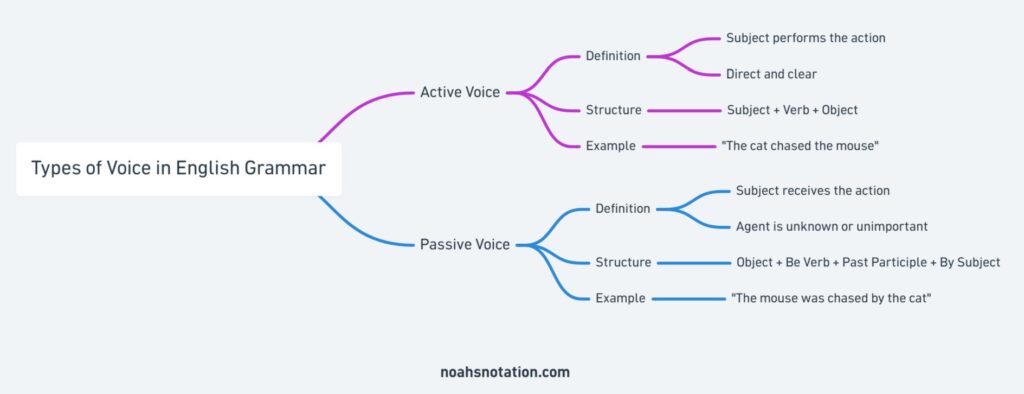
Active and passive voice are two important ways of expressing actions in English sentences. In active voice, the subject performs the action, making the sentence clear and direct. On the other hand, passive voice focuses on the action itself or the receiver of the action rather than the doer.
The main difference lies in emphasis. Active voice highlights who is doing the action, while passive voice highlights what is being done. To transform an active sentence into passive, the object of the active sentence becomes the subject, the verb changes into a “be” verb + past participle (V3), and the original subject is usually added after “by.”
Examples
Active: They called off the meeting.
Passive: The meeting was called off by them.
Explanation: The object “meeting” becomes the subject, and the verb changes to “was called off.”
Active: She writes a letter.
Passive: A letter is written by her.
Explanation: The verb “writes” becomes “is written,” and the object “letter” becomes the subject.
Active: They are building a house.
Passive: A house is being built by them.
Explanation: Continuous tense changes into “is being + V3.”
Active: He has completed the work.
Passive: The work has been completed by him.
Explanation: Perfect tense becomes “has been + V3.”
Active: The teacher will check the papers.
Passive: The papers will be checked by the teacher.
Explanation: Future tense changes into “will be + V3.”
Example Sentences
1. The chef cooked the meal. → Active voice because the subject performs the action.
The meal was cooked by the chef. → Passive voice because the focus is on the action and receiver.
They are repairing the road. → Active voice since “they” is doing the action.
The road is being repaired. → Passive voice because the doer is not important, only the action matters.
More Examples…
Active → Passive
1. She writes a letter → A letter is written by her.2. They built a bridge → A bridge was built by them.
3. He has completed the task → The task has been completed by him.
4. We are watching a movie → A movie is being watched by us.
5. The chef cooks food → Food is cooked by the chef.
6. They will finish the project → The project will be finished by them.
7. He repaired the car → The car was repaired by him.
8. She can solve the problem → The problem can be solved by her.
9. They are painting the house → The house is being painted by them.
10. He writes stories → Stories are written by him.
Passive → Active
1. The book was written by him → He wrote the book.2. The room is being cleaned by her → She is cleaning the room.
3. The work has been done by them → They have done the work.
4. The letter is written by her → She writes the letter.
5. The food was cooked by the chef → The chef cooked the food.
6. The match will be played by them → They will play the match.
7. The car was repaired by him → He repaired the car.
8. The problem can be solved by her → She can solve the problem.
9. The house is being painted by them → They are painting the house.
10. The story is told by him → He tells the story.
Lets Practice!
Active vs Passive Voice Worksheet
Choose the correct voice type
We’d Love to Hear From You!
Now it’s your turn! Did this guide on voice in English grammar help you understand Active and Passive Voice better? Drop your thoughts in the comment section below — we read every single one!
If you tried our practice worksheet, share your score and let us know how you did. Did you find it easy or a little tricky? Either way, we’re proud of you for giving it a shot!
Got a question your teacher hasn’t answered yet? Ask it right here — our team and fellow learners are always happy to help.
And if you found this guide useful, share it with your classmates, friends, or fellow teachers — because good knowledge is always worth passing on!
Got a topic you’d like us to cover next? Tell us in the comments — your suggestions help us write better guides for you. See you in the next one!