Article generation failed: Error code: 402 – {‘error’: {‘message’: ‘Insufficient credits. Add more using https://openrouter.ai/settings/credits’, ‘code’: 402}}
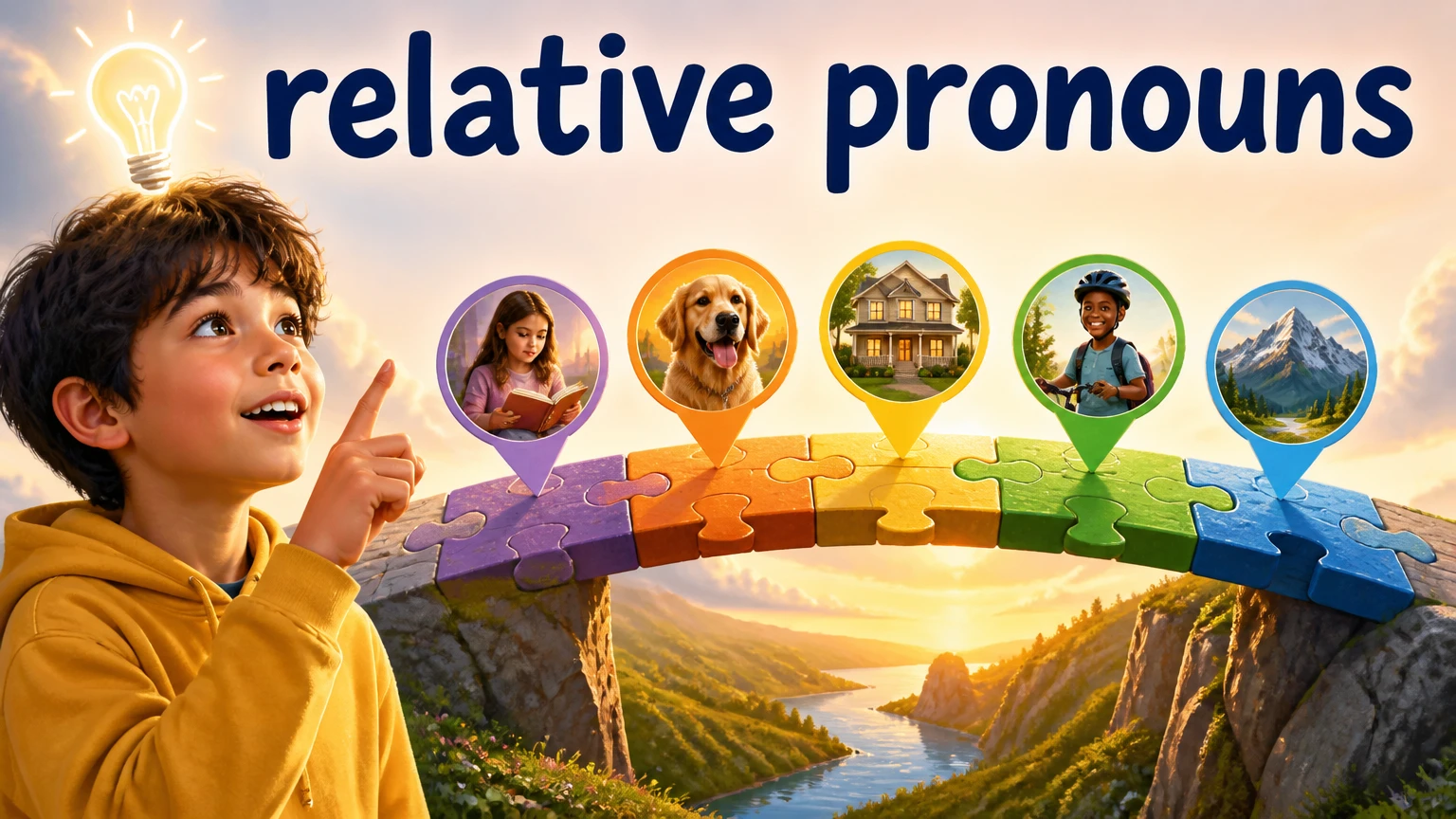
Relative pronouns are essential components of English grammar that allow us to connect two clauses and provide more information about a person, place, thing, or idea. They function as both a pronoun and a conjunction, helping to make our sentences more fluid and less repetitive.
Table of Contents
What are Relative Pronouns?
A relative pronoun is used to connect a relative clause (a dependent clause that provides more information) to a main clause. It refers back to a noun or pronoun mentioned previously, which is known as the antecedent.
In this sentence, “who” is the relative pronoun. It refers back to “the woman” and introduces the clause “lives next door.”
Common Relative Pronouns and Their Uses
Choosing the correct relative pronoun depends on whether you are referring to a person or an object, and what role that noun plays in the relative clause.
| Relative Pronoun | Used For | Role in Sentence |
|---|---|---|
| Who | People | Subject of the clause |
| Whom | People | Object of the clause |
| Which | Animals and Objects | Subject or Object |
| That | People, Animals, and Objects | Subject or Object (Informal) |
| Whose | Possession (People/Animals) | Shows ownership |
1. Who and Whom
Who is used when the pronoun is the subject of the clause. Whom is used when the pronoun is the object, often following a preposition.
- “The scientist who discovered the cure won a Nobel Prize.” (Subject)
- “The person to whom you should speak is the manager.” (Object)
2. Which and That
Which is used for things and animals. That is a versatile pronoun often used in place of “who” or “which” in defining clauses, particularly in spoken English.
Defining vs. Non-Defining Relative Clauses
Understanding the difference between these two types of clauses is crucial for correct punctuation.
Defining (Restrictive) Clauses
These clauses provide essential information to identify the noun. Without the clause, the sentence loses its meaning. No commas are used.
“The book that I borrowed from the library is overdue.”
Non-Defining (Non-Restrictive) Clauses
These clauses provide extra, non-essential information. The sentence still makes sense without them. Commas are required before and after the clause.
“My car, which I bought last year, has already broken down.”
When Can You Omit the Relative Pronoun?
In informal English, you can often leave out the relative pronoun if it is the object of the relative clause.
With pronoun: “The movie that we watched was boring.”
Without pronoun: “The movie we watched was boring.” (Correct and natural)
“The man lives next door is nice.”
“The man who lives next door is nice.”
Practice Exercises
Fill in the blanks with the correct relative pronoun (who, whom, whose, which, or that):
- The girl ________ won the race is my sister.
- The laptop ________ I bought yesterday is very fast.
- That is the man ________ car was stolen.
- The doctor ________ I consulted was very helpful.
Answers:
1. who/that, 2. which/that, 3. whose, 4. whom/that
Can I use “whose” for objects?
While “whose” is primarily for people (“The boy whose dog barked”), it is increasingly accepted in modern English to use it for objects to avoid awkward phrasing like “of which.” (e.g., “The tree whose leaves are turning brown.”)
Is “whom” still used?
“Whom” is becoming less common in casual conversation, where people often use “who” or “that.” However, it remains essential in formal writing and after prepositions (e.g., “To whom it may concern”).