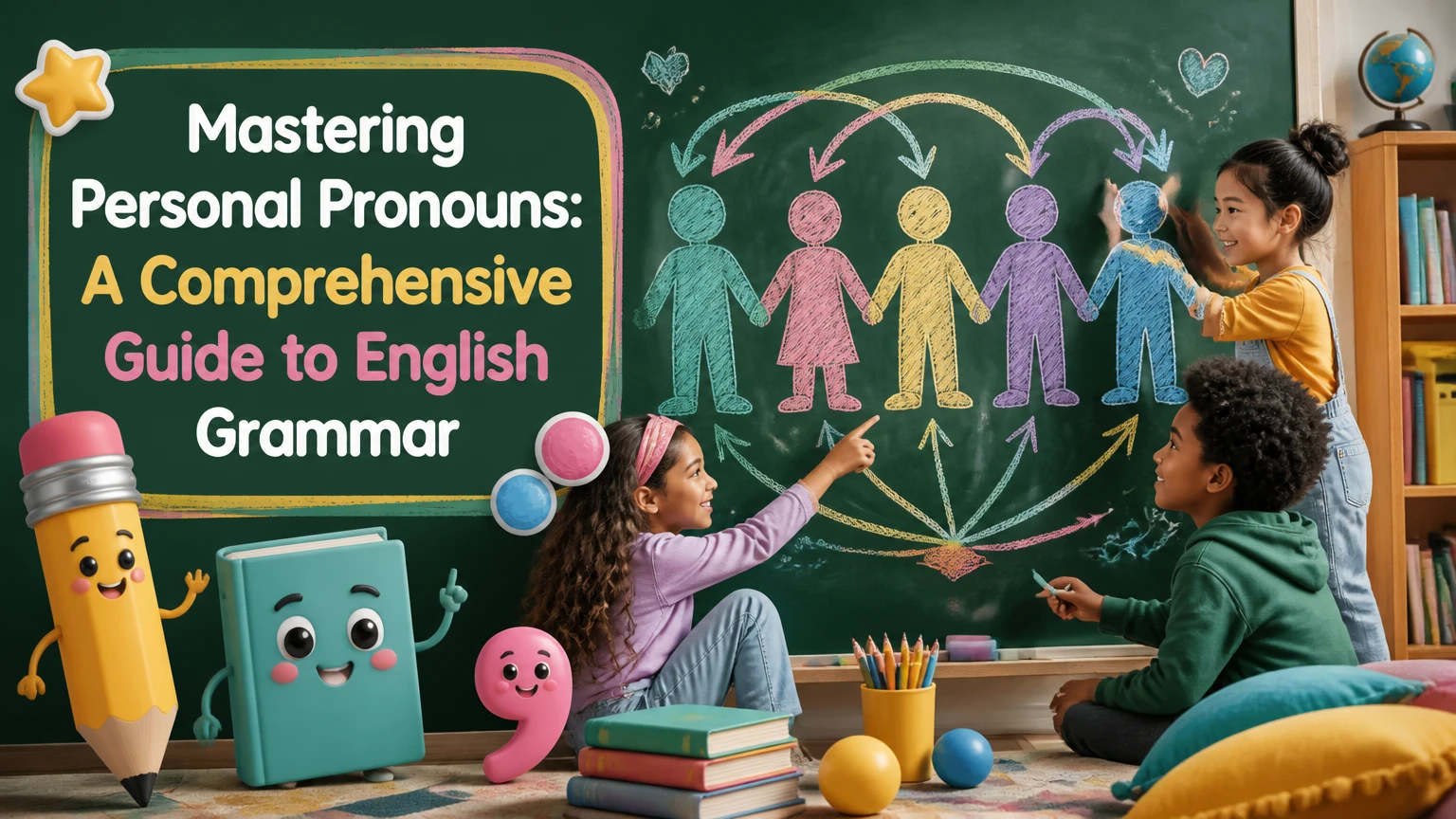
Personal pronouns are essential building blocks of the English language, acting as efficient substitutes for specific nouns to prevent repetitive and cumbersome sentence structures. By using words such as I, you, he, she, it, we, and they, speakers and writers can maintain a smooth flow of information while clearly identifying the subjects and objects of their communication. Understanding the nuances of these pronouns is vital for anyone looking to achieve fluency, as they dictate the relationship between the speaker, the listener, and the individuals or things being discussed. Whether you are writing a formal essay or engaging in a casual conversation, the correct application of personal pronouns ensures that your meaning is precise and your tone is professional. This guide will explore the diverse functions of these words, helping learners navigate the complexities of person, number, gender, and case in everyday English usage.
Table of Contents
- Defining Personal Pronouns
- Structural Breakdown: Person, Number, and Gender
- Understanding Grammatical Cases
- Subjective Personal Pronouns
- Objective Personal Pronouns
- Possessive Pronouns vs. Possessive Adjectives
- Reflexive and Intensive Pronouns
- Comprehensive Usage Rules and Syntax
- Common Mistakes and How to Avoid Them
- Advanced Topics: Formal vs. Informal Usage
- Practice Exercises and Worksheets
- Frequently Asked Questions (FAQ)
- Conclusion and Final Tips
Defining Personal Pronouns
A personal pronoun is a short word we use as a simple substitute for the proper name of a person or a specific thing. Each of the personal pronouns shows us the grammatical person, number, gender, and case of the noun it replaces. Without these versatile tools, English would feel incredibly repetitive; imagine having to say “John went to John’s car because John forgot John’s keys” instead of “John went to his car because he forgot his keys.”
The primary function of a personal pronoun is to represent a “participant” in the discourse. This participant can be the person speaking (first person), the person being spoken to (second person), or a person/thing being spoken about (third person). Because they are “personal,” they typically refer to humans, though the pronoun “it” is used for animals, objects, and abstract concepts.
In linguistics, personal pronouns are categorized as a “closed class” of words. This means that the English language rarely adds new personal pronouns to its core set, unlike “open classes” such as nouns or verbs where new words like “selfie” or “google” emerge frequently. This stability makes them a foundational element of grammar that every learner must master early in their journey.
Structural Breakdown: Person, Number, and Gender
To use personal pronouns correctly, one must understand the three main dimensions they occupy. These dimensions help the listener identify exactly who is being discussed without the need for constant clarification. The first dimension is Person, which defines the perspective of the narrative.
First person refers to the speaker or a group including the speaker (I, me, we, us). Second person refers to the party being addressed (you). Third person refers to people or things that are not the speaker or the listener (he, she, it, they, him, her, them).
The second dimension is Number. English personal pronouns distinguish between singular (one person or thing) and plural (more than one). For example, “I” is singular, while “we” is plural. Interestingly, the pronoun “you” serves as both the singular and plural form in modern English, which can sometimes lead to ambiguity corrected by context or regional dialects like “you all” or “y’all.”
The third dimension is Gender. In the third-person singular, English distinguishes between masculine (he/him), feminine (she/her), and neuter (it). In recent years, the use of “they” as a singular pronoun has become widely accepted to refer to individuals who do not identify with a specific gender or when the gender of a person is unknown.
Understanding Grammatical Cases
In English grammar, “case” refers to the grammatical role a noun or pronoun plays in a sentence. While modern English nouns do not change their form based on case (except for the possessive), personal pronouns are highly inflected, meaning they change their spelling and sound depending on their position in the sentence.
There are three primary cases for personal pronouns: Subjective (or Nominative), Objective (or Accusative), and Possessive (or Genitive). The subjective case is used when the pronoun is the “doer” of the action. The objective case is used when the pronoun “receives” the action or follows a preposition. The possessive case shows ownership or relationship.
The following table provides a comprehensive overview of how personal pronouns change across these three dimensions. This serves as a foundational reference for all subsequent sections of this article.
Table 1: The Complete Matrix of Personal Pronouns
| Person | Number | Subjective | Objective | Possessive Pronoun | Possessive Adjective |
|---|---|---|---|---|---|
| 1st Person | Singular | I | me | mine | my |
| 2nd Person | Singular | you | you | yours | your |
| 3rd Person (M) | Singular | he | him | his | his |
| 3rd Person (F) | Singular | she | her | hers | her |
| 3rd Person (N) | Singular | it | it | (rarely used) | its |
| 1st Person | Plural | we | us | ours | our |
| 2nd Person | Plural | you | you | yours | your |
| 3rd Person | Plural | they | them | theirs | their |
Subjective Personal Pronouns
Subjective pronouns, also known as nominative pronouns, function as the subject of a verb. The subject is the person or thing that performs the action of the sentence. For example, in the sentence “She runs fast,” the word “she” is the subject performing the action of running.
These pronouns also appear after “linking verbs” (like to be) in formal grammar, known as a predicate nominative. While many people say “It’s me” in casual speech, the strict grammatical rule is “It is I.” However, modern usage has shifted significantly toward the objective case in these specific instances.
When you have a compound subject (a subject with more than one person), it is a common mistake to use the objective form. For instance, you should say “Sarah and I went to the store,” not “Sarah and me went to the store.” A helpful tip is to remove the other person from the sentence to see if the pronoun still makes sense: “I went to the store” works, but “Me went to the store” does not.
Table 2: 25 Examples of Subjective Pronouns in Sentences
| Pronoun | Example Sentence | Person/Number |
|---|---|---|
| I | I am learning how to play the piano. | 1st Singular |
| I | I think we should leave now. | 1st Singular |
| I | I hope you have a wonderful day. | 1st Singular |
| You | You are my best friend. | 2nd Singular/Plural |
| You | You should try this delicious cake. | 2nd Singular/Plural |
| You | You look very professional today. | 2nd Singular/Plural |
| He | He works at the local hospital. | 3rd Singular (M) |
| He | He forgot his umbrella at home. | 3rd Singular (M) |
| He | He is the captain of the football team. | 3rd Singular (M) |
| She | She loves to read mystery novels. | 3rd Singular (F) |
| She | She decided to start her own business. | 3rd Singular (F) |
| She | She speaks three different languages. | 3rd Singular (F) |
| It | It is raining quite heavily outside. | 3rd Singular (N) |
| It | It smells like fresh lavender in here. | 3rd Singular (N) |
| It | It was a difficult decision to make. | 3rd Singular (N) |
| We | We are going on vacation next week. | 1st Plural |
| We | We finished the project ahead of schedule. | 1st Plural |
| We | We believe in your potential. | 1st Plural |
| They | They arrived at the airport on time. | 3rd Plural |
| They | They built a new park in the city center. | 3rd Plural |
| They | They are coming over for dinner. | 3rd Plural |
| I | I saw the movie last night. | 1st Singular |
| You | You can sit anywhere you like. | 2nd Singular/Plural |
| He | He plays the guitar beautifully. | 3rd Singular (M) |
| They | They don’t want to miss the bus. | 3rd Plural |
Objective Personal Pronouns
Objective pronouns are used when the pronoun is the object of a verb or a preposition. This means the pronoun is receiving the action rather than performing it. For example, in “The dog chased me,” the word “me” is the object because it is the one being chased.
There are three types of objects: direct objects, indirect objects, and objects of a preposition. A direct object receives the action directly (e.g., “I called him“). An indirect object tells us to whom or for whom the action is done (e.g., “She gave me a gift”). An object of a preposition follows words like with, for, to, by, and between (e.g., “This secret is between us“).
A frequent point of confusion occurs with the phrase “between [someone] and [me/I].” Because “between” is a preposition, it must be followed by the objective case. Therefore, “between you and me” is the only grammatically correct version, while “between you and I” is a common hypercorrection that is technically incorrect.
Table 3: 25 Examples of Objective Pronouns in Sentences
| Pronoun | Example Sentence | Function |
|---|---|---|
| me | The teacher asked me a question. | Indirect Object |
| me | Please call me when you arrive. | Direct Object |
| me | Can you come with me? | Obj of Preposition |
| you | I will send you the details. | Indirect Object |
| you | The manager wants to see you. | Direct Object |
| you | This package is for you. | Obj of Preposition |
| him | We invited him to the party. | Direct Object |
| him | Give him the keys, please. | Indirect Object |
| him | I am standing right behind him. | Obj of Preposition |
| her | The news surprised her. | Direct Object |
| her | Show her the new design. | Indirect Object |
| her | I bought these flowers for her. | Obj of Preposition |
| it | I don’t like it very much. | Direct Object |
| it | Put the book back on it. | Obj of Preposition |
| it | The cat is chasing it. | Direct Object |
| us | They told us the truth. | Indirect Object |
| us | The coach praised us for our effort. | Direct Object |
| us | Wait for us at the entrance. | Obj of Preposition |
| them | I saw them at the mall. | Direct Object |
| them | Tell them the meeting is canceled. | Indirect Object |
| them | I walked past them without noticing. | Obj of Preposition |
| me | He told me a funny story. | Indirect Object |
| her | Don’t listen to her. | Obj of Preposition |
| him | The police questioned him. | Direct Object |
| us | The sun is shining on us. | Obj of Preposition |
Possessive Pronouns vs. Possessive Adjectives
Possessive forms indicate ownership. However, learners often confuse possessive pronouns with possessive adjectives. While they both show possession, they function differently in a sentence’s structure. A possessive adjective (my, your, his, her, its, our, their) always precedes a noun. For example: “This is my car.” Here, “my” modifies the noun “car.”
In contrast, a possessive pronoun (mine, yours, his, hers, ours, theirs) replaces the noun phrase entirely. For example: “This car is mine.” In this sentence, “mine” stands alone and acts as the subject or object. Note that “its” is almost always used as an adjective (“The dog wagged its tail”) and is rarely used as a standalone pronoun.
One of the most important spelling rules in English involves the word “its.” The possessive form “its” has no apostrophe. The word “it’s” is a contraction for “it is” or “it has.” Confusing these two is one of the most common errors in written English, even among native speakers.
Table 4: 20 Examples of Possessive Pronouns (Standalone)
| Possessive Pronoun | Example Sentence | Replaced Noun Phrase |
|---|---|---|
| mine | The red bike is mine. | my bike |
| mine | You took yours, so I took mine. | my thing |
| yours | Is this coffee yours? | your coffee |
| yours | The choice is yours. | your choice |
| his | The trophy is his. | his trophy |
| his | I have my car, and he has his. | his car |
| hers | The house with the blue door is hers. | her house |
| hers | That idea was hers. | her idea |
| ours | The victory is ours! | our victory |
| ours | Their garden is big, but ours is bigger. | our garden |
| theirs | The responsibility is theirs. | their responsibility |
| theirs | I don’t have a map; can we use theirs? | their map |
| mine | That pen is mine; please return it. | my pen |
| yours | My shoes are wet, but yours are dry. | your shoes |
| hers | I lost my phone, so she lent me hers. | her phone |
| theirs | Our team won, but theirs played well. | their team |
| his | I found my keys, but he still can’t find his. | his keys |
| ours | This land is ours. | our land |
| mine | The pleasure is all mine. | my pleasure |
| theirs | The fault was theirs alone. | their fault |
Reflexive and Intensive Pronouns
Reflexive pronouns end in -self (singular) or -selves (plural). We use a reflexive pronoun when the subject and the object of a sentence are the same person or thing. For example, “I hurt myself.” You cannot say “I hurt me” because the person performing the action is the same as the person receiving it.
The reflexive pronouns are: myself, yourself, himself, herself, itself, ourselves, yourselves, and themselves. They are also used after prepositions when the prepositional object refers back to the subject, such as “She bought a gift for herself.”
These same words can also function as intensive pronouns. An intensive pronoun is used to emphasize a noun or another pronoun. For example, “I myself saw the ghost.” In this case, “myself” isn’t necessary for the sentence’s basic meaning, but it adds emphasis to the fact that “I” was the witness. If you remove an intensive pronoun, the sentence still makes sense; if you remove a reflexive pronoun, it usually does not.
Table 5: Reflexive vs. Intensive Usage
| Pronoun | Reflexive Usage (Necessary) | Intensive Usage (Emphatic) |
|---|---|---|
| myself | I taught myself to cook. | I will do it myself. |
| yourself | You should be proud of yourself. | You yourself said it was true. |
| himself | He shaved himself this morning. | The King himself attended. |
| herself | She looked at herself in the mirror. | She built the house herself. |
| itself | The oven cleans itself. | The movie itself was boring. |
| ourselves | We organized ourselves into teams. | We ourselves are to blame. |
| yourselves | Help yourselves to some food. | You yourselves must decide. |
| themselves | They found themselves in trouble. | They themselves did the work. |
Comprehensive Usage Rules and Syntax
Mastering personal pronouns requires understanding specific rules of syntax and agreement. The most fundamental rule is Pronoun-Antecedent Agreement. An antecedent is the noun that the pronoun replaces. A pronoun must agree with its antecedent in number and gender. If the antecedent is “The boy” (singular, masculine), the pronoun must be “he” or “him.” If the antecedent is “The books” (plural, neuter), the pronoun must be “they” or “them.”
Another important rule involves the Order of Pronouns. When referring to yourself and others, it is polite and grammatically standard to place the other person first. For example, say “Jamie and I” instead of “I and Jamie.” This applies to both subjective and objective cases (“They invited Jamie and me”).
The use of Generic Pronouns is a third area of focus. Historically, “he” was used as a generic pronoun for an unknown person (“Every student must bring his book”). However, modern English prefers “they” as a gender-neutral singular pronoun (“Every student must bring their book”) to be more inclusive and accurate when the gender is not specified.
Finally, we must consider pronouns in Comparisons. When using “than” or “as,” the case of the pronoun depends on the implied verb. For example, “He is taller than I [am]” is technically correct in formal writing, though “He is taller than me” is common in speech. To be safe in formal contexts, always mentally complete the sentence to determine the correct case.
Common Mistakes and How to Avoid Them
Even advanced English speakers make mistakes with personal pronouns. One of the most frequent errors is the confusion between “I” and “me” in compound structures. People often think “I” sounds more formal and use it incorrectly as an object. For example, “He gave the tickets to Sarah and I” is incorrect. It should be “Sarah and me” because it is the object of the preposition “to.”
Another common error is the misuse of reflexive pronouns. People often use “myself” when they should use “me” or “I,” usually in an attempt to sound more sophisticated. For example, “Please contact myself if you have questions” is incorrect; it should be “Please contact me.” Remember: only use “-self” words if the subject of the sentence is the same person.
The its vs. it’s error remains a persistent issue. This is a spelling mistake rather than a grammatical one, but it significantly impacts the quality of writing. “Its” is possessive (like “his” or “her”), while “it’s” is a contraction. A quick test is to replace the word with “it is.” If the sentence still makes sense, use “it’s.” If not, use “its.”
Table 6: Correcting Common Pronoun Errors
| Incorrect Sentence | Correct Sentence | Rule Explained |
|---|---|---|
| Me and him are going out. | He and I are going out. | Use subjective case for subjects. |
| The secret is between you and I. | The secret is between you and me. | Use objective case after prepositions. |
| Give it to myself. | Give it to me. | Use reflexive only if subject is “I”. |
| The dog wagged it’s tail. | The dog wagged its tail. | “Its” is the possessive form. |
| Her and her mom left. | She and her mom left. | “She” is the subject. |
| It was them who called. | It was they who called. | Formal predicate nominative. |
| Than him, I am taller. | I am taller than he (is). | Comparison implies a verb. |
| Send the mail to John and I. | Send the mail to John and me. | Objective case for indirect object. |
Advanced Topics: Formal vs. Informal Usage
In the evolution of the English language, the gap between “standard” grammar and “spoken” English has widened, particularly regarding personal pronouns. One major area is the Who vs. Whom distinction. While “whom” is the objective form of “who,” it is rapidly disappearing from casual speech. However, in formal writing, “To whom was the letter addressed?” is still preferred over “Who was the letter addressed to?”
The Singular They is another advanced topic. While it has been used by writers like Shakespeare and Austen, it was frowned upon by 19th-century grammarians. Today, major style guides like APA and MLA endorse the singular “they” for individuals whose gender is unknown or who identify as non-binary. This reflects a shift toward functional grammar that prioritizes clarity and respect over rigid historical rules.
In very formal or legal contexts, you might encounter Archaic Pronouns like “thou,” “thee,” “thy,” and “thine.” These were the original second-person singular pronouns (with “you” being plural). While they are no longer used in modern communication, understanding them is helpful for reading classical literature or religious texts. Modern English is unique among European languages for having lost its formal/informal distinction in the second person (unlike “tu/vous” in French or “du/Sie” in German).
Practice Exercises and Worksheets
To master personal pronouns, consistent practice is essential. The following exercises are designed to test your understanding of case, number, and agreement across different contexts.
Exercise 1: Subjective vs. Objective Case
Choose the correct pronoun to complete each sentence.
- (I / Me) want to go to the park today.
- Can you help (he / him) with his homework?
- The teacher gave (we / us) a lot of assignments.
- (She / Her) and (I / me) are best friends.
- Wait for (they / them) at the bus stop.
- (We / Us) are winning the game!
- Is that gift for (she / her)?
- Between you and (I / me), I think he’s lying.
- (He / Him) is the person I told you about.
- They invited my brother and (I / me) to the wedding.
Exercise 2: Possessive Pronouns vs. Adjectives
Fill in the blanks with the correct possessive form.
| Question | Sentence | Answer |
|---|---|---|
| 1 | This is ____ (my/mine) phone. | my |
| 2 | That book is ____ (your/yours). | yours |
| 3 | The bird built ____ (its/it’s) nest. | its |
| 4 | We sold ____ (our/ours) car. | our |
| 5 | This house is ____ (their/theirs). | theirs |
| 6 | I found ____ (her/hers) glasses. | her |
| 7 | The decision was ____ (my/mine). | mine |
| 8 | Is this seat ____ (his/his)? | his |
| 9 | ____ (Our/Ours) team is the best. | Our |
| 10 | The computer is ____ (her/hers). | hers |
Exercise 3: Reflexive Pronouns
Complete the sentence with the appropriate reflexive or intensive pronoun.
- I accidentally cut _______ while chopping vegetables.
- The children did their homework by _______.
- She _______ told me the news.
- We should treat _______ to a nice dinner.
- The cat washed _______ after eating.
- You must protect _______ from the cold.
- Did you build this birdhouse _______?
- The president _______ signed the document.
- The machine shuts _______ off after ten minutes.
- They found _______ in a difficult situation.
Answer Key for Exercises
| Ex # | Answers |
|---|---|
| 1 | 1. I, 2. him, 3. us, 4. She/I, 5. them, 6. We, 7. her, 8. me, 9. He, 10. me |
| 2 | 1. my, 2. yours, 3. its, 4. our, 5. theirs, 6. her, 7. mine, 8. his, 9. Our, 10. hers |
| 3 | 1. myself, 2. themselves, 3. herself, 4. ourselves, 5. itself, 6. yourself/yourselves, 7. yourself, 8. himself, 9. itself, 10. themselves |
Frequently Asked Questions (FAQ)
Q: Is it “It is I” or “It is me”?
A: In formal, traditional grammar, “It is I” is correct because the verb “to be” acts as a linking verb, requiring the subjective case (predicate nominative). However, in modern, everyday English, “It is me” is almost universally accepted and sounds much more natural to native speakers.
Q: Why can’t I use “myself” instead of “me” to sound more polite?
A: This is a common habit known as “over-refinement.” Reflexive pronouns like “myself” have specific grammatical functions (referring back to the subject). Using “myself” when there is no “I” as a subject is grammatically incorrect. Stick to “me” for objects and “I” for subjects.
Q: Is “they” singular or plural?
A: Historically, “they” is plural. However, it has been used as a singular pronoun for centuries when the gender of a person is unknown. Today, it is officially recognized as a singular pronoun by most major dictionaries and style guides for both unknown gender and for people who prefer gender-neutral pronouns.
Q: How do I know whether to use “who” or “whom”?
A: A simple trick is the “he/him” test. If you can answer the question with “he,” use “who.” If you can answer with “him,” use “whom.” (e.g., Who/Whom wrote this? He wrote it -> Who. To who/whom should I speak? Speak to him -> Whom.)
Q: What is the difference between “your” and “you’re”?
A: “Your” is a possessive adjective indicating ownership (e.g., “your book”). “You’re” is a contraction of “you are” (e.g., “you’re welcome”). They are homophones, meaning they sound the same but have different meanings and spellings.
Q: Can a personal pronoun refer to an animal?
A: Yes. While “it” is the standard pronoun for animals, we often use “he” or “she” for pets or animals whose gender is known and with whom we have an emotional connection. This is called personification and is very common in English.
Conclusion and Final Tips
Personal pronouns are the invisible threads that hold English sentences together, providing clarity, brevity, and focus. By mastering the distinction between subjective, objective, and possessive cases, you can avoid the most common pitfalls that plague even native writers. Remember to always check your pronoun-antecedent agreement and be mindful of the context—formal writing often requires stricter adherence to traditional rules than casual conversation. To continue improving, pay close attention to how authors use pronouns in books and articles, and don’t be afraid to use the “removal test” for compound subjects and objects. With consistent practice and attention to detail, the correct use of personal pronouns will become second nature, significantly enhancing your communication skills in both written and spoken English.