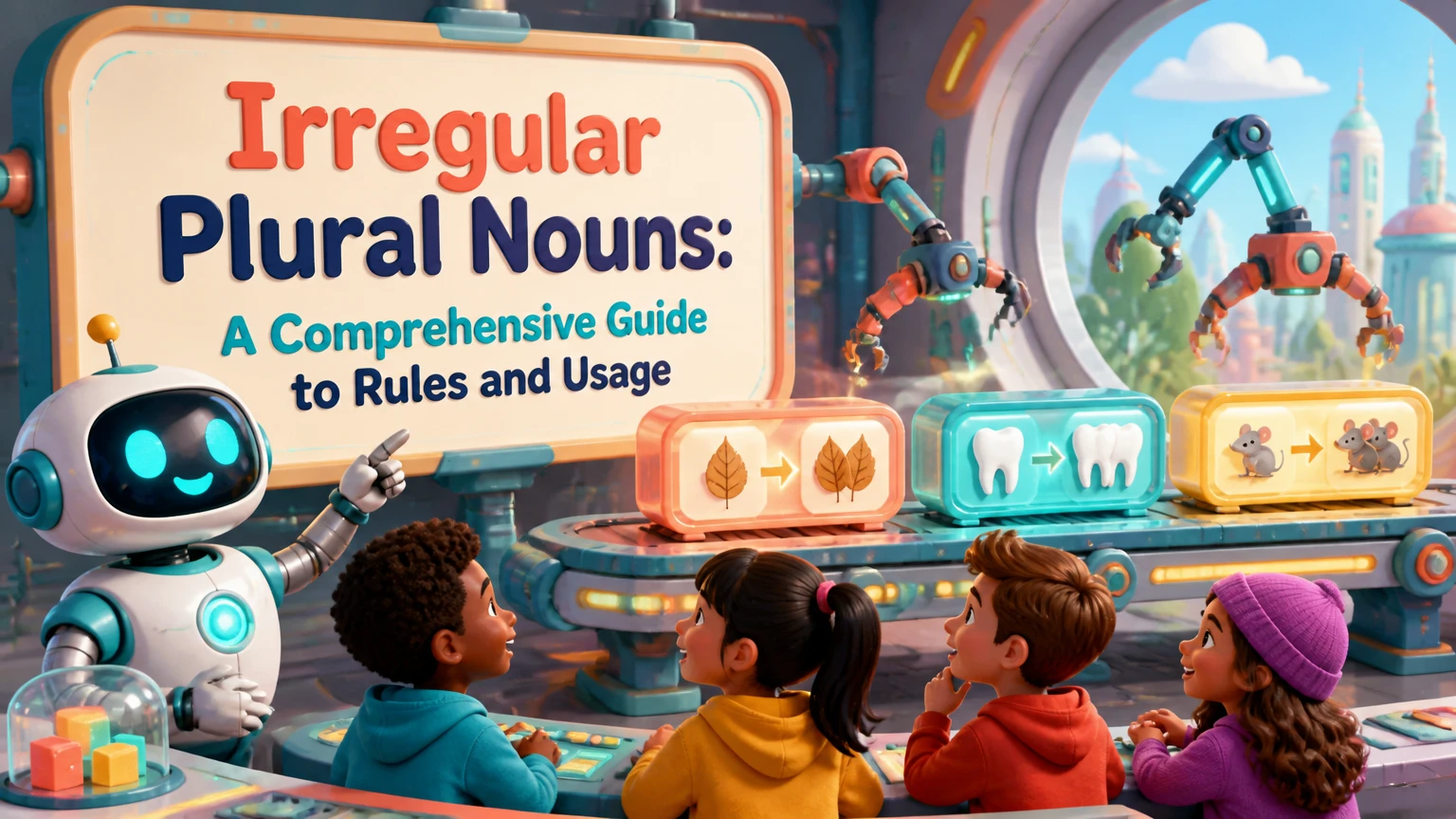
Noun plurals in the English language are often more complex than simply adding a suffix like “s” or “es” to the end of a word. While most nouns follow predictable patterns, irregular plural nouns represent a significant group of words that deviate from standard conventions by changing their internal vowels, adopting foreign endings, or remaining entirely unchanged. Mastering these variations, including common examples such as children, mice, feet, criteria, and sheep, is essential for achieving true fluency and precision in both written and spoken English. Understanding these nuances helps learners avoid common grammatical pitfalls and allows for more sophisticated communication in academic, professional, and creative contexts.
Table of Contents
- Definition of Irregular Plural Nouns
- Structural Breakdown and Linguistic Origins
- Category 1: Internal Vowel Changes (Mutation)
- Category 2: The Old English “-en” Ending
- Category 3: Nouns Ending in -f and -fe
- Category 4: Base Plurals (No Change)
- Category 5: Latin and Greek Loanwords
- Category 6: Compound Nouns and Their Plurals
- Comprehensive Example Tables
- Advanced Usage Rules and Subject-Verb Agreement
- Common Mistakes and How to Avoid Them
- Practice Exercises and Assessment
- Advanced Topics: Collective Nouns and Mass Nouns
- Frequently Asked Questions (FAQ)
- Conclusion and Final Tips
Definition of Irregular Plural Nouns
An irregular plural noun is a noun that does not follow the standard rule of adding -s or -es to its singular form to indicate more than one. In standard English morphology, the vast majority of nouns are “regular,” meaning their pluralization is predictable and follows a phonetic pattern based on the final sound of the word. Irregular nouns, however, are historical remnants or linguistic imports that preserve older forms of the language or adhere to the grammar of their original source languages, such as Latin, Greek, or Old Norse.
These nouns function identically to regular nouns in a sentence; they serve as subjects, objects, or complements. The primary challenge lies in their orthography (spelling) and phonology (pronunciation). Because they do not follow a single unified rule, they must often be memorized individually or learned as part of specific morphological clusters. For example, the shift from man to men is a result of a linguistic process called i-mutation, which was common in Germanic languages over a millennium ago.
Functionally, irregular plurals are vital for clarity. Using a regularized form of an irregular noun (like saying “childs” instead of children) is considered a hallmark of “interlanguage” in ESL learners or “overregularization” in young children. While the meaning is usually understood, the error is stark. Therefore, a deep dive into these categories is not just an academic exercise but a practical necessity for anyone aiming for professional-level English proficiency.
Structural Breakdown and Linguistic Origins
To understand why irregular plurals exist, we must look at the history of the English language. English is a Germanic language that has been heavily influenced by French, Latin, and Greek. Each of these influences left behind specific ways of handling plurality. The structural breakdown of these nouns generally falls into three historical buckets: Germanic relics, the “f” to “v” voicing shift, and classical loanwords.
Germanic relics include words that change their internal vowels. This is known as “ablaut” or “umlaut.” In these cases, the vowel in the middle of the word shifts to a different sound to indicate plurality. This is why goose becomes geese. These are some of the oldest words in the English language, often referring to basic human concepts, body parts, or common animals.
Classical loanwords, primarily from Latin and Greek, follow the pluralization rules of their mother tongues. This is why a word ending in -us might change to -i (like cactus to cacti) or a word ending in -is might change to -es (like analysis to analyses). Over time, some of these words have become “regularized” in common speech, leading to dual forms like formulae and formulas, both of which are now acceptable in different contexts.
Category 1: Internal Vowel Changes (Mutation)
One of the most recognizable types of irregular plurals involves a change in the vowel sound within the word itself. This is not a random occurrence but a systemic change inherited from Proto-Germanic. In these instances, the consonants at the beginning and end of the word usually remain the same, while the core vowel transforms. This transformation is often referred to as “mutation plurals.”
For example, the word tooth becomes teeth. Note how the “oo” sound shifts to an “ee” sound. This pattern is consistent across several common English words. However, it is important to note that this is a “closed” category. New words entering the English language today will never follow this pattern; they will almost always be regularized. You will never see a new word like “booth” become “beeth.”
Understanding these changes requires memorization because there is no modern rule that dictates which vowels will change or how. Learners must simply become familiar with the small set of words that utilize this ancient mechanism. These words are high-frequency, meaning they appear very often in daily conversation, making them a priority for any student of the language.
Category 2: The Old English “-en” Ending
In Old English, many more nouns formed their plurals by adding -en rather than -s. Over centuries, the -s ending (which came from a specific northern dialect) became the dominant standard. However, a few survivors of the -en era remain in modern English. The most common of these is child becoming children and ox becoming oxen.
The word children is particularly interesting because it is actually a “double plural.” In very old forms of English, the plural was childer. Later, speakers added the -en suffix to the already plural childer, resulting in children. This shows how language evolves through the layering of different rules over time. Another rare example is brother becoming brethren, though this is now mostly reserved for religious or formal fraternal contexts.
While this category is very small, the words within it are essential. Children is one of the most frequently used nouns in the English language. Misusing it by saying “childs” is a very noticeable error. Therefore, even though there are only a handful of these words, they carry significant weight in terms of perceived grammatical competence.
Category 3: Nouns Ending in -f and -fe
Many nouns that end in -f or -fe undergo a specific transformation where the f changes to a v before adding -es. This is known as “voicing.” Because v is a voiced consonant and f is unvoiced, this shift often makes the word easier to pronounce when followed by a plural suffix. Common examples include leaf becoming leaves and wife becoming wives.
However, this rule is not universal, which is what makes it “irregular.” Some words ending in -f follow the regular rule and simply add -s, such as roof becoming roofs or chief becoming chiefs. There is no perfect phonetic rule to determine which words will shift and which won’t, though words of Germanic origin are more likely to undergo the f to v change than those of French origin.
In some cases, both forms are accepted. For instance, the plural of dwarf can be dwarfs or dwarves, though the latter was popularized largely by J.R.R. Tolkien. Similarly, scarf can become scarfs or scarves. When in doubt, checking a dictionary is the best course of action for this specific category, as usage can vary by region and style guide.
Category 4: Base Plurals (No Change)
Base plurals, also known as “zero plurals,” are nouns that do not change their form at all between the singular and the plural. The word remains exactly the same regardless of whether you are talking about one item or one hundred. This is most common with certain animals, particularly those that are hunted or live in groups, such as deer, fish, and moose.
The use of base plurals can sometimes be confusing for learners because the number must be inferred from the context of the sentence or from the accompanying verbs and articles. For example, “The sheep is in the field” refers to one animal, while “The sheep are in the field” refers to multiple animals. The noun itself provides no clue; the verb is/are does the heavy lifting.
It is also worth noting that some of these words have “regular” plurals that are used in specific scientific contexts. For example, while fish is the standard plural for multiple individuals of the same species, fishes is often used by biologists when referring to multiple species of fish. However, for everyday communication, sticking to the base plural is almost always the correct choice.
Category 5: Latin and Greek Loanwords
English has borrowed thousands of words from Latin and Greek, especially in the fields of science, medicine, and law. Many of these words have retained their original pluralization patterns. These are often the most difficult irregular plurals for students because they involve endings that are unfamiliar to the standard English phonetic system.
Latin nouns ending in -us often change to -i (e.g., stimulus to stimuli). Those ending in -um change to -a (e.g., datum to data). Greek nouns ending in -is usually change to -es (e.g., crisis to crises), and those ending in -on change to -a (e.g., phenomenon to phenomena). Because these words are so common in academic writing, mastering them is vital for university-level success.
The table below provides a clear breakdown of these classical patterns. It is important to remember that as these words become more integrated into common English, they often develop a regular plural form. For example, while curricula is the traditional plural of curriculum, curriculums is increasingly accepted in non-academic settings. However, in formal writing, the classical form is usually preferred.
Category 6: Compound Nouns and Their Plurals
Compound nouns are words made up of two or more words that act as a single unit of meaning. When a compound noun is irregular or contains a “head word” (the primary noun being described), the pluralization usually happens to the head word, not the end of the phrase. This often results in plurals that look strange to the untrained eye.
For example, in the term mother-in-law, the “head word” is mother. Therefore, the plural is mothers-in-law, not “mother-in-laws.” Similarly, a passer-by becomes passers-by. This rule applies because you are talking about multiple mothers or multiple people passing, not multiple “laws” or “bys.”
In cases where the compound noun is written as a single word without hyphens, it usually follows standard rules at the end of the word (e.g., cupfuls), but there are exceptions. If the compound noun includes an irregular noun, like fireman, the plural follows the irregular pattern of that specific noun: firemen. Understanding which part of the compound carries the “noun-ness” is the key to pluralizing these words correctly.
Comprehensive Example Tables
The following tables provide a massive repository of irregular plural nouns organized by their specific morphological patterns. These tables serve as a quick reference guide for students and writers who need to verify the correct form of a noun.
Table 1: Internal Vowel Change (Mutation Plurals)
This table lists nouns where the internal vowel sound changes to indicate plurality. These are among the oldest and most common irregular nouns in English.
| Singular Form | Irregular Plural Form | Example Sentence |
|---|---|---|
| Man | Men | The men are working on the construction site. |
| Woman | Women | Three women joined the board of directors. |
| Foot | Feet | My feet are sore after the long hike. |
| Tooth | Teeth | Children lose their baby teeth around age six. |
| Goose | Geese | A flock of geese flew over the lake. |
| Mouse | Mice | The cat is chasing the mice in the attic. |
| Louse | Lice | The school checked the students for head lice. |
| Dormouse | Dormice | Dormice are known for their long hibernation. |
| Fireman | Firemen | The firemen arrived quickly at the scene. |
| Saleswoman | Saleswomen | The saleswomen exceeded their monthly targets. |
| Postman | Postmen | The postmen deliver mail even in the rain. |
| Policeman | Policemen | Several policemen were patrolling the park. |
| Gentleman | Gentlemen | “Ladies and gentlemen, please take your seats.” |
| Superwoman | Superwomen | The book celebrates the superwomen of history. |
| Englishman | Englishmen | The two Englishmen discussed the weather. |
| Freshman | Freshmen | The freshmen are attending orientation today. |
| Kinsman | Kinsmen | He invited all his kinsmen to the feast. |
| Showman | Showmen | The circus featured many talented showmen. |
| Middleman | Middlemen | Eliminating middlemen can reduce costs for consumers. |
| Forefoot | Forefeet | The horse injured its forefeet during the race. |
Table 2: Nouns Ending in -f and -fe (Voicing Change)
This category involves changing the final “f” sound to a “v” sound. Note that not all words ending in “f” follow this rule, making these specific examples important to memorize.
| Singular Form | Irregular Plural Form | Common Usage Context |
|---|---|---|
| Leaf | Leaves | Nature and botany |
| Knife | Knives | Kitchen and tools |
| Wife | Wives | Family and relationships |
| Life | Lives | General existence |
| Thief | Thieves | Crime and law |
| Half | Halves | Mathematics and fractions |
| Calf | Calves | Animals and anatomy |
| Shelf | Shelves | Furniture and storage |
| Loaf | Loaves | Food and baking |
| Wolf | Wolves | Wildlife |
| Self | Selves | Psychology and philosophy |
| Sheaf | Sheaves | Agriculture (wheat) |
| Elf | Elves | Mythology and fantasy |
| Wharf | Wharves | Shipping and docks |
| Scarf | Scarves | Clothing/Accessories |
| Dwarf | Dwarves | Mythology/Fantasy |
| Hoof | Hooves | Animal anatomy |
| Midwife | Midwives | Medical profession |
| Housewife | Housewives | Domestic life |
| Shelf | Shelves | Home organization |
Table 3: Latin and Greek Irregular Plurals
Academic and technical English relies heavily on these forms. Using the correct plural in a scientific or formal context is essential for credibility.
| Singular (-us, -um, -is, -on) | Plural (-i, -a, -es, -a) | Field of Study |
|---|---|---|
| Alumnus | Alumni | Education |
| Cactus | Cacti | Botany |
| Focus | Foci | Science/Math |
| Nucleus | Nuclei | Biology/Physics |
| Syllabus | Syllabi | Education |
| Bacterium | Bacteria | Medicine |
| Curriculum | Curricula | Education |
| Datum | Data | Statistics |
| Medium | Media | Communications |
| Stratum | Strata | Geology |
| Analysis | Analyses | General Research |
| Axis | Axes | Mathematics |
| Basis | Bases | Logic/Philosophy |
| Crisis | Crises | Sociology/Politics |
| Diagnosis | Diagnoses | Medicine |
| Hypothesis | Hypotheses | Science |
| Oasis | Oases | Geography |
| Thesis | Theses | Academic Writing |
| Criterion | Criteria | Logic/Evaluation |
| Phenomenon | Phenomena | Science |
Table 4: Base Plurals (No Change)
These nouns are identical in both singular and plural forms. Context and verb agreement are the only ways to distinguish quantity.
| Noun | Example (Singular) | Example (Plural) |
|---|---|---|
| Sheep | One sheep is lost. | Ten sheep are grazing. |
| Deer | A deer ran by. | Many deer live here. |
| Fish | The fish is gold. | The fish are swimming. |
| Moose | I saw a moose. | Three moose appeared. |
| Series | This series is good. | Both series are ending. |
| Species | A new species was found. | Several species exist. |
| Aircraft | The aircraft is landing. | All aircraft are grounded. |
| Spacecraft | One spacecraft launched. | The spacecraft are in orbit. |
| Offspring | Her offspring is talented. | Their offspring are many. |
| Shrimp | A shrimp is small. | We ate grilled shrimp. |
| Trout | The trout is huge. | The trout are biting. |
| Salmon | A salmon swims upstream. | Salmon are spawning. |
| Bison | The bison is heavy. | Bison roam the plains. |
| Swine | A swine is a pig. | Keep the swine in the pen. |
| Cod | The cod is fresh. | They caught many cod. |
| Squid | A giant squid was seen. | Squid use ink to escape. |
| Quail | The quail is hidden. | The quail are flying. |
| Headquarters | The headquarters is big. | Our headquarters are open. |
| Means | A means to an end. | All means were exhausted. |
| Crossroads | A crossroads in life. | Where the crossroads meet. |
Advanced Usage Rules and Subject-Verb Agreement
One of the most critical aspects of mastering irregular plural nouns is ensuring that the rest of your sentence agrees with the noun’s number. This is known as subject-verb agreement. For regular nouns, this is usually intuitive because the -s at the end of the noun signals a plural verb (e.g., “The dogs bark”). However, with irregular plurals, the lack of an -s can sometimes trick the brain into using a singular verb.
For example, consider the word criteria. Because it ends in ‘a’ rather than ‘s’, many people mistakenly say “The criteria is…” when they should say “The criteria are…” because criteria is the plural of criterion. Similarly, data is technically a plural noun (the singular is datum), and in formal scientific writing, one should say “The data suggest…” rather than “The data suggests.” However, in common parlance, data is often treated as a mass noun with a singular verb.
Another area of complexity involves collective nouns that look singular but can be treated as plural depending on the context. While not strictly “irregular plurals” in the morphological sense, words like team, staff, and family follow similar logic. In British English, these are often plural (“The team are playing well”), while in American English, they are usually singular (“The team is playing well”). Understanding these regional nuances is part of advanced grammar mastery.
Common Mistakes and How to Avoid Them
The most common mistake learners make is “overregularization.” This happens when a speaker applies the standard -s or -es rule to a noun that requires an irregular form. Examples include saying “mouses” instead of mice, “childs” instead of children, or “gooses” instead of geese. While these mistakes are common in children learning their first language, adults should strive to eliminate them through targeted practice.
Another frequent error involves “double plurals.” This occurs when a speaker uses the irregular plural form but then adds an -s to it anyway. Common culprits include “mens,” “womens,” and “peoples.” Note that peoples is actually a correct word, but only when referring to different ethnic or national groups (e.g., “The peoples of the world”). When referring to a group of individual humans, the plural of person is simply people.
A third category of mistakes involves the -f to -ves shift. Many learners are unsure whether to use roofs or rooves. In modern English, roofs is the only correct form. Similarly, beliefs is the plural of belief; “believes” is a verb, not a plural noun. Distinguishing between these homophones and spelling variations requires careful attention to the word’s grammatical function in the sentence.
| Incorrect Form | Correct Irregular Form | Explanation |
|---|---|---|
| Two childs | Two children | “Child” uses the ancient -en plural. |
| Many mens | Many men | “Men” is already plural; do not add -s. |
| The tooths | The teeth | Internal vowel shift is required. |
| Five wolfs | Five wolves | F changes to V in this Germanic word. |
| One criteria | One criterion | Criteria is plural; criterion is singular. |
| The phenomenons | The phenomena | Greek loanwords use -a for plurals. |
| Three gooses | Three geese | Vowel mutation (oo to ee). |
| All knifes | All knives | F to V voicing change. |
| The deers | The deer | Base plural; no change allowed. |
| Two stimulus | Two stimuli | Latin -us changes to -i. |
Practice Exercises and Assessment
To master irregular plurals, you must practice identifying and producing them in context. The following exercises are designed to test your knowledge of the rules discussed above. Try to complete them without looking back at the tables.
Exercise 1: Fill in the Blanks
Complete each sentence by providing the correct plural form of the noun in parentheses.
- The cat caught three (mouse) _______ in the garden.
- We need to buy two (loaf) _______ of bread for the party.
- All the (woman) _______ in the room stood up to applaud.
- The scientist analyzed the (datum) _______ collected during the experiment.
- I saw a herd of (deer) _______ crossing the road this morning.
- The (leaf) _______ on the trees turn orange in the autumn.
- Many (person) _______ believe that the economy will improve soon.
- The dentist checked all of my (tooth) _______.
- We studied various (phenomenon) _______ in our physics class.
- The (thief) _______ stole several expensive paintings from the gallery.
Exercise 2: Identifying Correct Verb Agreement
Choose the correct verb form (singular or plural) to match the irregular plural subject.
- The criteria for the scholarship (is / are) very strict.
- The sheep (is / are) currently being sheared by the farmer.
- My feet (aches / ache) after standing all day at work.
- The bacteria (was / were) visible under the microscope.
- The geese (flies / fly) south for the winter every year.
Answer Key
| Exercise 1 Answers | Exercise 2 Answers |
|---|---|
| 1. mice, 2. loaves, 3. women, 4. data, 5. deer | 1. are, 2. are, 3. ache, 4. were, 5. fly |
| 6. leaves, 7. people, 8. teeth, 9. phenomena, 10. thieves | (Note: Sheep can be singular or plural, but context implies plural here.) |
Advanced Topics: Collective Nouns and Mass Nouns
Beyond the morphological changes of individual nouns, advanced learners must also grapple with the conceptual nature of plurality in English. This involves understanding mass nouns (uncountable nouns) and collective nouns. While these aren’t “irregular plurals” in the sense of spelling, they are “irregular” in how they handle the concept of “more than one.”
Mass nouns, such as information, furniture, advice, and luggage, never take a plural form. You cannot have “informations” or “furnitures.” To pluralize these, you must use a “partitive” phrase, such as “three pieces of furniture” or “two bits of advice.” Misusing these is one of the most common signs of a non-native speaker, as many other languages allow these words to be pluralized regularly.
Collective nouns are words that represent a group but are grammatically singular, like audience, committee, or government. The “irregularity” here is psychological. If you view the group as a single unit, use a singular verb (“The committee decides“). If you view the group as individuals acting independently, you can use a plural verb (“The committee disagree among themselves”). This flexibility is a hallmark of sophisticated English usage.
Frequently Asked Questions (FAQ)
Q: Why do some words have two plural forms, like ‘octopuses’ and ‘octopi’?
A: This happens because of a misunderstanding of the word’s origin. Octopus is Greek, not Latin. The Latin plural would be octopi, but since it’s Greek, the correct classical plural is octopodes. However, in modern English, octopuses is the most widely accepted and grammatically standard form. Octopi is often considered a “hypercorrection” and is technically incorrect, though commonly used.
Q: Is ‘data’ singular or plural?
A: Historically, data is the plural of datum. In formal academic and scientific writing, it is treated as plural (“The data are…”). However, in everyday English and in the field of information technology, it is almost always treated as a singular mass noun (“The data is…”). Both are acceptable depending on the level of formality required.
Q: How can I remember which -f words change to -ves?
A: There is no perfect rule, but most of the words that change are short, old Germanic words (leaf, wife, thief, life). Newer words or words with French roots (chief, proof, belief, chef) almost always take a regular -s. When in doubt, remember the “Twelve V-Words”: thieves, wives, knives, leaves, lives, shelves, selves, calves, halves, loaves, wolves, and sheaves.
Q: What is the plural of ‘person’?
A: The standard plural is people. While persons is used in legal and very formal contexts (e.g., “Maximum capacity: 10 persons”), people is the correct choice for 99% of situations. Peoples is only used when referring to multiple ethnic or cultural groups.
Q: Are there any nouns that are always plural?
A: Yes, these are called plurale tantum. Examples include scissors, pants, trousers, glasses (spectacles), and tweezers. These items consist of two parts and always take a plural verb, even if you are talking about one object (“The scissors are sharp”). To count them, use “pair of” (e.g., “three pairs of pants”).
Q: Why is ‘children’ so different from ‘child’?
A: As mentioned earlier, it’s a relic of Old English. The -er was an old plural marker, and -en was another. Over time, English speakers combined both markers into one word. It is one of the few surviving examples of this linguistic doubling.
Q: Is ‘fish’ or ‘fishes’ correct?
A: Both can be correct. Use fish when talking about multiple individuals, regardless of whether they are the same species (“I caught three fish”). Use fishes only when referring to multiple different species of fish in a scientific context.
Q: Can ‘dice’ be singular?
A: Traditionally, die is the singular and dice is the plural. However, in modern casual English, dice is frequently used for both singular and plural. In formal writing or game design, it is still best to use die for one and dice for two or more.
Conclusion and Final Tips
Mastering irregular plural nouns is a journey through the history of the English language. While the sheer number of exceptions may seem daunting at first, they generally fall into predictable categories based on their linguistic origins. By focusing on high-frequency words like people, children, women, and feet, you can quickly improve the accuracy of your daily communication. For academic and professional writing, paying close attention to Latin and Greek forms like analyses and criteria will ensure your work remains credible and precise. Remember to always check subject-verb agreement and use tools like dictionaries when encountering a word for the first time. With consistent practice and exposure, these irregular forms will eventually become second nature, allowing you to speak and write English with the confidence of a native speaker.