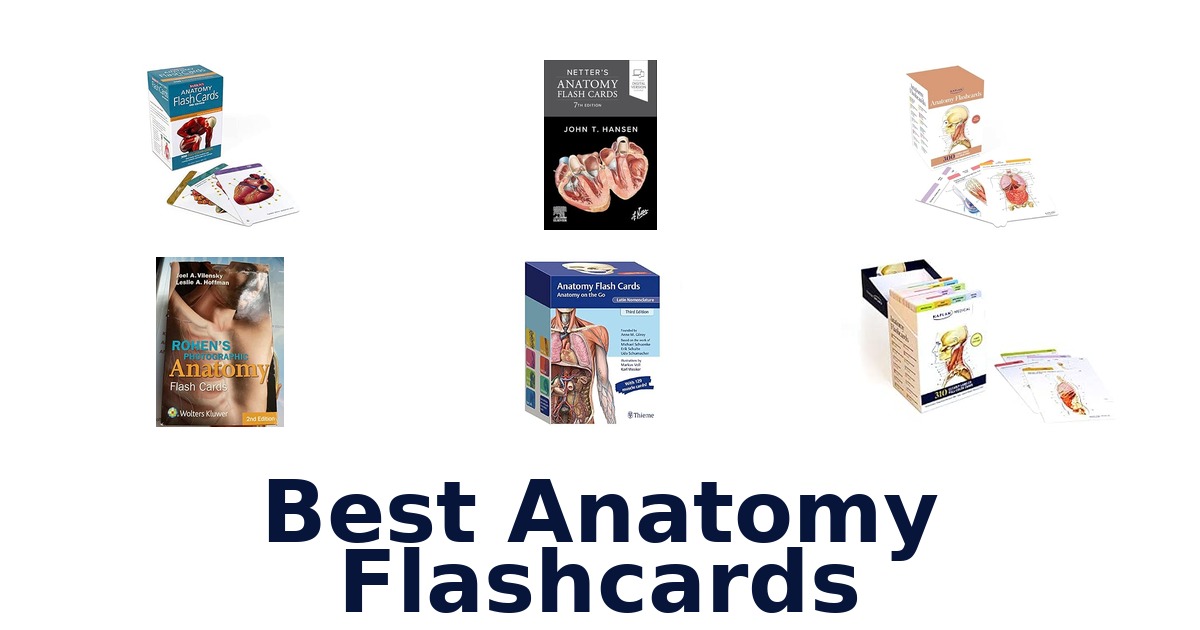
A strong anatomy flashcard set pairs clear visual references with a study format and level of detail suited to its learner, from introductory review to clinical study. The Best Anatomy Flashcards in this roundup include a 300-card set with anatomically precise drawings and exhaustive descriptions, visual-identification cards focused on spatial relationships, and options aimed at nursing or medical learners. There are also focused approaches, including Latin nomenclature and photographic anatomy.
Product details vary considerably: some listings specify card counts or study features, while others provide little information beyond the title and authors. Use the stated content and intended learning approach to narrow the field, and check physical size where portability matters.
The ranking prioritizes anatomy-specific study fit and concrete details rather than assuming that every set covers the same systems or level.
The Joanne Tillotson Anatomy Flashcards lead because the listing specifies 300 cards with anatomically precise drawings and exhaustive descriptions, a strong combination for learners who want an extensive visual reference set. For a different study approach, QuickStudy Anatomy Flash Cards explicitly emphasize visual identification and spatial relationships, while Tribe RN offers 320 anatomy and physiology cards with exam-focused features for nursing and pre-med learners. Choose according to whether you prioritize detailed anatomy illustrations, spatial recognition, or broader anatomy-and-physiology review.
Our Top Picks
 Best Overall
Joanne Tillotson Anatomy Flashcards
Its 300 cards combine anatomically precise drawings with exhaustive descriptions, giving anatomy learners substantial illustrated material and explanatory detail in one set.
View on Amazon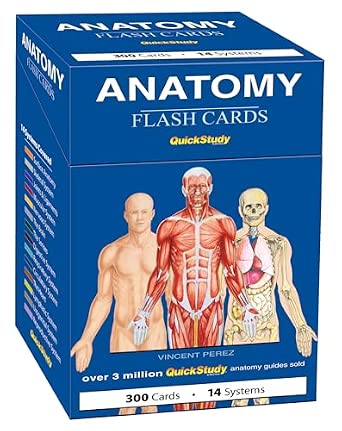 Best for Spatial Study
QuickStudy Anatomy Flash Cards
The listing specifically highlights visual identification and spatial relationships, making this a particularly direct fit for learners studying anatomical position and recognition.
View on Amazon Most Cards
Tribe RN Anatomy and Physiology Cards
Its 320-card set covers major body systems and lists illustrations, mnemonics, and exam-focused anatomy and physiology resources for nursing and pre-med study.
View on Amazon- Broad Anatomy Review Barron's Anatomy Flash Cards
Compare the Best Anatomy Flashcards
| # | Product | Buy |
|---|---|---|
| 1 | 1. Joanne Tillotson Anatomy FlashcardsBest Overall | View on Amazon |
| 2 | 2. QuickStudy Anatomy Flash CardsBest for Spatial Study | View on Amazon |
| 3 | 3. Tribe RN Anatomy and Physiology CardsMost Cards | View on Amazon |
| 4 |  4. Barron's Anatomy Flash CardsBroad Anatomy Review 4. Barron's Anatomy Flash CardsBroad Anatomy Review | View on Amazon |
| 5 |  5. Anatomy on the Go Latin CardsLatin nomenclature practice 5. Anatomy on the Go Latin CardsLatin nomenclature practice | View on Amazon |
| 6 |  6. Netter's Anatomy Flash CardsClinically oriented anatomy learners 6. Netter's Anatomy Flash CardsClinically oriented anatomy learners | View on Amazon |
| 7 |  7. Rohen's Photographic Anatomy CardsPhotographic anatomy learners 7. Rohen's Photographic Anatomy CardsPhotographic anatomy learners | View on Amazon |
| 8 |  8. Barron's Anatomy Flash Cards 2nd EditionBarron's anatomy card review 8. Barron's Anatomy Flash Cards 2nd EditionBarron's anatomy card review | View on Amazon |
| 9 |  9. McCann Tillotson Anatomy FlashcardsMcCann-Tillotson card learners 9. McCann Tillotson Anatomy FlashcardsMcCann-Tillotson card learners | View on Amazon |
| 10 |  10. Generic Human Anatomy FlashcardsPocket visual study cards 10. Generic Human Anatomy FlashcardsPocket visual study cards | View on Amazon |
Detailed Reviews: Best Anatomy Flashcards
#1 · Best Overall
1. Joanne Tillotson Anatomy Flashcards
Best for: Detailed illustration learners.
Why it ranks #1: Its 300 cards combine anatomically precise drawings with exhaustive descriptions, giving anatomy learners substantial illustrated material and explanatory detail in one set.
Three hundred cards pair anatomically precise drawings with exhaustive descriptions, giving learners both a visual reference and substantial explanatory text on each study card. That combination suits students who want to connect what a structure looks like with a fuller written account while working through anatomy topics in a card-based format.
The 300-card count provides a substantial set for repeated study, while the anatomically precise drawings support visual recognition of structures. Exhaustive descriptions add explanatory context alongside those images, so learners can use each card to connect identification with written detail rather than relying on a picture alone. The card format also makes the material usable as a portable study resource, though the supplied information does not specify a storage system or topic-by-topic organization.
- 300 flashcards in the set
- Anatomically precise drawings
- Exhaustive descriptions
- Card format for study
- The supplied details do not specify topic organization or a storage method.
Skip it if you need stated coverage of named body systems or exam alignment; those details are not supplied for this set.
A good fit for anatomy learners who want many cards combining precise illustrations and substantial descriptions. Choose it when that visual-and-text pairing suits your study routine; the supplied facts do not establish a particular curriculum alignment or organization system.
Listed on Amazon as: Anatomy Flashcards: 300 Flashcards with Anatomically Precise Drawings and Exhaustive Descriptions
View on Amazon#2 · Best for Spatial Study
2. QuickStudy Anatomy Flash Cards
Best for: Spatial anatomy review.
Why it ranks #2: The listing specifically highlights visual identification and spatial relationships, making this a particularly direct fit for learners studying anatomical position and recognition.
Visual identification and spatial relationships are the stated focus of this QuickStudy reference, helping learners practice recognizing anatomy and understanding how structures relate in space. Its flash-card format makes it a targeted option for people who want a concise visual study tool rather than a source whose listed strengths center on extensive written descriptions.
The QuickStudy reference-and-study-tool positioning signals a compact role in a learner’s study routine, while visual identification gives practice recognizing anatomical structures. Attention to spatial relationships adds another useful task: considering where structures sit relative to one another. Together, those stated focuses support image-led review and spatial reasoning. The supplied facts do not name covered systems, card count, illustrations, or a specific exam alignment, so buyers should weigh it as a focused visual aid.
- QuickStudy reference and study tool
- Supports visual identification
- Focuses on spatial relationships
- Flash-card format
- The supplied details do not state card count or specific body-system coverage.
Skip it if you need a stated card count, named system coverage, or explicit exam alignment; those specifics are not provided here.
Consider this for learners whose anatomy practice centers on identifying structures and relating them spatially. It fits a focused visual-review role, but the available product facts leave card quantity, system coverage, and curriculum alignment unspecified.
Listed on Amazon as: Anatomy Flash Cards: a QuickStudy Reference & Study Tool
View on Amazon#3 · Most Cards
3. Tribe RN Anatomy and Physiology Cards
Best for: Nursing and exam review.
Why it ranks #3: Its 320-card set covers major body systems and lists illustrations, mnemonics, and exam-focused anatomy and physiology resources for nursing and pre-med study.
Three hundred twenty high-yield anatomy and physiology flashcards cover all major body systems, giving nursing students and other learners a broad, exam-focused review resource. Clear illustrations and mnemonics add visual and memory cues, while stated alignment with ATI, NCLEX, and medical curriculum essentials makes its intended study context explicit.
Coverage of all major body systems gives the 320-card set breadth for anatomy and physiology review, while clear illustrations and mnemonics offer visual and memory supports for complex topics. Its stated alignment with ATI, NCLEX, and medical curriculum essentials helps nursing and pre-med learners relate review to exam preparation. The product is described as durable, tear-resistant, portable, and organized, though the supplied facts do not explain its specific organization method.
- 320 anatomy and physiology cards
- Covers all major body systems
- Clear illustrations and mnemonics
- States alignment with ATI and NCLEX essentials
- The set is paper, so it is not a digital flashcard resource.
Skip it if you need a digital deck or a set limited to anatomy without physiology; this product covers both subjects on paper.
A strong fit for nursing students and other exam-focused learners seeking broad anatomy and physiology review with illustrations and mnemonics. Its paper-card format suits physical study, not learners specifically requiring a digital deck.
Full product details
| Brand | Tribe RN |
|---|---|
| Included Components | 320 cards |
| Item Dimensions | 5.27 x 4.58 x 4 inches |
| Manufacturer | Tribe RN |
| Part Number | TRN-MED-FLASH-ANTMY |
| Manufacturer recommended age | 16 – 16 months |
| Material | Paper |
| Model Number | TRN-MED-FLASH-ANTMY |
| Size | 320 Cards |
| Additional Information | Important Information Proposition 65 Warning for California Consumers WARNING: Cancer and Reproductive Harm – www.P65Warnings.ca.gov Toy Safety Our recommended age: Manufacturer's minimum age: 16 months |
#4 · Broad Anatomy Review
4. Barron's Anatomy Flash Cards
Best for: Broad anatomy study aid.
Why it ranks #4: The listing describes an extensive review of the body's structural framework and function, positioning it as a hands-on aid for students and medical practitioners.
An extensive review of the body’s structural framework and how it functions gives these Barron’s cards a broad anatomy-and-function emphasis. The supplied description also identifies the set as a hands-on learning tool for students and medical practitioners, so it can serve as an active study aid as well as an all-in-one reference.
The combination of structural-framework review and explanation of how the body functions links anatomy with physiology, which can help learners study structure in relation to function. Its stated role as both an all-in-one reference and study aid supports using the cards for review as well as hands-on learning. The description names students and medical practitioners as users, but does not specify card count, illustrated content, or exam-specific alignment.
- Reviews the body's structural framework
- Describes how the body functions
- Hands-on learning tool
- Presented as an all-in-one reference and study aid
- The supplied details do not specify card count or exam alignment.
Skip it if you need a stated quantity, named body-system breakdown, or confirmed exam-specific organization in your anatomy cards.
This suits students and medical practitioners seeking a hands-on resource that addresses structure and function together. Its broad reference role is clear, while buyers needing a known card count or exam-specific coverage have no such details in the supplied description.
Listed on Amazon as: Anatomy Flash Cards (Barron's Test Prep)
View on Amazon#5
5. Anatomy on the Go Latin Cards
Best for: Latin nomenclature practice.
Why it ranks #5: Its title specifies Latin nomenclature and a portable study format, a focused choice for learners who want to connect anatomy review with Latin terms.
Latin nomenclature is the defining focus of this Anatomy on the Go flashcard set, making it relevant to learners who want anatomy study explicitly tied to Latin terms. The title also signals a portable-use orientation, though the supplied facts do not describe card quantity, illustrations, or the specific structures covered.
The Latin-nomenclature focus gives this set a distinct terminology emphasis, which can inform study sessions centered on anatomical names. Its Anatomy on the Go subtitle signals the intended portable context, allowing buyers to consider it for study away from a desk without assuming specific dimensions or construction. The listing names Anne M. Gilroy, Markus Voll, and Karl H. Wesker, but provides no verified coverage breakdown, card count, or illustration details.
- Explicit Latin nomenclature focus
- Anatomy on the Go title
- Flashcard format
- Names Anne M. Gilroy as author
- The supplied facts do not state card count, dimensions, or coverage.
Skip it if you need documented dimensions, a card quantity, or a named list of structures before selecting a portable anatomy set.
Consider this for learners whose study goal includes Latin anatomical nomenclature and who want a resource presented for on-the-go use. Its practical fit remains uncertain if you need verified dimensions, a contents breakdown, or a specified number of cards.
Listed on Amazon as: Anatomy Flash Cards, Latin Nomenclature: Anatomy on the Go
View on Amazon#6
6. Netter's Anatomy Flash Cards
Best for: Clinically oriented anatomy learners.
Why it ranks #6: The supplied Netter suite information emphasizes clear clinical views and illustrations, which may suit clinically oriented learners, though the listing's details are mixed.
Netter’s anatomy suite presents the human body from a clinical perspective, making clinical framing the key draw for learners connecting anatomy study with practice. The supplied facts also describe exceptionally clear views and paintings by Frank Netter and Carlos A. G. Machado, giving this title a named visual tradition alongside its clinical orientation.
The clinical perspective gives the resource a practice-facing frame, while the stated clear views by Frank Netter and Carlos A. G. Machado provide the named visual element. The supplied information also references a case-based approach to diagnosis in the title, which points toward clinical application rather than anatomy identification alone. However, the additional atlas and textbook details do not establish this card set’s contents, so buyers should avoid assuming their plate counts or radiologic images apply here.
- Clinical perspective on the human body
- Clear anatomical views are stated
- Paintings by Frank Netter
- Paintings by Carlos A. G. Machado
- The supplied facts do not specify this card set’s count or exact contents.
Skip it if you need a verified card count, radiologic images, or a specified plate inventory for this particular flashcard title.
A fitting choice to consider for learners seeking clinically framed anatomy with Netter and Machado named in the supplied description. Keep the boundary clear: atlas and textbook specifications listed elsewhere are not confirmed as contents of this card set.
Listed on Amazon as: Netter's Anatomy Flash Cards (Surgical Pathology: A Case Based Approach to Diagnosis)
View on Amazon#7
7. Rohen's Photographic Anatomy Cards
Best for: Photographic anatomy learners.
Why it ranks #7: The photographic approach is explicit in the title, offering a distinct visual format for learners who want photographic anatomy rather than relying only on drawn illustrations.
Photographic imagery is the defining cue in Rohen’s Photographic Anatomy Flash Cards, making the set an option for learners who want anatomy presented through photographs. The supplied facts identify the title and two authors, Joel A. Vilensky and Leslie A. Hoffman, but do not specify card count, photographic subjects, or coverage.
The photographic focus distinguishes this title from listings that identify drawings or paintings, giving buyers a clear visual format to consider. Its flashcard format supports individual-card review, while the named authorship by Joel A. Vilensky and Leslie A. Hoffman helps identify the particular resource. The supplied information does not state which structures or systems appear, how many cards are included, or whether photographs are labeled, so those practical details remain unknown.
- Photographic anatomy focus
- Flashcard format
- Authored by Joel A. Vilensky
- Authored by Leslie A. Hoffman
- The supplied facts do not specify card count or photographic coverage.
Skip it if you need a verified number of cards, named structures, or details about photographic labeling before choosing a visual study set.
A possible fit for learners who specifically want photographic anatomy cards and recognize the named authors. Choose with the boundary in mind: the supplied information does not establish image labeling, card quantity, or system-by-system coverage.
Listed on Amazon as: Rohen's Photographic Anatomy Flash Cards
View on Amazon#8
8. Barron's Anatomy Flash Cards 2nd Edition
Best for: Barron's anatomy card review.
Why it ranks #8: This is a clearly identified anatomy flashcard set, but the supplied listing gives no card count or specific learning features to distinguish its coverage.
Barron’s and the second-edition designation are the clearest identifying features of this anatomy flashcard set, giving returning buyers a specific edition to look for. The supplied listing confirms a card format and names Kurt Albertine as author, but does not provide coverage, card count, or other edition-specific features.
The card format supports an anatomy study approach organized around individual flashcards, while the second-edition label helps distinguish this listing from an unspecified earlier edition. Kurt Albertine is identified as the author, providing a clear authorship detail for buyers comparing resources. Since the supplied facts do not describe illustrations, system coverage, or card quantity, the practical scope of study cannot be determined from the listing information alone.
- Second edition identified
- Anatomy flashcard format
- Authored by Kurt Albertine
- Barron's title
- The supplied details do not state card count or subject coverage.
Skip it if you require confirmed illustrations, a named body-system breakdown, or a stated quantity of cards to plan your study.
This is worth considering for buyers specifically seeking Barron’s second-edition anatomy cards by Kurt Albertine. The edition and format are clear, but learners needing known coverage or a defined card count should account for those missing details.
Listed on Amazon as: Barron's Anatomy Flash Cards, 2nd Edition
View on Amazon#9
9. McCann Tillotson Anatomy Flashcards
Best for: McCann-Tillotson card learners.
Why it ranks #9: The title and authors establish an anatomy-specific card set, but no card count, illustrations, or study features are verified for this listing.
The McCann/Tillotson authorship identifies this card-format anatomy resource as a concise option for learners seeking a flashcard study aid. The supplied listing provides no further feature details, so its clearest supported distinction is the named creators and the format; buyers should not assume a particular card count, illustration style, or scope from the title alone.
Because the listing identifies the product as Anatomy Flashcards and names McCann/Tillotson as authors, it supports a straightforward card-based anatomy study role. Cards can be approached individually during review, but the supplied facts do not describe how topics are organized or what information appears on each card. That makes it difficult to judge coverage, visual detail, or fit with a specific course from the available description, so those needs should guide selection.
- Anatomy flashcard format
- Authored by McCann/Tillotson
- Identified specifically as an anatomy resource
- Card-based study aid
- The supplied listing gives no card count, coverage, or illustration details.
Skip it if you require documented card quantity, named body-system coverage, or a specified illustration approach before choosing a study set.
This may suit a buyer seeking a basic anatomy card resource from McCann/Tillotson. Its fit is hard to assess beyond that identity and format, so prefer a listing with explicit coverage details when course requirements matter.
Listed on Amazon as: Anatomy Flashcards
View on Amazon#10
10. Generic Human Anatomy Flashcards
Best for: Pocket visual study cards.
Why it ranks #10: Its 30-piece set offers labeled, color-coded diagrams in a stated pocket-size format, but fewer cards and limited verified detail put it behind broader options.
Color-coded, clearly labeled illustrations turn complex structures, body systems, and organs into visual reference diagrams across this 30-piece set. Its stated compact 2.52-by-3.5-inch portrait cards support carrying a small reference for study on the go, particularly for visual learners preparing for exams or clinical refreshers.
Color coding and clear labels support visual recognition of structures, organs, and body systems, while the 30-piece set gives buyers a defined, compact reference collection. At 2.52 by 3.5 inches in portrait orientation, the cards are described as pocket-sized, which suits carrying them between study sessions. The listing positions them for medical and nursing students and healthcare professionals, but its 30-card quantity is a narrower set than a large review deck.
- 30-piece set
- Color-coded illustrations with clear labels
- Covers structures, body systems, and organs
- Compact 2.52-by-3.5-inch portrait cards
- Thirty cards make this a compact reference set rather than an extensive deck.
Skip it if you need hundreds of cards for broad repeated review; Tribe RN's 320-card anatomy and physiology set offers a much larger collection.
This suits visual learners wanting pocket-sized diagrams for quick anatomy review, exam preparation, or clinical refreshers. Its labeled color-coded cards are easy to carry, but the 30-piece scope may not satisfy buyers seeking an extensive deck.
Full product details
| Brand | Generic |
|---|---|
| Included Components | Human Anatomy Flashcards |
| Item Dimensions | 1 x 1 x 0.1 inches |
| Item Dimensions L x W | 1"L x 1"W |
| Manufacturer | shaojuyi |
| Part Number | shaojuyi-260904 |
| Manufacturer recommended age | 3 years and up |
| Material | Paper |
| Size | 2.52×3.5inch |
| Additional Information | Important information Safety Information use |
Listed on Amazon as: 30 Pcs Human Anatomy Flashcards Anatomy and Physiology Visual Study Guide & Flash Cards Set for Medical, Nursing Student Essentials, Pocket Size Medical Terminology Diagram Cards
View on AmazonAvoid choosing by card count alone
Card count alone can mislead when the learning approach matters more than the size of the set. Joanne Tillotson Anatomy Flashcards lists 300 cards and specifies both precise drawings and exhaustive descriptions, while Tribe RN Anatomy and Physiology Cards lists 320 resources spanning anatomy and physiology, with illustrations and mnemonics. Those are different kinds of breadth: a larger number does not establish that one set has more anatomy detail or matches a particular course.
QuickStudy Anatomy Flash Cards instead explicitly calls out visual identification and spatial relationships, which may be more useful to a learner practicing recognition than a broad count. Check for an explicitly stated focus that matches your study task, and treat unverified coverage as unknown.
This matters especially when buying for a syllabus or exam: the supplied descriptions do not provide complete topic lists, so card totals cannot confirm that a specific structure or body system is included.
Match visual format to the kind of recognition you need
A visual format should resemble the material you need to recognize, rather than simply look appealing. Joanne Tillotson Anatomy Flashcards specifies anatomically precise drawings, QuickStudy Anatomy Flash Cards names visual identification and spatial relationships, and Rohen’s Photographic Anatomy Cards signals a photographic approach in its title. These descriptions suggest different study experiences, but they do not establish that the sets cover identical structures or provide interchangeable views.
For example, a learner working with drawn diagrams may want illustrations, while someone seeking photographic anatomy may prefer the photographic format; the listing does not confirm how closely either resembles a particular lab or course resource. Netter’s Anatomy Flash Cards is accompanied by supplied suite information describing clinical views and illustrations, but the product details are mixed.
Before choosing, check the exact edition and card content where possible, and do not infer complete clinical, photographic, or syllabus coverage from a title alone.
How to Choose Anatomy Flashcards
Card count and stated scope
Look for a card count and a subject scope that fit the amount and breadth of review you want. Joanne Tillotson Anatomy Flashcards lists 300 cards, Tribe RN Anatomy and Physiology Cards lists 320, and Generic Human Anatomy Flashcards lists 30 pieces. Tribe RN also says it covers major body systems and includes anatomy and physiology resources, while Joanne Tillotson’s set specifies precise drawings and exhaustive descriptions.
Those figures and descriptions are not proof of equal depth or syllabus coverage. Learners wanting a large stated set can compare the 300- and 320-card options; someone seeking a smaller portable reference may consider the 30-piece set, while recognizing its more limited count.
Match the scope to the course, and verify topic coverage separately if a specific system or exam outline is essential.
Illustration and recognition style
Choose a visual style that supports the kind of anatomy recognition you practice. Joanne Tillotson Anatomy Flashcards specifies anatomically precise drawings, QuickStudy Anatomy Flash Cards lists visual identification and spatial relationships, and Rohen’s Photographic Anatomy Cards identifies photographic anatomy in its title. Tribe RN Anatomy and Physiology Cards also lists clear illustrations and mnemonics.
These details distinguish the listed approaches, but they do not guarantee that a set uses the exact diagrams or images in your classes. A learner focused on identifying structures and their positions may prefer QuickStudy’s stated emphasis; a learner wanting detailed drawn references may favor Joanne Tillotson; photographic study may point toward Rohen’s.
If your learning materials use a particular visual style, check previews or full product details before deciding, since not every listing gives comparable sample information.
Terminology and intended study context
Check whether the set emphasizes terminology, clinical context, or general anatomy review. Anatomy on the Go Latin Cards names Latin nomenclature in its title, making terminology its clearest stated distinction. Netter’s Anatomy Flash Cards comes with supplied information about clear views of the human body from a clinical perspective, although that information also references broader Netter publications and should not be treated as a verified card count.
Tribe RN Anatomy and Physiology Cards describes exam-focused resources for nursing and pre-med learners, and Barron’s Anatomy Flash Cards is described as a hands-on tool for students and medical practitioners. Learners prioritizing Latin terms should consider the Latin set; nursing and pre-med learners may find Tribe RN’s stated audience relevant; those seeking clinical orientation may investigate Netter’s.
For a specific exam, verify alignment rather than assuming a title or audience statement guarantees it.
Which Anatomy Flashcards Should You Choose?
For the most substantiated all-around anatomy set, choose Joanne Tillotson Anatomy Flashcards: its listing gives a 300-card count, precise drawings, and exhaustive descriptions. If spatial recognition is your main challenge, QuickStudy Anatomy Flash Cards specifically names visual identification and spatial relationships. Nursing or pre-med learners seeking a larger combined anatomy-and-physiology set can consider Tribe RN Anatomy and Physiology Cards, with 320 cards and stated exam-focused features.
Choose Anatomy on the Go Latin Cards when Latin nomenclature is the priority, or Rohen’s Photographic Anatomy Cards if you want to explore photographic anatomy. For clinical perspective, Netter’s Anatomy Flash Cards may be relevant, but its supplied product information is mixed.
Check actual card previews and topic coverage before buying for a specific course or exam.
Frequently Asked Questions
How can I tell whether anatomy flashcards match my course or exam syllabus?
Compare the card topics and terminology with your syllabus or exam outline before choosing. Check whether the set covers the systems, structures, and level of detail your course requires. Product descriptions that specify a focus, such as anatomy and physiology or exam preparation, can help narrow options, but verify coverage against your materials.
Are labeled diagrams or photographic anatomy cards better for visual study?
Choose based on what you need to recognize: labeled diagrams can support focused study of named structures, while photographic cards let you explore anatomy in photographic form. Neither format is universally better. Consider your course materials and whether you learn more effectively from precise illustrations, visual identification practice, or photographs.
How should I use flashcards to learn anatomical terms and spatial relationships?
Use each card to practice both naming structures and locating them in relation to nearby anatomy. Review actively by identifying a structure before checking the answer, then revisit missed cards. For Latin terminology, focus on the term and its meaning; for spatial relationships, compare the structure’s position with surrounding landmarks.
What should I check about a flashcard set before choosing it?
Check the stated card count, subject coverage, visual format, and any stated study focus, then compare those details with your learning needs. The listings here range from a 300-card set with precise drawings and descriptions to a 320-card anatomy-and-physiology set, plus options focused on Latin nomenclature or photographic anatomy.
Are anatomy flashcards useful for nursing and pre-med students?
They can support review, but match the set to the content you need. Tribe RN is described as offering 320 anatomy and physiology cards with exam-focused features for nursing and pre-med learners. Check the stated topics against your course, since a combined subject set may differ from a set focused on anatomy alone.
Final Words
For a detailed visual reference, choose Joanne Tillotson Anatomy Flashcards: the listing specifies 300 cards, anatomically precise drawings, and exhaustive descriptions. Choose QuickStudy if visual identification and spatial relationships are your priority, or Tribe RN for a larger combined anatomy-and-physiology set aimed at nursing and pre-med learners. Latin nomenclature and photographic anatomy point to Anatomy on the Go and Rohen’s, respectively.
Check each set’s stated focus against your course.