
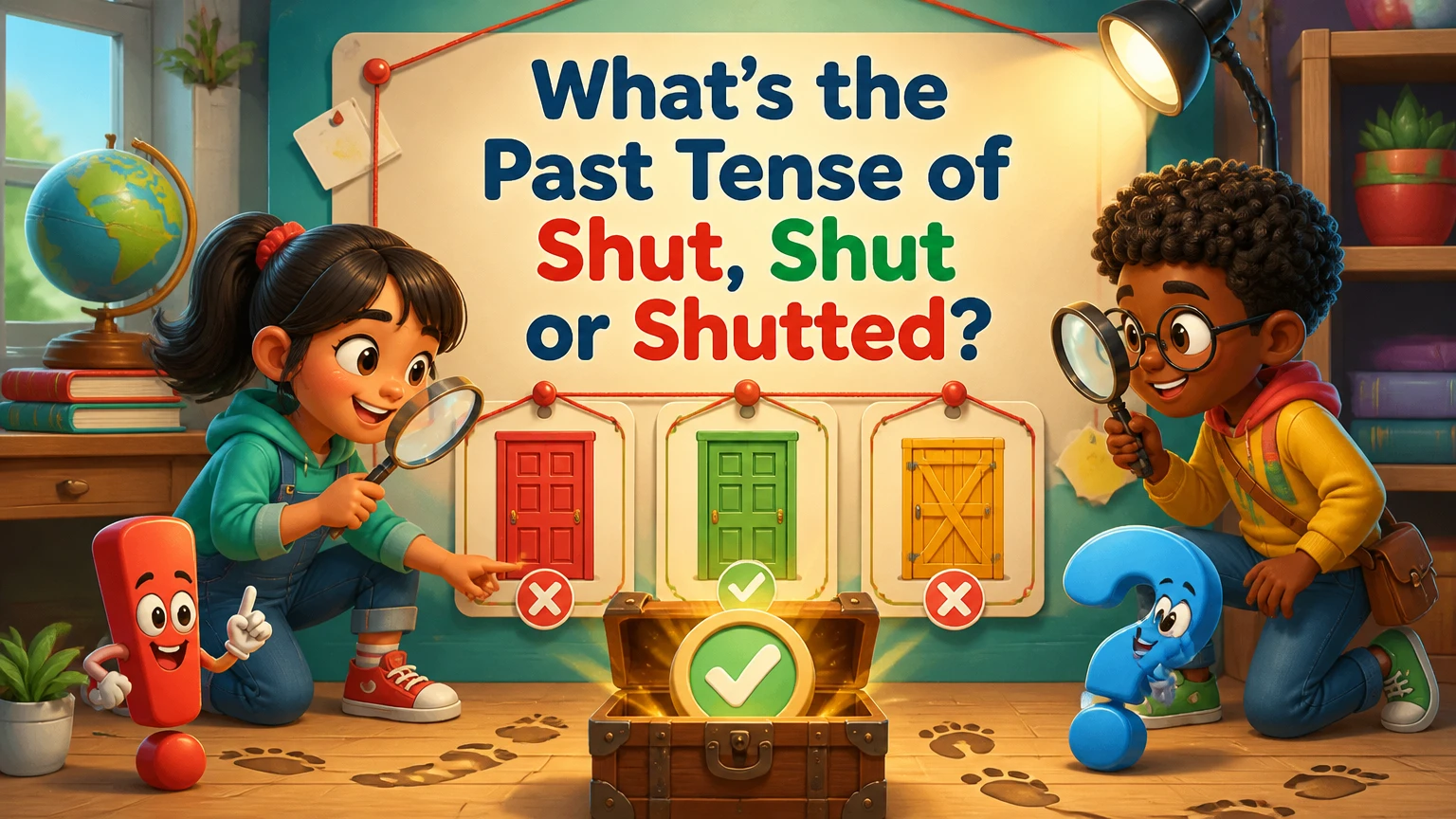
The past tense of shut is shut, not shutted. In standard English, shut has the same form for the base verb, simple past, and past participle: “I shut the door,” “I have shut the door,” and “The door was shut.”
Key Facts at a Glance
- Shut is the standard past tense of the verb shut.
- Shutted is not the standard past-tense form in modern English.
- Shut is also the past participle after has, have, or had.
- The present participle is shutting, with a doubled t before -ing.
- The pronunciation of shut remains /ʃʌt/ in its base, past, and participle forms.
- “Shut” can describe closing an object, ending access, stopping equipment, or becoming unavailable.
What’s the Past Tense of Shut, Shut or Shutted?
The correct form is shut. English speakers use “shut” for the present base form and the simple past without adding -ed.
| Time or grammatical role | Correct form | Example |
|---|---|---|
| Base form | shut | Please shut the window. |
| Third-person present | shuts | She shuts the gate at six. |
| Simple past | shut | She shut the gate at six. |
| Past participle | shut | She has shut the gate. |
| Present participle | shutting | She is shutting the gate. |
| Infinitive | to shut | He wants to shut the door. |
The sentence “Yesterday, I shut the door” is correct. “Yesterday, I shutted the door” applies the regular verb + -ed rule to an irregular verb, so it is nonstandard in contemporary formal and conversational English.
Why Does Shut Stay the Same?
The verb shut is an irregular zero-change verb, meaning its spelling does not change between the base form, simple past, and past participle. Regular verbs such as “open,” “walk,” and “clean” usually add -ed, while zero-change verbs preserve one form.
English inherited many short, strong verbs from earlier Germanic languages. Historical sound changes and long-term usage allowed some high-frequency verbs to retain identical forms. Modern learners do not need to reconstruct that history, but recognizing the pattern helps explain why “shut” behaves differently from “opened.”
Which Verbs Work Like Shut?
Several common English verbs also use one spelling for their base form, simple past, and past participle. Their pronunciation may remain unchanged as well, although context identifies the tense.
| Verb | Base form | Simple past | Past participle |
|---|---|---|---|
| cut | cut | cut | cut |
| hit | hit | hit | hit |
| hurt | hurt | hurt | hurt |
| let | let | let | let |
| put | put | put | put |
| set | set | set | set |
| shut | shut | shut | shut |
| split | split | split | split |
The pattern is useful, but it is not a universal rule for every short verb ending in t. “Get” becomes “got” or “gotten,” “forget” becomes “forgot,” and “meet” becomes “met.” Memorize each verb’s principal forms rather than relying only on its final letter.
How Do You Conjugate Shut Correctly?
Use shut after a past-time expression, after has, have, or had, and after a passive form of be. Use shuts only with a singular third-person subject in the present tense, and use shutting for a progressive action.
| Construction | Pattern | Correct example |
|---|---|---|
| Present simple | subject + shut/shuts | I shut the shop; he shuts the shop. |
| Simple past | subject + shut | They shut the shop yesterday. |
| Present perfect | has/have + shut | We have shut the shop. |
| Past perfect | had + shut | The manager had shut the shop. |
| Future perfect | will have + shut | They will have shut the shop by nine. |
| Passive | be + shut | The museum was shut for repairs. |
| Progressive | be + shutting | The guard is shutting the doors. |
| Infinitive | to + shut | She agreed to shut the gate. |
The auxiliary determines much of the grammatical structure. In “They have shut the office,” have marks the perfect construction and shut functions as the past participle. In “They shut the office yesterday,” shut is the simple past.
Is Shutting the Correct -ing Form?
Shutting is correct because the verb doubles its final consonant before -ing. The spelling follows the common pattern for a one-syllable verb with a short vowel and a single final consonant: “run” becomes “running,” “sit” becomes “sitting,” and “shut” becomes “shutting.”
| Incorrect form | Correct form | Example |
|---|---|---|
| shuting | shutting | The machine is shutting down. |
| shutted | shut | He shut the drawer. |
| shuts, for a past event | shut | She shut the blinds earlier. |
| shut, for a current third-person habit | shuts | She shuts the blinds at noon. |
The doubled t belongs to the progressive spelling, not to the simple past. “Shutting” means an action is in progress or forms part of another continuous construction.
What Does Shut Mean?
Shut usually means to move something so that an opening is covered or blocked. The verb also describes stopping access, ending business, turning off a device, or becoming unavailable.
| Meaning | Example | More precise alternative |
|---|---|---|
| Close a physical opening | She shut the window. | close |
| Stop access | Security shut the road. | close, block |
| End operations | The factory shut in 2020. | cease operations |
| Stop a machine | He shut the engine. | turn off |
| Become unavailable | The website shut after midnight. | go offline |
| Prevent speech | The ruling shut down the discussion. | silence, stop |
“Shut” and “close” overlap, but they are not interchangeable in every context. “Close the file” commonly means finish or exit a digital document, while “shut the file” sounds unusual unless the file is a physical folder or the speaker is using a marked regional style.
What Are the Main Phrasal Verbs With Shut?
Phrasal verbs combine shut with a particle such as down, off, or out, creating a meaning that depends on the complete expression. The past form remains shut, although the particle may move in some constructions.
| Phrasal verb | Meaning | Past-tense example |
|---|---|---|
| shut down | stop a machine, service, or operation | The server shut down at midnight. |
| shut off | stop a flow or power source | She shut off the water. |
| shut out | prevent entry or participation | The team shut out its opponent. |
| shut in | confine indoors | The storm shut us in for two days. |
| shut up | close something or stop speaking | He shut up the shop early. |
| shut away | place in storage or confinement | They shut the documents away. |
“Shut down” can be intransitive, as in “The computer shut down,” or transitive, as in “The technician shut down the computer.” The form does not become “shutted down.”
Is Shutted Ever Correct?
Shutted is not the accepted past tense in standard modern English, but readers may encounter it in learner writing, child speech, dialect representation, or historical texts. Those appearances do not make “shutted” suitable for formal English, edited publications, examinations, or professional communication.
A historical dictionary or literary source may record an unusual form because English has always contained regional variation. A quoted speaker may also say “shutted” intentionally to represent a child’s developing grammar. Outside those marked contexts, replace “shutted” with shut.
| Context | Use | Reason |
|---|---|---|
| Formal report | shut | Standard edited English |
| School assignment | shut | Expected grammar |
| Business email | shut | Clear and conventional |
| Child’s quoted speech | shutted may remain | Preserves the quotation |
| Historical quotation | shutted may remain | Reproduces the source |
| Standard narrative prose | shut | Avoids a nonstandard form |
The important distinction is between a word being understandable and a form being standard. Most readers understand “shutted,” but recognition does not establish grammatical acceptability.
How Is Shut Different From Closed?
Shut and closed can both describe a physical opening, but “closed” is often more neutral, formal, or temporary, while “shut” can sound more forceful or conversational. Neither word automatically indicates whether something is locked.
| Sentence | Main implication | Does it indicate a lock? |
|---|---|---|
| The door was shut. | The door was not open. | No |
| The door was closed. | The opening was covered. | No |
| The door was locked. | A locking mechanism prevented opening. | Yes |
| The shop was closed. | The business was unavailable. | No |
| The shop shut permanently. | The business stopped operating. | No |
| The valve was shut off. | Flow or power was stopped. | Usually indicates interruption |
A door can be shut but unlocked, closed and locked, or open but inaccessible because a security barrier blocks it. Choose “locked” when the mechanism matters, and choose “closed” when neutral description or formal tone matters.
What Common Errors Occur With Shut?
The most common error is regularization: writers add -ed because regular verbs form the past with that suffix. Other errors involve confusing the simple past with the present third-person form, or using “shut” where “shutting” is required for an ongoing action.
Error 1: Adding -ed
- Incorrect: The wind shutted the door.
- Correct: The wind shut the door.
Error 2: Using Shuts for a Past Event
- Incorrect: Yesterday, Maria shuts the gate.
- Correct: Yesterday, Maria shut the gate.
“Shuts” is present tense for “he,” “she,” or “it.” The past form remains “shut” for every subject.
Error 3: Using Shut Without an Auxiliary
- Incorrect: They have shutting the store.
- Correct: They have shut the store.
- Correct: They have been shutting the store early.
The perfect auxiliary have requires the past participle shut. The progressive construction have been shutting requires the -ing form.
Error 4: Confusing Shut With Lock
- Ambiguous: I shut the cabinet.
- More specific: I shut and locked the cabinet.
“Shut” describes position. “Locked” describes security. Add both verbs when the cabinet must be secured.
How Can You Check Whether Shut Is Correct?
Use the time expression, auxiliary, and subject as three separate checks. The sentence “Yesterday, she shut the gate” passes all three checks because “yesterday” requires past time, “she” does not change the past form, and “shut” is the standard irregular form.
- Check the time: words such as “yesterday,” “last week,” and “earlier” often signal simple past.
- Check the auxiliary: use “has shut,” “have shut,” or “had shut” for perfect constructions.
- Check the subject: use “shuts” only for present “he,” “she,” or “it.”
- Check the action: use “shutting” when the closing action is in progress.
- Read the sentence aloud: “She shut the door” is natural; “She shutted the door” is nonstandard.
- Check the intended meaning: use “locked,” “closed,” “disabled,” or “ended” if “shut” lacks the required precision.
Grammar software may flag “shutted,” but a tool should confirm, not replace, the writer’s understanding. Automated checkers can miss dialect, quoted speech, and intentional historical forms.
What Are Correct Examples of Shut?
The following examples show how shut functions in ordinary, technical, figurative, and passive sentences.
- The librarian shut the book.
- We shut the windows before the storm.
- The restaurant shut at 10 p.m.
- The company shut its regional office.
- I have shut the valve.
- The technician had shut down the server.
- The gate was shut but not locked.
- The cold weather shut in the residents.
- The referee shut out the opposing team.
- The child is shutting the drawer.
- Please shut off the lights.
- The airport was temporarily shut because of fog.
- The manager shut down the discussion.
- The shop shuts at six on weekdays.
- The factory shut permanently after the lease ended.
The verb can be transitive or intransitive. “She shut the door” has a direct object, while “The shop shut at five” does not.
Practice: Shut, Shuts, Shutting, or Shutted?
Choose the correct form in each sentence.
- Yesterday, the guard ___ the entrance.
- The store ___ at 8 p.m. every day.
- The workers are ___ the gates.
- We have already ___ the windows.
- The old plant ___ down last year.
- He ___ the valve before repairs began.
- The machine is ___ down automatically.
- The office had ___ before we arrived.
Answers: 1. shut, 2. shuts, 3. shutting, 4. shut, 5. shut, 6. shut, 7. shutting, 8. shut.
The fastest memory rule is simple: shut, shut, shut for base form, past tense, and past participle. Add -s only for present “he,” “she,” or “it,” and change the spelling to shutting for the progressive form.
Frequently Asked Questions
Is Shut an Irregular Verb?
Yes. Shut is an irregular verb because it does not form its past tense by adding the regular -ed ending. More specifically, “shut” is a zero-change irregular verb: “shut,” “shut,” and “shut” are the base, past, and past participle forms.
Is Shut a Past-Tense Word or a Present-Tense Word?
Shut can be either present or past, depending on context. “I shut the door every night” uses the present base form, while “I shut the door last night” uses the simple past. A time expression, auxiliary, or surrounding sentence reveals the grammatical role.
What Is the Past Participle of Shut?
The past participle of shut is also shut. Use it with a perfect auxiliary, as in “She has shut the window,” or in a passive construction, as in “The window was shut before the storm.”
Do You Say Shut or Closed a Door?
Both “shut the door” and “closed the door” are standard. “Shut” is often more conversational or forceful, while “closed” is neutral and common in formal descriptions. Use “locked the door” when the sentence must state that a locking mechanism secured it.
Why Do People Say Shutted?
People say shutted mainly because they apply the regular -ed pattern to an irregular verb. Children and English learners often make this kind of predictable overgeneralization. The form can also appear in dialect or quoted speech, but standard English uses shut.
What Is the Difference Between Shut Down and Shut Off?
Shut down usually means stopping an operation, system, or business, while shut off usually means stopping a flow, supply, or power source. “The computer shut down” and “She shut off the electricity” are both correct, but their objects and meanings differ.
The Bottom Line
The answer to “whats the past tense of shut shut or shutted” is shut. Write “I shut the door,” “I have shut the door,” and “The door was shut.” Use “shuts” for present third-person singular and “shutting” for an ongoing action. In standard English, do not use “shutted” as the past tense.


