
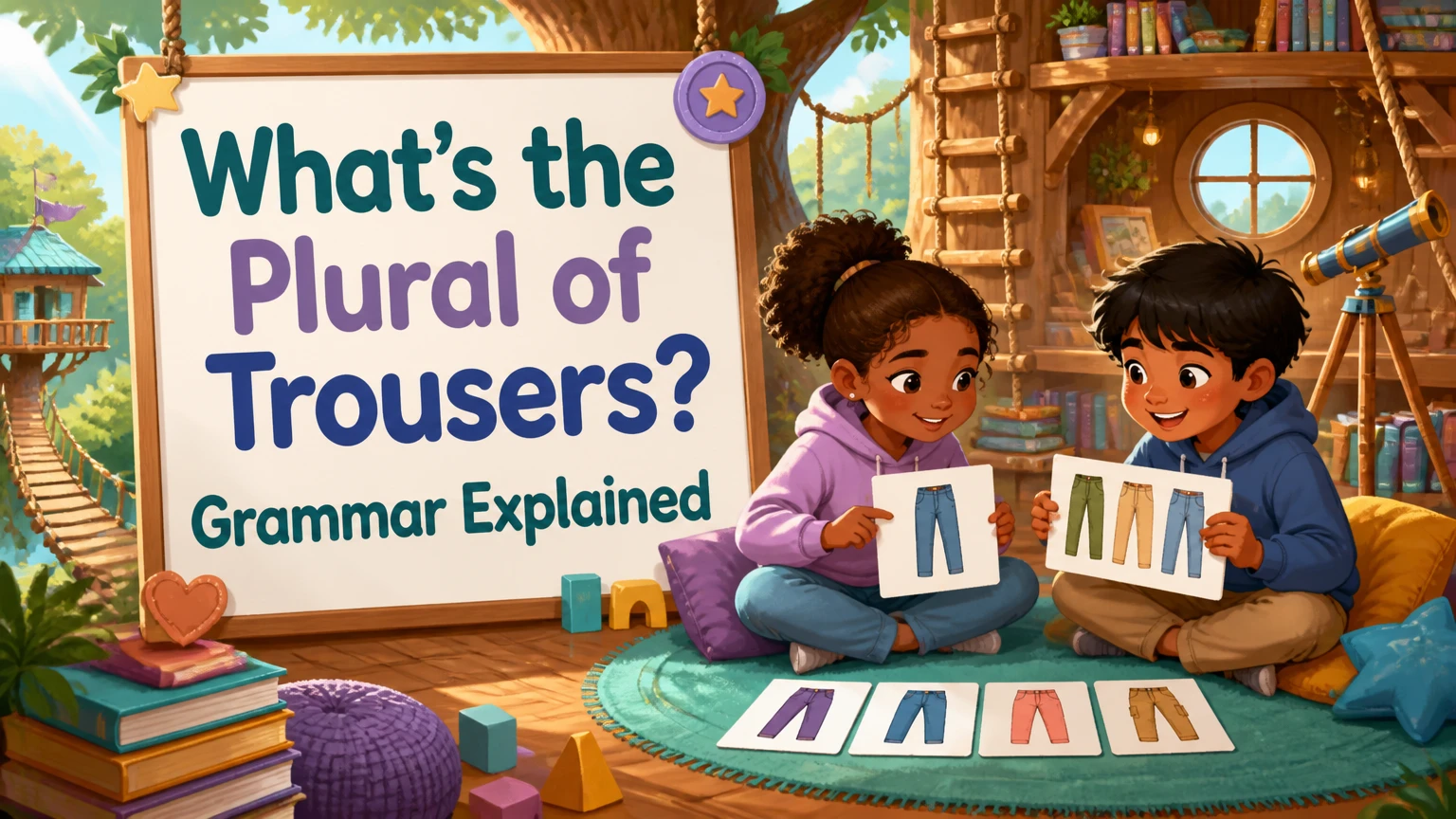
The plural of trousers is trousers. In standard English, trousers is a plural-only clothing noun, so one garment is usually called a pair of trousers, not a trouser. Use plural verbs and pronouns with the noun: “These trousers are clean” and “They fit well.”
Key Facts at a Glance
- Trousers is both the ordinary plural form and the usual word for one garment.
- Standard English normally counts one garment as a pair of trousers.
- Multiple garments are two pairs of trousers or several pairs of trousers.
- Trousers takes a plural verb: “My trousers are new.”
- The normal pronouns are they, them, and their.
- Trouser appears mainly in compounds such as trouser pocket and trouser leg.
What Is the Plural of Trousers?
The plural of trousers is trousers, because trousers already has the plural form used for the garment. English grammar classifies this use as a plurale tantum, a Latin term meaning “plural only.” The noun does not normally change when it refers to one garment or more than one garment.
For example, “I bought new trousers” can describe one garment or multiple garments, depending on context. If the number matters, English adds a counting phrase: “I bought one pair of trousers” or “I bought three pairs of trousers.”
The Cambridge Dictionary defines trousers as “a piece of clothing covering the legs and reaching from the waist to the ankles.” That definition describes one clothing item even though the noun has plural grammar. The plural ending is therefore part of the conventional word form, not proof that the speaker owns several garments.
Is Trousers Singular or Plural?
Trousers is grammatically plural, although it can refer to one garment. The correct sentence is “My trousers are wet,” not “My trousers is wet.” In the same way, write “Where are my trousers?” and answer “They are in the dryer.”
This pattern differs from ordinary count nouns. A speaker says “one shirt is clean” and “two shirts are clean,” but says “one pair of trousers is clean” and “two pairs of trousers are clean.” The word pair carries the singular or plural number, while trousers remains unchanged.
| Meaning | Standard expression | Verb or determiner |
|---|---|---|
| One garment | a pair of trousers | is |
| One unspecified garment | my trousers | are |
| Two garments | two pairs of trousers | are |
| Several garments | several pairs of trousers | are |
| One leg section | a trouser leg | is |
Why Do We Say a Pair of Trousers?
English uses a pair of trousers because the garment has two connected leg sections. The phrase pair of supplies a countable unit, while trousers names the garment itself. Physical construction helps explain the expression, but historical usage and convention determine the grammar.
The same counting structure appears with several items made from two joined or matching parts. Common examples include a pair of scissors, a pair of spectacles, and a pair of binoculars. These nouns generally take plural verbs when the object itself is the subject: “The scissors are sharp.”
The Oxford English Dictionary traces trousers to earlier forms related to Irish and Scottish Gaelic triubhas. Historical spellings varied, and the modern English form became associated with bifurcated legwear. The etymology explains where the word came from, not a rule that every two-part object must have a plural-only name.
What Is the Singular of Trousers?
The standard singular expression is a pair of trousers, not a trouser. When referring to only one section, use a trouser leg. When referring to the whole garment without counting it, simply use trousers, as in “These trousers need pressing.”
A writer should choose the replacement according to meaning:
- Whole garment: “She wore a pair of black trousers.”
- One garment without emphasis on counting: “She wore black trousers.”
- One leg section: “The left trouser leg is torn.”
- A garment category: “The store sells formal trousers.”
The phrase a trouser may appear in specialist contexts, but it is not the normal form in general English. Clothing manufacturers, fashion editors, and costume historians sometimes use trouser as a shortened technical label, especially in compounds or product descriptions. That specialist use does not make a trouser the standard everyday singular.
How Do You Count Trousers?
Count one garment as one pair of trousers and multiple garments as two pairs of trousers, three pairs of trousers, or several pairs of trousers. Use the phrase pair of when a number, quantifier, or singular article must identify the quantity.
| Quantity | Correct phrase | Example sentence |
|---|---|---|
| One | one pair of trousers | I packed one pair of trousers. |
| Two | two pairs of trousers | He owns two pairs of trousers. |
| Three | three pairs of trousers | We ordered three pairs of trousers. |
| Unknown number | several pairs of trousers | Several pairs of trousers were altered. |
| One item, no count | trousers | Her trousers are drying. |
The plural of pair is pairs, so the phrase changes from a pair of trousers to two pairs of trousers. Do not write two pair of trousers in standard edited English, although that form occurs in some informal regional varieties.
A useful practical distinction separates ownership from inventory. “I need new trousers” does not specify whether the shopper wants one garment or several. “I need two pairs of trousers” gives the exact quantity and is preferable for orders, packing lists, uniforms, and stock records.
Is “A Pair of Trousers” Singular?
A pair of trousers is grammatically singular because the head noun pair is singular. Write “This pair of trousers is expensive,” even though trousers has a plural form. Write “These trousers are expensive” when trousers itself is the subject.
This difference is a standard example of agreement with the head noun:
- “The pair of trousers is on the chair.”
- “The trousers are on the chair.”
- “That pair of trousers fits me.”
- “Those trousers fit me.”
The determiner also changes. Use this, that, or each with pair: “This pair is faded.” Use these, those, or all with trousers: “Those trousers are faded.”
What Verb Goes With Trousers?
The noun trousers takes a plural verb in standard English. Use are, were, fit, need, and look when trousers is the subject, even when the sentence describes one garment.
| Incorrect sentence | Correct sentence | Reason |
|---|---|---|
| My trousers is clean. | My trousers are clean. | Trousers takes a plural verb. |
| This trousers fits badly. | These trousers fit badly. | Use these with the noun. |
| The trousers needs ironing. | The trousers need ironing. | Use the plural verb need. |
| Where is my trousers? | Where are my trousers? | The question matches plural grammar. |
| It is in the wash. | They are in the wash. | Use plural pronouns. |
When pair is the subject, agreement follows pair: “A pair of trousers is hanging by the door.” This rule prevents a common error in sentences containing of. The nearby noun trousers does not control the verb when pair is the grammatical head.
Which Pronouns Refer to Trousers?
Use they, them, and their for trousers. Use it when the antecedent is pair, as in “I bought a pair of trousers, and it was on sale.”
Examples include:
- “My trousers are in the wash. They should be dry tonight.”
- “I cannot find my trousers. Have you seen them?”
- “The trousers lost their crease.”
- “This pair is new, but it feels stiff.”
The pronoun follows the noun being replaced, not the physical number of leg sections. A single garment still receives plural pronouns when the speaker uses trousers as the noun.
Can Trouser Be Singular?
Trouser can be singular in compounds and specialist language, but standard everyday English usually does not use it as the standalone singular noun for the garment. Correct compounds include trouser pocket, trouser belt, trouser press, and trouser leg.
| Use of trouser | Standard example | Meaning |
|---|---|---|
| Compound modifier | trouser pocket | A pocket in trousers |
| Body part of garment | trouser leg | One leg section |
| Equipment | trouser press | Equipment that presses trousers |
| Fashion label | trouser suit | A suit with trousers |
| Standalone everyday noun | a trouser | Usually nonstandard or specialist |
The modifier trouser does not need to be plural because English noun compounds often use a singular form before another noun. Compare shoe shop, book shelf, and car door. The singular-looking modifier does not mean that the main noun has a normal singular form.
A technical document might say “insert the lining into each trouser,” particularly when describing garment components or manufacturing units. Readers outside that specialist setting may find the wording unusual. For general communication, each pair of trousers or each trouser leg is clearer.
Are Trousers and Pants the Same?
Trousers and pants can refer to similar outer garments, but regional meaning differs. In British English, trousers normally means outer legwear, while pants commonly means underwear. In American English, pants usually means outer legwear, and trousers sounds more formal or less common.
| Variety or context | Outer garment | Underwear term | Typical example |
|---|---|---|---|
| British English | trousers | pants | I need to iron my trousers. |
| American English | pants | underwear | These pants are too long. |
| Formal international English | trousers | underwear | The uniform includes grey trousers. |
| Retail product naming | trousers or pants | briefs, underwear | The label identifies the market. |
Both trousers and pants can be plural-only in their relevant clothing senses. American English commonly says a pair of pants, while British English commonly says a pair of trousers. The choice should follow the intended audience, especially when writing product copy, translation, or international instructions.
Do not assume that pants is a universally safe substitute. A British reader may interpret “Take off your pants” as an instruction to remove underwear, whereas an American reader will usually understand “pants” as trousers.
Do Jeans, Shorts, and Leggings Follow the Same Pattern?
Jeans, shorts, and many uses of leggings follow a similar plural-only pattern when they refer to one garment. Speakers commonly say a pair of jeans, a pair of shorts, and a pair of leggings, although the uncounted forms are also frequent.
| Garment noun | Uncounted form | Counted singular | Plural count |
|---|---|---|---|
| Trousers | trousers | a pair of trousers | two pairs of trousers |
| Jeans | jeans | a pair of jeans | two pairs of jeans |
| Shorts | shorts | a pair of shorts | two pairs of shorts |
| Leggings | leggings | a pair of leggings | two pairs of leggings |
| Overalls | overalls | a pair of overalls | two pairs of overalls |
Usage varies by dialect and garment design. Pajamas and pyjamas also normally take plural agreement in English, while clothing is an uncountable singular noun: “The clothing is clean.”
The shared pattern does not mean every garment word behaves identically. Skirt, dress, coat, and shirt have ordinary singular and plural forms: one skirt, two skirts; one dress, two dresses. The grammar depends on the established noun, not simply on whether clothing covers two legs.
How Should You Use Trousers in Formal English?
Use trousers without an article when speaking generally, and use a pair of trousers when identifying one garment. Formal English requires plural agreement with trousers and singular agreement with pair.
Examples for different situations:
- General description: “The company uniform includes navy trousers.”
- One purchase: “I bought a pair of navy trousers.”
- Multiple purchases: “The supplier delivered four pairs of navy trousers.”
- Measurement: “These trousers have a 32-inch waist and a 30-inch inseam.”
- Tailoring: “The trousers need a 2-centimetre hem adjustment.”
- Laundry: “Your trousers are in the washing machine.”
- Formal report: “Each pair of trousers is inspected before shipment.”
Clothing measurements do not alter the grammar. A garment with a 30-inch inseam remains trousers, and a garment with a 36-inch inseam remains a pair of trousers when counted. Terms such as waist, rise, inseam, hem, and break describe construction or fit, not number.
Does the Fabric or Style Change the Grammar?
Fabric and style do not change the plural form. Wool trousers, cotton chinos, cargo trousers, suit trousers, and linen trousers all use plural agreement when trousers is the subject.
| Style | Typical fabric | Correct uncounted phrase | Correct counted phrase |
|---|---|---|---|
| Chinos | cotton twill | These chinos are durable. | a pair of chinos |
| Suit trousers | wool blend | The suit trousers are pressed. | a pair of suit trousers |
| Cargo trousers | cotton or nylon | The cargo trousers are loose. | two pairs of cargo trousers |
| Linen trousers | linen blend | Linen trousers are prone to creasing. | a pair of linen trousers |
| Corduroy trousers | cotton corduroy | His corduroy trousers are warm. | three pairs of corduroy trousers |
A product description can therefore say “black trousers in a stretch-wool blend,” but an inventory record should say “12 pairs of black trousers.” The first describes attributes. The second records quantity.
What Are the Common Mistakes?
The most common errors are using a trouser, pairing trousers with a singular verb, and using pair incorrectly in a quantity phrase. Each mistake has a short correction that preserves the intended meaning.
- Incorrect: “I bought a trouser.”
Correct: “I bought a pair of trousers.”
Use a trouser leg only when referring to one leg section. - Incorrect: “My trousers is dirty.”
Correct: “My trousers are dirty.”
The noun requires plural agreement. - Incorrect: “I packed two pair of trousers.”
Correct: “I packed two pairs of trousers.”
The counted noun pair becomes plural. - Incorrect: “This trousers is expensive.”
Correct: “These trousers are expensive,” or “This pair of trousers is expensive.”
Match the determiner and verb to the selected structure. - Incorrect: “Where is my trousers?”
Correct: “Where are my trousers?”
Questions still require plural agreement. - Potentially confusing: “The trouser is torn.”
Clearer: “The trouser leg is torn,” or “The pair of trousers is torn.”
Specify whether the whole garment or one leg section is damaged.
An expert editing rule is to locate the head noun before choosing the verb. In a pair of trousers, the head is pair. In my trousers, the head is trousers. This rule resolves nearly every agreement question involving the expression.
When Is Trousers Used Without Pair?
Use trousers without pair when quantity is unimportant, already understood, or expressed by a plural determiner. This is the most natural form in everyday descriptions such as “These trousers are too long” and “I wear trousers to work.”
Use pair when the sentence needs a singular count:
- “I need a pair of trousers for the interview.”
- “The shop has one pair of trousers in my size.”
- “She bought two pairs of trousers.”
- “Each pair of trousers has a concealed pocket.”
In ordinary conversation, speakers often say “I bought trousers yesterday” even when they bought one garment. The context supplies the quantity. Retailers, warehouses, and formal purchasing documents usually add pair because precise stock counts matter.
The phrase also helps distinguish garments with similar names. “I packed trousers” identifies a clothing category. “I packed one pair of trousers and two pairs of shorts” records separate items clearly.
What Does the Plural Form Tell Us About English?
The form trousers demonstrates that grammatical number and physical quantity are not identical. One object can have a plural noun form, just as one pair of scissors can be described with a plural-only noun.
English inherited and developed many such lexical conventions. Scissors, spectacles, binoculars, tweezers, and several clothing terms commonly take plural verbs. Speakers learn the number pattern as part of the noun’s usage rather than calculating it from the object’s shape.
The two-leg explanation is useful but incomplete. Some two-part objects have ordinary singular forms, including shoe, sock, and glove. Conversely, scissors has plural grammar because of historical and lexical convention, even though modern scissors function as one tool. Grammar records usage over time more reliably than it records engineering design.
A practical implication follows: do not create a singular form by removing the final s. Dictionaries, regional conventions, and specialist terminology determine whether a singular-looking form is acceptable. For ordinary English, the safe choices are trousers, a pair of trousers, and a trouser leg.
FAQ
Is “trouser” a real word?
Yes, trouser is a real word, but its common uses are attributive or technical. English uses trouser pocket, trouser leg, and trouser press naturally. As a standalone noun meaning one complete garment, a trouser is unusual in standard everyday English; use a pair of trousers instead.
What is the plural of “a pair of trousers”?
The plural is two pairs of trousers or several pairs of trousers. Only pair changes to pairs, while trousers remains unchanged. For example, “I own one pair of trousers” becomes “I own three pairs of trousers.”
Should I say “these trousers” or “this trousers”?
Say these trousers because trousers is grammatically plural. Say this pair of trousers when using the singular count phrase. The corresponding verbs are “These trousers are comfortable” and “This pair of trousers is comfortable.”
Can “trousers” refer to only one item?
Yes. Trousers can refer to one complete garment even though it has plural grammar. “My trousers are in the wash” may describe one garment. Use a pair of trousers when the sentence must make the singular quantity explicit.
Are “pants” and “trousers” interchangeable?
They are broadly interchangeable for outer legwear in American English, but not in every regional context. British English usually uses trousers for outerwear and pants for underwear. Choose the term that matches the audience and market.
Why are trousers plural but clothing singular?
Trousers is a plural-only noun established by English usage, while clothing is an uncountable singular noun. The difference is lexical, not a universal rule about garments or two-legged objects. Therefore, write “The trousers are clean” but “The clothing is clean.”
The Bottom Line
The answer to what’s the plural of trousers is trousers. The word already has the plural-only form used for the garment, so standard English says “These trousers are comfortable.” For one counted garment, write “a pair of trousers”; for more than one, write “two pairs of trousers.” Use trouser mainly in compounds such as trouser leg and trouser pocket.


