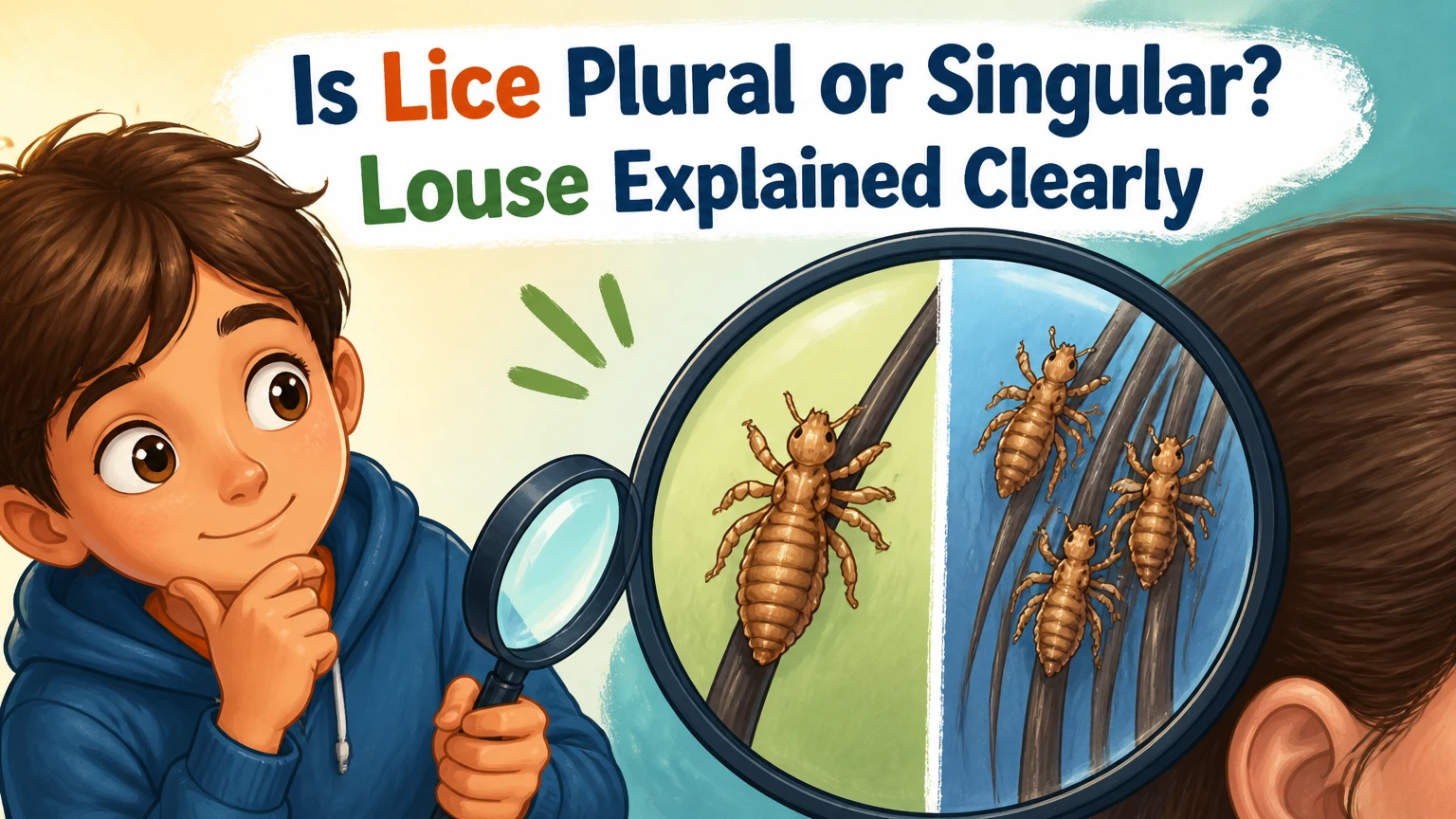
Lice is the plural form of louse. Use louse for one parasitic insect and lice for two or more. For example, “I found one louse” is singular, while “I found several lice” is plural. The plural is irregular because the vowel changes from ou in louse to i in lice.
Key Facts at a Glance
- Louse means one insect; lice means more than one insect.
- The correct plural verb is usually “lice are,” not “lice is.”
- Nits are lice eggs or empty egg cases, not adult lice.
- Human lice include head lice, body lice, and pubic lice.
- Lice crawl and cannot jump or fly.
- A confirmed infestation requires finding live crawling lice or viable eggs near the scalp, not merely experiencing itching.
Is Lice Plural or Singular?
Lice is plural, and louse is singular. The sentence “There is one louse” uses the singular noun, whereas “There are three lice” uses the plural noun.
The word follows an irregular plural pattern similar to other older English forms, including mouse/mice and goose/geese. English does not form this plural by adding -s, so louses is generally incorrect when referring to multiple insects. The spelling lice applies to several individual insects collectively, whether they are on hair, clothing, or skin.
| Meaning | Correct noun | Example |
|---|---|---|
| One insect | louse | “A louse was moving near the scalp.” |
| Two insects | lice | “Two lice were found during inspection.” |
| Many insects | lice | “The child has head lice.” |
| One egg | nit | “A nit was attached to the hair shaft.” |
| Many eggs | nits | “Several nits were close to the scalp.” |
What Is the Singular Form of Lice?
The singular form of lice is louse. The noun changes spelling and pronunciation, so a person should not write “one lice” in standard English.
Correct examples include:
- “One louse was visible under bright light.”
- “The comb removed a single louse.”
- “Several lice were found behind the ears.”
- “The school nurse identified head lice.”
The same distinction applies in compound terms. Head louse refers to one insect, while head lice refers to an infestation or multiple insects. Body louse and pubic louse are singular; body lice and pubic lice are plural.
Should You Say “Lice Is” or “Lice Are”?
Use “lice are” when lice refers to multiple insects. For example, “Lice are transmitted mainly through prolonged hair-to-hair contact” is grammatically standard.
Use “lice is” only when lice functions as part of a singular name, title, or subject that English treats as one unit, although that construction is uncommon. In ordinary medical, educational, and everyday writing, the following patterns are safest:
| Intended meaning | Verb pattern | Example |
|---|---|---|
| Multiple insects | lice are | “Lice are wingless insects.” |
| A single insect | a louse is | “A louse is difficult to see.” |
| An infestation | the infestation is | “The infestation is under control.” |
| A treatment process | treatment is | “Treatment is repeated according to the label.” |
How Are Louse and Lice Pronounced?
Louse rhymes approximately with “house,” while lice rhymes approximately with “ice.” The spelling difference represents a real vowel change, not merely a different written ending.
| Word | IPA pronunciation | Approximate sound | Number |
|---|---|---|---|
| louse | /laʊs/ | “lows” or “house” with an l | Singular |
| lice | /laɪs/ | “ice” with an l | Plural |
| nit | /nɪt/ | “nit” | One egg or egg case |
| nits | /nɪts/ | “nits” | Multiple eggs or cases |
The plural lice can sound like lies in many accents. Context supplies the meaning. “Lice are present” refers to insects, while “she lies down” uses the verb lie.
What Does Louse Mean?
A louse is a small, wingless, parasitic insect that feeds on blood or lives among the hair, skin, or clothing of a host. In ordinary human-health discussions, louse most often means one head louse, body louse, or pubic louse.
Adult human lice are generally about 2-3 millimeters long, roughly the size of a sesame seed. They have six legs with claws adapted for gripping hair or fabric. Lice do not have wings and cannot jump. They move by crawling, which is why direct contact is the principal route for head-lice transmission.
The term can also describe lice found on animals. Human lice are host-specific, so lice from dogs, cats, or other animals do not normally establish a human infestation. That distinction matters when someone tries to explain an unexplained itchy scalp using a pet’s parasites.
Are Lice and Nits the Same?
Lice and nits are different. Lice are living insects, while nits are eggs or empty egg cases attached to hair shafts, usually close to the scalp.
A viable head-louse egg is cemented firmly to a hair and commonly appears yellow, tan, or gray-white. Dandruff and ordinary debris usually brush away more easily. However, identifying a nit by appearance alone can be difficult, especially under poor lighting.
| Term | Biological stage | Typical location | Can it crawl? |
|---|---|---|---|
| Nit | Egg or egg case | Glued to a hair shaft | No |
| Nymph | Immature louse | Hair or scalp | Yes |
| Adult louse | Mature insect | Hair or scalp | Yes |
| Dandruff | Shed skin | On or between hairs | No |
| Empty casing | Hatched egg shell | Hair shaft | No |
Head-lice eggs hatch in roughly 6-9 days under favorable conditions. Nymphs mature through several stages, and adult females can lay eggs. The exact timing varies with temperature and other environmental conditions, so treatment labels should determine retreatment timing rather than a universal calendar rule.
What Types of Lice Affect Humans?
Three types of lice commonly affect humans: head lice, body lice, and pubic lice. Their body shape, preferred habitat, and public-health significance differ.
| Type | Scientific name | Main habitat | Typical transmission |
|---|---|---|---|
| Head louse | Pediculus humanus capitis | Scalp hair, especially behind ears and at the neck | Direct head-to-head contact |
| Body louse | Pediculus humanus humanus | Clothing seams; feeds on skin | Infested clothing, crowding, limited laundering |
| Pubic louse | Pthirus pubis | Pubic and other coarse hair | Close sexual or bodily contact |
Head lice are the most familiar form in school-age children. The Centers for Disease Control and Prevention states that head lice do not transmit disease, although scratching can cause skin irritation or secondary bacterial infection.
Body lice are associated with clothing and bedding rather than permanent residence in scalp hair. The CDC notes that body lice can spread diseases such as epidemic typhus, trench fever, and louse-borne relapsing fever. Pubic lice are often called “crabs” because their claws and body shape appear crab-like under magnification.
How Do Lice Spread?
Head lice spread mainly through direct, prolonged hair-to-hair contact. Lice crawl from one person’s hair to another person’s hair; they do not jump or fly.
Transmission through recently shared hats, brushes, pillows, or towels is possible but less common than direct contact because a louse away from a human host has limited access to food and suitable conditions. Head lice are not a sign of poor hygiene, and clean hair does not prevent attachment.
Practical transmission risks include:
- Children pressing heads together during play.
- Shared beds during an active infestation.
- Shared brushes, combs, hair accessories, or headphones.
- Clothing or bedding used by someone with body lice.
- Close sexual contact in cases involving pubic lice.
Schools generally do not need broad pesticide spraying or closure for head lice. The American Academy of Pediatrics has advised against “no-nit” exclusion policies because nits alone do not demonstrate active, transmissible infestation and such policies can unnecessarily remove children from class.
What Is the Practical Treatment Sequence?
A practical head-lice response has four parts: confirm live lice, treat according to the product label, remove or monitor remaining lice and eggs, and check close contacts. The total process commonly takes 7-14 days, although the exact retreatment date depends on the product.
Step 1: Confirm an Active Infestation
Use a bright light and a fine-toothed lice comb on wet, conditioned hair. Finding a live crawling louse is the clearest confirmation. Itching alone is not enough because scalp irritation, eczema, and product reactions can produce similar symptoms.
Step 2: Choose One Appropriate Treatment
Follow the exact instructions for an over-the-counter or prescription product. Do not combine multiple insecticides, apply extra doses, or use household pesticides on people.
Common options include permethrin, pyrethrins, dimethicone-based products, ivermectin lotion, spinosad suspension, and prescription malathion. Availability, age restrictions, pregnancy considerations, and local resistance patterns vary.
Step 3: Comb Methodically
Wet-comb small sections from the scalp toward the ends using a metal nit comb. Wipe the comb after every pass and repeat every 3-4 days for about two weeks if using combing as the primary method or as follow-up monitoring.
A conditioner improves comb glide for mechanical removal, but conditioner can interfere with some medicated products. Use conditioner during combing only when the product label permits it and never substitute a household chemical for a labeled treatment.
Step 4: Recheck and Retreat Only as Directed
Many products do not reliably kill every egg, so a second application is often needed. The correct interval may be 7, 9, or 10 days depending on the active ingredient and label instructions. Day 9 is not a universal rule for every lice treatment.
A treatment is working when live crawling lice decrease substantially and no active lice appear during repeated checks. A few slow-moving lice immediately after treatment may be dead or dying, but persistent vigorous lice require reassessment.
What Should You Clean?
Clean clothing, pillowcases, towels, and bedding used during the two days before treatment. Wash and dry them using the hottest cycle safe for the fabric, or seal unwashable items in a bag for at least two weeks.
| Item | Recommended action | Typical timing |
|---|---|---|
| Pillowcase | Wash and machine-dry hot | Used within previous 48 hours |
| Bed sheet | Wash and dry hot | Used within previous 48 hours |
| Hairbrush | Soak in hot water at least 54°C/130°F | About 5-10 minutes |
| Unwashable stuffed item | Seal in plastic bag | About 2 weeks |
| Sofa or carpet | Vacuum ordinary debris | Once after treatment |
| Home surfaces | No pesticide spray | Not recommended for head lice |
Lice cannot survive for long without access to a human host. The CDC states that adult head lice generally die within one to two days away from a person, while nits usually cannot hatch away from the warmth of the scalp. Excessive cleaning wastes time that is better spent checking hair and treating confirmed cases.
What Do Treatment Options Typically Cost?
Typical United States costs range from about $15 for a basic over-the-counter kit to more than $300 for a prescription or professional service. Actual prices depend on hair length, household size, insurance, region, and whether more than one treatment is required.
| Option | Typical price per person | Typical time | Main mechanism |
|---|---|---|---|
| Permethrin 1% OTC | $10-$25 | 10 minutes per application | Chemical neurotoxin |
| Dimethicone OTC | $20-$60 | 10 minutes to overnight | Physical coating or suffocation |
| Prescription lotion | $100-$300 uninsured | 10-15 minutes or label-specific | Drug-specific chemical or physical action |
| Professional comb-out | $75-$200 | 1-3 hours | Manual removal |
| Heated-air professional treatment | $150-$300 | About 30-90 minutes | Controlled heated air |
Prices are typical retail or service ranges, not guaranteed quotes. Professional treatment can reduce the labor burden, but it does not remove the need to inspect household members or follow aftercare instructions.
Which Treatment Choice Fits the Situation?
The best choice depends on age, hair length, prior treatment, pregnancy or nursing status, and whether live lice remain after a correctly performed application. No single product is reliably ideal for every household.
| Situation | Reasonable first consideration | Important limitation |
|---|---|---|
| Budget-conscious household | OTC product plus metal comb | Requires careful follow-up |
| Long or dense hair | Professional combing or a labeled lotion | Application and drying take longer |
| Previous pyrethrin failure | Clinician or pharmacist advice | Repeating the same active ingredient may fail |
| Pregnancy or nursing | Wet combing and medical advice | Product safety must be individually checked |
| Child under product age limit | Pediatric clinician | Do not infer safety from an adult label |
| Severe stress or limited time | Professional service | Higher cost and variable local quality |
“Super lice” usually refers to lice with reduced susceptibility to common pyrethrin or permethrin products. Resistance is geographically variable, so treatment failure should also prompt checking application errors, reinfestation, or misidentification.
What If Treatment Fails?
If live lice remain 8-12 hours after treatment and they appear as active as before, contact a pharmacist or clinician before repeating the same product. Persistent lice can indicate resistance, incorrect application, reinfestation, or an incorrect diagnosis.
Use this troubleshooting sequence:
- Confirm that the insects are lice rather than fleas, ticks, dandruff, or fabric fibers.
- Check whether the product covered all scalp hair and remained on for the labeled duration.
- Confirm that conditioner or oil was not used immediately before a product that requires untreated hair.
- Inspect household members with a comb, but treat only people with live lice or a clinician-supported diagnosis.
- Follow the label’s retreatment interval.
- Change the active ingredient only with pharmacist or clinician guidance.
A nit located more than about 6 millimeters, or one-quarter inch, from the scalp is often hatched, dead, or nonviable because hair grows away from the scalp. That distance is a useful clue, not an absolute diagnostic test.
Why Can the Scalp Still Itch After Lice Are Gone?
Scalp itching can continue for several days after successful treatment because bites and treatment chemicals irritate the skin. Itching alone does not prove that live lice remain.
Inspect the hair with a comb every 2-3 days for up to two weeks. Look for moving insects near the scalp rather than relying on the number of itchy areas. Seek medical advice if there are sores, pus, fever, severe swelling, eye involvement, or persistent symptoms without visible lice.
The Bottom Line
Is lice plural or singular? Lice is plural, and louse is singular. Write “one louse,” “two lice,” and “lice are,” unless a particular title or fixed expression creates a different grammatical structure. In a health context, distinguish living lice from nits, confirm active infestation with careful inspection, and follow the treatment label rather than assuming every case requires a universal Day 9 retreatment.
Frequently Asked Questions
Is “lice” a collective noun?
Lice is primarily an irregular plural noun, not a singular collective noun. It refers to multiple insects, so standard writing uses plural agreement: “The lice are difficult to see.” For the infestation as one condition, write “the infestation is difficult to manage.”
Can “lice” refer to one type of louse?
Yes. Lice can refer collectively to multiple members of one species or group, such as head lice. The word remains plural even when the group belongs to one category. The singular term remains louse, as in “one head louse.”
Are lice visible without magnification?
Adult lice are usually visible without magnification, although their small size and movement make detection difficult. Adults commonly measure about 2-3 millimeters. A bright light, wet hair, and a fine-toothed comb improve detection more than trying to identify insects from scalp itching alone.
Can you have nits but no live lice?
Yes. Nits may remain after lice have hatched, died, or been removed. Nits close to the scalp deserve closer inspection, but an empty casing farther along the hair shaft does not establish an active infestation. Finding live crawling lice is the strongest practical confirmation.
Should a child stay home from school because of head lice?
Policies differ, but head lice usually do not require prolonged exclusion after treatment begins. The American Academy of Pediatrics has opposed no-nit policies because nits are not proof of active transmission. Families should follow the school’s current policy and notify close contacts when appropriate.
What is the plural of “head louse”?
The plural of head louse is head lice. For example, “A head louse was found” is singular, while “Head lice were found” is plural. The compound noun changes from louse to lice rather than becoming head louses.