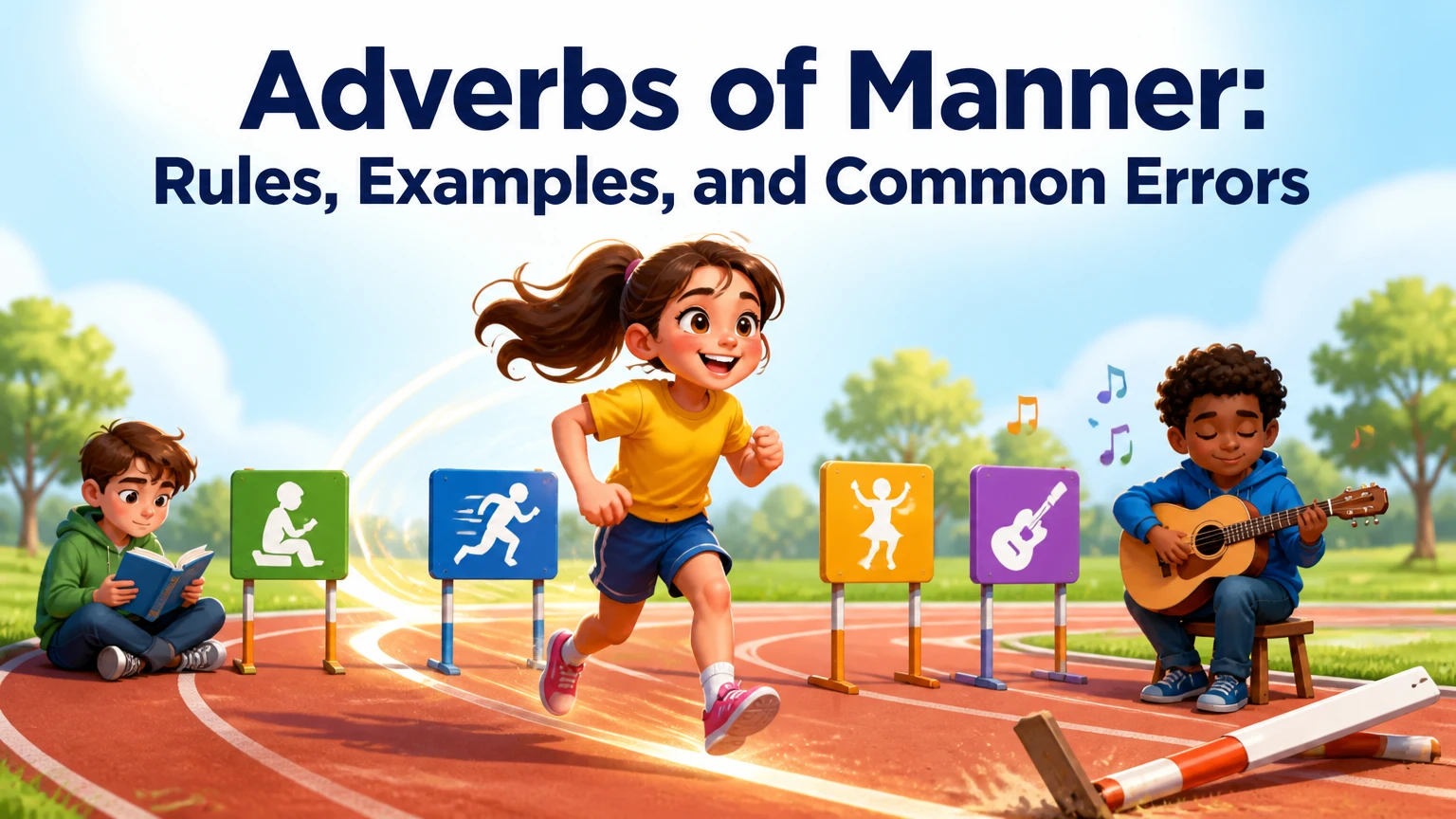
Adverbs of manner describe how an action happens. They modify verbs by expressing the way, speed, attitude, care, or style of an action, as in The child answered politely or The machine operates quietly. Most are formed with -ly, but irregular and flat forms require separate learning.
Key Facts at a Glance
An adverb of manner normally answers How? about an action verb.
Most manner adverbs end in -ly, including carefully, slowly, and quietly.
English also uses flat adverbs such as fast, hard, late, and straight.
Place a manner adverb after an intransitive verb or after the object of a transitive verb in neutral sentences.
Well modifies many action verbs, while good normally modifies nouns or follows a linking verb.
Words such as friendly and lovely end in -ly but function as adjectives.
What Are Adverbs of Manner?
Adverbs of manner are words or phrases that tell readers how an action is performed. In Maya carefully repaired the bicycle, carefully modifies repaired and describes the quality of Maya’s work.
The category includes single words, such as badly, and longer adverbial phrases, such as with great patience. The phrase has the same function because it explains the manner of the action without using the -ly suffix.
Manner is one semantic class of adverbs. Other classes express time, place, frequency, degree, or viewpoint. Compare the following sentences:
- The athlete ran quickly. Manner
- The athlete ran yesterday. Time
- The athlete ran outside. Place
- The athlete often ran. Frequency
- The athlete ran extremely quickly. Degree plus manner
The verb determines whether a manner description makes sense. Actions such as speak, walk, write, listen, drive, and solve commonly accept manner adverbs. A stative verb such as own usually does not: She owns the house carefully is semantically unsuitable.
What Question Does a Manner Adverb Answer?
A manner adverb usually answers How did the subject perform the action? In The nurse spoke calmly, the answer to How did the nurse speak? is calmly.
The diagnostic question is useful but not perfect. In He looks carefully at the map, carefully describes the act of looking. In He looks tired, tired describes the subject through a linking verb and is an adjective, not a manner adverb.
How Are Adverbs of Manner Formed?
Most adverbs of manner are formed by adding -ly to an adjective, although spelling changes and unrelated forms create important exceptions. The base adjective identifies a quality, while the derived adverb applies that quality to an action.
| Adjective | Adverb | Formation | Example |
|---|---|---|---|
| quiet | quietly | Add -ly | The class worked quietly. |
| careful | carefully | Add -ly | She checked the figures carefully. |
| angry | angrily | Change y to i, add -ly | The customer replied angrily. |
| gentle | gently | Remove final e, add -y | He placed the glass gently. |
| tragic | tragically | Add -ally | The plan failed tragically. |
These patterns predict many common forms, but they do not produce every English adverb. Language history, pronunciation, and lexical convention determine exceptions such as good/well, fast, and hard.
How Does the Final Letter Change?
Adjectives ending in a consonant plus y generally change y to i before -ly. Thus, happy becomes happily, easy becomes easily, and angry becomes angrily.
Adjectives ending in -le commonly replace the final e with y: simple becomes simply, gentle becomes gently, and terrible becomes terribly. Adjectives ending in -ic often take -ally, as in basic/basically and dramatic/dramatically.
The rules have lexical exceptions. Public becomes publicly, not publically in the most widely accepted standard form, although publically appears in some usage. True becomes truly, not truely. A dictionary is preferable when a derived form looks unfamiliar.
Do All Adjectives Have a Direct Manner-Adverb Form?
No. Some adjectives require a phrase rather than a direct -ly derivative, and some direct derivatives have specialized meanings. Friendly is an adjective, so standard English uses in a friendly way or in a friendly manner rather than friendly as a manner adverb.
Other natural alternatives include:
- in a professional manner
- with enthusiasm
- without hesitation
- in silence
- with care
A phrase can be more precise than a single adverb because it identifies the attitude, instrument, or circumstances behind the action.
Where Should Adverbs of Manner Go?
Manner adverbs usually appear after an intransitive verb or after a transitive verb’s direct object. Front and mid-position are possible, but the writer must consider emphasis, rhythm, and whether the adverb could be mistaken for part of another phrase.
| Sentence position | Example | Typical effect | Main restriction |
|---|---|---|---|
| After an intransitive verb | The baby slept peacefully. | Neutral description | Works when no object follows |
| After a direct object | She closed the window quietly. | Natural neutral order | Avoid splitting verb and object |
| Before the main verb | She quietly closed the window. | Moderate emphasis | Less suitable for some formal constructions |
| At the sentence front | Quietly, she closed the window. | Literary or dramatic focus | Comma may be needed for clarity |
| After an auxiliary | They have carefully measured it. | Clear scope over the action | Keep the adverb near the intended verb |
Can a Manner Adverb Come Before the Verb?
Yes. A manner adverb can precede the main verb, as in The mechanic carefully inspected the engine. This placement emphasizes the manner and is especially common when the adverb is short and the object is not excessively long.
The position is not automatically dramatic or incorrect. She quietly opened the letter is ordinary contemporary English. By contrast, Quietly, she opened the letter gives the manner greater narrative prominence.
With an auxiliary verb, the adverb commonly follows the first auxiliary: The team has carefully reviewed the contract. In a negative clause, placement can alter emphasis: She did not carefully read the instructions may mean she failed to read them with care, while She carefully did not read the instructions means she deliberately avoided reading them.
Why Should the Verb and Direct Object Usually Stay Together?
English generally places a transitive verb directly before its object. The pattern verb + object + manner adverb is therefore more natural than verb + manner adverb + object.
- Natural: He answered the question politely.
- Natural: He politely answered the question.
- Awkward in standard neutral prose: He answered politely the question.
The split form is sometimes possible in poetry, older prose, or highly marked styles, but it should not be the default for learners. Keeping the object beside its verb reduces processing effort and prevents the adverb from interrupting the core action.
How Does Placement Affect Meaning?
Adverb position can change scope, which means the part of the sentence the adverb modifies. Consider Only Maria carefully copied the signature. The sentence may imply that Maria alone copied it, or that Maria copied it carefully while others did so differently.
Compare:
- Fortunately, the keys were found. The speaker evaluates the whole event.
- The keys were fortunately found. The evaluation remains possible but sounds less natural.
- The keys were found quickly. Quickly describes the finding process.
- The keys were quickly found in the drawer. Quickly still describes the finding, but the placement creates a tighter link with the passive verb.
What Types of Manner Adverbs Exist?
Manner adverbs can be grouped by their form and relationship to an adjective. The most useful classification includes regular -ly forms, spelling-change forms, suppletive or irregular forms, and flat adverbs.
| Category | Examples | Adjective relationship | Usage note |
|---|---|---|---|
| Regular -ly | slowly, clearly, safely | Direct suffix | Highly productive pattern |
| Spelling change | easily, gently, truly | Stem changes | Follow conventional spelling |
| Irregular | well, ill | Different lexical form | Memorize with common verbs |
| Flat adverb | fast, hard, late, straight | Same form as adjective | Meaning depends on context |
| Phrase | with care, in silence, by hand | No single derived word | Often adds precision |
What Are Flat Adverbs?
Flat adverbs have the same form as an adjective but modify a verb in context. Common examples include fast, hard, late, early, straight, high, low, and loud.
- The train moved fast.
- The workers tried hard.
- She arrived late.
- The arrow flew straight.
Flat adverbs are not incomplete versions of -ly words. Fastly is not the standard adverb corresponding to fast. However, some -ly forms exist with different meanings: hardly means “almost not,” lately means “recently,” and highly means “to a great degree,” as in highly effective.
| Flat form | Common adverb meaning | Related -ly form | Meaning of related form |
|---|---|---|---|
| hard | with great effort | hardly | almost not |
| late | after the expected time | lately | recently |
| high | at or to a high position | highly | greatly or favorably |
| near | at a short distance | nearly | almost |
| direct | without detour | directly | immediately or in a direct way |
The difference is semantic, not merely grammatical. Replacing a flat adverb with an -ly form can produce a completely different sentence.
Is Well the Adverb of Good?
Well is the usual adverb that modifies an action, while good is usually an adjective that modifies a noun. The standard contrast is She sings well and She has a good voice.
Well can also be an adjective after a linking verb when it means healthy: I am well. The adjective good may follow a linking verb when it describes a condition or quality: The soup tastes good. In that sentence, good describes the soup, not the manner of tasting.
- Incorrect for performance: He completed the task good.
- Correct: He completed the task well.
- Correct noun description: He produced a good result.
- Health meaning: After treatment, she feels well.
In informal speech, good is sometimes used adverbially, especially in fixed expressions such as It went good, but edited standard English normally prefers well.
How Do Manner Adverbs Compare With Adjectives?
Adjectives modify nouns or pronouns, whereas adverbs of manner modify action verbs. The same general idea can therefore require different grammatical forms depending on the word being described.
| Word or phrase | Part of speech | Modifies | Correct example |
|---|---|---|---|
| careful | adjective | noun | a careful driver |
| carefully | adverb | verb | drove carefully |
| quiet | adjective | noun or subject complement | a quiet room |
| quietly | adverb | verb | worked quietly |
| good | adjective | noun or linking-verb complement | a good answer |
| well | adverb or adjective | action or health state | answered well; felt well |
A useful test is to identify the target. In The careful student wrote, careful describes student. In The student wrote carefully, carefully describes wrote.
Why Is Friendly Not an Adverb?
Friendly, lovely, lonely, lively, and silly are generally adjectives despite their final -ly. Their endings are part of the word, not proof that the word is an adverb.
- She is friendly. Adjective after a linking verb.
- She greeted us in a friendly way. Adverbial phrase.
- He gave a lively presentation. Adjective modifying presentation.
- The puppy moved lively is nonstandard in most formal contexts.
Some varieties of English use friendly adverbially in compounds such as user-friendly, but that construction does not make friendly a general manner adverb. Use in a friendly manner, warmly, or a context-specific verb such as welcomed.
When Should Writers Use a Manner Adverb?
Use a manner adverb when the manner supplies information that the verb does not already communicate. She whispered already signals low volume, but She whispered urgently adds an important emotional or practical detail.
Manner adverbs are especially useful when they distinguish contrasting actions:
- He answered reluctantly, rather than willingly.
- The surgeon worked precisely, rather than approximately.
- The child walked backward, rather than forward.
- The software updates automatically, rather than manually.
A weak adverb often repeats an implication already contained in a strong verb. Ran quickly can become sprinted, but the replacement is not always better. Ran quickly but silently contains information that sprinted cannot preserve because speed and sound are separate attributes.
Should Writers Replace Adverbs With Stronger Verbs?
Writers should replace a manner adverb when a precise verb expresses the complete event more efficiently. Writers should retain the adverb when the adverb adds a separate dimension, corrects an expectation, or prevents ambiguity.
| Broad expression | More specific verb | Information lost or retained |
|---|---|---|
| walked slowly | strolled | Leisurely pace retained; neutral walking may change |
| looked angrily | glared | Hostility becomes stronger and more specific |
| spoke quietly | whispered | Low volume becomes stronger and more specialized |
| moved quickly | hurried | Speed and purposeful movement combine |
| wrote carefully | drafted | Carefulness is not necessarily retained |
The practical editing rule is simple: circle each manner adverb and ask whether the verb already entails its meaning. If the answer is yes, test a stronger verb. If the answer is no, keep the adverb or replace it with a more exact phrase.
How Do Manner Adverbs Work in Professional Writing?
Professional writing benefits from manner adverbs when they define a required standard, procedure, or quality threshold. Instructions such as Review the contract thoroughly and Respond promptly to safety reports communicate expectations that the verbs alone do not specify.
Vague adverbs can weaken procedural documents. Replace handle the request quickly with a measurable instruction such as acknowledge the request within one business day, where the organization can support that service level.
| Weak instruction | More precise instruction | Practical improvement |
|---|---|---|
| Check the file carefully. | Verify all eight required fields. | Defines the inspection scope |
| Reply promptly. | Reply within two business days. | Defines the deadline |
| Store the samples safely. | Store samples at 2-8°C. | Defines the condition |
| Complete the form correctly. | Match the legal name to the identification record. | Defines the test |
Manner adverbs describe performance, but measurable specifications often produce better compliance. A document should not use accurately, properly, or appropriately as a substitute for a missing standard.
What Are Common Errors With Manner Adverbs?
The most frequent errors involve confusing adjectives and adverbs, applying -ly mechanically, and placing an adverb between a verb and its object. Correcting the underlying grammar is more reliable than memorizing isolated sentences.
| Error | Correction | Reason |
|---|---|---|
| She sings good. | She sings well. | Well modifies the action |
| Drive fastly. | Drive fast. | Fast is the standard flat adverb |
| He opened quietly the door. | He opened the door quietly. | Keep verb and object together |
| She smiled friendly. | She smiled in a friendly way. | Friendly is normally an adjective |
| He works hardly. | He works hard. | Hardly means almost not |
| They arrived lately. | They arrived late. | Lately means recently |
Why Does Hardly Not Mean With Great Effort?
Hard means with effort, intensity, or force, while hardly means almost not. The -ly ending changes the word’s meaning rather than simply converting the adjective into an adverb.
- The students worked hard. They made a strong effort.
- The students hardly worked. They made little or no effort.
- I could hardly hear her. I could almost not hear her.
The same contrast appears in late/lately, near/nearly, and high/highly. Learners should study these as separate vocabulary items.
Can a Manner Adverb Modify a Passive Verb?
Yes. A manner adverb can modify the action expressed in a passive construction, usually after the auxiliary or near the past participle.
- The documents were carefully filed.
- The bridge was safely inspected.
- The packages were delivered promptly.
Placement after the past participle is also possible in some sentences: The documents were filed carefully. The first version often emphasizes the care taken during the process, while the second can sound more like a final description of how the filing occurred.
A passive sentence may hide the performer, so the adverb can become especially important. The samples were incorrectly labeled identifies a process failure without naming the employee responsible.
How Can Learners Practise Adverbs of Manner?
Learners can master core manner adverbs through a short daily cycle: identify the action, ask How?, choose a natural adverb, and then check the sentence against a dictionary or reliable corpus. Ten minutes per day for two weeks provides repeated exposure without encouraging mechanical suffixing.
Use these four exercises:
- Verb pairing: Write five verbs, such as explain, walk, listen, prepare, and reply, then add two plausible manner adverbs to each.
- Error correction: Correct pairs such as He drives fastly, She did good, and They hardly studied, then explain the meaning difference.
- Position shifting: Move quietly in She quietly closed the door to the front and final positions, noting the change in emphasis.
- Verb upgrading: Compare looked angrily with glared, and decide which version communicates the intended intensity.
Natural combinations matter more than isolated lists. Strongly recommend, deeply regret, closely examine, and fully understand are common collocations, while grammatically possible combinations may sound unusual in context.
Which Manner Adverbs Should Learners Memorize First?
Learners should first memorize high-frequency forms and irregular contrasts that appear in everyday speech and writing. The following set covers routine actions, evaluation, speed, effort, and politeness.
| Priority | Adverb | Common verb partners | Example |
|---|---|---|---|
| 1 | well | work, speak, perform | She performed well. |
| 2 | carefully | read, check, handle | Read the label carefully. |
| 3 | quickly | move, respond, finish | The team responded quickly. |
| 4 | slowly | move, speak, change | The patient walked slowly. |
| 5 | quietly | speak, enter, work | Please work quietly. |
| 6 | hard | work, try, study | They studied hard. |
| 7 | politely | ask, refuse, reply | He replied politely. |
| 8 | clearly | explain, write, state | State the reason clearly. |
Memorizing the adverb with two verbs builds collocational knowledge. A learner who knows work hard may still need practice before producing hardly work with the intended meaning.
FAQ
What Is the Difference Between an Adverb of Manner and an Adverb of Degree?
An adverb of manner describes how an action occurs, as in She spoke softly. An adverb of degree indicates intensity or amount, as in She spoke very softly, where very modifies softly rather than the verb spoke.
Is Quickly Always an Adverb of Manner?
Quickly is usually an adverb of manner when it describes the speed of an action, as in The technician repaired the device quickly. In some contexts, speed overlaps with time or completion, but the word still most directly answers how the repair occurred.
Can a Sentence Have Two Manner Adverbs?
Yes. A sentence can contain two manner descriptions when they express different attributes: The cyclist moved quickly and cautiously. The first adverb describes speed, while the second describes risk management. Avoid combinations that repeat the same meaning without adding contrast.
Are Adverbs of Manner Required in Every Sentence?
No. A sentence needs a manner adverb only when the manner matters or the verb leaves it unspecified. The door opened is complete without one, while The door opened slowly adds information about the movement and may change the reader’s interpretation.
What Is the Best Position for a Long Adverbial Phrase?
A long manner phrase usually works best after the direct object or at the end of the clause. The engineer tested the system with exceptional care is clearer than placing the long phrase between tested and the system, where it interrupts the verb-object relationship.
How Do You Identify the Manner Adverb in a Sentence?
Find the action verb and ask how the action occurred. In The goalkeeper caught the ball confidently, confidently answers How did the goalkeeper catch the ball? and therefore functions as an adverb of manner. Confirm that the word modifies the verb rather than a noun.
The Bottom Line
Adverbs of manner describe how an action is performed, most often through -ly forms such as carefully, quietly, and clearly. Correct usage also requires learning flat adverbs such as fast and hard, irregular well, adjective-only forms such as friendly, and placement rules that keep transitive verbs close to their objects. Use a manner adverb when it adds precise information, and replace it with a stronger verb only when the verb preserves the intended meaning.