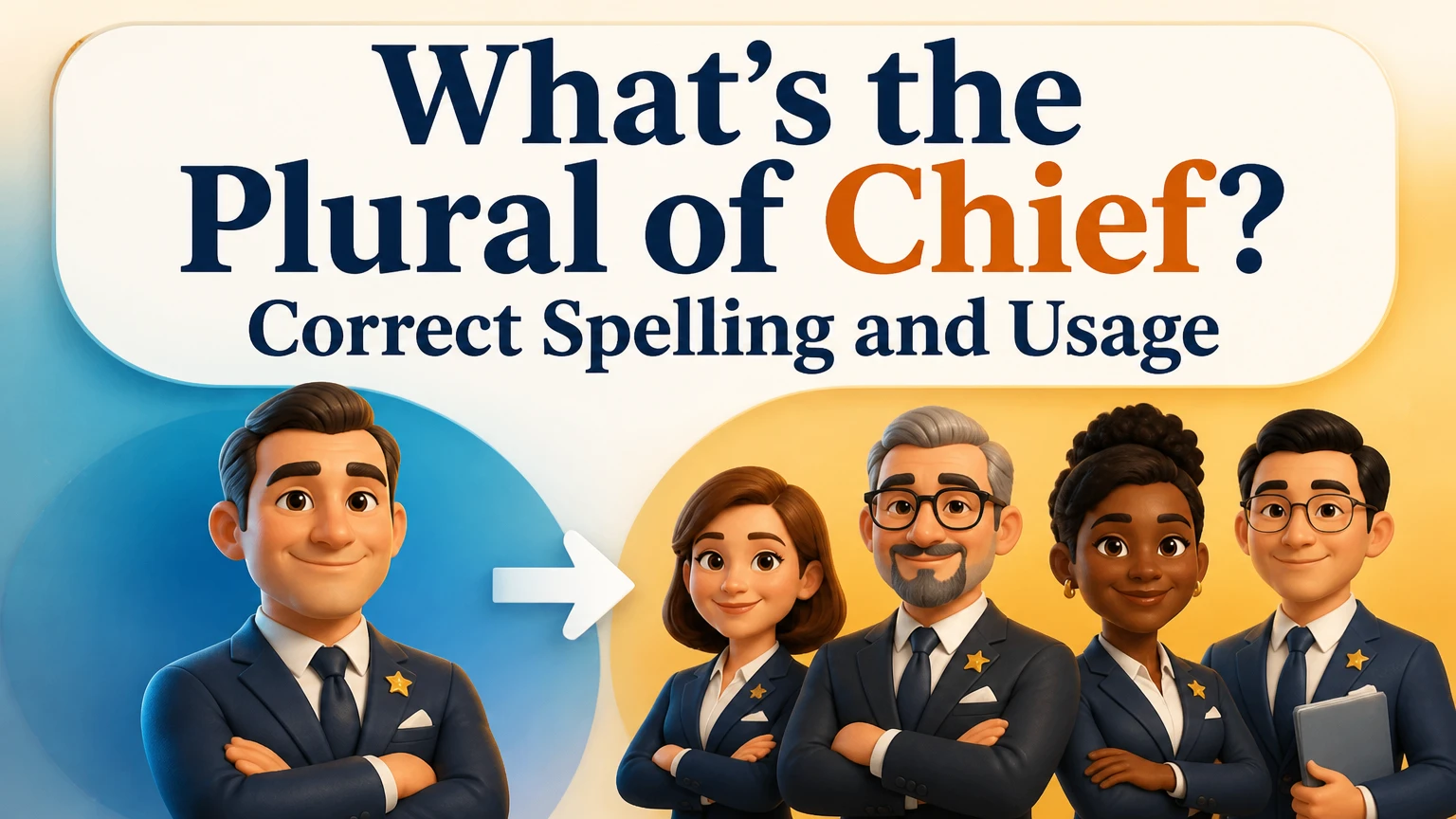
The plural of chief is chiefs. The word chief keeps its final f and takes the regular plural ending -s, so chieves is incorrect in standard modern English. Use chiefs for more than one leader, head, officer, or person with the highest rank in a group.
Key Facts at a Glance
- Chief is singular; chiefs is plural.
- Chieves is not the standard plural spelling of chief.
- The plural chiefs is pronounced like “cheefs,” with a final s sound.
- Chief’s means “belonging to one chief,” while chiefs’ means “belonging to two or more chiefs.”
- The noun chief can mean a leader, head, or person with primary authority.
- When chief is an adjective meaning “main” or “most important,” it does not have a plural form.
What Is the Plural of Chief?
The plural of chief is chiefs, formed by adding -s. For example, one police chief becomes two police chiefs, and one executive chief becomes several corporate chiefs.
The spelling follows standard modern English usage. Although chief ends in -f, English does not apply one universal rule to every word ending in -f or -fe. Some words change the ending to -ves, as in thief to thieves, while others add -s, as in chief to chiefs, roof to roofs, and chef to chefs.
| Singular | Correct plural | Example |
|---|---|---|
| chief | chiefs | The chiefs approved the plan. |
| thief | thieves | The thieves escaped. |
| roof | roofs | The buildings have metal roofs. |
| chef | chefs | Three chefs prepared dinner. |
| wolf | wolves | The wolves moved north. |
The reliable approach is to learn each noun’s established plural rather than infer its spelling from the final letter alone.
Why Does Chief Become Chiefs Instead of Chieves?
Chief becomes chiefs because its accepted English plural is formed with -s, not -ves. The spelling cannot be predicted perfectly from the word’s final f, because English plural formation reflects historical development, pronunciation, and established usage rather than a single mechanical rule.
The English word chief came through Anglo-French from Latin caput, meaning “head.” That history helps explain why chief resembles other French-derived words such as chef, but etymological origin is not a complete rule for modern plural spelling. English contains exceptions and competing historical patterns.
A useful comparison is:
- chief → chiefs
- chef → chefs
- belief → beliefs
- roof → roofs
- thief → thieves
- wife → wives
- leaf → leaves
The practical rule is specific: write chiefs, not chieves. Treating every final f as a signal for -ves creates errors because the plural must be learned from standard dictionary and editorial usage.
Is Chieves Ever Correct?
No. Chieves is not the standard modern English plural of chief. A spellchecker, dictionary, or professional editor will normally mark chieves as an error, and formal writing should use chiefs.
The confusion usually comes from transferring the pattern in thief to chief. The words rhyme in the singular, but their plural spellings differ. This is a spelling distinction, not a difference in meaning or dialect in ordinary contemporary English.
How Do You Pronounce Chiefs?
Chiefs is pronounced approximately “cheefs,” with one syllable. In the International Phonetic Alphabet, the plural is commonly represented as /tʃiːfs/, while the singular chief is /tʃiːf/.
The final s in chiefs is pronounced /s/, not /z/. The pronunciation therefore adds a short unvoiced consonant after the f sound.
| Form | IPA | Approximate sound | Syllables |
|---|---|---|---|
| chief | /tʃiːf/ | cheef | 1 |
| chiefs | /tʃiːfs/ | cheefs | 1 |
| chef | /ʃɛf/ | shef | 1 |
| chefs | /ʃɛfs/ | shefs | 1 |
The spelling chiefs may look unusual because the consonant cluster /fs/ is less common at the ends of English words. It remains fully pronounceable and does not require an extra vowel.
What Does Chief Mean?
As a noun, chief means a leader, head, or person with authority over a group. The exact authority depends on context: a chief may lead a police department, command a fire service, direct an organization, or hold a traditional governance role.
As an adjective, chief means principal, main, or most important. The adjective appears in phrases such as chief concern, chief reason, and chief advantage. Adjectives do not become plural in English, so the adjective remains chief whether the noun it modifies is singular or plural.
| Use | Singular example | Plural example |
|---|---|---|
| Leader | The chief spoke first. | The chiefs spoke first. |
| Police rank | The police chief arrived. | The police chiefs arrived. |
| Corporate role | The chief approved the budget. | The chiefs approved the budget. |
| Main or principal | The chief reason is cost. | The chief reasons are cost and timing. |
In chief reasons, the noun reasons is plural, but chief remains unchanged because it functions as an adjective.
Where Is Chiefs Used?
The plural chiefs appears in corporate, government, emergency-service, military, historical, and cultural contexts. The spelling remains the same across all of these contexts, although capitalization and respectful terminology may vary.
| Context | Common phrase | Sentence example | Capitalization |
|---|---|---|---|
| Corporate | technology chiefs | Technology chiefs met privately. | Lowercase when generic |
| Police | police chiefs | Police chiefs issued guidance. | Lowercase when generic |
| Fire service | fire chiefs | Fire chiefs coordinated crews. | Lowercase when generic |
| Military | chiefs of staff | The chiefs of staff conferred. | Lowercase in generic use |
| Formal title | Chiefs Executive Council | The Chiefs Executive Council met. | Capitals only if official name |
| Indigenous governance | hereditary chiefs | Hereditary chiefs addressed the assembly. | Usually lowercase generically |
Cultural and historical writing requires more than correct spelling. Writers should identify the specific nation, community, institution, or governance structure when relevant, because chief may not describe every leadership system accurately. The plural is still chiefs, but the surrounding terminology should follow the community’s own usage and reputable style guidance.
Should Chief Be Capitalized?
Capitalize Chief when it forms part of a formal title directly before a person’s name or appears in an official organizational name. Use lowercase when the word is a general description or follows the person’s name.
Examples:
- Chief Maria Lopez addressed the council.
- Maria Lopez, chief of police, addressed the council.
- The police chiefs met downtown.
- The Fire Chiefs Association issued a statement, if that is the organization’s official name.
Titles vary by house style. The Associated Press Stylebook generally limits capitalization of formal titles before names, while organizations may capitalize their own official titles differently. Consistency within one document matters more than capitalizing every occurrence.
How Do You Use Chiefs in a Sentence?
Use chiefs when the sentence refers to two or more people or entities that are chiefs. The noun may appear alone or in a compound phrase such as department chiefs, tribal chiefs, chief executives, or chiefs of staff.
Examples:
- The city’s five fire chiefs reviewed the evacuation plan.
- Several police chiefs attended the hearing.
- The company’s regional chiefs submitted their forecasts.
- The chiefs of staff exchanged briefing notes.
- The council consulted hereditary chiefs before voting.
- The department chiefs will meet on Thursday.
The word does not need an apostrophe merely because it ends in s. Apostrophes mark possession or contractions, not ordinary plural nouns.
What Is the Plural of Chief of Staff?
The plural of chief of staff is usually chiefs of staff. Only chief becomes plural because of staff is a prepositional phrase that describes the role.
Examples:
- One chief of staff attended the meeting.
- Four chiefs of staff attended the meeting.
- The chiefs of staff compared schedules.
The phrase is different from chiefs’ staffs. That form means the staffs or teams belonging to several chiefs, not several people who hold the position of chief of staff.
| Meaning | Correct form | Example |
|---|---|---|
| Several role holders | chiefs of staff | The chiefs of staff met. |
| Property of several chiefs | chiefs’ offices | The chiefs’ offices are nearby. |
| Teams belonging to chiefs | chiefs’ staffs | The chiefs’ staffs prepared reports. |
| One role holder’s team | chief of staff’s staff | The chief of staff’s staff called. |
Is Chief’s the Plural of Chief?
No. Chief’s is singular possessive, while chiefs is the ordinary plural. The apostrophe and second f matter because they signal different grammatical functions.
- chief: one leader
- chiefs: more than one leader
- chief’s: belonging to one leader
- chiefs’: belonging to more than one leader
| Form | Grammar | Meaning | Example |
|---|---|---|---|
| chief | singular noun | one leader | The chief arrived. |
| chiefs | plural noun | two or more leaders | The chiefs arrived. |
| chief’s | singular possessive | belonging to one chief | The chief’s vehicle arrived. |
| chiefs’ | plural possessive | belonging to several chiefs | The chiefs’ vehicles arrived. |
A practical substitution test can help. Replace chiefs with leaders. If leaders fits, the sentence probably needs the plural chiefs. Replace chief’s with leader’s. If that fits, the sentence probably expresses singular possession.
How Do You Form the Possessive Plural of Chief?
The possessive plural of chief is chiefs’, formed by adding an apostrophe after the regular plural chiefs. The apostrophe follows the final s because the plural already ends in s.
Examples:
- The chiefs’ meeting began at noon.
- The chiefs’ decisions affected every district.
- We reviewed the chiefs’ statements.
- The chiefs’ vehicles remained outside.
The most frequent error is writing chief’s when the owner is plural. The sentence “The chiefs’ uniforms were inspected” refers to uniforms belonging to multiple chiefs. The sentence “The chief’s uniform was inspected” refers to one chief.
Chiefs Versus Chieves: Which Spelling Is Correct?
Chiefs is correct, and chieves is incorrect in standard modern English. The contrast is straightforward: chiefs preserves the final f and adds s, while chieves incorrectly applies the plural pattern found in thief and wife.
| Test | Chiefs | Chieves |
|---|---|---|
| Standard spelling | Correct | Incorrect |
| Singular source | chief | chief |
| Plural ending | -s | Incorrect -ves |
| Suitable for formal writing | Yes | No |
| Suitable for edited business writing | Yes | No |
| Meaning | More than one chief | No standard plural meaning |
The spelling chieves should not be used as a stylistic variant. If a draft contains it, replace every instance with chiefs unless the word is part of a quotation that must be reproduced exactly.
Why Does Thief Become Thieves but Chief Become Chiefs?
Thief and chief have similar spellings and pronunciation, but English established different plural forms for them. Thief uses the historical -ves pattern, while chief uses regular -s pluralization.
The difference is lexical rather than fully predictable. Historical origin can provide clues, but speakers and writers cannot safely determine every plural from etymology. Modern dictionaries, established corpora, and consistent edited usage provide the final answer.
A useful memory pair is:
A thief becomes thieves, but a chief becomes chiefs.
The rhyme makes the contrast memorable while preserving the correct spelling.
Do Chiefs and Chefs Have the Same Pronunciation?
No. Chiefs and chefs are pronounced differently. Chiefs begins with the “ch” sound /tʃ/, while chefs begins with the “sh” sound /ʃ/.
- chiefs: /tʃiːfs/, approximately “cheefs”
- chefs: /ʃɛfs/, approximately “shefs”
The words also differ in their vowel sounds. Chiefs has the long ee sound in see, while chefs has the vowel sound in dress in many standard English accents.
| Word | Initial sound | Main vowel | IPA |
|---|---|---|---|
| chiefs | ch | long ee | /tʃiːfs/ |
| chefs | sh | short e | /ʃɛfs/ |
| chief | ch | long ee | /tʃiːf/ |
| chef | sh | short e | /ʃɛf/ |
Common Mistakes With Chiefs
Correcting chiefs errors requires distinguishing plural spelling, possession, capitalization, and compound nouns. The following mistakes occur in otherwise polished writing because the final f encourages a false comparison with thieves.
- Writing chieves: Replace chieves with chiefs.
- Using chief’s for a plural: Write chiefs when no ownership is expressed.
- Using chiefs’ for an ordinary plural: Remove the apostrophe when the chiefs do not own anything.
- Capitalizing every job title: Use lowercase for generic phrases such as police chiefs.
- Pluralizing the adjective: Write chief concerns, not chiefs concerns, when chief means “main.”
- Pluralizing the whole compound incorrectly: Write chiefs of staff, not usually chief of staffs, for multiple role holders.
An editing pass should identify the grammatical role before checking the spelling. Ask whether the word names one person, multiple people, one owner, or multiple owners.
What Is the Best Way to Remember the Spelling?
The most reliable memory aid is to group chief with common -f words that take -s, including chef, roof, belief, and cliff. Then contrast that group with thief, wolf, leaf, and wife, which take -ves.
| Add -s | Change to -ves |
|---|---|
| chief → chiefs | thief → thieves |
| chef → chefs | wolf → wolves |
| roof → roofs | leaf → leaves |
| belief → beliefs | wife → wives |
| cliff → cliffs | knife → knives |
The grouping is a memory tool, not a complete linguistic law. English has additional exceptions, including proofs, proofs and roofs, alongside words whose accepted variants may depend on meaning or regional convention.
An experienced editing rule is simple: do not invent an -ves plural from a word ending in f. Check the established form when the word is unfamiliar.
FAQ
Is Chiefs a regular plural noun?
Yes. Chiefs is the regular plural of chief because the word takes the suffix -s without changing its spelling. English grammar calls this a regular plural formation, even though the broader group of -f nouns includes words with different plural patterns.
Can chief be plural when it is an adjective?
No. Adjectives do not normally change for number in English. In chief reasons, chief means “main” or “principal,” and reasons carries the plural marking. The noun use changes to chiefs, as in “Several chiefs attended.”
Is chiefs’ grammatically correct?
Yes. Chiefs’ is the plural possessive form of chief. Use it when something belongs to two or more chiefs, as in “The chiefs’ agreement was published.” Use chief’s for possession by one chief.
What is the plural of tribal chief?
The plural is tribal chiefs. The adjective tribal remains unchanged, while the noun chief becomes chiefs. Writers should use the governance terminology preferred by the specific community when discussing Indigenous or traditional leadership.
Should I write fire chiefs or fire chief’s?
Write fire chiefs when referring to multiple fire-service leaders. Write fire chief’s only when one fire chief owns or is associated with something, as in “The fire chief’s report.” For possession by several fire chiefs, write fire chiefs’.
Does every word ending in f take -ves?
No. English words ending in f or fe may take -s, change to -ves, or occasionally permit more than one accepted form. Chiefs, roofs, and beliefs take -s, while thieves, wolves, and leaves take -ves.
The Bottom Line
The plural of chief is chiefs, never chieves in standard modern English. Use chiefs for multiple leaders, officers, or heads of organizations; use chief’s for possession by one chief and chiefs’ for possession by several chiefs. The final f does not change to v, and the same spelling applies in corporate, government, emergency-service, military, and cultural contexts. Knowing that distinction resolves the question “what’s the plural of chief” and prevents the related apostrophe errors.
Title tag: whats the plural of chief? Correct Spelling Explained
Meta description: Write chiefs, not chieves. Check pronunciation, possessives, capitalization, and chief of staff examples before you submit your next document.